The Best Instant Coffee Brands
By Coffee Studies Editorial·Published July 16, 2026·9 min read
Quick answer
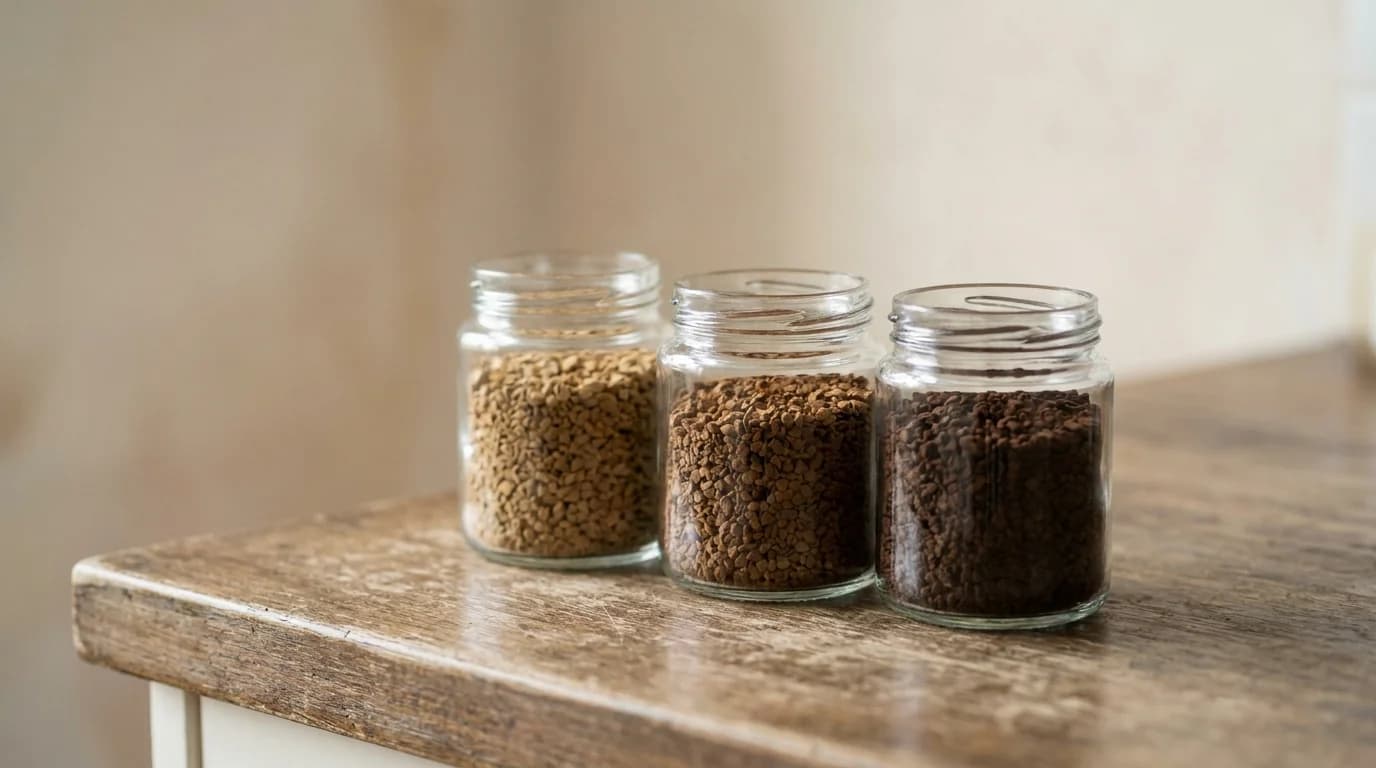
Instant coffee is not one product category — it is at least four, sitting at very different price and quality points. A stick of gas-station 3-in-1 and a $2-per-serving Onyx packet are both technically instant, but they are wildly different objects. This guide walks through the tiers, the brands that anchor each one, and how to actually pick something you'll enjoy drinking.
2 methods
spray drying and freeze drying account for essentially all commercial instant coffee, with freeze-dried preserving more aroma[2]
~1.8 g
typical dose of instant coffee that reconstitutes into an 8 oz cup, across brands and formats[4]
Since 1938
Nescafé launched as the first mass-market freeze-tested spray-dried instant, defining the category for decades[6]
How to judge instant coffee
Before naming brands, it helps to have a small vocabulary for what separates a good jar from a bad one. Five criteria carry most of the weight.
1. Drying method
Spray drying blasts the concentrated extract with hot air, driving off volatile aroma compounds along with the water. Freeze drying removes water as vapor from ice under vacuum — no heat, better aroma retention[2]. Almost every mid-tier and premium instant on the shelf is freeze-dried. Cheap bulk instants and 3-in-1 sticks are usually spray-dried.
2. Bean quality
Instant coffee has historically leaned on robusta for yield and body. Robusta is fine — plenty of good espresso blends use it — but it brings roughly twice the caffeine and more bitter, woody notes than arabica[5]. Premium and specialty instants disclose their bean origin (arabica-only, single-origin, or specific country). If a label says nothing about origin, assume a blend.
3. Aroma retention
Coffee has hundreds of volatile aroma compounds[3], and how many survive from green bean to jar is the single biggest driver of finished quality. Aroma retention is a function of drying method, packaging (single-serve sachets protect better than jars), aromatisation (added back post-drying in many mass-market products), and freshness of the batch.
4. Price per serving
Instant coffee spans a wide price range, roughly $0.05 to $2.00 per serving. Mid-tier freeze-dried (Nescafé Gold, Mount Hagen) sits around $0.15-0.35 per serving. Specialty single-serve packets sit at $1-2. Bulk supermarket brands run $0.05-0.10. Where you land depends more on how much you value aroma than on any objective quality ceiling.
5. Single-origin vs blend
Blends are the norm — they let manufacturers hit a consistent flavor profile year-round despite variability in each origin. Single-origin instants are a specialty tier: they show the character of a specific farm or region, at the cost of consistency between production runs.
The quality tiers
Every instant coffee on the market fits into one of four broad tiers.
Figure
Approximate price per serving by tier (USD)
Values in $ per serving
Tier 1: Bulk supermarket and 3-in-1
This is the category most people picture when they hear "instant coffee." Cheap, high-throughput spray-dried powder, usually a robusta-heavy blend, packaged in large jars or single-serve sticks. 3-in-1 sticks add non-dairy creamer, sugar, and often salt as a flavor enhancer.
Representative brands: Folgers Classic Instant, Maxwell House Original, Nescafé Classic (spray-dried, not to be confused with Gold), and the myriad 3-in-1 formats sold across Southeast Asia and Eastern Europe. These are workhorse products: they perform their job (deliver caffeine, resemble coffee) at the lowest possible price. Aroma is minimal and fades quickly.
Tier 2: Standard freeze-dried jars
The everyday supermarket freeze-dried category. Bigger arabica share, sometimes 100% arabica, freeze-dried granules in a screw-top glass jar. Aromatisation is common. This is the "good enough" tier for most home drinkers who want a passable cup with minimal effort.
Anchor brands include Nescafé Gold (widely available, arabica blend, consistent), Taster's Choice (essentially the North American Nescafé Gold), Moccona (freeze-dried in Australia and Europe, chunky granule style), and Maxwell House International. Store brands from Aldi, Trader Joe's, and Costco (Kirkland) frequently source from the same processors and land in this tier at a lower shelf price.
Tier 3: Premium freeze-dried and mid-tier specialty
The category where instant coffee starts to become interesting. Freeze- dried, higher-quality arabica beans, often organic or fair-trade certified, sometimes disclosed origin. Packaging is often better — single-serve sachets or smaller premium jars — which helps preserve aroma between servings.
Mount Hagen (Germany) — an organic arabica freeze-dried instant from Papua New Guinea and other origins, widely available in both jars and single-serve packets. Consistent quality, well-balanced, and one of the most-recommended entry points to premium instant.
Waka Coffee — arabica-only freeze-dried single-serve packets, sold in origin-specific runs (Colombia, Ethiopia, India, decaf, half-caff). The packet format keeps aroma intact between uses.
Alpine Start — a Colorado brand designed for outdoor and travel use. Arabica freeze-dried in single-serve packets, plus latte and cold-brew variants. Popular with hikers and campers.
Steeped Coffee — technically not instant. Steeped Coffee sells freshly-ground coffee sealed in a permeable filter bag, brewed by steeping like tea. Between instant and pour-over on both quality and convenience. Worth mentioning because it solves the "instant that tastes fresh-brewed" problem from the other direction.
Tier 4: Specialty single-origin instant
The newest and most interesting tier. Small specialty roasters produce tiny freeze-dried runs of specific single-origin lots, packaged in individual sealed sachets at prices comparable to whole-bean specialty coffee. Aromatics survive because dosing and packaging are optimised for a single serving.
Sudden Coffee / Blackout Coffee — Sudden Coffee helped establish this category with specialty single-serve freeze-dried instant; the brand has evolved but the model has spread widely.
Onyx Coffee Lab — releases limited freeze-dried runs of the same lots they sell as whole bean. Prices are steep — often over a dollar per serving — but quality tracks the roaster's whole-bean line.
Tandem Coffee Roasters, Verve Coffee, Voila Coffee, Swift Cup — similar model: specialty roasters producing freeze-dried single-serve sachets of traceable lots. Each releases different origins on rotation, so specific offerings change.
The value proposition of Tier 4 is that a well-made specialty instant, brewed from a hotel-room kettle, can be genuinely close to what the same beans would produce through a pour-over — much closer than any Tier 1 or Tier 2 product can manage.
Format: jars vs single-serve packets vs bags
Format matters more than most drinkers appreciate.
Jars are cheap per gram and let you dose to taste (weaker or stronger cups). The downside is aroma decay: each time you open the jar, volatile aromas escape into the headspace, and residual moisture from the environment slowly degrades the granules. A jar you finish in two weeks tastes better than the same jar drunk over three months.
Single-serve packets protect each dose in a nitrogen-flushed pouch. Aroma is preserved until the moment you open the sachet. The tradeoff is cost per serving and packaging waste — a $1.50 packet is 5-10x the per-serving cost of a jar of the same coffee.
Steeped bags (Steeped Coffee, and a few similar brands) split the difference: freshly ground coffee sealed in a permeable bag, brewed by steeping in hot water for four to five minutes. Not truly instant — you have to wait — but the finished cup is much closer to filter brew than any dissolved instant product.
Comparison table
| Tier | Format | Bean profile | Aroma | Price/serving |
|---|---|---|---|---|
| Bulk supermarket | Jar, sticks | Robusta-heavy blend | Low | ~$0.05-0.10 |
| Standard freeze-dried | Jar | Arabica blend | Moderate | ~$0.15-0.30 |
| Premium freeze-dried | Jar, single-serve | 100% arabica, often certified | Good | ~$0.30-0.60 |
| Specialty single-origin | Single-serve sachet | Traceable single-origin arabica | Excellent | ~$1.00-2.00 |
How to taste-test at home
If you're switching from one instant to another, or trying to justify a step up in tier, a structured side-by-side helps. This is a simplified version of what specialty coffee cuppers do[7].
- Dose consistently. Use a small kitchen scale to measure exactly 2 grams of each instant into identical white mugs.
- Same water, same temperature. Bring filtered water to about 195°F (90°C). Pour 8 oz of water into each mug.
- Smell dry, then wet. Before pouring water, smell the dry granules in each mug. Then pour and smell the freshly-wetted cup. Note the difference between dry and wet aroma — freeze-dried products often smell dramatically better wet.
- Taste without additions. Wait 2 minutes for the cup to cool slightly, then taste each side by side. No milk, no sugar. First impression matters most.
- Rate on four axes. Aroma, bitterness (is it clean or harsh?), body (thin or full?), and how the cup evolves as it cools.
A good freeze-dried arabica will hold its character as it cools; a harsh robusta-heavy spray-dried instant tends to get more bitter and flatter.
Practical recommendations
If you want the cheapest passable cup: Nescafé Gold in the largest jar you can find. It is not exciting, but it is consistent and it is the reference point everyone else is compared against.
If you want the best jar money can reasonably buy: Mount Hagen organic freeze-dried. Widely available, arabica, well-balanced, and about double the price per gram of Nescafé Gold — a fair tradeoff for noticeably better coffee.
If you want the best single cup for travel or camping: Waka Colombian, Alpine Start, or a specialty single-origin packet from a roaster you already like. All ship well, stay fresh in the sachet, and survive being made in a plastic hotel kettle.
If instant is your daily coffee and you want to keep improving: Rotate between two or three premium freeze-dried products, taste them side by side, and figure out which characteristics you value. Once you know that, you can shop the specialty tier with intent instead of guessing.
What to skip
- Old jars. Instant loses aroma fast once opened. Buy small jars you'll finish in a month.
- Flavored 3-in-1 sticks if you care about coffee flavor. They are a different product — non-dairy creamer, sugar, and coffee in a ratio where the coffee is not the star. Fine for what they are; not the same conversation as this article.
- Instant coffee positioned around functional claims (mushroom instants, adaptogen instants). If you want mushroom coffee, buy it; just do not judge it as instant coffee.
For more on how instant is made and why drying method matters so much, see how instant coffee is made and freeze-dried vs spray-dried coffee. For the decaf equivalent of this guide, see the best decaf coffee brands.
The honest summary
Instant coffee has come a long way from the bulk spray-dried robusta of the 1970s. The mid-tier freeze-dried category is genuinely good coffee. The specialty single-serve tier is genuinely specialty. The bulk tier is still what it always was — cheap caffeine that tastes like cheap caffeine. Pick the tier that matches how much you care about aroma, and within that tier, favor freeze-dried arabica over spray-dried blends. Everything else is preference.
Frequently asked questions
- What is the best instant coffee overall?
- There is no single answer because 'best' depends on price point and use case. For mass-market freeze-dried, Mount Hagen and Nescafé Gold consistently rank near the top; for specialty single-serve packets, Waka, Alpine Start, and Verve are widely recommended; for true specialty single-origin instant, small roasters like Onyx and Tandem release limited runs at prices comparable to whole-bean specialty coffee.
- Is freeze-dried instant coffee actually better?
- Generally yes for aroma. Freeze drying preserves more volatile aroma compounds than spray drying because the coffee never sees high heat. That does not automatically make it taste better — bean quality and freshness matter as much or more than drying method — but at similar bean quality, freeze-dried tends to win on aroma and complexity.
- What is the difference between jarred instant coffee and single-serve packets?
- Format, mostly. Jars are cheaper per gram and let you dose to taste, but the aroma fades faster once opened. Single-serve packets protect each dose in a sealed pouch, which is why specialty brands often use them. Steeped Coffee bags use ground coffee in a sealed pouch — a middle ground between instant and brewed.
- How do I taste-test instant coffee at home?
- Brew each product at the same dose (about 2 grams per 8 oz) and same water temperature (around 195 F or 90 C, just off the boil). Smell the dry granules, then the freshly wetted cup. Taste each side by side without milk or sugar. Rate aroma, bitterness, body, and how quickly it fades as it cools. The differences between tiers become obvious once you compare directly.
- Is expensive instant coffee worth it?
- For daily background coffee, probably not — mid-tier freeze-dried covers most people. For travel, camping, or hotel-room coffee where fresh-brewed is not available, specialty single-serve packets are a large upgrade over hotel-provided instant, and the per-serving cost compares favorably to a specialty café.
References
Every factual claim in this article is drawn from the sources below. See the source library for how we grade evidence.
- [1]Instant coffee: a probabilistic risk assessment of metals, acrylamide and ochratoxin APMC / NIH · 2024 · Observational study · Tier 2 · Moderate
- [2]Spray-freeze-drying as emerging and substantial quality enhancement technique in food industryPMC / NIH · 2024 · Review · Tier 2 · Moderate
- [3]Coffee volatile compounds and roast markersPMC / NIH · 2016 · Review · Tier 2 · Moderate
- [4]Instant coffeeWikipedia · Reference work · Tier 3 · Contextual
- [5]CoffeeEncyclopaedia Britannica · Reference work · Tier 3 · Contextual
- [6]The Story of Nescafé — 1938 to TodayNestlé · 2023 · Reference work · Tier 3 · Contextual
- [7]SCA Cupping ProtocolsSpecialty Coffee Association · 2023 · Reference work · Tier 3 · Contextual
- [8]World Coffee Statistics DatabaseInternational Coffee Organization · Official dataset · Tier 1 · Strong
Related reading
- Instant & Decaf CoffeeHow Is Instant Coffee Made? Freeze-Dry vs Spray-Dry→
- Instant & Decaf CoffeeFreeze-Dried vs Spray-Dried Coffee→
- Instant & Decaf CoffeeIs Instant Coffee Bad for You?→
- Instant & Decaf CoffeeBest Decaf Coffee Brands: Ranked by Method and Taste→
- Instant & Decaf CoffeeHalf-Caff Coffee: What It Is and Why It Works→
- Instant & Decaf CoffeeThe History of Nescafé: How Nestlé Invented Instant Coffee→