What Is Mushroom Coffee? A Deep, Cited Guide
By Coffee Studies Editorial·Published July 14, 2026·Updated September 30, 2026·14 min read
Quick answer
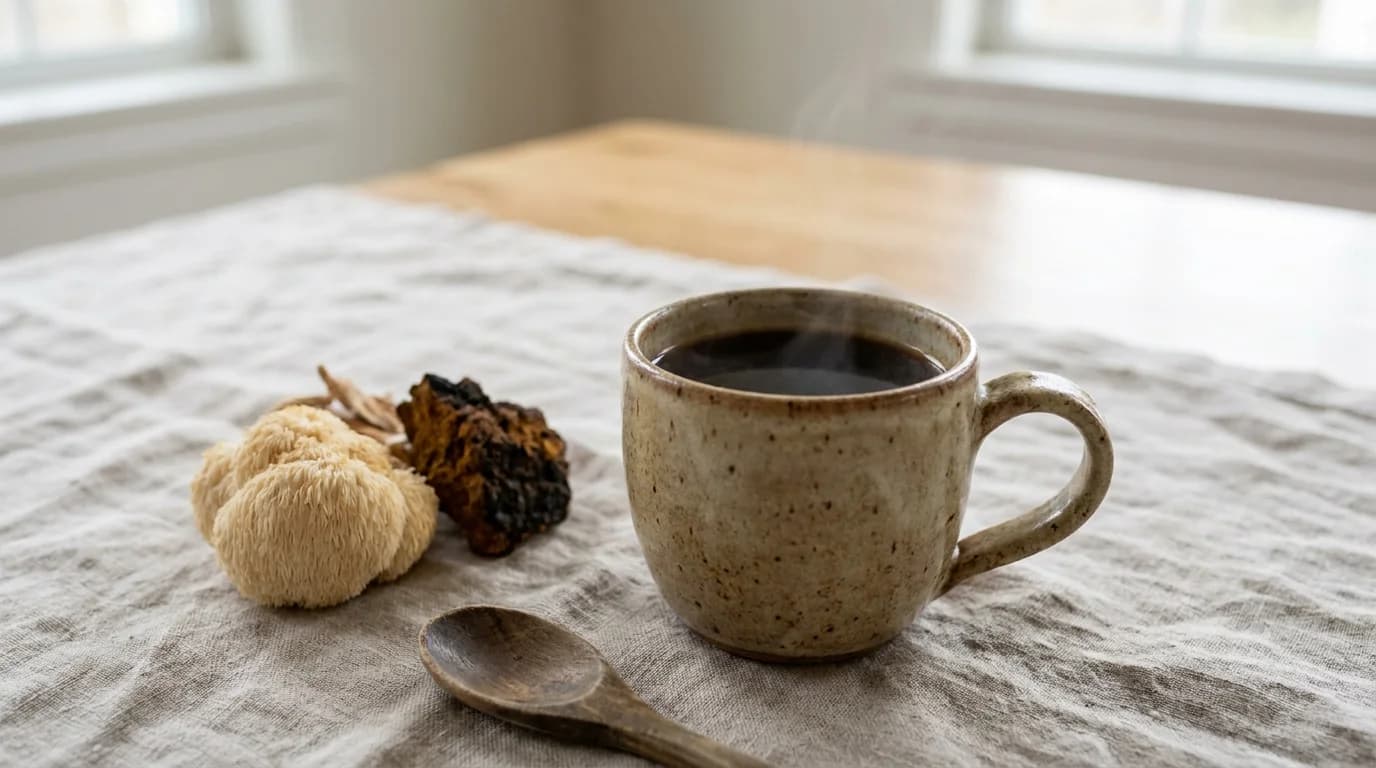
Mushroom coffee went from health-food shelf to supermarket aisle in about five years. The name is more literal than it sounds. The drink is coffee, most often instant, combined with dried extracts of edible functional mushrooms. It is not a coffee substitute and it is not psychoactive. The species involved are culinary and medicinal mushrooms with long histories of food use.
What follows is longer and less flattering than most writing on this category, for a specific reason. Search "best mushroom coffee" and nearly every result on the first page is published by a company that sells mushroom coffee. That is worth stating plainly about this page too: Coffee Studies is published by Nature Lion, which sells a mushroom coffee under the Shyne brand. We think the useful response to that conflict is not to pretend it away but to apply the same standard to everyone, including ourselves, and to publish the parts of the picture a seller would rather skip. There are three of those, and they are the spine of this guide.
Caffeine, typical sachet
Mushroom extract, commonly declared
Single-species dose in cited trials
What is actually in the bag
A bag of mushroom coffee is built from three things, in descending order of weight:
A coffee base. Almost always instant, because the product has to dissolve. That is a real constraint rather than a shortcut: you cannot brew a ground mushroom extract through a filter and expect the extract to end up in the cup. Some brands use spray-dried instant, some use freeze-dried, and a minority use a finely milled whole-bean product intended for a specific brewer.
One or more mushroom extracts. Usually a powder, either an extract concentrated from mushroom material or plain dried and milled mushroom. The distinction matters enormously and almost no label explains it.
Flavour and functional extras. Cacao, cinnamon, MCT or coconut milk powder, sweeteners, sometimes added adaptogens like ashwagandha, sometimes nootropic additions like L-theanine. Some of the taste complaints about the category are really complaints about these.
The species list is short. Lion's mane and chaga appear most often, cordyceps and reishi frequently, turkey tail and maitake occasionally, and a handful of blends add shiitake or tremella. Health Canada lists several of these as acceptable natural health product ingredients, which is a regulatory statement about permitted use rather than a finding of efficacy[10].
The first thing sellers skip: fruiting body or grain
This is the most decision-relevant fact in the whole category and it is almost never on the front of a bag.
A mushroom has two parts that get sold. The fruiting body is the mushroom itself, the thing you would recognise. Mycelium is the fine root-like network that grows through a substrate before fruiting. Growing fruiting bodies takes months, space and skill. Growing mycelium takes days in a tank or on a tray of sterilised grain, usually rice or oats.
The commercially important consequence is what happens next. Mycelium grown on grain cannot be cleanly separated from that grain, so the whole mass is dried and milled together. The resulting powder is a genuine mycelium product and it is also, by weight, substantially the grain it grew on. Comparative analyses of fruiting bodies against cultured mycelia find materially different compositions, including in the bioactive fractions the products are sold for[4]. A detailed review of lion's mane specifically catalogues distinct compound profiles between fruiting body and mycelium, with some named actives concentrated in one and not the other[3].
Neither form has to be labelled differently. Both can say "lion's mane" on the front, and the full picture on fruiting body vs mycelium on grain is the single most useful thing to understand before buying anything in this category. The tell is in the ingredient line: wording like "mycelial biomass", "cultured on oats", "full spectrum" or "myceliated" points to the grain-grown form, while "fruiting body" or "extract from fruiting bodies" points to the mushroom. If the label says neither, that is itself information.
There is a related labelling issue one level down. Many products declare "polysaccharides" rather than "beta-glucans". Beta-glucans are the specific fraction most of the immune research concerns[7]. Starch is also a polysaccharide. A high polysaccharide number on a grain-grown product is therefore not the reassurance it appears to be, and sequential extraction work shows how much the measured beta-glucan fraction depends on the extraction protocol used[8].
The second thing sellers skip: the dose gap
When a brand says research supports lion's mane for cognition, there is usually a real study behind it. The question nobody puts next to the claim is how much was used.
Lion's mane carries the most human cognition data of any species in these blends, so it is the fair test case. The most-cited trial is a 2009 double-blind placebo-controlled study in older Japanese adults with mild cognitive impairment, which reported improved scores on a cognitive scale during supplementation, with the benefit fading after the supplement stopped. The dose was 3 g per day of dried Hericium erinaceus, for 16 weeks, in a group of about 30 people[1]. A 2023 double-blind pilot in healthy young adults used 1.8 g per day and reported modest effects, while being explicit about its own small size and pilot status[2].
Now compare that to a sachet. Blends that declare a total mushroom amount commonly land somewhere between a few hundred milligrams and about 1.5 g, and that total is frequently split across four to six species.
Figure
Single-species amounts: cited trials against a typical multi-mushroom sachet
Values in milligrams of mushroom material per day
The gap is roughly an order of magnitude, and it is larger than it looks, because trial doses were a single species taken daily for months while a blend divides a smaller total several ways.
This is not an argument that mushroom coffee does nothing. It is an argument that the studies cited in its marketing do not test the thing being sold. That distinction is the honest position, and it applies to every brand in the category.
The third thing sellers skip: what the research is actually about
Read the literature on these species and a pattern emerges quickly that the wellness framing obscures. The large, well-conducted work is mostly oncology and immunology, not focus and calm.
The Cochrane review of Ganoderma lucidum for cancer treatment found the available trials did not justify using it as a first-line treatment, and described the evidence base as limited[5]. A separate Cochrane review of Coriolus versicolor, turkey tail, for reducing chemotherapy and radiotherapy side effects in colorectal cancer found insufficient evidence to draw conclusions[6]. Those are careful, systematic assessments, and both of them are about clinical oncology at pharmacological doses, not about a morning drink.
Much of the rest of what gets cited is cell-culture and animal work. A great deal of the chaga literature, for instance, is in-vitro work on cancer cell lines, and a 2021 review moving from folk use toward clinical application is frank that human data remain sparse[9]. Laboratory findings are how research begins, not evidence of an effect in a person drinking a sachet.
What the research says
The fair summary, species by species, is that lion's mane has the most human cognition data and it is still small and mixed; reishi has genuine clinical literature concentrated in cancer care with cautious systematic reviews; turkey tail has a Cochrane review that found the evidence insufficient; and chaga and cordyceps are overwhelmingly preclinical so far as human outcomes go.
None of that makes these mushrooms useless or unsafe. Beta-glucans are a real and actively studied class of compounds with plausible immune activity[7]. It does mean that the gap between "this compound is interesting to researchers" and "this drink will change how you feel" is wide, and that most category marketing simply steps over it.
What "10:1 extract" means, and why it is not regulated
Extract ratios are the other number on these labels, and they are less informative than they look.
A 10:1 extract means, in principle, that 10 kg of raw mushroom went in and 1 kg of finished powder came out. Higher ratio, more concentrated. That is the theory.
Three things undermine it in practice. First, the ratio says nothing about what was concentrated. You can hit a high ratio and still have lost the fraction that mattered, because what survives depends entirely on the solvent and conditions used. Sequential-extraction work on mushroom beta-glucans shows measured composition shifting substantially with the protocol applied[8]. Second, the ratio is calculated from the starting material, and grain-grown mycelium starting material is already part grain. A 10:1 extract of something that was half oats is not comparable to a 10:1 extract of fruiting bodies. Third, nobody audits the claim. There is no standard method and no required verification.
A stated beta-glucan percentage is a more meaningful number than a ratio, because it names the fraction being measured rather than describing a process, and the polysaccharide labelling problem is why that difference matters so much.
Hot water or alcohol: why dual extraction exists
The compounds in these mushrooms do not all dissolve in the same thing, and this is the one piece of manufacturing science that genuinely affects what reaches you.
Beta-glucans and the other polysaccharides are water-soluble. They come out in hot water, which is why a traditional chaga or reishi decoction is simmered for hours rather than steeped. Triterpenes, the bitter compounds prominent in reishi, are not meaningfully water-soluble. They need alcohol.
"Dual extraction" means both were done and the two resulting fractions recombined. For reishi it matters, because the triterpenes are a large part of why the species is studied at all. For lion's mane the picture is different again: reviews of the species catalogue distinct compound classes with different solubilities and different distributions between fruiting body and mycelium[3].
The practical read: a water-only extract of reishi is an incomplete product, and a label that says only "extract" has not told you which kind. This also explains why some blends are noticeably bitter. Bitterness in a reishi product is evidence of triterpenes, which is to say evidence that the alcohol step happened.
What it costs per cup
Mushroom coffee is expensive relative to coffee and cheap relative to supplements, which is roughly where you would expect a hybrid to land.
Instant coffee runs a few cents a cup. A supermarket bag of whole-bean specialty coffee lands somewhere between 30 and 60 cents a cup depending on dose and origin. Mushroom coffee typically runs between about 1 and 2.50 US dollars per serving at direct-to-consumer subscription prices, and higher at one-off retail.
Where that money goes is worth understanding, because it explains the fruiting-body question from the supply side. Fruiting body extract is the expensive input. Grain-grown mycelium is dramatically cheaper to produce, which is precisely why the labelling ambiguity persists: the two forms can carry the same species name at very different costs to the manufacturer and similar prices to you.
If you are comparing products, the number to build is cost per gram of declared mushroom extract, not cost per sachet. Products differ by more than threefold on that basis, and the cheapest per sachet is frequently the most expensive per gram of what you came for.
Where the category came from
Mushrooms in coffee is not a 2010s wellness invention, though the current product category is.
Ganoderma coffee, reishi blended into instant coffee, has been sold across East and Southeast Asia since at least the 1980s, largely through multi-level marketing networks, and remains a substantial market. Chaga as a hot drink has a much longer history across Siberia, Scandinavia and northern North America, where it was simmered as a decoction rather than blended with coffee. Finland's wartime use of chaga as a coffee substitute during shortages is the origin of a good deal of the current European interest.
The Western branded category dates to the early 2010s, with Four Sigmatic founded in Finland in 2012 and reaching the US market shortly after. The current wave, with Ryze and Everyday Dose reaching genuinely mainstream volumes, is much more recent and is largely a direct-to-consumer and social-media phenomenon rather than a health-food-store one.
The regulatory picture differs by country
Which claims a brand can legally make depends on where it is selling, and this explains a lot of the variation you will notice between the same product's marketing in different markets.
In Canada, functional mushroom products are generally regulated as natural health products, requiring a product licence and an NPN. Health Canada maintains monographs listing acceptable ingredients and the specific claims permitted with them[10]. That is a meaningful pre-market step, though a listing indicates permitted use rather than demonstrated efficacy.
In the United States, these products are dietary supplements under DSHEA. There is no pre-market approval for efficacy. Structure-function claims are permitted with a disclaimer, which is why US packaging carries far bolder language than the same product sold in Canada.
In the European Union, health claims must come from an approved register, and the novel food rules add a further question about whether a given mushroom extract has an established history of consumption in the EU. In practice this makes EU marketing the most restrained of the three.
A brand's claims therefore tell you as much about its regulator as about its product. That is worth remembering when comparing a US brand's page to a Canadian one.
How much caffeine is in mushroom coffee
Less than a full cup of coffee, in almost every case, and for an unglamorous reason: part of the serving is mushroom extract, so there is less coffee in it.
An 8 oz cup of brewed coffee averages around 95 mg of caffeine[12]. Mushroom coffee sachets commonly land in the 45 to 60 mg range. Some brands are lower on purpose. Products positioned as coffee alternatives may use black tea as the caffeine source, which drops the figure further, and decaf mushroom blends exist.
If you are switching to mushroom coffee for reduced caffeine, that mechanism is real and it is the one claim in the category with an unambiguous basis. The FDA puts 400 mg per day as an amount not generally associated with negative effects in healthy adults, which is useful context for where any of these numbers sit[11].
What it tastes like
Earthier than coffee, and usually drier on the finish. The mushroom fraction is small and dried extracts are close to flavour-neutral, so the coffee dominates. Most people describe a slightly nutty, slightly woody cup rather than anything recognisably mushroom.
Species differ. Chaga brings a faint woody, almost tea-like note that many people like. Reishi and cordyceps behave differently again: reishi is genuinely bitter, which is why blends containing much of it usually also contain cacao or sweetener. Lion's mane and cordyceps are close to neutral at these proportions.
The honest caveat is the instant base. If you are used to well-made filter or espresso coffee, the thing most likely to disappoint you is not the mushrooms, it is the instant coffee, and no amount of extract fixes that.
Who it makes sense for
On the evidence as it stands, mushroom coffee is a reasonable choice if you want a lower-caffeine hot drink you enjoy, you like the taste, and you treat any functional benefit as unproven upside rather than the reason you are buying it. That is a narrower recommendation than the category makes for itself, and it is the one the research supports.
It makes less sense if you are buying it specifically to replicate a study you read about, because sachet doses do not match study doses. And there are people who should check with a clinician first: several of these species have documented effects on platelet function and immune signalling, which matters on anticoagulants or immunosuppressants, and chaga is high in oxalates, which matters with kidney disease or a history of stones.
How to read a label in thirty seconds
- Find the word "fruiting body". If it is absent, assume grain-grown mycelium and price the product accordingly.
- Look for beta-glucans, not polysaccharides. A polysaccharide percentage on a grain-grown product can be substantially starch.
- Check whether per-species amounts are declared or only a blend total. A blend total tells you almost nothing about any single species.
- Find the caffeine figure. If it is absent, you cannot compare the product to your current cup.
- Look for third-party testing, and for what was tested. Heavy metals and pesticide screening are the meaningful ones.
The honest summary
Mushroom coffee is a pleasant, lower-caffeine coffee drink built from edible mushrooms with long food histories. The species in it are genuinely interesting to researchers. The claims made for it in a coffee format run well ahead of the evidence, the doses do not match the studies cited, and the labelling rules allow a cheap grain-grown ingredient to look identical to an expensive one.
Buy it because you like it, read the ingredient line rather than the front of the bag, and treat the functional promises as a hypothesis rather than a finding. If you want that applied to specific products, we ranked the major brands on what each one actually discloses and audited the category leader's label in detail in our RYZE review. The rest of this hub goes species by species and mechanism by mechanism, with the doses and the limits stated each time.
Frequently asked questions
- Does mushroom coffee have caffeine?
- Yes, unless the blend is specifically decaf. Because part of the serving is mushroom extract rather than coffee, a typical sachet lands well below a full cup of brewed coffee, often in the 45 to 60 mg range against roughly 95 mg for an 8 oz cup. Amounts vary widely by brand, and some blends use black tea or no caffeine source at all, so the label is the only reliable answer.
- Does mushroom coffee taste like mushrooms?
- Rarely, and not strongly. Dried extracts are close to flavour-neutral and the mushroom fraction is small relative to the coffee, so what most people notice is an earthier, slightly nuttier, sometimes drier cup. Chaga contributes a faint woody note and reishi a genuine bitterness. If a blend tastes strongly of mushroom, that usually points to a high proportion of unextracted powder.
- Is mushroom coffee actually good for you?
- It is very likely harmless for most people, and the evidence that it does anything specific at sachet doses is thin. The mushrooms used are edible foods with long culinary histories, and Health Canada lists several as natural health product ingredients. But the human trials people cite used several grams per day of a single species, while a coffee sachet typically declares a few hundred milligrams split across several species.
- What is the difference between fruiting body and mycelium on grain?
- The fruiting body is the mushroom itself. Mycelium on grain is the root-like network grown through a grain substrate, usually rice or oats, and sold ground up with that grain still in it. The second is far cheaper and the finished powder is substantially starch. Both may be labelled simply as the mushroom's name, which is why the ingredient wording matters more than the species list.
- How much mushroom extract should mushroom coffee contain?
- There is no established effective dose for a coffee format, so no honest number exists. For context, the cognition trials most often cited used about 1.8 to 3 g per day of a single species. If a blend declares 500 mg total across six mushrooms, each species is present at a small fraction of any studied amount.
- Who should avoid mushroom coffee?
- Anyone on anticoagulants or immunosuppressants, anyone pregnant or breastfeeding, and anyone with a mushroom allergy should ask a clinician first, because several of these species have documented effects on platelet function and immune signalling. Chaga is additionally high in oxalates, which matters for anyone with kidney disease or a history of stones.
References
Every factual claim in this article is drawn from the sources below. See the source library for how we grade evidence.
- [1]Improving effects of the mushroom Yamabushitake (Hericium erinaceus) on mild cognitive impairment: a double-blind placebo-controlled clinical trialPhytotherapy Research · 2009 · Controlled trial · Tier 2 · Moderate
- [2]The Acute and Chronic Effects of Lion's Mane Mushroom Supplementation on Cognitive Function, Stress and Mood in Young Adults: A Double-Blind, Parallel Groups, Pilot StudyNutrients · 2023 · Controlled trial · Tier 2 · Moderate
- [3]Chemistry, Nutrition, and Health-Promoting Properties of Hericium erinaceus (Lion's Mane) Mushroom Fruiting Bodies and Mycelia and Their Bioactive CompoundsJournal of Agricultural and Food Chemistry · 2015 · Review · Tier 2 · Moderate
- [4]Comparative Study of Contents of Several Bioactive Components in Fruiting Bodies and Mycelia of Culinary-Medicinal MushroomsInternational Journal of Medicinal Mushrooms · 2012 · Observational study · Tier 2 · Moderate
- [5]Ganoderma lucidum (Reishi mushroom) for cancer treatmentCochrane Database of Systematic Reviews · 2016 · Systematic review · Tier 1 · Strong
- [6]Coriolus (Trametes) versicolor mushroom to reduce adverse effects from chemotherapy or radiotherapy in people with colorectal cancerCochrane Database of Systematic Reviews · 2022 · Systematic review · Tier 1 · Strong
- [7]Edible Mushrooms and Beta-Glucans: Impact on Human HealthNutrients · 2021 · Review · Tier 2 · Moderate
- [8]Compositional differences of beta-glucan-rich extracts from three relevant mushrooms obtained through a sequential extraction protocolFood Chemistry · 2023 · Observational study · Tier 2 · Moderate
- [9]Inonotus obliquus – from folk medicine to clinical useJournal of Traditional and Complementary Medicine · 2021 · Review · Tier 2 · Moderate
- [10]Mushrooms Monograph — Natural Health Products Ingredients DatabaseHealth Canada · 2018 · Agency guidance · Tier 1 · Strong
- [11]Spilling the Beans: How Much Caffeine Is Too Much?U.S. Food and Drug Administration · 2024 · Agency guidance · Tier 1 · Strong
- [12]FoodData CentralU.S. Department of Agriculture · Official dataset · Tier 1 · Strong
Related reading
- Mushroom CoffeeLion's Mane Coffee: The Evidence and the Dose→
- Mushroom CoffeeChaga Coffee: The Birch Fungus, and the Oxalate Problem→
- Mushroom CoffeeReishi and Cordyceps Coffee: The Evidence→
- Mushroom CoffeeMushroom Coffee Brands in Canada: Compared→
- Coffee AlternativesCoffee Alternatives: A Guide to What Actually Works→
- Mushroom CoffeeRYZE Mushroom Coffee Review: A Label Audit→