What Is Functional Coffee? Ingredients, Claims and the Rules
By Coffee Studies Editorial·Published October 29, 2026·9 min read
Quick answer
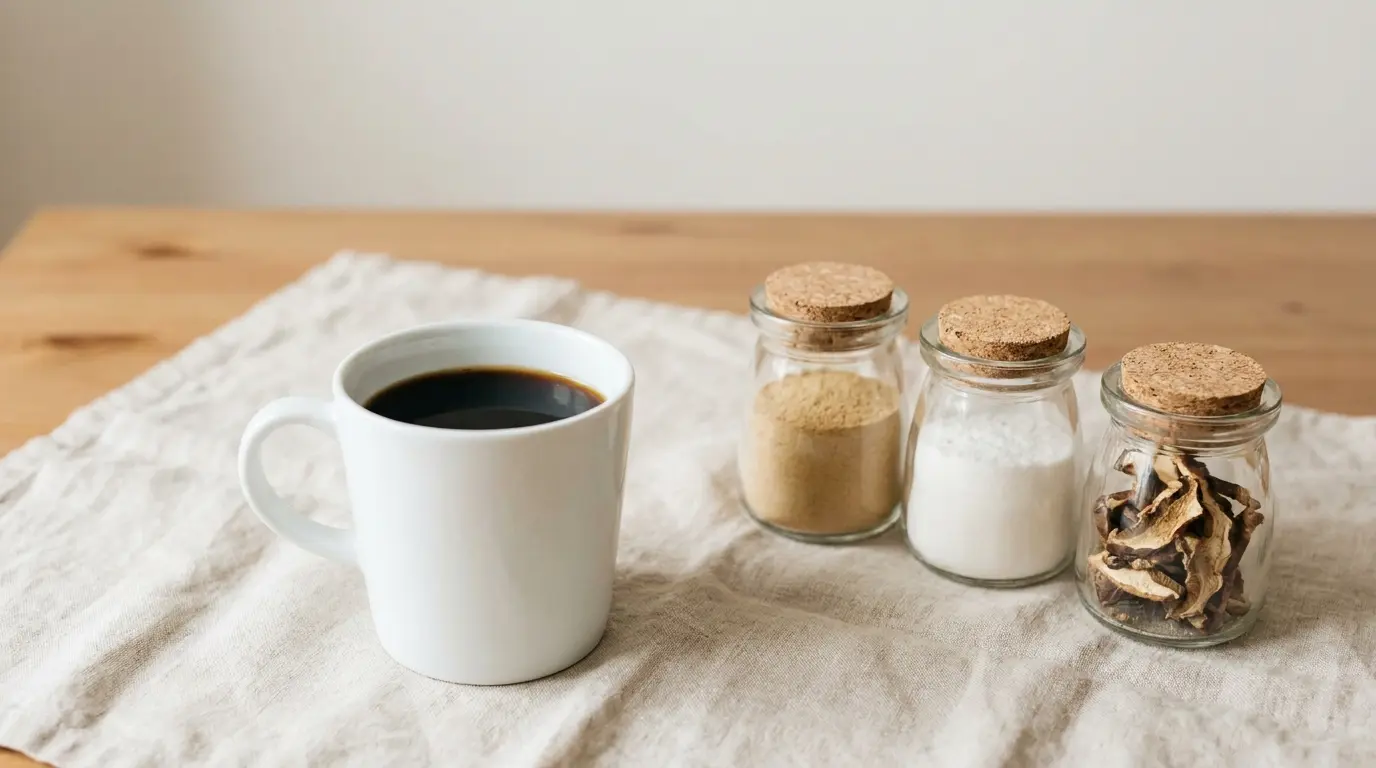
Functional coffee is ordinary coffee with something added for a purpose beyond caffeine. The BBC's definition: coffee that aims to give you "benefits beyond the typical caffeine boost". The something is usually a mushroom extract, protein, collagen, a fat, or a herb.
[1]Regular coffee, you will notice, was never called non-functional. Neither Canada nor the United States has a legal category for the functional kind. So the label runs on the ordinary food rules, and that is the part the bag never explains.
No legal definition
the US FDA said in 2006 it has neither a definition nor a specific regulatory rubric for foods marketed as functional; Canada's definition sits in an archived policy paper[2]
30 percent more in a year
the growth in mushroom coffees on UK coffee shop menus, counted by the food research company Tastewise and reported by the BBC[1]
USD 4.48 to 5.03 billion
the 2025 world market, by two research vendors (Mordor Intelligence and Fortune Business Insights) who disagree with each other[5]
What counts as functional coffee?
Any coffee sold on a purpose beyond caffeine. That is the whole test, because nobody official has set a tighter one. Here is how the people who have tried put it.
| Who | How they put it |
|---|---|
| BBC News | Coffees with extra ingredients that "aim to provide consumers with benefits beyond the typical caffeine boost" |
| Health Canada, archived policy paper | A food that "is similar in appearance to, or may be, a conventional food, is consumed as part of a usual diet, and is demonstrated to have physiological benefits" beyond basic nutrition |
| Institute of Food Technologists, 2004 expert report | "foods and food components that provide a health benefit beyond basic nutrition (for the intended population)" |
| US FDA, Federal Register, 2006 | "there is no formal definition of what the industry means by functional food"; such foods are regulated like other conventional foods |
| Mordor Intelligence, market research vendor | Coffee "formulated or positioned to provide additional functional benefits beyond conventional coffee consumption", from energy support to beauty |
The vendor definition is the one the shelf runs on, and it is a list of purposes, not a test. Here are the ingredient families you will meet, with what the label says and where we go deeper.
| Family | What a label says or charges | Go deeper |
|---|---|---|
| Mushroom extracts (lion's mane, chaga, cordyceps, maitake, reishi) | Laird PERFORM lists lion's mane extract, chaga, cordyceps and maitake extract as a proprietary mix, with no per-species amount; a lion's mane shot at Black Sheep Coffee in Birmingham is 99p | What is mushroom coffee |
| Protein | Starbucks US stores: $1 to add high-protein milk, $2 for high-protein cold foam | Protein coffee |
| Collagen | A collagen shot at Black Sheep Coffee is £1.09 | Coffee and collagen |
| Fats (MCT oil, butter) | Sold as Bulletproof or keto coffee on claims of alertness, energy and appetite | Bulletproof coffee and keto coffee |
| Adaptogens and herbs (ashwagandha) | "a herb some people think helps with stress", in the BBC's words | Below |
| Added caffeine and vitamins | In Canada a drink or dry mix with added caffeine over 150 ppm is a supplemented food with its own label rules | Below |
Label wording and prices read from the sellers' pages and the BBC on 29 October 2026.
[7] [1] [11] [18]Does functional coffee work?
Mostly not at the dose in the cup, as far as anyone has measured. The ingredients have real research behind them, but the trials used amounts a coffee rarely carries. Bini Suresh of the British Dietetics Association said as much to the BBC. The doses in coffees "are too low to replicate the effects reported in research trials". [1]
Here is each family against the review we could find for it. The right-hand column holds the caveats, which is where the honest answer lives.
| Ingredient | The claim, as made | What the cited review found |
|---|---|---|
| Lion's mane | "cognitive performance and mood balancing" (Laird) | A 2025 systematic review rests on two clinical trials with a combined mean increase of 1.17 on the Mini-Mental State Examination, and concludes far more broadly. Suresh, via the BBC: "no robust evidence that lion's mane in typical coffee doses can meaningfully improve memory, focus, or brain health" |
| Collagen | A collagen shot sold as an add-on | A 2021 meta-analysis of 19 studies, 1,125 participants, 95% women, reported 90 days of hydrolysed collagen is associated with less skin ageing; a 2023 meta-analysis agreed and "identified several biases in the included RCTs" |
| Protein | "high-protein milk", "high-protein cold foam" | The general population "doesn't really struggle" to get enough protein, says James Fleming, professor of sports nutrition at St Mary's University; only the elderly and professional athletes need to add it |
| MCT oil and butter | Alertness, energy, appetite, metabolism | A 2023 review found "weak or insufficient evidence" and no significant gain in cognition, alertness or energy over regular coffee. The MCT cognition meta-analysis, 422 participants, is in patients with mild cognitive impairment and Alzheimer's disease, not healthy adults, and flags a risk of bias |
| Ashwagandha | Helps with stress (the folk claim) | A 2022 meta-analysis, 1,002 participants, reported a benefit for stress and anxiety at 300 to 600 mg a day and rated the certainty of the evidence low |
Notice the pattern: mostly women, or patients, or low certainty, or two trials carrying a wide conclusion. None of that is a reason to avoid the coffee. It is a reason to treat the sentence on the bag as a sentence on a bag.
What can the label legally say?
Whatever the ordinary food rules of the country allow, because there is no functional category in either. The two countries draw the lines differently, and the difference is worth knowing before you read a label.
| Question | Canada | United States |
|---|---|---|
| Is "functional" a legal category? | No. The definition is in an archived policy paper | No. The FDA has "neither a definition nor a specific regulatory rubric" |
| Is a bag of mushroom coffee a food or a supplement? | Decided case by case on composition, representation, format, and public perception and history of use; for drinks, format is "a primary factor" | A food, unless the label says "dietary supplement" and the product is not represented as a conventional food |
| What can a food label claim? | Function claims, nutrient function claims and disease risk reduction claims, each a defined type; some must go to Health Canada for approval first | Structure/function claims, which for foods must rest on nutritive value; no FDA notification and no disclaimer |
| What can a supplement label claim? | A natural health product needs a licence first; the eight-digit NPN on the label means Health Canada authorised it | Structure/function claims with substantiation, notified to the FDA within 30 days of marketing, plus a disclaimer in boldface no smaller than one-sixteenth inch |
| Disease claims | Must be "based on sound scientific evidence" (CFIA) | A supplement represented as treating, preventing or curing a disease "meets the definition of a drug" |
| Added caffeine | A drink or dry mix over 150 ppm from all sources is a supplemented food, under rules in force since 21 July 2022 | The FDA's general caffeine guidance |
So the line that matters is food versus supplement, and the format draws it. A bag of ground coffee sold as coffee is a food in both countries. The same lion's mane extract in a capsule with a claim is a different thing.
In Canada that capsule is a natural health product and needs an NPN. In the US it is a dietary supplement. Its label carries "This statement has not been evaluated by the Food and Drug Administration." That reading is ours; neither rulebook names coffee.
How big is this?
Between USD 4.48 billion and 5.03 billion in 2025, depending on which research vendor you ask. Two firms sized the same year and did not land on the same number. That gap is the definition problem as a figure. With no agreed boundary, a market is whatever the vendor decided to count.
Figure
Functional coffee market estimates, USD billion
Values in USD billion
The street-level numbers are firmer. Tastewise counted 30 percent more mushroom coffees on UK coffee shop menus in a year. Starbucks has sold barista-made protein coffee in its US stores since September. The BBC did the arithmetic on the add-on shots. Swap your daily regular for a functional one and you spend "about £30 more" a month.
[1]What is the 2 hour coffee rule?
A rule about when to drink coffee, not what to put in it. It lands in this search because the word functional attracts the biohacking crowd. The neuroscientist Andrew Huberman advises avoiding caffeine for the first 90 to 120 minutes after waking. The idea is to let adenosine, the molecule behind sleepiness, bottom out first.
[23]A 2024 review by 20 authors in a sports nutrition journal found no basis for it. The case that delaying caffeine prevents an afternoon crash "is completely lacking". Delaying would simply push the need for an afternoon dose later. If you like your coffee on waking, the evidence is on your side. [24]
What to do
- Read the ingredient line, not the front. Look for the word extract and a per-serving amount for each addition. Laird's line mixes two extracts with two plain mushrooms and gives no per-species amount. The dose cannot be checked from the page.
- Expect ordinary caffeine. The same bag says to brew 10 grams per 12 ounces, a normal cup. See how much caffeine is in coffee for what that carries.
- Treat the claim as a claim. In the US a food label can carry a structure/function claim with no FDA notification and no disclaimer. Neither country's rules tell you the dose matched a trial.
- Check interactions before a herb or mushroom becomes a daily habit. Our mushroom coffee side effects page covers the reported ones.
- If you want the ingredient, buy the ingredient. A capsule with an NPN, or a supplement with a declared dose, tells you what you are getting. The coffee usually does not.
What the research says
The experts the BBC spoke to agree on the dose problem. The amounts in coffees are often "too low to replicate the effects reported in research trials". [1] A 2023 review of Bulletproof coffee found weak or insufficient evidence for its claims. [11] The collagen meta-analyses report an association with less skin ageing after 90 days. The samples are 95% women, and the 2023 review names several biases.
[9][10]The MCT cognition meta-analysis is in patients with mild cognitive impairment and Alzheimer's disease and calls for further trials. [12] The ashwagandha meta-analysis rates its evidence low certainty. [13] The lion's mane systematic review reports a 1.17 mean gain on the Mini-Mental State Examination from two trials. Its conclusion goes much further than that. [8] None of this is a benefit claim of ours; it is what the reviews say, caveats attached.
The short version
Functional coffee is coffee with a purpose written on the bag and an ingredient added to justify it. The ingredient has research behind it, at doses the coffee rarely matches. The word functional means nothing in law in Canada or the United States. Read the ingredient line, look for a per-serving amount, expect the usual caffeine, and treat the claim as a claim. If the ingredient is the point, buy the ingredient.
Watch
See it, not just read it
2 videos picked for this page. They play right here, full screen on a phone, and you come straight back to the article.
Hosted on YouTube. Credit belongs to the channels named.
Frequently asked questions
- What is functional coffee?
- Coffee with an ingredient added for a purpose beyond caffeine. The BBC's definition: coffees made with mushrooms, protein or collagen that aim to provide benefits beyond the typical caffeine boost. The term has no legal definition. The US FDA said in 2006 it has neither a definition nor a specific regulatory rubric for such foods.
- Does functional coffee work?
- The reviews behind each ingredient are mixed, and the dose in the cup is the weak point. Bini Suresh of the British Dietetics Association told the BBC why. Doses in coffees are often too low to replicate the effects reported in research trials. A 2023 review of Bulletproof coffee found weak or insufficient evidence for its claims.
- What is the best functional coffee?
- This site does not rank brands. Judge a bag by its label instead. Look for an ingredient line that says extract rather than just mushroom, and a per-serving amount for each addition. Then check whether a study used that dose. Laird's PERFORM page, for example, calls its mushrooms a proprietary mix and gives no per-species amount.
- What is the 2 hour coffee rule?
- Advice popularised by Andrew Huberman to avoid caffeine in the first 90 to 120 minutes after waking. A 2024 review in the Journal of the International Society of Sports Nutrition examined it. The authors concluded that a basis for the idea is completely lacking. It has nothing to do with functional coffee as a category.
- What are people saying about Laird functional mushroom coffee?
- Laird's own page for its PERFORM medium roast lists five ingredients: Organic Peruvian Coffee, Organic Lion's Mane Mushroom Extract, Organic Chaga Mushroom, Organic Cordyceps Mushrooms and Organic Maitake Mushroom Extract. It calls the mushrooms a proprietary mix and gives no per-species amount. The British Dietetics Association told the BBC coffee doses are often too low to replicate research trials.
- Is functional coffee regulated?
- Yes, as ordinary coffee; neither Canada nor the United States has a special category. In Canada a coffee sold as a food may carry only the defined claim types. A capsule of the same extract with a health claim is a natural health product and needs an NPN. In the US the FDA regulates foods marketed as functional under the same framework as other conventional foods.
- Is mushroom coffee the same as functional coffee?
- Mushroom coffee is one kind of functional coffee. The BBC's definition names mushrooms, protein and collagen as the usual additions. Tastewise, via the BBC, counted 30 percent more mushroom coffees on UK coffee shop menus in a year. Mushrooms are the most visible family, not the only one.
References
Every factual claim in this article is drawn from the sources below. See the source library for how we grade evidence.
- [1]Do mushroom and protein 'functional' coffees have health benefits?BBC News · 2025 · Reference work · Tier 3 · Contextual
- [2]Conventional Foods Being Marketed as "Functional Foods"; Public Hearing; Request for CommentsU.S. Food and Drug Administration, Federal Register · 2006 · Government data · Tier 1 · Strong
- [3]Policy Paper: Nutraceuticals/Functional Foods and Health Claims On Foods (archived)Health Canada · 2025 · Agency guidance · Tier 1 · Strong
- [4]Functional Foods: Opportunities & Challenges (IFT Expert Report preview)Institute of Food Technologists, Food Technology magazine · 2004 · Reference work · Tier 2 · Moderate
- [5]Functional Coffee Market: Trends, Size & Industry Analysis (2026-2031)Mordor Intelligence · 2026 · Industry report · Tier 3 · Contextual
- [6]Functional Coffee Market Size, Share & Industry Analysis, 2026-2034Fortune Business Insights · 2026 · Industry report · Tier 3 · Contextual
- [7]Organic PERFORM Functional Mushroom Coffee, Medium Roast Ground (product page and ingredient list)Laird Superfood · 2026 · Reference work · Tier 3 · Contextual
- [8]Benefits, side effects, and uses of Hericium erinaceus as a supplement: a systematic reviewFrontiers in Nutrition · 2025 · Systematic review · Tier 2 · Moderate
- [9]Effects of hydrolyzed collagen supplementation on skin aging: a systematic review and meta-analysisInternational Journal of Dermatology · 2021 · Meta-analysis · Tier 1 · Strong
- [10]Effects of Oral Collagen for Skin Anti-Aging: A Systematic Review and Meta-AnalysisNutrients (MDPI) · 2023 · Meta-analysis · Tier 1 · Strong
- [11]Assessing the Validity of Bulletproof Coffee's ClaimsBeverages (MDPI) · 2023 · Review · Tier 2 · Moderate
- [12]Medium Chain Triglycerides induce mild ketosis and may improve cognition in Alzheimer's disease. A systematic review and meta-analysis of human studiesAgeing Research Reviews · 2020 · Meta-analysis · Tier 1 · Strong
- [13]Does Ashwagandha supplementation have a beneficial effect on the management of anxiety and stress? A systematic review and meta-analysis of randomized controlled trialsPhytotherapy Research · 2022 · Meta-analysis · Tier 1 · Strong
- [14]Nutrition labelling: Nutrition claimsHealth Canada · 2026 · Agency guidance · Tier 1 · Strong
- [15]Health claims on food labelsCanadian Food Inspection Agency · 2025 · Agency guidance · Tier 1 · Strong
- [16]Guidance Document: Classification of products at the food-natural health product interface: products in food formatsHealth Canada · 2017 · Agency guidance · Tier 1 · Strong
- [17]About Natural Health ProductsHealth Canada · 2025 · Agency guidance · Tier 1 · Strong
- [18]Guidance document: Supplemented Foods RegulationsHealth Canada · 2022 · Agency guidance · Tier 1 · Strong
- [19]21 CFR 101.93: Certain types of statements for dietary supplementsU.S. Food and Drug Administration, eCFR · 2026 · Government data · Tier 1 · Strong
- [20]Structure/Function ClaimsU.S. Food and Drug Administration · 2026 · Agency guidance · Tier 1 · Strong
- [21]Questions and Answers on Dietary SupplementsU.S. Food and Drug Administration · 2026 · Agency guidance · Tier 1 · Strong
- [22]Spilling the Beans: How Much Caffeine Is Too Much?U.S. Food and Drug Administration · 2024 · Agency guidance · Tier 1 · Strong
- [23]Using Caffeine to Optimize Mental & Physical Performance (episode transcript)Huberman Lab · 2022 · Reference work · Tier 3 · Contextual
- [24]Common questions and misconceptions about caffeine supplementation: what does the scientific evidence really show?Journal of the International Society of Sports Nutrition · 2024 · Review · Tier 2 · Moderate
Related reading
- Functional CoffeeWhat Is Bulletproof Coffee? Butter, MCT Oil, the Claims→
- Functional CoffeeWhat Is Keto Coffee? Fat-Fuelled Coffee Explained→
- Functional CoffeeProtein Coffee: How to Add Protein to Your Cup→
- Functional CoffeeCoffee and Collagen: What the Evidence Shows→
- Mushroom CoffeeBest Mushroom Coffee: Ranked by Disclosure→
- Mushroom CoffeeDecaf Mushroom Coffee: What to Know→