Coffee and Collagen: What the Evidence Shows
By Coffee Studies Editorial·Published July 16, 2026·10 min read
Quick answer
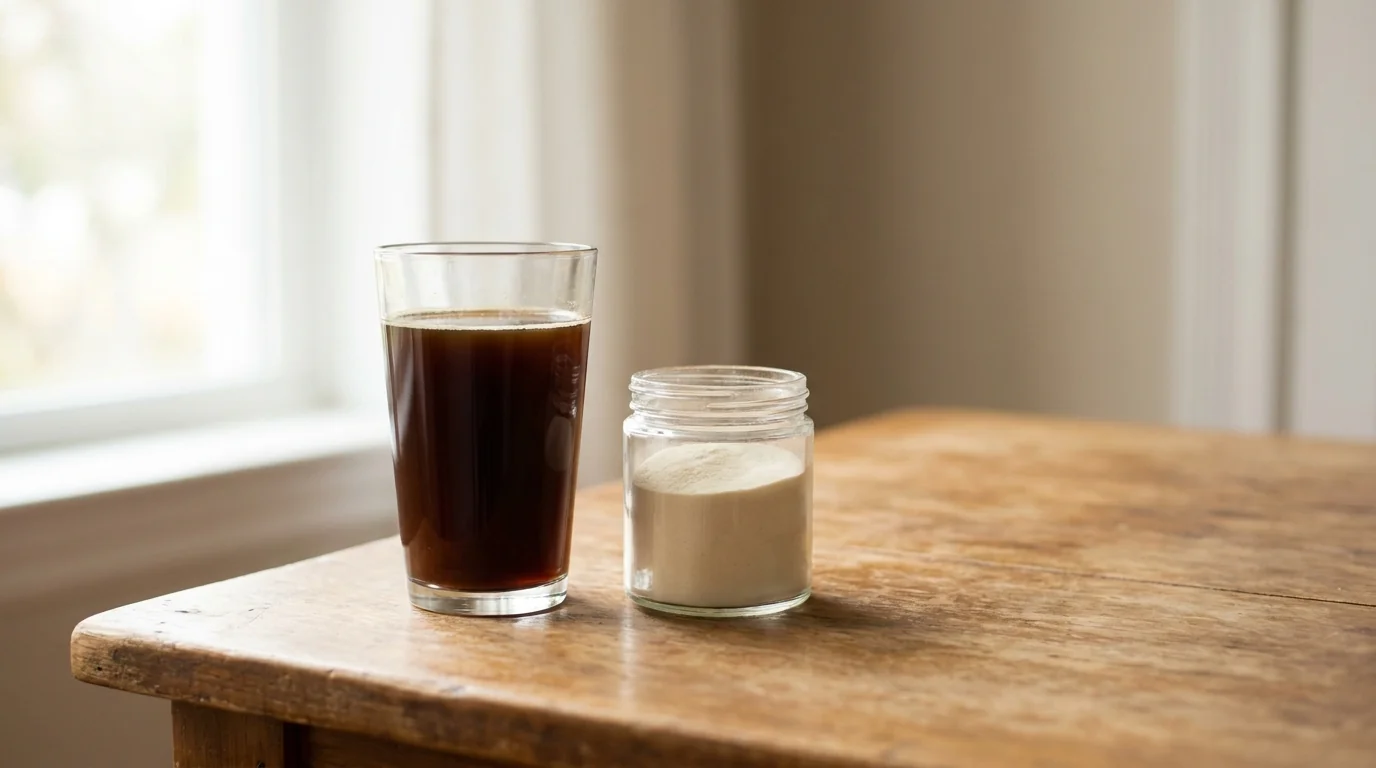
Collagen coffee is one of the most successful convergences of the supplement industry with everyday coffee culture — a way to add a daily protein supplement to a morning habit without any additional effort. It also highlights an interesting nutrition tension: collagen has legitimate but modest evidence for specific benefits (skin, joints), but is also probably the most oversold supplement of the past decade, with marketing claims that outrun the evidence. If you drink collagen coffee, understanding what collagen peptides actually do — and don't do — helps you decide whether the supplement is worth the cost and effort.
Excellent in coffee
collagen peptides dissolve in hot coffee better than most other proteins — no clumping, no curdling[4]
10-20 g per serving
typical collagen coffee serving; matches the doses used in most RCTs (2.5-15 g/day range)[1]
Incomplete protein
collagen has an unusual amino profile — great for connective tissue, poor for muscle synthesis on its own[1]
What collagen coffee actually is
Collagen coffee is coffee with added collagen peptides:
- Base: any coffee (drip, French press, espresso-based drinks, iced coffee, cold brew — collagen works in all).
- Collagen source: typically 1-2 scoops (10-20 g) of hydrolysed collagen peptides.
- Preparation: stir into hot or cold coffee. Dissolves easily; produces slight creaminess and body but no meaningful flavour change.
- Total volume: unchanged from base coffee.
- Additional calories: ~35-80 per scoop (all from collagen protein).
The category is dominated commercially by Vital Proteins (founded 2013, acquired by Nestlé in 2020), but many brands compete: Ancient Nutrition, Sports Research, Great Lakes Wellness, Bulletproof brand collagen, and many smaller specialty producers.
What collagen peptides are
Collagen is the most abundant protein in the human body — roughly 30% of total protein, found in skin, tendons, ligaments, cartilage, bone matrix, blood vessels, and elsewhere. It's a structural protein with a distinctive triple-helix arrangement.
Collagen peptides are collagen that has been hydrolysed — enzymatically broken down into smaller fragments (typically 2,000-5,000 daltons molecular weight, vs the ~300,000 dalton molecular weight of intact collagen). This processing makes them:
- Water-soluble — both cold and hot.
- Tasteless — the peptides don't have collagen's gelatinous texture.
- Easily absorbed — small peptides are absorbed intact or broken further into amino acids during digestion.
Sources of collagen for supplementation:
- Bovine collagen (from beef hides) — most common. Rich in Type I and Type III collagen. Widely available.
- Marine collagen (from fish scales/skins) — higher Type I content. Marketed particularly for skin applications. Somewhat higher cost.
- Chicken collagen — Type II heavy; typically marketed for joint applications.
- Porcine collagen (from pig skin) — less common in supplements but nutritionally similar to bovine.
- Eggshell membrane collagen — smaller category; different composition.
Most collagen supplements are bovine unless specified otherwise. Marine collagen commands a price premium for its Type I content and often for perceived quality/ sustainability reasons.
Why coffee is a good vehicle
Adding collagen specifically to coffee makes sense for several practical reasons:
Coffee is a universal morning habit — no new routine required.
Collagen mixes exceptionally well in coffee — better than most proteins. No clumping (unlike whey), no curdling, no need for a blender.
Coffee doesn't affect collagen absorption — despite occasional concerns about tannins or caffeine, the practical evidence suggests collagen absorption is essentially unaffected by consumption with coffee.
Warm liquid dissolves better than cold — hot coffee dissolves collagen instantly; cold requires slightly more stirring but works fine.
Flavour compatibility — collagen is tasteless. Doesn't interfere with the coffee's flavour or bitter profile.
Portable timing — daily morning coffee = daily consistent collagen dose, essential for benefit (see "What the Evidence Shows" below).
What the evidence actually shows
The collagen supplementation evidence base has grown substantially since ~2015 but has meaningful quality issues. What we can say with reasonable confidence:
Skin outcomes
Skin outcomes:
- Multiple RCTs (typically 8-24 weeks) show modest improvements in skin elasticity, hydration, and wrinkle depth with 2.5-10 g/day collagen peptides.
- Systematic reviews and meta-analyses (Choi et al. 2019, de Miranda et al. 2021, others) find statistically significant but small effect sizes.
- The effect appears real but modest — not transformational.
- Effect is more consistent for skin hydration than for wrinkle depth specifically.
Joint pain outcomes
Joint pain outcomes:
- Multiple RCTs in osteoarthritis populations show modest pain reduction with collagen supplementation (typically 10 g/day of collagen peptides, or 40 mg/day of undenatured collagen — different product).
- Effect sizes similar to some other supplements marketed for joint pain; smaller than pharmaceutical treatments.
- Time-course typically 3-6 months for observable changes.
Athletic recovery and injury
Athletic recovery / injury:
- Some evidence for collagen supplementation supporting connective tissue recovery from athletic training.
- Emerging area; less evidence than skin or joint.
Bone health
Bone health:
- Some evidence for collagen supplementation in postmenopausal women showing modest improvements in bone mineral density.
- Effect smaller than pharmaceutical bone health interventions.
Weight loss:
- Some marketing claims about collagen supporting weight loss; not well-supported by evidence beyond standard protein satiety effects.
Quality caveats:
- Many collagen studies are industry-funded (by supplement manufacturers). This doesn't automatically invalidate them but warrants caution.
- Placebo effects in skin/joint outcomes are substantial — hard to blind participants perfectly.
- Study durations are typically 8-24 weeks; longer-term effects less well-characterised.
- Individual response varies substantially.
The honest read: Oral collagen supplementation shows modest but real benefits for skin and joint outcomes at reasonable doses over reasonable durations. Effect sizes are small enough that many users may not notice. Individual response varies. Collagen isn't a scam, but also isn't a transformational supplement — realistic expectations matter[1].
The amino acid profile
Collagen's amino acid composition is unusual among proteins:
Very high:
- Glycine (~22%)
- Proline (~13%)
- Hydroxyproline (~13% — not found in most proteins)
- Alanine (~9%)
Low or absent:
- Tryptophan (essentially absent)
- Cysteine (very low)
- Some other essential amino acids underrepresented
What this means:
- Great for connective tissue synthesis. The glycine-proline-hydroxyproline triplets are the basic structural units of collagen in the body. Providing these building blocks supports the body's own collagen synthesis.
- Poor for muscle protein synthesis. Muscle building requires all essential amino acids in sufficient quantities, particularly leucine. Collagen doesn't provide these.
- Not a complete protein. By nutritional standards (PDCAAS score ~0), collagen alone doesn't meet essential amino acid needs.
- Doesn't replace other protein sources. For overall protein nutrition, need to combine collagen with complete proteins (whey, eggs, meat, dairy, or combined plant proteins).
Practical implication: if muscle building or general protein sufficiency is your goal, whey or a complete protein source is better in coffee than collagen — see protein coffee for the muscle-building angle. If skin/joint support is your specific goal, collagen makes sense. Both can be combined (though most protein powders already contain more complete amino profiles than collagen alone).
Dosing
Studies use a wide dose range:
- 2.5-5 g/day: minimal effective dose for some skin outcomes.
- 10 g/day: common dose in joint pain research.
- 15-20 g/day: higher-dose research; typical daily serving for coffee supplementation.
Practical dosing:
- 10 g/day — reasonable daily target for general skin/joint support (roughly 1 scoop of most commercial products).
- Split doses — some evidence suggests split dosing (5 g twice daily) may be as effective as single doses.
- Consistency matters more than exact dose — need daily consistency over months for benefit.
- With vitamin C — collagen synthesis requires vitamin C. Some collagen products include vitamin C; if not, ensure dietary vitamin C intake is adequate.
Commercial brands and cost
Vital Proteins
Vital Proteins (Nestlé-owned since 2020):
- Market leader. Bovine collagen peptides.
- Standard container: ~20 servings, ~$30-40.
- Cost per gram: ~$0.15-0.20.
- Wide grocery store distribution.
Ancient Nutrition
Ancient Nutrition:
- Multi-source collagen (bovine, chicken, fish, egg).
- Various flavoured and unflavoured products.
- Similar pricing to Vital Proteins.
Sports Research
Sports Research:
- Popular Amazon-first brand.
- Marine and bovine options.
- Often lower price per gram than premium brands.
Bulletproof Collagen:
- Grass-fed bovine collagen; part of Bulletproof brand ecosystem.
- Higher priced.
Great Lakes Wellness:
- Long-standing collagen supplier.
- Both peptides and gelatin (unhydrolysed collagen).
Costco Kirkland Signature Collagen:
- Bulk pricing; substantial per-gram cost savings.
Marine collagen specialists:
- Sports Research Marine Collagen, various brands.
- Typically 30-50% price premium over bovine.
Cost math:
- 10 g/day habit at $0.15-0.25/g = ~$1.50-2.50/day.
- Annual cost: ~$550-900.
- Add to coffee, no additional preparation cost.
- For most people, this is a meaningful monthly supplement expense.
Making collagen coffee
Standard approach:
- Brew coffee as usual (any method).
- Add 1-2 scoops (10-20 g) of collagen peptides.
- Stir for a few seconds until dissolved.
- Drink.
Tips:
- Add before pouring coffee for easier dissolving — put collagen in cup first, then pour coffee.
- Milk froth mixing — if making a latte, whisk collagen into the steamed milk before combining with espresso.
- Cold coffee — collagen dissolves fine in cold coffee or cold brew, may need slightly more stirring.
- Multiple daily servings — split dose can go in morning coffee + afternoon coffee.
- Combined with other additions — collagen mixes fine with cream, sugar-free syrup, MCT oil, and other common coffee additions.
Doesn't work well:
- In espresso alone — small volume doesn't dissolve full scoop well; add to a larger drink.
- In carbonated coffee drinks — reduces the fizz.
Coffee and collagen absorption (myths and reality)
Various concerns have been raised about whether coffee affects collagen absorption:
Caffeine and collagen synthesis:
- Some studies have investigated whether caffeine affects collagen synthesis in cells (in vitro).
- Human evidence for meaningful effects on collagen supplementation is limited to absent.
- Practical concern: minimal.
Coffee tannins and protein absorption:
- Coffee tannins can bind some proteins/minerals.
- Amount of collagen-binding is likely small at typical intake.
- No consistent evidence that morning coffee substantially reduces collagen supplementation efficacy.
Timing:
- Some sources recommend taking collagen separately from coffee.
- Evidence for meaningful benefit from separation is weak.
- Practical convenience of coffee-timed collagen probably outweighs any theoretical absorption benefit from separation.
The mainstream evidence: taking collagen with coffee is fine. Don't overthink it.
Common misconceptions
- "Topical collagen creams work as well as oral supplements." Topical collagen molecules are too large to penetrate skin meaningfully. Skin supplementation benefits (if any) come from oral supplementation, not creams. Skin creams with peptides or retinoids work differently.
- "Bone broth is a good collagen source." Bone broth contains collagen but at highly variable concentrations — often much less per serving than commercial peptide products. Not a bad source if well-made, but hard to standardise.
- "Collagen is a complete protein." No — collagen has an incomplete amino profile. Fine as a supplement for skin/joint support; not sufficient as a primary protein source.
- "Marine collagen is much better than bovine." Modest differences in Type I content; overall similar functional benefits. Marine may be better for people avoiding beef sources.
- "You can build muscle with collagen coffee." Not effectively — collagen lacks the leucine needed for optimal muscle protein synthesis. Use whey or other complete protein for muscle goals.
- "Coffee destroys collagen." No — collagen dissolved in hot coffee remains bioavailable.
Practical rules
If you want to try collagen supplementation:
- Start with 10 g/day.
- Commit to at least 8-12 weeks before assessing effect.
- Don't expect transformational results — small incremental benefit in skin/joint outcomes is the realistic expectation.
For coffee integration:
- Any decent collagen peptide product works in coffee.
- Cost-per-gram matters — bulk options (Costco, larger containers) are substantially cheaper.
For skin outcomes:
- Include vitamin C in your diet (or in a combined supplement).
- Basic skincare (SPF daily) has bigger effect than any collagen supplement.
For joint pain:
- Collagen is one option among many with modest evidence.
- Combined with proven interventions (weight management, exercise, when appropriate NSAIDs) may provide incremental benefit.
For overall nutrition:
- Collagen is a supplement, not a primary protein source.
- Ensure adequate overall protein intake from complete sources.
Caffeine ceiling:
The honest summary
Collagen coffee is coffee combined with hydrolysed collagen peptides — an easy way to add a daily collagen supplement to an established morning habit. Collagen dissolves exceptionally well in hot coffee (better than most other proteins), adds no flavour, and provides ~10-20 g of collagen protein per serving. Evidence for oral collagen supplementation shows modest but real benefits for skin (elasticity, hydration) and joint pain outcomes in RCTs, though effect sizes are small and the field has quality concerns (industry funding, placebo effects, individual variation). Collagen is not a complete protein and isn't sufficient as a primary protein source. Best suited for people specifically targeting skin or joint support who want a low-friction daily supplement habit; not particularly useful as a general nutrition supplement.
Frequently asked questions
- What is collagen coffee?
- Collagen coffee is coffee (typically hot brewed or iced) combined with hydrolysed collagen peptides — a form of processed collagen protein that dissolves well in liquid. Standard serving is 10-20 g of collagen peptides per cup, providing 10-18 g of collagen protein. Popular as a low-friction way to add a daily collagen supplement to an existing coffee habit. Vital Proteins and various other brands market collagen peptides specifically for coffee use.
- What are hydrolysed collagen peptides?
- Collagen peptides are collagen protein that has been enzymatically broken down (hydrolysed) into smaller peptide fragments (typically 2,000-5,000 daltons molecular weight). This makes them cold-water soluble and easily absorbed. Sourced from animal collagen — usually bovine hides (beef collagen), fish scales/skins (marine collagen), or chicken. All work similarly. Marine collagen tends to be higher in Type I collagen (skin-relevant); bovine tends to be higher in Types I and III mixed.
- Does collagen supplementation actually work?
- Evidence is mixed but suggests modest benefits in some outcomes. Meta-analyses of skin outcomes show modest improvements in skin elasticity, hydration, and wrinkle depth with 2.5-10 g/day of collagen peptides over 8-12+ weeks in RCTs. Joint pain outcomes (particularly osteoarthritis) show similar modest benefits. Effect sizes are small; many studies are industry-funded which raises quality concerns. If collagen supplementation helps, it's a modest supportive effect rather than a transformation.
- How does collagen mix in coffee?
- Very well — collagen peptides are among the best-dissolving proteins in hot coffee. Unlike whey (which can clump or curdle), collagen dissolves smoothly with minimal stirring. Adds essentially no flavour beyond a subtle richness. Doesn't affect the coffee's aroma or acidity noticeably. Can be added to hot, warm, or cold coffee equally well. Standard technique: pour the scoop into your cup before or after the coffee, stir briefly, drink.
- Is collagen a good protein source?
- Not a complete one. Collagen has an unusual amino acid profile — very high in glycine (~22%), proline (~14%), and hydroxyproline (~13%); low in essential amino acids that muscle synthesis needs (particularly leucine and tryptophan). Collagen is excellent for connective tissue synthesis (skin, joints, tendons) but shouldn't be a primary muscle-building protein source. Combine collagen with whey, egg, or other complete proteins if muscle protein synthesis is a goal.
References
Every factual claim in this article is drawn from the sources below. See the source library for how we grade evidence.
- [1]Coffee consumption and health: umbrella review of meta-analyses of multiple health outcomesBMJ · 2017 · Umbrella review · Tier 1 · Strong
- [2]Spilling the Beans: How Much Caffeine Is Too Much?U.S. Food and Drug Administration · 2024 · Agency guidance · Tier 1 · Strong
- [3]Caffeine in foodsHealth Canada · 2022 · Agency guidance · Tier 1 · Strong
- [4]Brewing FundamentalsCoffee Science Foundation · Reference work · Tier 2 · Moderate
- [5]Kinetic and Dynamic Description of CaffeineJournal of Caffeine and Adenosine Research · 2018 · Review · Tier 2 · Moderate
Related reading
- Functional CoffeeProtein Coffee: How to Add Protein to Your Cup→
- Functional CoffeeWhat Is Bulletproof Coffee? Butter, MCT Oil, the Claims→
- Caffeine & HealthIs Coffee Healthy? What Large Studies Actually Show→
- Functional CoffeeWhat Is Keto Coffee? Fat-Fuelled Coffee Explained→
- Mushroom CoffeeLion's Mane Side Effects and Safety→
- Mushroom CoffeeReishi Side Effects, Doses and Interactions→