Lion's Mane Coffee: The Evidence and the Dose
By Coffee Studies Editorial·Published July 14, 2026·Updated September 30, 2026·7 min read
Quick answer
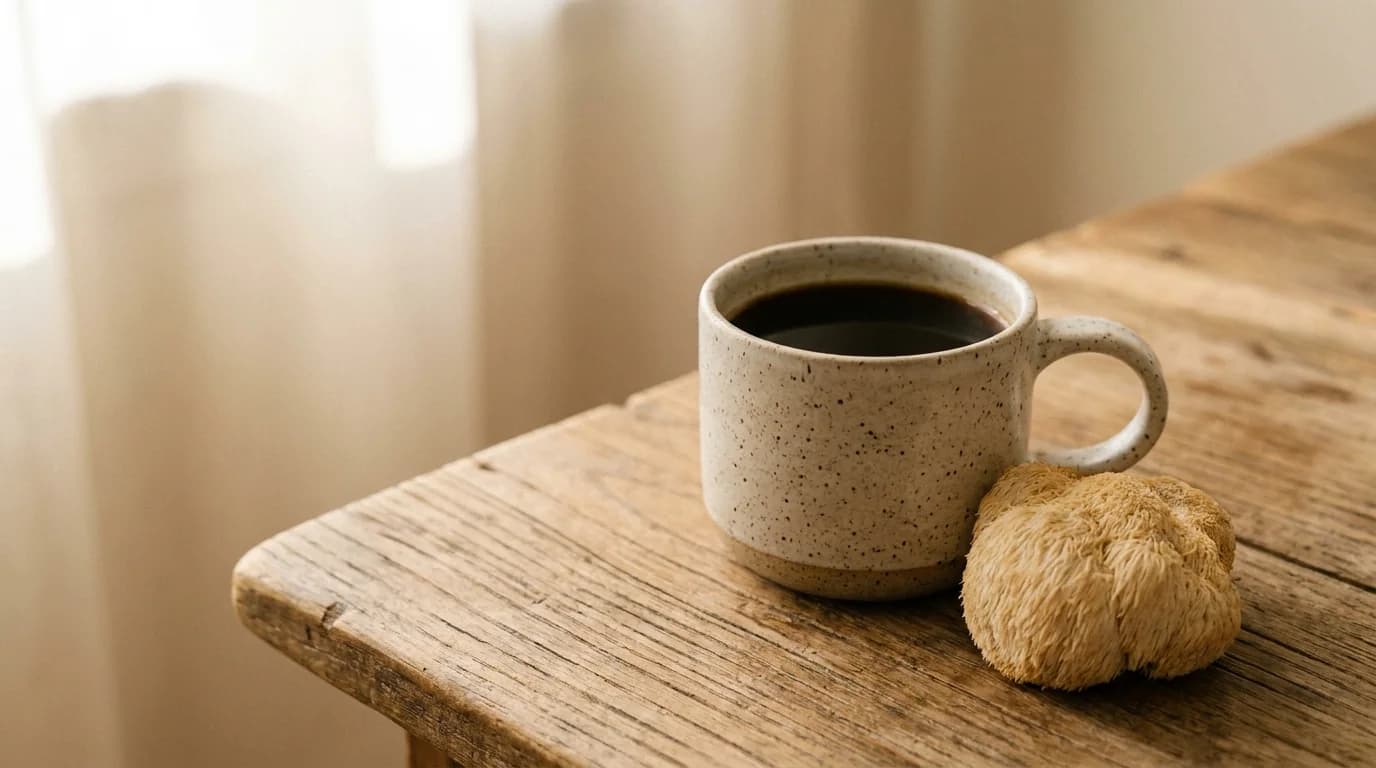
Lion's mane is the reason most people try mushroom coffee. It is the focus mushroom, the one in the blend doing the cognitive work in the marketing copy, and at 246,000 searches a month in the United States it is more searched than mushroom coffee itself.
It is also the species with the most genuine human cognition data in this category, which makes it the fair place to test whether the claims hold. The answer is more interesting than either side of the usual argument. The research is real and it is small. And lion's mane turns out to be the one mushroom where the fruiting-body-versus-mycelium question does not resolve the way it does everywhere else.
Most-cited trial dose
Healthy-adult pilot dose
Caffeine from the mushroom
What lion's mane is
Hericium erinaceus does not look like a mushroom. It grows on hardwood as a white, rounded mass of soft downward-hanging spines, closer in appearance to a sea creature or a shaggy pompom than to a cap and stem. It has no gills. The spines are where the spores form.
It is a genuine culinary mushroom with a long food history, unlike reishi or chaga which are too woody to eat. Cooked fresh, it is firm and mildly sweet, and it is often compared to crab or lobster. It is cultivated commercially across East Asia, North America and Europe, and it grows readily on supplemented hardwood sawdust, which is part of why it became the anchor species for this category.
Its many names cause confusion: yamabushitake in Japanese, houtou in Chinese, bearded tooth fungus, monkey head mushroom. All one species.
Hericenones and erinacines: the mechanism, and the twist
This is the part worth understanding properly, because it is both the scientific basis for lion's mane's reputation and the single most commercially awkward fact in the mushroom supplement industry.
Lion's mane contains two groups of compounds that stimulate nerve growth factor biosynthesis in laboratory systems. Nerve growth factor is a protein involved in the survival and maintenance of certain neurons, so a compound that promotes its production is an obvious candidate for cognitive research. In cultured human astrocytoma cells, Hericium erinaceus extracts have been shown to induce NGF gene expression[6].
The two groups are:
- Hericenones, associated with the fruiting body
- Erinacines, associated with the mycelium
Both are documented as NGF-biosynthesis stimulators in the foundational chemistry work on the species[5]. A detailed review of the species' chemistry catalogues the distinct compound profiles of fruiting bodies and mycelia, with named actives associated with one tissue and not the other[7].
Here is why that matters commercially. Everywhere else in this category, mycelium grown on grain is the cheap substitute and fruiting body is the premium input, and our guide to that distinction explains why the labelling ambiguity persists. Lion's mane is the exception, and it is a real exception rather than an industry talking point: erinacine A, the compound behind a substantial share of the neuroscience on this species, is a mycelium compound. A 2020 double-blind placebo-controlled pilot in early Alzheimer's disease used erinacine A-enriched Hericium erinaceus mycelia[4]. That study could not have been done with fruiting bodies.
So the honest position on lion's mane is narrower than "fruiting body always wins". A well-made erinacine-standardised mycelium product has a legitimate scientific case. What is still not defensible is an unstandardised mycelium-on-grain powder sold at fruiting-body prices with no disclosure of form and no stated erinacine or beta-glucan content, because then you have neither the compound nor the means to check.
What the human trials found
Four studies carry most of the weight, and it is worth knowing their size.
Mori 2009, mild cognitive impairment. The most-cited trial. A double-blind, placebo-controlled study in older Japanese adults diagnosed with mild cognitive impairment, taking 3 g per day of dried Hericium erinaceus for 16 weeks. Cognitive scale scores improved relative to placebo during supplementation. The detail usually left out of marketing is that scores declined again after supplementation stopped, and the trial had roughly 30 participants[1].
Nagano 2010, mood. A four-week trial in women, delivering Hericium erinaceus in cookies, reporting reductions in self-reported depression and anxiety measures[3]. Small, short, and subjective in its outcome measures, but a genuine randomised design and one of the few studies pointing at mood rather than memory.
Docherty 2023, healthy young adults. A double-blind pilot at 1.8 g per day, reporting modest effects on cognitive performance and mood. The authors are explicit that it is a pilot with a small sample, which is the right way to report it[2].
Li 2020, early Alzheimer's. A pilot double-blind placebo-controlled study using erinacine A-enriched mycelia in patients with early Alzheimer's disease[4]. Important as the clearest example of standardised mycelium being used in a clinical setting.
What none of these did is test a few hundred milligrams of unstandardised extract in a coffee, taken alongside caffeine, in a general population. That study does not exist.
Figure
Lion's mane: trial doses against a typical blend's per-species share
Values in milligrams of lion's mane per day
What the research says
Lion's mane has the strongest human cognition signal of any mushroom in these blends, and the signal is still small, short-term and unreplicated at scale. The mechanism is plausible and laboratory-supported: hericenones and erinacines stimulate NGF biosynthesis in cell systems[5][6]. The largest human trial improved cognitive scores at 3 g per day and the effect faded on withdrawal[1].
Two limits deserve equal billing with the promise. First, NGF induction in cultured cells is a long way from measurable cognition in a person. Second, all of the trials used gram-scale daily doses of a single species for weeks, and none used a coffee. Health Canada lists mushroom species as acceptable natural health product ingredients with specified permitted claims, which reflects permitted use rather than demonstrated efficacy[9].
Does it taste like anything in coffee?
Close to nothing, at these proportions. Lion's mane extract is among the most flavour-neutral ingredients in the category, which is a large part of why it became the anchor species. Fresh lion's mane has a distinct seafood-like sweetness, but a dried extract at a few hundred milligrams in a cup of coffee contributes essentially no flavour.
If a lion's mane coffee tastes strongly earthy or muddy, the likely sources are chaga, reishi or a high proportion of unextracted powder rather than the lion's mane.
Safety, and who should check first
Lion's mane has a reassuring profile relative to most supplement ingredients. It is a food, eaten fresh for a long time in several cuisines, and reported adverse effects in trials are uncommon and mild, mostly digestive.
The genuine cautions:
- It is a mushroom. Mushroom allergy is real, and isolated reports describe skin and respiratory reactions.
- Anticoagulants. Less documented for lion's mane than for reishi, but the general caution across medicinal mushroom extracts applies, and it is a cheap conversation to have.
- Immunosuppressants. Beta-glucans are studied specifically for immune activity[8], which is a reason for care in anyone on immunosuppressive therapy.
- Pregnancy and breastfeeding. Not meaningfully studied at supplement doses.
None of that makes lion's mane coffee risky for a typical healthy adult. The caffeine is the more consequential ingredient for most people, and the FDA's 400 mg per day reference point is the useful yardstick there[10].
What to look for on a lion's mane product
- A stated form. "Fruiting body" or "mycelium", explicitly. For lion's mane uniquely, either can be defensible. Silence is not.
- If mycelium, a standardisation claim. Erinacine content, or at minimum beta-glucan percentage. Unstandardised myceliated grain gives you no way to know what you have.
- A per-species amount. A blend total cannot be compared to any trial.
- A beta-glucan percentage rather than total polysaccharides, since grain substrate contributes starch to the latter.
- Third-party testing, specifically for heavy metals.
The short version
Lion's mane is the best-evidenced mushroom in mushroom coffee and the evidence is still thin: a handful of small randomised trials, gram-scale doses, weeks of daily use, effects that faded when supplementation stopped. The mechanism through nerve growth factor is genuinely interesting and mostly demonstrated in cells rather than people.
It is also the one species where a mycelium product can be the more scientific choice rather than the cheaper one, because erinacines come from mycelium and much of the neuroscience used erinacine-enriched material. That is a real distinction, and it only helps you if the product tells you which it is and how much is in there.
Frequently asked questions
- Is lion's mane shown to help focus?
- The human evidence is small and mixed rather than absent. A 2009 double-blind placebo-controlled trial in about 30 older Japanese adults with mild cognitive impairment reported improved cognitive scores on 3 g per day over 16 weeks, with the effect declining after supplementation stopped. A 2023 double-blind pilot in healthy young adults at 1.8 g per day reported modest effects and was explicit about its small size. Nothing at this scale settles the question, and no trial has tested a coffee sachet dose.
- How much lion's mane should I take?
- There is no established effective dose, and honest sources will not give you one. For reference, the trials used 1.8 to 3 g per day of dried mushroom or extract, taken daily for four to sixteen weeks. If a mushroom coffee declares 500 mg of total blend across six species, the lion's mane fraction is a small share of any studied amount.
- What are hericenones and erinacines?
- They are two groups of compounds that stimulate nerve growth factor biosynthesis in laboratory studies, and they are the mechanistic basis for lion's mane's cognitive reputation. The distinction that matters commercially is where they come from: hericenones are associated with the fruiting body and erinacines with the mycelium. That is why lion's mane is the one species where mycelium-based products have a genuine scientific argument.
- Does lion's mane have side effects?
- Reported side effects in trials are uncommon and mild, mostly digestive discomfort. Skin reactions and respiratory symptoms have been described in isolated reports, consistent with it being a mushroom people can be allergic to. The species has a long culinary history, which is reassuring at food amounts. Anyone on anticoagulants or immunosuppressants, or pregnant or breastfeeding, should ask a clinician first.
- Does lion's mane coffee have caffeine?
- The caffeine comes from the coffee, not the mushroom. Lion's mane itself contains none. Because part of the serving is mushroom extract, a typical blend lands below a full cup of coffee, often around 45 to 60 mg against roughly 95 mg for an 8 oz brewed cup.
- Is lion's mane the same as Hericium erinaceus?
- Yes. Hericium erinaceus is the botanical name. It is also sold as yamabushitake in Japan, houtou in China, bearded tooth fungus and monkey head mushroom. All refer to the same species, the white cascade of soft spines that grows on hardwood.
References
Every factual claim in this article is drawn from the sources below. See the source library for how we grade evidence.
- [1]Improving effects of the mushroom Yamabushitake (Hericium erinaceus) on mild cognitive impairment: a double-blind placebo-controlled clinical trialPhytotherapy Research · 2009 · Controlled trial · Tier 2 · Moderate
- [2]The Acute and Chronic Effects of Lion's Mane Mushroom Supplementation on Cognitive Function, Stress and Mood in Young Adults: A Double-Blind, Parallel Groups, Pilot StudyNutrients · 2023 · Controlled trial · Tier 2 · Moderate
- [3]Reduction of depression and anxiety by 4 weeks Hericium erinaceus intakeBiomedical Research · 2010 · Controlled trial · Tier 2 · Moderate
- [4]Prevention of Early Alzheimer's Disease by Erinacine A-Enriched Hericium erinaceus Mycelia Pilot Double-Blind Placebo-Controlled StudyFrontiers in Aging Neuroscience · 2020 · Controlled trial · Tier 2 · Moderate
- [5]Hericenones and erinacines: stimulators of nerve growth factor (NGF) biosynthesis in Hericium erinaceusMycology · 2010 · Review · Tier 2 · Moderate
- [6]Nerve Growth Factor-Inducing Activity of Hericium erinaceus in 1321N1 Human Astrocytoma CellsBiological and Pharmaceutical Bulletin · 2008 · Observational study · Tier 3 · Contextual
- [7]Chemistry, Nutrition, and Health-Promoting Properties of Hericium erinaceus (Lion's Mane) Mushroom Fruiting Bodies and Mycelia and Their Bioactive CompoundsJournal of Agricultural and Food Chemistry · 2015 · Review · Tier 2 · Moderate
- [8]Edible Mushrooms and Beta-Glucans: Impact on Human HealthNutrients · 2021 · Review · Tier 2 · Moderate
- [9]Mushrooms Monograph — Natural Health Products Ingredients DatabaseHealth Canada · 2018 · Agency guidance · Tier 1 · Strong
- [10]Spilling the Beans: How Much Caffeine Is Too Much?U.S. Food and Drug Administration · 2024 · Agency guidance · Tier 1 · Strong
Related reading
- Mushroom CoffeeWhat Is Mushroom Coffee? A Deep, Cited Guide→
- Mushroom CoffeeReishi and Cordyceps Coffee: The Evidence→
- Mushroom CoffeeFruiting Body vs Mycelium on Grain→
- Mushroom CoffeeChaga Coffee: The Birch Fungus, and the Oxalate Problem→
- Mushroom CoffeeMushroom Coffee Brands in Canada: Compared→
- Mushroom CoffeeLion's Mane Side Effects and Safety→