Chaga Coffee: The Birch Fungus, and the Oxalate Problem
By Coffee Studies Editorial·Published July 14, 2026·Updated September 30, 2026·8 min read
Quick answer
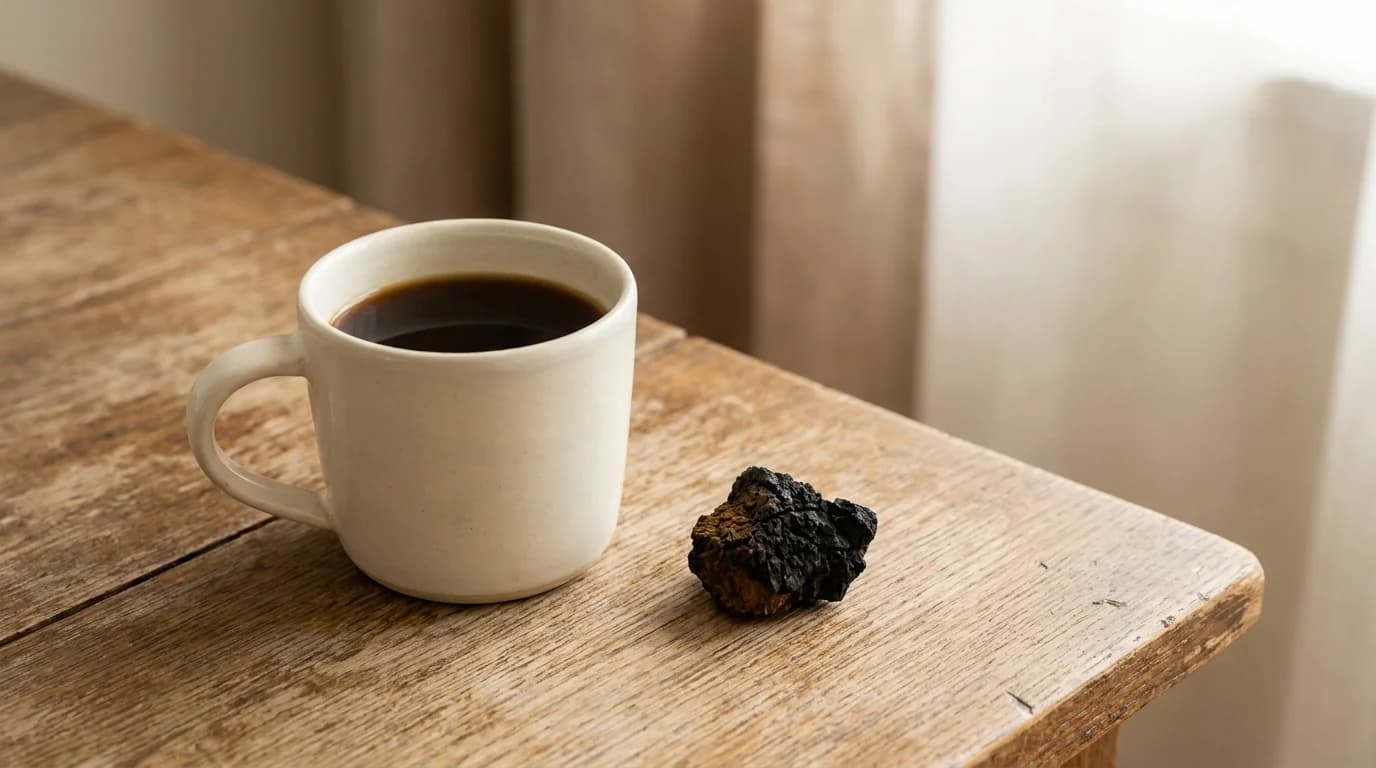
Chaga is the odd one out in mushroom coffee. It is not a culinary mushroom like lion's mane, it is not a cultivated extract like cordyceps, and strictly speaking it is not really a mushroom at all. It is a black, cracked, charcoal-looking mass that grows on the trunks of living birch trees, and it has been simmered into a hot drink across the northern hemisphere for centuries.
It is also the species in this category with a genuine, documented safety issue that most pages skip entirely. That issue is oxalates, and it is worth getting right because both the alarm and the reassurance depend on dose.
Caffeine
Case-report doses
Cultivated supply
What chaga actually is
The black chunk sold as chaga is a sclerotium: a hard, sterile mass of fungal tissue that Inonotus obliquus forms on the outside of an infected birch trunk. It is not the fruiting body. The real fruiting body is inconspicuous, forms under the bark, and generally appears only as the host tree dies.
That matters for two reasons. First, the sclerotium is a mixture of fungal tissue and wood from the host, which is why chaga's chemistry includes birch-derived compounds. Second, it takes years to form. You cannot farm it the way you farm lion's mane.
Its outside is black and deeply cracked, a colour that comes from melanin. Break one open and the interior is a rusty orange-brown, which is the most reliable way to tell genuine chaga from a burl or a look-alike.
Where it comes from, and the sustainability question
Almost all chaga on the market is wild-harvested, from birch forests in Russia, the Baltic states, Finland, Sweden, Canada and the northern United States. There is no meaningful cultivated supply of the sclerotium.
This creates a real pressure that the category rarely discusses. A harvestable conk takes years to develop, aggressive harvesting can kill the host birch, and demand has risen sharply with the mushroom coffee boom. Products labelled "cultivated chaga" are usually mycelium grown on grain, which is a different material with a different composition, and the form question applies here as sharply as anywhere.
If sourcing matters to you, the things worth looking for are a named harvest region, a statement about sustainable harvest practice, and ideally a wildcrafting certification. Silence on all three from a product marketed on wildness is worth noticing.
The history: wartime coffee, not wellness
Chaga's use as a drink is genuinely old and has nothing to do with the modern supplement industry.
It was simmered as a long decoction across Siberia and among northern peoples for generations, prepared by breaking the conk into chunks and holding it below the boil for hours rather than steeping it briefly. Finland used chaga as a coffee substitute during wartime shortages, which is the origin of a good deal of current Nordic interest, and is also why chaga is the medicinal fungus that slots most naturally into a coffee format: people were already drinking it that way.
The long simmer is not folklore. Chaga's studied water-soluble fraction is its polysaccharides, and those need sustained hot water to extract[2]. A brief steep in a mug gives you colour and very little else.
What the research shows, and what it does not
Chaga has a large laboratory literature and a very small human one, and the gap between the two is wider here than for any other species in these blends.
The compound work is real. Chaga contains polysaccharides studied for immune activity[2][6], a set of small phenolic antioxidants characterised in detail two decades ago[3], melanin, and triterpenes including betulin and inotodiol. Betulin is worth flagging honestly: it originates in birch bark and chaga takes it up from its host, so its presence is a consequence of where chaga grows rather than something the fungus makes.
The human side is close to empty. A 2021 review tracking chaga from folk medicine toward clinical use is explicit that human data remain sparse[1]. The bulk of what gets cited in marketing is in-vitro work on cancer cell lines and rodent studies. That is legitimate early science and it is not evidence about a person drinking a cup of coffee.
What the research says
Of the mushrooms in these blends, chaga has the weakest human evidence and one of the larger preclinical literatures. A review specifically written to assess the move from traditional use to clinical application concluded that human data are still limited[1].
The composition research is solid: characterised polysaccharides, phenolic antioxidants, and host-derived triterpenes[2][3]. Measured beta-glucan content depends substantially on the extraction protocol, so a stated percentage is only comparable when the method is named[7].
Unusually for this category, the best-documented human outcome associated with chaga is a harm rather than a benefit: oxalate nephropathy at sustained gram-scale doses[4][5]. That deserves to be stated as plainly as any benefit claim.
The oxalate problem, stated properly
This is the part of the chaga story that belongs on every page about it and appears on almost none.
Chaga is very high in oxalates. Oxalate binds calcium and can crystallise in the kidney as calcium oxalate, which at sufficient exposure causes oxalate nephropathy: crystal deposition in the renal tubules, with tubular injury and potentially irreversible loss of function.
This is not theoretical. There are published case reports.
A 2022 case report in Medicine describes a man in his late sixties who developed acute kidney injury presenting as nephrotic syndrome after taking roughly 10 to 15 g of chaga powder daily for around three months, alongside 500 mg per day of vitamin C. Biopsy showed calcium oxalate crystal deposition with tubular injury[4]. A 2020 report in the Journal of Korean Medical Science describes a man in his forties who progressed to end-stage renal disease after years of chaga ingestion, and reviews the earlier literature on the same mechanism[5].
Two details in those reports are important for reading the risk correctly.
The doses were large and sustained. Ten to fifteen grams of chaga powder daily, for months to years, is a supplement regimen, not a beverage. A mushroom coffee sachet contains a small fraction of that, often a few hundred milligrams of total blend across several species.
Vitamin C compounds the risk. Ascorbic acid is metabolised partly to oxalate, so high-dose vitamin C alongside a high-oxalate intake stacks two sources. One of the reported cases involved exactly that combination.
So the proportionate reading is this. A cup of chaga-containing mushroom coffee is not a meaningful kidney risk for a person with normal renal function. Daily gram-scale chaga powder is a documented one. And there is a group for whom even modest habitual intake deserves a conversation with a clinician:
- Anyone with reduced kidney function or chronic kidney disease
- Anyone with a history of calcium oxalate kidney stones
- Anyone taking high-dose vitamin C
- Anyone on a single kidney, or otherwise with limited renal reserve
Health Canada's natural health product framework lists mushroom ingredients with specified acceptable uses, which is a reasonable reference point for what a regulator considers supportable, though a listing speaks to permitted use rather than to safety at any dose a consumer might choose[8].
What chaga tastes like in coffee
Better than most of the category, which is why it is so common in blends.
Chaga is mild, woody and faintly sweet, with something close to a weak black tea character and a hint of vanilla. It adds body and a soft earthiness without the aggressive bitterness reishi brings. In a coffee blend it reads as depth rather than as an off-note, and many people who say they like the taste of mushroom coffee are responding to the chaga.
On its own, prepared traditionally as a long simmer, it makes a dark amber drink that genuinely works as a caffeine-free hot beverage.
What to look for on a chaga product
- A named harvest region. Wild-harvested is the norm, so the question is where, not whether.
- Sclerotium or conk, stated, rather than "chaga mycelium", which is a different material grown on grain.
- A beta-glucan percentage rather than total polysaccharides.
- Extraction method. Chaga's studied fraction needs sustained hot water. A product that does not say how it was extracted has not answered the main question.
- Sustainability language with substance, not just the word "wildcrafted".
- An oxalate note or kidney caution, which almost no brand provides, and its absence tells you how carefully the product was documented.
The short version
Chaga is a birch fungus rather than a mushroom, harvested wild because it cannot practically be farmed, drunk as a long decoction for centuries, and used in Finland as a wartime coffee substitute. Its composition is well characterised and its human efficacy evidence is the thinnest in this category.
It is also the one ingredient here with a documented dose-dependent harm. At coffee-blend amounts that is a footnote for most people. At supplement doses, taken daily for months, it is in the medical literature. Anyone with kidney concerns should know that before deciding, and the fact that so few pages mention it is the clearest illustration of who writes most of the content in this category.
Frequently asked questions
- Is chaga safe to drink every day?
- For most healthy people at the amounts in a coffee blend, probably yes. The caution is dose-dependent and specific: chaga is very high in oxalates, and published case reports describe oxalate nephropathy and end-stage renal disease in people taking gram-scale chaga powder daily for months to years. Those cases involved roughly 10 to 15 g per day, far above a coffee sachet. Anyone with reduced kidney function, a history of kidney stones, or who is also taking high-dose vitamin C should treat chaga as a drug rather than a beverage ingredient.
- Is chaga actually a mushroom?
- Not in the usual sense. What is harvested is a sclerotium, a hard sterile mass of fungal tissue mixed with wood from the host birch, which forms on the outside of the trunk. The actual fruiting body is inconspicuous and forms under the bark, usually only as the tree dies. So the black chunk sold as chaga is fungal tissue plus birch, which is also why its composition includes birch-derived compounds such as betulin.
- What does chaga taste like?
- Mild, woody and slightly earthy, closer to a weak black tea than to a mushroom. It has a faint vanilla-like sweetness some people notice. It is the most palatable of the woody medicinal fungi and it is the reason chaga appears so often in coffee blends: it adds body without the bitterness reishi brings.
- Does chaga have caffeine?
- No. Chaga contains no caffeine. Chaga tea made on its own is naturally caffeine-free, which is why it worked as a wartime coffee substitute. In chaga coffee, all the caffeine comes from the coffee fraction.
- Is wild chaga better than cultivated?
- Wild is effectively the only option, and that is a supply problem rather than a quality selling point. Chaga cannot be commercially cultivated as a sclerotium on any useful timescale, so almost all of it is wild-harvested from birch forests in Russia, the Baltics, Scandinavia, Canada and the northern United States. Products labelled as cultivated chaga are usually mycelium grown on grain, which is a different material. Sustainability is a real concern, since a conk takes years to form and harvesting can kill the host tree.
- What is betulin and does it matter?
- Betulin and betulinic acid are triterpenes originating in birch bark that chaga takes up from its host. They are studied for various activities in laboratory settings and are often listed on chaga product marketing. Their presence is genuine but it is a consequence of chaga growing on birch rather than something the fungus itself produces, and the human evidence for what they do at drinkable doses is not established.
References
Every factual claim in this article is drawn from the sources below. See the source library for how we grade evidence.
- [1]Inonotus obliquus – from folk medicine to clinical useJournal of Traditional and Complementary Medicine · 2021 · Review · Tier 2 · Moderate
- [2]Recent Developments in Inonotus obliquus (Chaga mushroom) Polysaccharides: Isolation, Structural Characteristics, Biological Activities and ApplicationPolymers · 2021 · Review · Tier 2 · Moderate
- [3]Antioxidant Small Phenolic Ingredients in Inonotus obliquus (persoon) Pilat (Chaga)Chemical and Pharmaceutical Bulletin · 2007 · Observational study · Tier 3 · Contextual
- [4]Chaga mushroom-induced oxalate nephropathy that clinically manifested as nephrotic syndrome: A case reportMedicine · 2022 · Observational study · Tier 2 · Moderate
- [5]Development of End Stage Renal Disease after Long-Term Ingestion of Chaga Mushroom: Case Report and Review of LiteratureJournal of Korean Medical Science · 2020 · Observational study · Tier 2 · Moderate
- [6]Edible Mushrooms and Beta-Glucans: Impact on Human HealthNutrients · 2021 · Review · Tier 2 · Moderate
- [7]Compositional differences of beta-glucan-rich extracts from three relevant mushrooms obtained through a sequential extraction protocolFood Chemistry · 2023 · Observational study · Tier 2 · Moderate
- [8]Mushrooms Monograph — Natural Health Products Ingredients DatabaseHealth Canada · 2018 · Agency guidance · Tier 1 · Strong
Related reading
- Mushroom CoffeeWhat Is Mushroom Coffee? A Deep, Cited Guide→
- Mushroom CoffeeLion's Mane Coffee: The Evidence and the Dose→
- Mushroom CoffeeReishi and Cordyceps Coffee: The Evidence→
- Mushroom CoffeeFruiting Body vs Mycelium on Grain→
- Mushroom CoffeeMushroom Coffee Brands in Canada: Compared→
- Mushroom CoffeeMushroom Coffee Side Effects: What to Know→