The History of Nescafé: How Nestlé Invented Instant Coffee
By Coffee Studies Editorial·Published July 16, 2026·12 min read
Quick answer
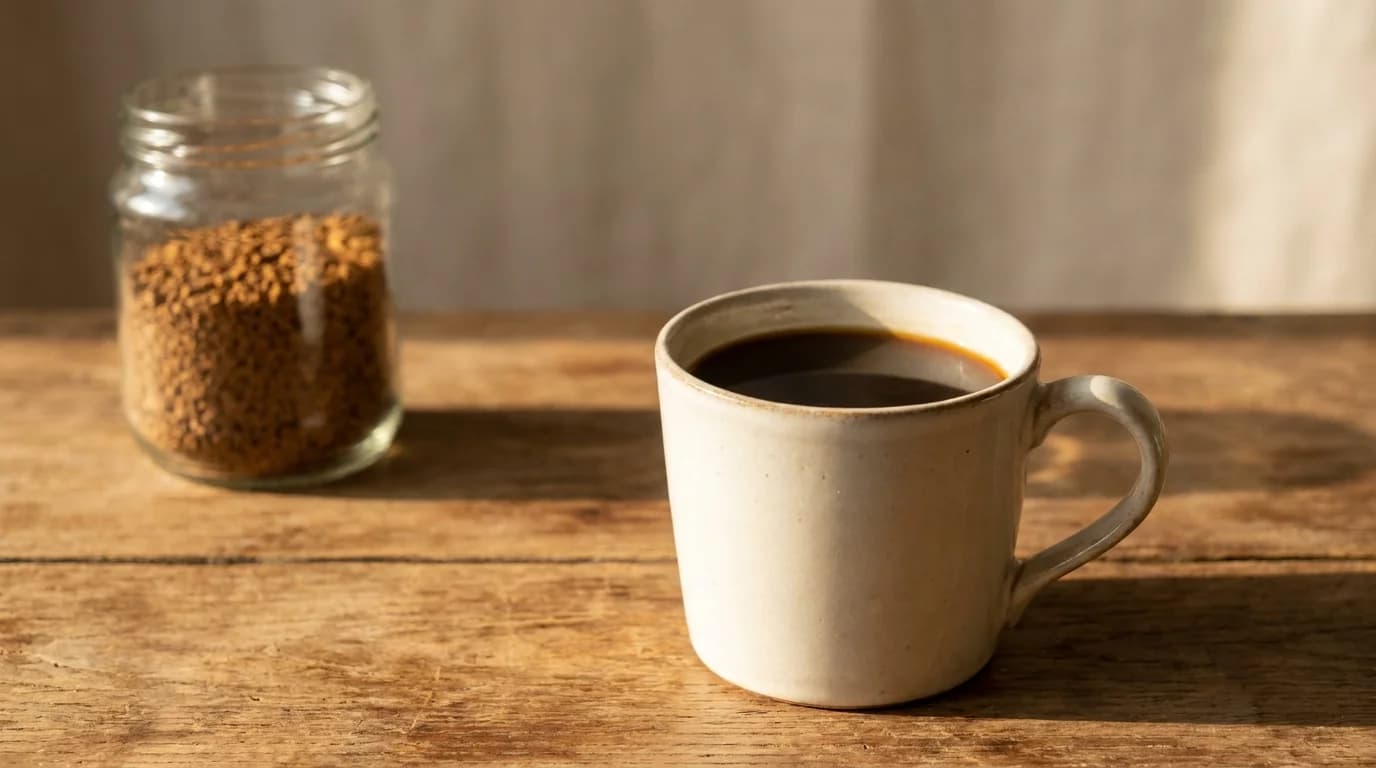
Nescafé is the largest-selling coffee brand in the world by volume, but it began as a solution to a very specific business problem: what to do with a mountain of unsold Brazilian coffee beans that nobody wanted to buy during the Great Depression. The story runs through the 1929 crash, seven years of Swiss laboratory work by a chemist named Max Morgenthaler, a 1938 launch nobody paid much attention to, a war that turned the product into a global phenomenon, and a 1965 freeze-drying breakthrough that created the premium instant coffee tier that still defines the category today.
1 April 1938
the launch date of Nescafé in Switzerland — the product of a seven-year Nestlé research programme[1]
~1 million cups/day
reported peak US military consumption of Nescafé during WWII, catapulting the brand to global scale[3]
1965
launch year of Nescafé Gold Blend — Nestlé's first freeze-dried product and the start of the premium instant tier[1]
The Brazilian coffee surplus problem
To understand why Nescafé exists you have to understand what happened to the Brazilian coffee industry in 1929.
Brazil in the late 1920s produced roughly 70% of the world's coffee — a scale so enormous that Brazilian production alone set the global coffee price. The Brazilian government maintained a "valorization" scheme that bought up surplus coffee to prop up prices, storing it in warehouses.
When the Wall Street crash hit in October 1929 and global demand collapsed, Brazil was left holding a coffee surplus of historic proportions. Government warehouses filled up. Coffee that couldn't be sold was destroyed — burned in locomotive furnaces, dumped into the sea, used as railway ballast[7]. Estimates suggest tens of millions of bags were destroyed during the early 1930s to try to support prices.
The Brazilian government wanted a better solution than burning coffee. Specifically, they wanted a way to preserve the coffee's economic value in a stable form that could sit in warehouses without spoiling and be sold gradually — a "coffee reserve" in some processed, shelf-stable form. In 1930 the Brazilian Coffee Institute approached Nestlé, then already a global food-processing company headquartered in Vevey, Switzerland, and asked whether Nestlé's food science could solve the problem.
Nestlé accepted the challenge.
Max Morgenthaler's seven years
The task fell to Max Morgenthaler, a Swiss chemist working at Nestlé's Vevey research laboratories. Morgenthaler wasn't starting from zero — soluble coffee products had existed since the late 1800s. Various inventors had produced dried coffee extracts that dissolved in hot water:
- 1890s: New Zealand-based inventor David Strang patented a "soluble dry coffee" method[5].
- 1901: Japanese-American chemist Satori Kato demonstrated a stable instant coffee at the Pan-American Exposition in Buffalo, New York.
- 1910: George Constant Louis Washington, a Belgian living in the US, patented and commercialised an instant coffee sold under the "Red E Coffee" brand that later became "G. Washington's Prepared Coffee" — the first mass-market instant[4].
The problem with all of these earlier products was flavour stability and taste. Instant coffees of the 1900s-1920s dissolved in water, but they tended to taste harsh, bitter, or stale. Aroma compounds were driven off during drying and the residual powder oxidised rapidly on the shelf. G. Washington's coffee had significant WWI-era sales but was widely regarded as inferior to fresh brewed coffee.
Morgenthaler's brief was to produce a soluble coffee that Nestlé considered good enough to put its name on — meaningfully better than the existing category.
Morgenthaler's key insight was that a soluble carrier compound could stabilise the flavour molecules during and after drying. His breakthrough involved carrying dextrin (a partially hydrolysed starch) through the spray-drying process along with the concentrated coffee extract. The dextrin formed a matrix that encapsulated volatile flavour compounds and reduced oxidation on the shelf[1].
The trade-off was that early Nescafé contained added dextrin along with the coffee solids — about 25% carbohydrate carrier in the original formulation. It wasn't 100% coffee. But it tasted meaningfully better than the alternatives and stayed tasting that way for months in a sealed tin.
Seven years of iteration — 1930 to 1937 — produced a product Nestlé considered ready for market. The name was chosen from a portmanteau of Nestlé and café: Nescafé.
The 1938 launch
Nescafé launched commercially on 1 April 1938 in Switzerland[1]. The initial rollout was modest: a single Swiss market, priced above regular ground coffee, packaged in a small tin.
Public reception was mixed. Swiss coffee drinkers had established preferences and were sceptical of dried coffee powder from Nestlé. Sales were slow enough that Nestlé considered discontinuing the product within the first year.
Then the war intervened.
World War II and the US military
When World War II broke out in 1939, coffee was a strategic commodity. Fresh coffee is bulky, heavy, requires brewing equipment, and doesn't keep well in field conditions. The US Army was in the process of developing K-ration and C-ration field packs and needed a compact, shelf-stable coffee solution.
Nescafé was exactly what they needed.
- Compact: a few grams of powder made a full cup.
- Shelf-stable: sealed tins kept for months in field conditions.
- Fast: hot water and stir — no grinding, no brewing.
- Portion-controlled: one packet per cup, no waste.
Nestlé — headquartered in neutral Switzerland but with production facilities in the US and Latin America — ramped up US production of Nescafé for military supply. By 1943, essentially all Nescafé production at Nestlé's US facilities was going to the US armed forces[3].
At peak WWII consumption, US forces reportedly consumed around one million cups of Nescafé per day across the European, Pacific, and North African theatres. The volume was so significant that Nestlé's US operations expanded substantially during the war to meet military demand.
The consequence for the postwar civilian market was enormous. Millions of American servicemen returned home in 1945-1946 having drunk instant coffee daily for years. They had adjusted their taste for it and, importantly, valued the convenience. Postwar consumer marketing built on this foundation, and Nescafé sales in the North American market exploded through the late 1940s and 1950s.
Maxwell House launched its own instant coffee to compete; Kraft, General Foods, and other food conglomerates followed. By 1950 instant coffee was a mainstream US supermarket category — a market that had barely existed in 1935.
The classic red-mug era
Nescafé's visual branding solidified in the 1950s and 1960s around what became one of the most recognisable coffee imagery in the world: the red mug. The Nescafé logo, featuring the wordmark in white on red or the red mug alongside the name, became a global constant across markets from the UK to Brazil to Japan.
Nescafé advertising through the 1950s-1970s was heavy on suburban home life, family coffee moments, and the convenience-modernity story. In the UK, Nescafé's "Gold Blend Couple" TV advertising campaign in the late 1980s and early 1990s — a serialised will-they-won't-they romance between two neighbours who kept borrowing coffee from each other — became a cultural phenomenon and drove Gold Blend sales to record levels.
The consistency of the branding is a case study in itself. The Nescafé wordmark and red mug have been used continuously for over 60 years with only modest refreshes — one of the longer-running brand identity continuities in consumer packaged goods.
Spray drying to freeze drying: the 1965 Gold moment
The original 1938 Nescafé was spray-dried — the concentrated coffee extract was sprayed as a fine mist into a tower of hot air (typically well above 200 °C at the inlet), where the water evaporated instantly and dry particles fell to the bottom of the tower as a fine powder[6]. Spray drying is fast, high-throughput, and relatively cheap, which is why it dominated commercial instant coffee for decades.
The trade-off is that the high temperatures drive off volatile aroma compounds. Traditional spray-dried instant tastes distinctively different from fresh brewed coffee — flatter, more roasted, less aromatic — and this was one of the persistent knocks on instant coffee through the mid-20th century.
Freeze drying solved this problem. In freeze drying, the concentrated coffee extract is frozen into a slab at around −40 °C, broken into granules, and placed in a vacuum chamber where the ice sublimates — passing directly from solid to vapor without ever becoming liquid[6]. Because the process never applies significant heat, most of the coffee's low-boiling aroma compounds survive into the finished granule.
Nestlé launched Nescafé Gold Blend in 1965 as the first freeze-dried Nescafé product, positioned as the premium tier of the Nescafé line[1]. Gold Blend commanded a price premium — freeze drying is more energy- intensive and slower than spray drying — but the aroma preservation was meaningfully better and the product justified its shelf position.
Gold Blend was a strategic success. It established the premium instant coffee tier that other manufacturers followed (Taster's Choice in the US, Moccona globally, Douwe Egberts freeze-dried), and it gave Nescafé a natural upgrade path for consumers who wanted better-tasting instant without switching brands. Nescafé Gold remains one of the flagship Nescafé products globally, particularly strong in the UK, Europe, and Asia-Pacific.
For a detailed comparison of the two drying methods and how they affect the finished cup, see Freeze-Dried vs Spray-Dried Coffee.
Global expansion and product line extension
From the 1950s onward Nescafé expanded aggressively into emerging coffee markets — places where fresh brewed coffee infrastructure was thin but Nescafé's convenience proposition was compelling:
- Japan — Nescafé arrived in the 1960s and helped establish the Japanese coffee-drinking habit alongside the earlier tea culture. Japan became a major Nescafé market.
- UK — historically a tea-drinking country, the UK became one of Nescafé's largest single markets in Europe, driven substantially by Gold Blend and the Gold Blend Couple advertising campaign.
- Latin America — Nescafé built major markets across Mexico, Colombia, Brazil (ironically, given the origin story), and elsewhere in the region.
- India, China, Southeast Asia, Africa — Nescafé is now the dominant coffee brand across most emerging Asian and African markets, often introducing coffee-drinking to markets with no prior coffee culture.
- 3-in-1 sachets — from the 1980s onward, Nescafé pushed pre-mixed coffee-creamer-sugar sachets that became the dominant format in many emerging markets.
Product line extensions followed the geographic expansion:
- Nescafé Classic — the mass-market spray-dried product, dominant in most emerging markets.
- Nescafé Gold Blend / Gold — freeze-dried premium tier (1965).
- Nescafé Cappuccino / 3-in-1 / instant milk drinks — from the 1980s onward.
- Nescafé Dolce Gusto — single-serve pod system launched in 2006 to compete with the Nespresso and Keurig systems.
- Nescafé Azera — barista-style microground instant coffee launched in 2010 to compete with fresh brewed at the premium end.
The current Nescafé portfolio spans virtually every price tier and preparation format in the soluble coffee category.
Current market position
Nescafé remains the largest-selling coffee brand in the world by volume. Nestlé is the world's largest food and beverage company by revenue, and coffee is one of its largest single businesses — Nestlé's coffee segment (which includes Nescafé, Nespresso, Starbucks-at-home under license, and other coffee brands) generated approximately CHF 25 billion in 2023[2].
Nescafé specifically:
- Sold in nearly every country with commercial coffee distribution.
- Consumed at approximately 5,000 cups per second globally, per Nestlé's own marketing claims — an estimate based on annual volumes divided by seconds per year.
- Dominant in soluble coffee — the largest share of the global instant coffee category, competing with JDE Peet's (Douwe Egberts, Jacobs, Moccona), Tata (Tata Coffee Grand), and various regional brands.
- Growing especially fast in emerging markets — Southeast Asia, Africa, and Latin America — where the soluble coffee category is expanding faster than roast-and-ground[8].
The International Coffee Organization tracks soluble coffee as one of the two main product forms in world coffee trade alongside roast-and-ground, and Nescafé's share of that category makes it the single largest coffee brand by any measure other than café-served fresh coffee (where Starbucks leads).
The Nescafé Plan and sustainability
Since 2010 Nestlé has run the Nescafé Plan, a sustainability programme covering coffee sourcing, farmer training, and productivity improvements at origin. The plan commits to responsibly sourced green coffee, distribution of higher-yielding disease-resistant coffee seedlings to farmers, and other agronomic support. Nestlé's 2023 reporting indicated that most Nescafé green coffee is now sourced through the Nescafé Plan or equivalent responsible sourcing programmes[2].
Sustainability positioning is now a meaningful part of the brand story alongside the historical convenience-and-quality narrative — a reflection of shifted consumer expectations in developed markets.
The through-line
The Nescafé story runs from a Brazilian warehouse of unsold coffee in 1930, through a Swiss laboratory in the 1930s, through WWII ration packs in the 1940s, through the freeze-drying breakthrough in the 1960s, and into the global emerging-market coffee category of today. What began as a solution to a specific commodity oversupply problem became the largest coffee brand in the world through a combination of technical innovation, WWII-scale distribution, consistent branding over eight decades, and aggressive expansion into markets where coffee wasn't yet a habit.
For more on how instant coffee is actually made — the industrial extraction, concentration, and drying process that Nescafé pioneered and still uses — see How Is Instant Coffee Made?.
Common misconceptions
- "Nescafé was invented in Brazil." No — the research and the launch were Swiss. But the project began because of a Brazilian government request and the Brazilian coffee surplus was the reason Nestlé took on the work.
- "Nescafé is chemically flavoured coffee." No — Nescafé is real brewed coffee with the water removed by industrial drying. The original 1938 formulation contained added dextrin as a stability aid, but modern Nescafé products are typically 100% coffee solids for the pure varieties (with sugar and creamer for the 3-in-1 formats).
- "Nescafé and Nespresso are the same brand." No — both are Nestlé coffee brands but are managed separately. Nespresso launched in 1986 as a premium single-serve espresso pod system; Nescafé is the soluble coffee brand.
- "Instant coffee has always tasted the same." No — the spray-dried Nescafé of 1938 tasted meaningfully different from Gold Blend freeze-dried of 1965, which tastes meaningfully different from modern single-origin freeze- dried specialty instants. The category has evolved significantly.
The honest summary
Nescafé was launched by Nestlé on 1 April 1938 in Switzerland as the product of a seven-year research programme led by chemist Max Morgenthaler, initiated in 1930 in response to a Brazilian government request to help absorb the country's Depression-era coffee surplus. Morgenthaler's key innovation was using dextrin as a flavour-stability carrier through spray drying. WWII catapulted the product from a slow-selling Swiss curiosity to a global brand as the US military adopted it at roughly one million cups per day. Freeze-dried Nescafé Gold Blend launched in 1965, establishing the premium instant tier. Today Nescafé is the world's largest coffee brand by volume, sold in nearly every country and dominant across emerging coffee markets — the largest and most successful outcome of an 88-year-old attempt to make dried coffee taste good.
Frequently asked questions
- When was Nescafé invented?
- Nescafé was launched commercially on 1 April 1938 in Switzerland. The underlying research began in 1930 at Nestlé's headquarters in Vevey, Switzerland, after the Brazilian government approached the company for help using up a coffee surplus. Nestlé chemist Max Morgenthaler led a seven-year research programme that produced a soluble coffee powder Nestlé considered good enough to launch.
- Who invented Nescafé?
- Max Morgenthaler, a Swiss chemist working at Nestlé's Vevey research laboratories, is credited as the primary inventor of Nescafé. Morgenthaler joined the project in 1930 and worked on soluble coffee for seven years before the product was commercialised in 1938. His key contribution was carrying dextrin (a soluble carbohydrate) through the spray-drying process, which stabilised flavour compounds and prevented the rapid staling that had plagued earlier instant coffees. He continued to lead Nescafé product development for decades.
- Where does the name 'Nescafé' come from?
- The name Nescafé is a portmanteau of Nestlé and café — the French word for coffee. It fits Nestlé's naming convention of combining the founder's surname with a product category (Nesquik, Nespresso, Nestea). The 1938 launch name was 'Nescafé' with the accent, and the branding has been remarkably consistent for nearly nine decades: the red mug on the jar and the Nescafé wordmark are among the most recognisable coffee brand assets in the world.
- How did WWII affect Nescafé?
- World War II transformed Nescafé from a small Swiss product into a global brand. The US military adopted Nescafé heavily for ration packs — soldiers needed hot coffee that could be prepared quickly in the field, and instant coffee solved the logistics problem. At peak, US forces reportedly consumed around one million cups of Nescafé per day. American troops returning home after 1945 had developed a taste for instant coffee, which established the North American consumer market that Nescafé and later competitors like Maxwell House Instant would compete for through the postwar period.
- What is Nescafé Gold Blend and when did it launch?
- Nescafé Gold Blend launched in 1965 as Nestlé's first freeze-dried instant coffee, positioned as the premium tier of the Nescafé line. Freeze drying preserves more of coffee's aromatic compounds than spray drying (the original 1938 method), because it removes water without applying significant heat. Gold Blend commanded a price premium and helped define the freeze-dried instant coffee category that other manufacturers followed. It remains one of the flagship Nescafé products globally, particularly in the UK and Europe.
References
Every factual claim in this article is drawn from the sources below. See the source library for how we grade evidence.
- [1]The Story of Nescafé — 1938 to TodayNestlé · 2023 · Reference work · Tier 3 · Contextual
- [2]Nestlé Annual Report 2023 (Nescafé segment)Nestlé S.A. · 2023 · Reference work · Tier 3 · Contextual
- [3]CoffeeEncyclopaedia Britannica · Reference work · Tier 3 · Contextual
- [4]The History of CoffeeNational Coffee Association · Reference work · Tier 3 · Contextual
- [5]Instant coffeeWikipedia · Reference work · Tier 3 · Contextual
- [6]Spray-freeze-drying as emerging and substantial quality enhancement technique in food industryPMC / NIH · 2024 · Review · Tier 2 · Moderate
- [7]Uncommon Grounds: The History of Coffee and How It Transformed Our World (revised edition)Basic Books (Mark Pendergrast) · 2010 · Reference work · Tier 2 · Moderate
- [8]International Coffee OrganizationInternational Coffee Organization · Official dataset · Tier 1 · Strong
Related reading
- Instant & Decaf CoffeeHow Is Instant Coffee Made? Freeze-Dry vs Spray-Dry→
- Instant & Decaf CoffeeFreeze-Dried vs Spray-Dried Coffee→
- Instant & Decaf CoffeeSwiss Water Decaf: How Chemical-Free Decaf Works→
- Instant & Decaf CoffeeIs Instant Coffee Bad for You?→
- Instant & Decaf CoffeeBest Decaf Coffee Brands: Ranked by Method and Taste→
- Instant & Decaf CoffeeHalf-Caff Coffee: What It Is and Why It Works→