Ascaso Steel Duo: Two Thermoblocks Instead of Two Boilers
By Coffee Studies Editorial·Published October 17, 2026·5 min read
Quick answer
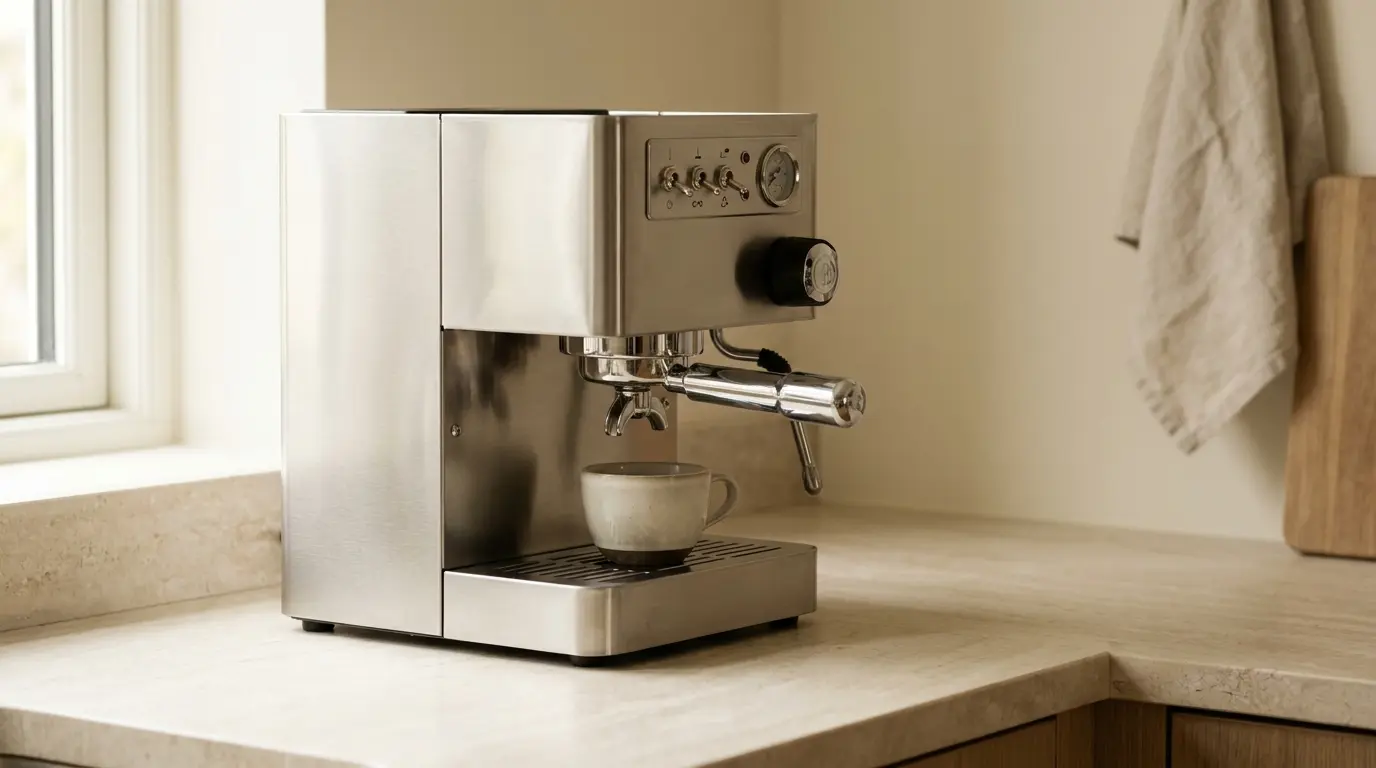
Almost every machine that can brew and steam at the same time does it with boilers. Either one large one with a pipe through it, or two separate ones. The Ascaso Steel Duo does it with neither. It has two independent thermoblocks, each with its own PID, and that single decision is what makes it interesting and what defines its limits.
What a thermoblock actually is
A thermoblock is a metal block with a heating element and a channel through it. Water is heated as it flows, like a tankless water heater, rather than being held hot in a tank.
The consequences are predictable. There is almost nothing to warm up, so the machine is ready in a fraction of the time a boiler needs. There is no boiler to descale, which removes a maintenance job and a failure mode. The machine is lighter and smaller. And because there is no reservoir of hot water, there is no thermal buffer to draw on when demand runs long.
Most machines that use a thermoblock use one, which means they brew or steam but not both, and most of them are cheap. The Steel Duo uses two and puts a PID on each, which is what moves it out of that company.
What two circuits buy
The practical difference between a single-boiler machine and a dual boiler is sequence. One circuit means brew, switch, wait, steam, wait. Two circuits mean brew and steam together, and the shot does not wait for the milk.
The Steel Duo delivers that, which is the thing people actually want from a dual boiler, without holding two tanks of hot water to do it. Each circuit has its own PID holding its own set point, so the brew temperature is set and held rather than timed, and the steam side is always ready.
It also offers volumetric dosing, meaning you program a shot volume and the machine stops itself, and it takes the 58 mm commercial portafilter, so cafe baskets and tampers fit.
What it does not have is thermal mass. A dual boiler holds litres of hot water and simply does not notice a fourth or fifth drink; a thermoblock machine is heating every drop on demand, and sustained steaming asks more of it. For a household making one to three drinks in a sitting this is theoretical. For a household making six in a row, boilers are the better engineering.
Against the machines people cross-shop it with
Against the Rancilio Silvia Pro X. Both are compact, both brew and steam at once, both are PID-controlled. The Silvia Pro X has two real boilers, which means more reserve and a heavier, more traditional machine, and a longer wait from cold. The Steel Duo is ready almost immediately and has nothing to descale.
Against the Rocket Appartamento. The Rocket is an E61 heat exchanger: classic group, one large boiler, a cooling flush habit, and twenty minutes to warm through. It is the more traditional object and the one with the thermal mass. The Ascaso is the modern answer to the same brief.
Against the Ascaso Dream PID. The Dream is the single-circuit version of the same engineering, with PID and volumetric dosing in a smaller and cheaper body. It brews and then switches to steam. If you drink mostly espresso, the Dream does the job for noticeably less.
The Steel Duo, the single-circuit Dream, and the dual-boiler alternative
 Dual thermoblock with PID, compactAscaso Steel DUO Espresso Machine V3 | PID | Programmable | Volumetric Controls | Dual Thermoblock | 120V (Black)Two independent thermoblocks, one for brew and one for steam, each under PID control, so it brews and steams together without a boiler and without the warm-up a boiler needs. Volumetric dosing. A compact alternative to the small dual boilers.amazon.com $2,095.00 USDamazon.ca —Price and availability as of View on Amazon
 Single thermoblock with PID, volumetricAscaso Dream PID, Programmable Home Espresso Machine w/Volumetric Controls, 120V (Black)The single-circuit version of the Steel Duo's engineering: PID control and volumetric dosing in a smaller and cheaper body, brewing and then switching to steam as any single-circuit machine does. The sensible buy if you drink mostly espresso rather than milk drinks.amazon.com $1,635.00 USDamazon.ca $2,332.52 CADPrice and availability as of View on Amazon
 Dual boiler with PID, compactRancilio Silvia Pro X Espresso Machine, 1 liters, Stainless SteelTwo boilers on two controllers in a body only a little wider than the Silvia. Set temperature holds, steam is always ready, milk textures while the shot runs, and nothing needs adding. The smallest serious dual boiler made.amazon.com $2,195.00 USDamazon.ca $3,850.00 CADPrice and availability as of View on Amazon
Product prices and availability are accurate as of the date/time indicated and are subject to change. Any price and availability information displayed on Amazon at the time of purchase will apply to the purchase of this product. Certain content that appears on this site comes from Amazon. This content is provided ‘as is’ and is subject to change or removal at any time.
Who it suits
Someone impatient. The warm-up difference against a boiler machine is the thing you notice every single morning, and it is the strongest argument for the design.
Someone short on counter. It is compact for a machine that brews and steams at once, and the alternatives at that capability are generally larger. The options by width are in compact espresso machines.
Someone in a hard-water area who would rather not own a boiler to descale.
Not someone making six milk drinks in a row. That is where boilers earn their bulk.
Not someone who wants the E61 object. If the look and feel of a traditional machine is part of why you are buying, this is not that, and no specification will change it.
What it will not fix
The grinder. Nothing in this machine compensates for an inconsistent grind, and grind particle distribution governs extraction more than anything the brew side does[2]. The pressure the machine delivers at the puck is the same nine bar as any other pump machine[1], so the variable left in play is what you put in the basket.
Budget for a real espresso grinder alongside it, not after it.
Common misconceptions
"Dual thermoblock is just a cheaper dual boiler." It is a different design with its own advantages, notably speed and no descaling of a boiler. It is not a watered-down version of one.
"No boiler means weak steam." It means steam without a reservoir. Adequate for a pitcher or two, less suited to sustained work.
"PID makes it a prosumer machine." PID is a controller. The category convention also expects boilers and a commercial group, and this has one of those two.
"Volumetric dosing improves the shot." It makes the shot repeatable across people. The quality is still grind and coffee.
What we have and have not checked
The configuration described, two independent PID-controlled thermoblocks with volumetric dosing and a 58 mm portafilter, is from the maker's published specification and the product listings. The behaviour of thermoblock heating versus boiler heating is intrinsic to those designs. We have not bench-tested the machine, have not measured its warm-up time or steam recovery, and give no figure for either because Ascaso lists several variants and revisions. Check the listing for the exact model. The product cards show live prices.
The honest summary
The Steel Duo reaches the dual boiler's useful trick, brewing and steaming together under proper temperature control, by a different route: two thermoblocks instead of two tanks. You gain a machine that is ready almost immediately, fits a smaller counter and has no boiler to descale. You give up thermal reserve, which only matters once the drinks run long. If the wait is what annoys you about serious espresso machines, this is the design that fixes it.
Frequently asked questions
- Is the Ascaso Steel Duo a dual boiler?
- No, and the distinction matters. It has two independent heating circuits, one for brew and one for steam, each with its own PID, which gives it the dual boiler's defining ability to brew and steam at the same time. But those circuits are thermoblocks that heat water as it passes rather than boilers that hold it. You get the simultaneous operation and the fast warm-up; you give up the thermal mass that a boiler provides across a long sequence of drinks.
- How long does the Ascaso Steel Duo take to heat up?
- Thermoblock machines are ready in a small fraction of the time a boiler machine needs, which is the main practical reason to choose this design over a dual boiler at a similar price. A traditional E61 heat exchanger wants fifteen to twenty minutes from cold before the group is at working temperature; a thermoblock machine does not have a group full of thermal mass to bring up in the same way. Check the maker's current figure for the exact model.
- Ascaso Steel Duo or Rancilio Silvia Pro X?
- Both brew and steam simultaneously under PID control in a compact body, at a broadly similar price. The Silvia Pro X uses two real boilers, so it has more thermal reserve for back-to-back milk drinks and the heavier, more traditional build. The Steel Duo is ready far sooner, has no boilers to descale, and is the more modern design. If you make several drinks in a row, the boilers help. If you make one or two and value not waiting, the thermoblocks do.
- What is the difference between the Ascaso Steel Duo and the Dream PID?
- The Dream PID is the single-circuit machine: PID temperature control and volumetric dosing in a smaller and cheaper body, but you brew and then switch to steam as on any single-boiler machine. The Steel Duo adds the second independent circuit, which is what lets it steam while the shot runs. If you drink mostly espresso the Dream is the sensible buy; if milk drinks are the point, the second circuit is what you are paying for.
- Does the Ascaso Steel Duo need a separate grinder?
- Yes. There is no grinder in it, and at this level the grinder matters more than the machine: grind consistency governs extraction ahead of anything the brew side contributes. Budget for a proper espresso grinder alongside it rather than afterwards, because a machine in this band fed by a weak grinder will show the grinder's failings rather than hide them.
- Is the Ascaso Steel Duo a prosumer machine?
- By the usual convention, partly. It has the 58 mm commercial portafilter, PID control, volumetric dosing and simultaneous brew and steam that the category implies, but not the boilers or the heavy E61 group that most people picture. It is better understood as a modern alternative to the prosumer formula rather than a member of it: the same capabilities reached by different engineering, with different trade-offs.
References
Every factual claim in this article is drawn from the sources below. See the source library for how we grade evidence.
- [1]Influence of Water Pressure on the Final Quality of Arabica Espresso CoffeeJournal of Agricultural and Food Chemistry · 2002 · Controlled trial · Tier 2 · Moderate
- [2]Brewing FundamentalsCoffee Science Foundation · Reference work · Tier 2 · Moderate
Related reading
- Coffee EquipmentDual Boiler vs Heat Exchanger: Which Espresso Machine Design Fits You→
- Coffee EquipmentProsumer Espresso Machine: What the Word Means and Where It Starts→
- Coffee EquipmentCompact Espresso Machines: What Fits, and What You Give Up→
- Coffee EquipmentRancilio Silvia vs Silvia Pro X: One Name, Two Different Machines→
- Coffee EquipmentE61, PID and Pumps: Reading an Espresso Machine Spec Sheet→
- Coffee EquipmentRocket Appartamento: The Heat Exchanger Most People Start With→