Prosumer Espresso Machine: What the Word Means and Where It Starts
By Coffee Studies Editorial·Published October 17, 2026·6 min read
Quick answer
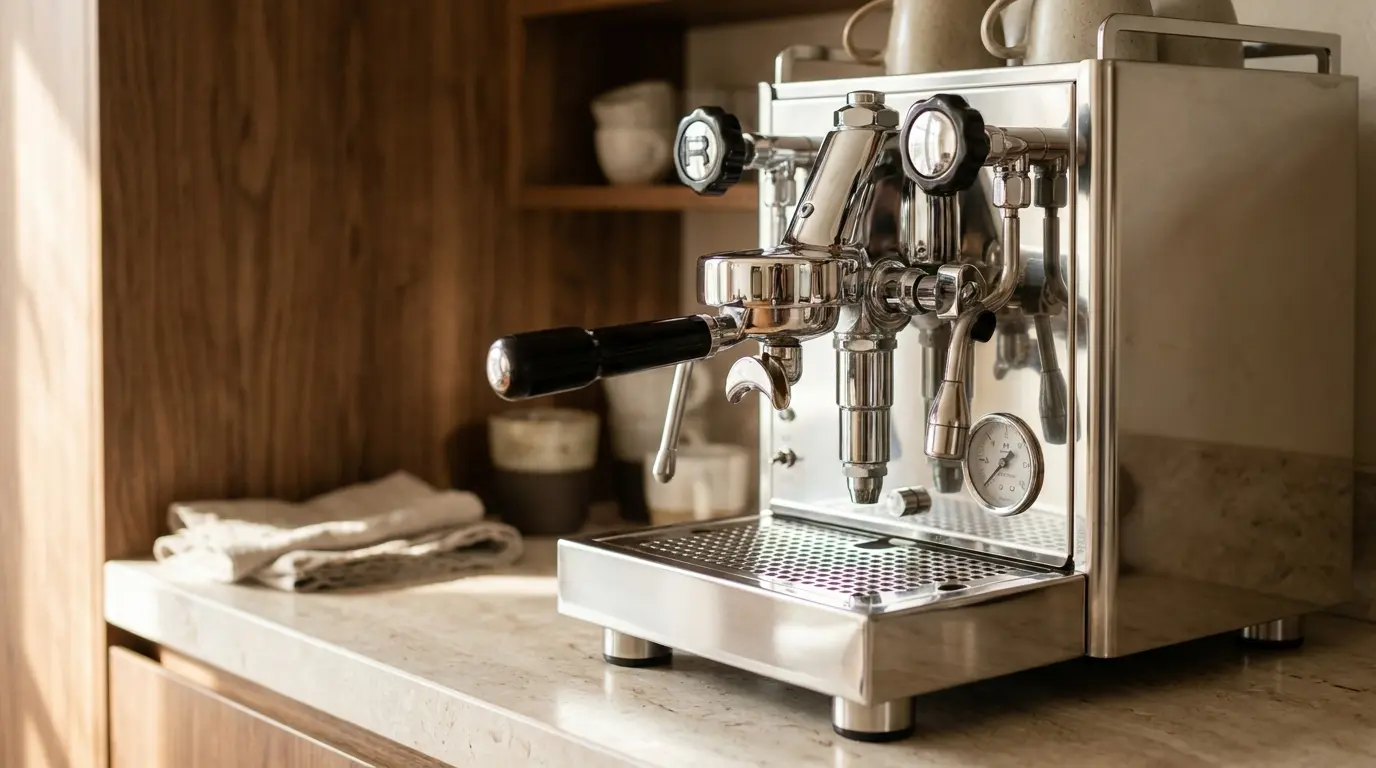
Prosumer is a word the industry invented and nobody defined. There is no standard, no certification and no agreed price floor, which is why it gets attached to machines from six hundred dollars to six thousand. It is still a useful word, because the machines people agree are prosumer do share a specific set of engineering decisions, and understanding those is more useful than arguing about the label.
The four things they share
A 58 mm commercial group. Not 51 or 54 mm. The commercial standard means every basket, tamper and bottomless portafilter made for cafe machines fits yours, and the puck is a cafe-sized puck. The group itself is usually heavy brass or a chromed casting, and that mass is doing thermal work, buffering the water temperature on the way to the coffee.
A real boiler. One, or two, holding actual hot water, rather than a thermoblock heating water as it flows past. A boiler gives thermal reserve, which is what lets a machine steam a second and third pitcher without flagging, and it gives steam that is dry rather than wet. The cost is warm-up time and bulk. The trade-offs between single boiler, heat exchanger, dual boiler and thermoblock are the subject of dual boiler vs heat exchanger.
A three-way solenoid valve. When the shot ends, the valve vents the pressure in the group, so the puck comes out as a dry disc rather than a wet slurry and the portafilter does not spit when you unlock it. It also makes backflushing possible, which is how these machines are cleaned. Appliance machines usually lack one, and that single omission is why they cannot be maintained the same way.
Standard, serviceable parts. Gaskets, solenoids, elements, pumps and pressurestats that a technician stocks and that you can buy yourself. This is the difference that shows up in year six, when an appliance with a sealed assembly becomes uneconomic to repair and a prosumer machine gets a new gasket for the price of a coffee.
What is deliberately missing from that list is anything about the shot. Pressure at the puck governs extraction[1] and these machines deliver the same nine bar as a Gaggia.
Where it starts
Around two thousand dollars buys the entry to the category, and there are two shapes of answer.
A single-group heat exchanger gives you one large boiler at steam temperature with brew water drawn through a pipe inside it, so you brew and steam together. The Rocket Appartamento is the usual first one. The habit it asks for is a short cooling flush before a shot after the machine has idled.
A compact dual boiler gives you separate brew and steam boilers, each with its own controller, so the temperature is simply set and no flush is needed. The Rancilio Silvia Pro X is the smallest serious one.
Alongside those sit two less obvious routes. The Ascaso Steel Duo uses two independent thermoblocks under PID instead of boilers, which brews and steams simultaneously with almost no warm-up. The Diletta line offers E61 heat exchangers and a dual boiler at prices under the Italian names.
Four entry points into the category
 Heat exchanger, E61 groupRocket Espresso Appartamento 2.0 Espresso Machine | Heat Exchanger | 1.8L | (White)The entry to the E61 heat exchanger: one copper boiler, brew and steam together, commercial fittings, a vibratory pump. No display and no PID; the brew temperature is set through the boiler and a short cooling flush before shots after idle is the one habit it asks.amazon.com $2,150.00 USDnot sold on amazon.caPrice and availability as of View on Amazon
 Dual boiler with PID, compactRancilio Silvia Pro X Espresso Machine, 1 liters, Stainless SteelTwo boilers on two controllers in a body only a little wider than the Silvia. Set temperature holds, steam is always ready, milk textures while the shot runs, and nothing needs adding. The smallest serious dual boiler made.amazon.com $2,195.00 USDamazon.ca $3,850.00 CADPrice and availability as of View on Amazon
 Dual thermoblock with PID, compactAscaso Steel DUO Espresso Machine V3 | PID | Programmable | Volumetric Controls | Dual Thermoblock | 120V (Black)Two independent thermoblocks, one for brew and one for steam, each under PID control, so it brews and steams together without a boiler and without the warm-up a boiler needs. Volumetric dosing. A compact alternative to the small dual boilers.amazon.com $2,095.00 USDamazon.ca —Price and availability as of View on Amazon
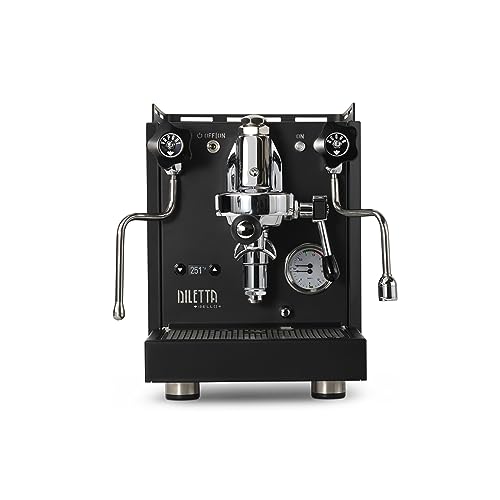 Heat exchanger, E61, PIDDiletta Bello+ Espresso Machine | E61 | PID Temperature Control | Shot Timer | Programmable Preinfusion | Handmade In Italy (Black)An E61 heat exchanger with a PID governing the boiler, which is the same arrangement as the Rocket Mozzafiato at a lower price. Brews and steams together; the cooling flush habit applies.amazon.com $2,149.00 USDnot sold on amazon.caPrice and availability as of View on Amazon
Product prices and availability are accurate as of the date/time indicated and are subject to change. Any price and availability information displayed on Amazon at the time of purchase will apply to the purchase of this product. Certain content that appears on this site comes from Amazon. This content is provided ‘as is’ and is subject to change or removal at any time.
What more money buys above the entry
Past about three thousand dollars the additions are real but incremental, and none of them is a different class of espresso.
A larger boiler, which means more drinks before anything sags. A rotary pump, which is quieter than a vibratory pump and can be plumbed into a water line. Plumb-in capability, which stops someone having to refill a tank. Flow control, a valve on the group that lets you shape pressure during the shot by hand, which is the expensive way to reach what a lever machine does by physics. PID on more of the system, which makes behaviour more predictable rather than better.
The components these upgrades concern, including what an E61 group actually is and what a PID does and does not control, are explained in E61, PID and pumps.
What it does not buy
A better shot than a good single boiler. With the same grinder, the same coffee and a settled hand, a Gaggia Classic or a Rancilio Silvia will produce espresso a prosumer machine cannot clearly beat. The prosumer machine will produce it more reliably and will keep producing it while you steam.
Forgiveness. These machines hide nothing. A prosumer machine behind a weak grinder makes the grinder's failings more obvious, not less, because grind drives extraction more than anything the machine does[2].
Convenience. Nothing in the category grinds, doses, tamps or textures for you. If you want that, the automation is in the appliance machines, and buying prosumer instead will make your mornings worse.
Who should actually buy one
Someone who makes several milk drinks in a row most days, or who has been pulling shots on a single boiler and is tired of the wait between brew and steam, or who wants a machine that will be repaired rather than replaced for the next ten years, or who simply wants the object. The last one is a legitimate reason and people are oddly shy about it.
Someone who makes one espresso a day, or who wants a drink without learning to texture milk, should not, however good the machine is.
Common misconceptions
"Prosumer means commercial." It means commercial parts in a domestic machine. A real commercial machine has a bigger boiler, often multiple groups, and expects a dedicated circuit and a plumbed supply.
"It is a professional machine so it needs no maintenance." The opposite. Backflushing, gaskets and descaling are expected, which is exactly why it lasts.
"E61 means prosumer." E61 is a group design. Plenty of prosumer machines use something else, including every compact dual boiler.
"The price difference is the shot." The price difference is capacity, consistency and longevity.
What we have and have not checked
The four shared characteristics described here are drawn from the machines commonly sold in this category and from their published specifications. "Prosumer" has no formal definition, so the boundary is a convention rather than a fact, and the price figures are the usual market range rather than quotes. We have not bench-tested the machines named, and the product cards show live prices.
The honest summary
Prosumer means a 58 mm commercial group, a real boiler, a solenoid so the puck comes out dry, and parts that outlive the machine's first owner. It starts around two thousand dollars and splits immediately into heat exchanger or dual boiler, which is a choice between a flush habit and a second boiler. It buys consistency, steam and longevity. It does not buy a better shot than a good single boiler, and it will not rescue a weak grinder.
Frequently asked questions
- What is a prosumer espresso machine?
- A home machine built from commercial components. There is no standards body and no definition anyone enforces, but the machines people agree are prosumer share four features: a 58 mm commercial group head, an actual boiler rather than a heat-on-demand block, a three-way solenoid valve that releases pressure so the puck comes out dry, and parts that are standard rather than proprietary. The result is a machine designed to be serviced rather than replaced.
- Where does prosumer start in price?
- Around two thousand dollars for a new machine from a maker with a service network, which buys either a single-group heat exchanger or a compact dual boiler. Below that you are generally in single-boiler machines with commercial groups, which are excellent and not usually called prosumer, or in appliance territory. Above about three thousand you are paying for larger boilers, rotary pumps, plumb-in capability and flow control rather than for a different class of shot.
- Is a prosumer machine worth it over a Breville?
- It depends entirely on whether you make several milk drinks in a row and whether you want to keep the machine for a decade. A prosumer machine steams while it brews, holds temperature without drifting, and can be repaired indefinitely. A Breville automates grinding, tamping or milk and gets a beginner to a drink faster. If nobody in the house wants to learn to texture milk, the prosumer machine is the wrong purchase no matter how well built it is.
- Do prosumer machines make better espresso?
- Not from the brew group alone. Extraction is governed by pressure at the puck, grind and the coffee, and a well-dialled single boiler with a good grinder will match a prosumer machine on a single shot. What the prosumer machine adds is that it does it the same way every time with no ritual, keeps doing it through a run of drinks, and does not run out of steam. Consistency and capacity, not ceiling.
- What is the best entry-level prosumer espresso machine?
- The two common answers are a single-group heat exchanger such as the Rocket Appartamento, which gives you the classic E61 workflow and brews and steams at once in exchange for a cooling flush habit, and a compact dual boiler such as the Rancilio Silvia Pro X, which holds a set temperature with no flush in a smaller footprint. Neither is better; they are different habits. Choose by whether you want the flush or the second boiler.
- Do I need a better grinder for a prosumer machine?
- Yes, and it is the most common mistake at this level. A prosumer machine exposes grind problems rather than hiding them, because nothing in it is compensating for you. Grind consistency drives extraction ahead of anything the machine contributes, so a two thousand dollar machine behind a two hundred dollar grinder is a bottleneck with a nice boiler attached. Budget for the grinder as part of the machine purchase.
References
Every factual claim in this article is drawn from the sources below. See the source library for how we grade evidence.
- [1]Influence of Water Pressure on the Final Quality of Arabica Espresso CoffeeJournal of Agricultural and Food Chemistry · 2002 · Controlled trial · Tier 2 · Moderate
- [2]Brewing FundamentalsCoffee Science Foundation · Reference work · Tier 2 · Moderate
Related reading
- Coffee EquipmentDual Boiler vs Heat Exchanger: Which Espresso Machine Design Fits You→
- Coffee EquipmentRocket Appartamento: The Heat Exchanger Most People Start With→
- Coffee EquipmentRancilio Silvia vs Silvia Pro X: One Name, Two Different Machines→
- Coffee EquipmentE61, PID and Pumps: Reading an Espresso Machine Spec Sheet→
- Coffee EquipmentAscaso Steel Duo: Two Thermoblocks Instead of Two Boilers→
- Coffee EquipmentDiletta Espresso Machines: Bello, Bello Plus and Alto Compared→