Coffee Grind Size Guide: Which Grind for Which Method
By Coffee Studies Editorial·Published July 15, 2026·5 min read
Quick answer
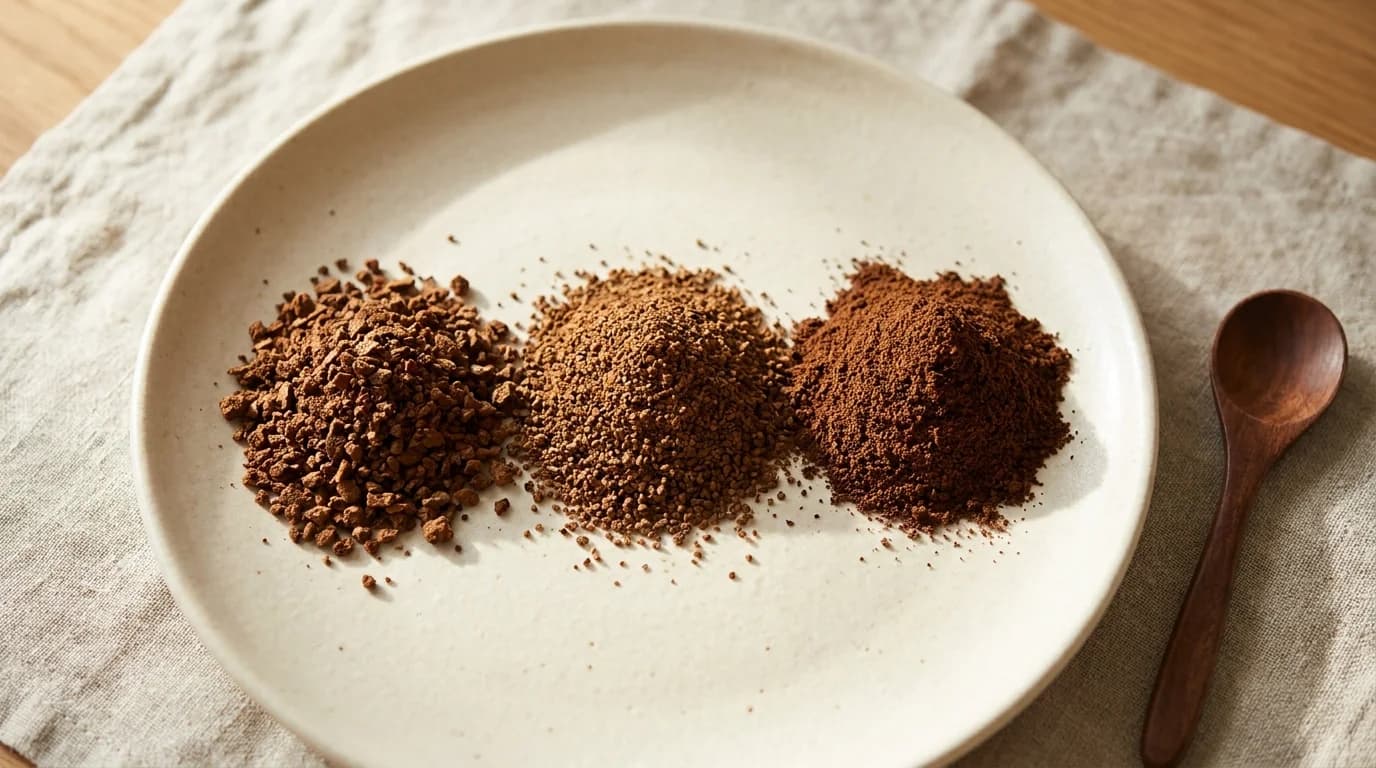
Grind size is the second most important brewing variable after ratio, and the one most home brewers get wrong for years without realising it. Its whole job is to control extraction — how much of the coffee's soluble mass ends up in your cup — by determining how much surface area the water can act on.
Surface area
the mechanism grind size controls — finer grinds expose more coffee to water, extracting faster[3]
Uniformity matters
research finds bean origin and grinder temperature both meaningfully affect the particle-size distribution produced[1]
Two variables
grind controls extraction; ratio controls strength — they are independent and both matter[2]
The grind chart, plain
Every brew method has a grind size that matches its contact time. Short contact times need fine grinds (more surface area); long contact times need coarse grinds (less surface area).
| Brew method | Contact time | Grind size | Rough texture |
|---|---|---|---|
| Turkish coffee | ~5 min in a pot | Extra fine | Powder |
| Espresso | 25–35 sec | Fine | Fine sand |
| Moka pot | ~4 min through steam | Fine to medium-fine | Fine sand / table salt |
| AeroPress (short) | 1–2 min | Medium-fine | Table salt |
| Pour-over | 3–4 min | Medium | Coarse sand |
| Drip / auto-drip | 4–6 min | Medium | Coarse sand |
| Chemex | 4–6 min | Medium-coarse | Kosher salt |
| French press | 4 min | Coarse | Breadcrumbs |
| Cold brew | 12–24 hours | Extra coarse | Coarse sea salt |
The reference textures are subjective — burr grinders often have numbered settings that a coffee shop staff member can help you translate to your specific method.
Why grind size does what it does
Extraction is a rate problem. Coffee's soluble compounds — caffeine, chlorogenic acids, sugars, hundreds of aroma molecules — dissolve out of the coffee particle into the surrounding water at a rate that depends on:
- Surface area (controlled by grind size)
- Water temperature (hotter = faster)
- Contact time (longer = more)
- Turbulence / agitation (more = faster)
The Specialty Coffee Association's "golden cup" extraction range is 18–22% — meaning 18–22% of the coffee's mass ends up dissolved in your cup. Below 18%, the cup tastes sour, weak, or vegetal (under- extracted). Above 22%, it tastes bitter, harsh, or astringent[3].
Grind size is the primary lever for hitting that range, because brew methods largely fix their own temperature and contact time. Espresso can't be brewed for four minutes; French press won't extract properly in thirty seconds. The grind matches the fixed contact time.
Uniformity matters more than exact size
A 2016 Scientific Reports study on grinding roasted coffee looked at what actually happens when beans are ground: the resulting distribution of particle sizes is affected by bean origin, roast, and grinder temperature — and different beans grind differently in the same grinder[1].
The practical implication: a uniform grind at "medium-fine" will brew better than a mixed grind at exactly the "right" setting.
This is the case for burr grinders over blade grinders. Blade grinders spin a blade that chops beans randomly — producing a mix of dust and boulders. The dust over-extracts (bitter) while the boulders under-extract (sour) in the same cup. Burr grinders crush beans between two burrs at a controlled gap, producing much more uniform particles.
The rough hierarchy of grinder quality:
- Manual burr grinder ($50–150) — huge upgrade over blade
- Basic electric burr grinder ($100–300) — good enough for most home methods
- Espresso-capable grinder ($300+) — needed only if you make espresso, which requires very fine, precise adjustment
- Blade grinder ($15–30) — better than nothing, but the ceiling on your cup is low
Dialling in without ceremony
If your coffee doesn't taste right, grind is the first thing to adjust. The heuristic:
- Bitter, harsh, astringent, dry finish → grind coarser
- Sour, thin, weak, quick to swallow → grind finer
- Balanced, sweet, clean finish → keep the grind
Change grind size in small steps — one or two clicks on most burr grinders. It's easy to overshoot.
If you're switching brew methods, start with the standard range for the new method (medium-coarse for French press, medium for pour-over) and adjust from there.
What grind size does not fix
Grind size can't compensate for:
- Wrong ratio. If your coffee is too weak, no amount of finer grinding will make it taste strong — you need more coffee per unit of water[2].
- Wrong water temperature. Cold water at any grind extracts slowly (this is why cold brew takes 12+ hours). Very hot water at any grind extracts fast.
- Stale beans. No grind salvages coffee that's been open for three months. The volatile aroma compounds are simply gone.
- A broken brewer. If your drip machine only reaches 82 °C at the shower head, you're going to under-extract at every grind because the water is too cold.
Common misconceptions
- "Finer grind means stronger coffee." No — finer means higher extraction, which usually means more bitter, not "stronger" in the sense of more caffeine. Strength (dissolved solids) is controlled by ratio, not grind[2].
- "You can grind espresso beans at any size." "Espresso" on a bag refers to the roast style, not the grind. You need to grind the beans yourself (or buy pre-ground espresso) at the right size for your method.
- "The best grinder is a burr grinder." Necessary but not sufficient — even burr grinders vary widely in quality. Cheap burrs can still produce a wide particle distribution.
- "Pre-ground coffee is fine." For consistency and shelf life, freshly ground is meaningfully better. Ground coffee stales in days; whole beans in weeks-to-months.
What a grinder capable of holding that size actually costs is in how much to spend on a coffee grinder.
The honest summary
Grind size matches your brew method to a target extraction range. Get roughly the right texture for your method (medium for pour-over, coarse for French press, fine for espresso), then adjust in small steps toward "balanced" if the cup tastes bitter or sour. Grinder uniformity matters more than exact size — a consistent burr grinder at "close enough" beats a blade grinder at "exact."
Frequently asked questions
- What grind size should I use for pour-over?
- Medium — roughly the texture of coarse sand or kosher salt. Adjust from there: if your pour-over tastes weak or sour, go finer. If it tastes bitter or astringent, go coarser. Small changes matter more than they look.
- What grind is best for French press?
- Coarse — closer to breadcrumb or coarse sea-salt texture. Fine grinds pass through the mesh filter and leave sediment in your cup, and over-extract during the long steep time.
- Why does grind size matter so much?
- Because it controls surface area. Fine grinds have a huge surface area, so water pulls flavour out fast — good for espresso's 25-second contact time, terrible for French press's four-minute steep. The right grind matches the brew method's contact time.
- Does a burr grinder make a difference?
- Yes — the biggest one. Burr grinders produce a much more uniform particle size than blade grinders, which chop coffee into a mix of dust and boulders. Uniform particles extract evenly; mixed particles give you over- and under-extraction in the same cup.
References
Every factual claim in this article is drawn from the sources below. See the source library for how we grade evidence.
- [1]The effect of bean origin and temperature on grinding roasted coffeeScientific Reports · 2016 · Controlled trial · Tier 2 · Moderate
- [2]Effects of brew strength, brew yield, and roast on the sensory quality of drip brewed coffeeJournal of Food Science · 2020 · Controlled trial · Tier 2 · Moderate
- [3]Brewing FundamentalsCoffee Science Foundation · Reference work · Tier 2 · Moderate
Related reading
- Brewing ScienceCoffee-to-Water Ratio Explained→
- Brew MethodsCold Brew Coffee Guide: Ratios, Steep Time, Technique→
- Brewing ScienceBurr vs Blade Grinder: Which Makes Better Coffee?→
- Brewing ScienceCoffee Extraction Explained: TDS, Solubles, and Yield→
- Brewing ScienceCoffee Strength vs Caffeine: They're Not the Same→
- Brewing ScienceWhy Is Coffee Bitter? The Chemistry of Coffee Bitterness→