Best Water Temperature for Coffee
By Coffee Studies Editorial·Published July 15, 2026·7 min read
Quick answer
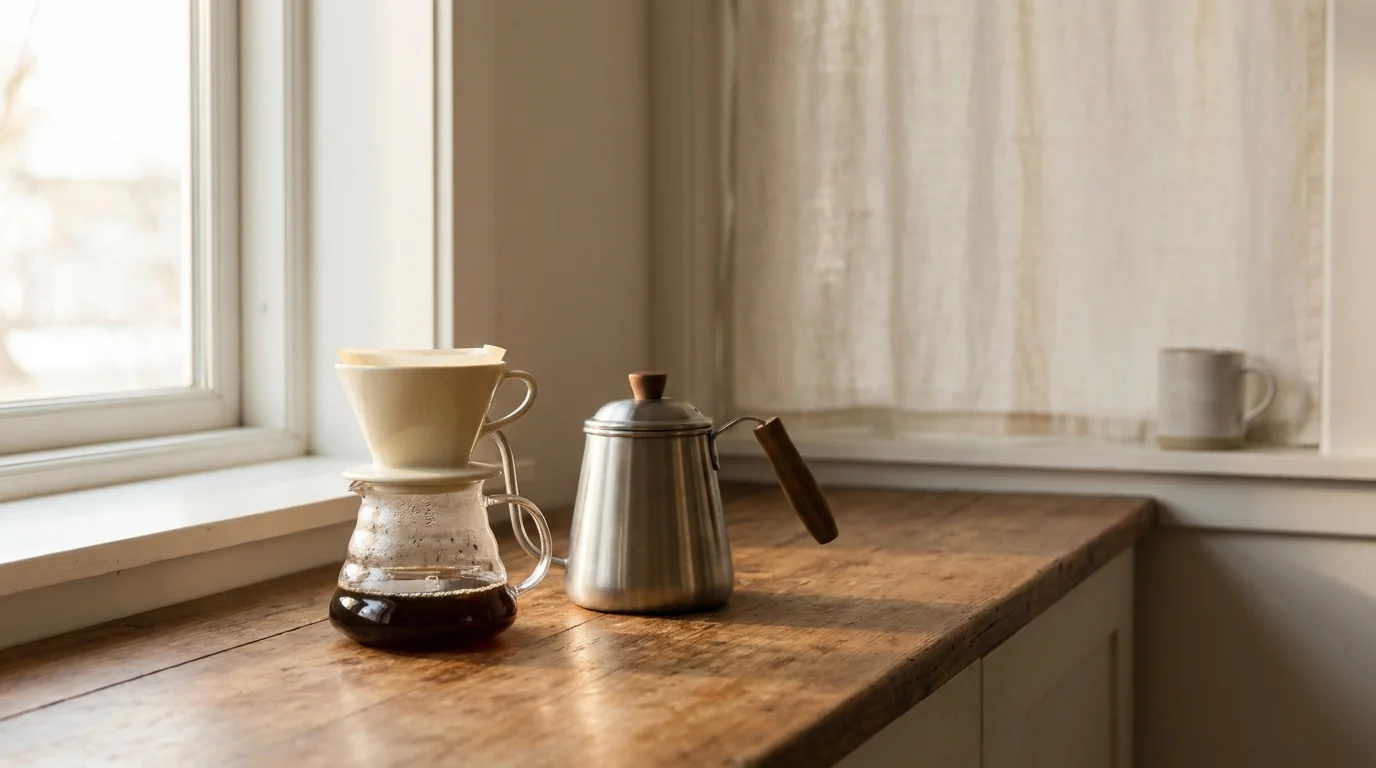
Water temperature is one of the four main brewing variables (with grind, ratio, and time), and the one most home brewers overthink. Research suggests it matters less at the margins than people assume — but getting it grossly wrong will ruin your cup. The useful thing to know is the range and how to hit it without a thermometer.
92-96°C
Specialty Coffee Association recommended range for most brewed coffee methods[3]
Off-boil 30 sec
a reliable way to hit the target without a thermometer — boil, wait 30 seconds, pour[3]
Smaller than you think
research shows temperature has smaller sensory effects than intuition suggests when strength and extraction are held constant[1]
The SCA range
The Specialty Coffee Association's classic brewing guidelines put the target range at 92-96°C (198-205°F) for hot-brewed coffee. Within this range:
- 92-93°C — slightly cooler end. Good for lighter roasts and brighter beans that can over-express at higher heat. Common for pour-over.
- 94-95°C — the middle default. Works for most methods and most beans.
- 96°C — the hot end. Good for slower-extracting methods and darker roasts that benefit from more aggressive extraction. Some prefer this end for French press.
The range is narrow — a spread of only 4°C — but it does matter. Below 92°C, extraction slows enough that most methods start to under-extract (sour, weak coffee). Above 96°C, extraction becomes aggressive enough to pull out bitter compounds faster (harsh, bitter coffee).
How to hit the range without a thermometer
The simplest reliable method:
1. Boil the water fully. 2. Turn off the heat. 3. Wait 30 to 45 seconds before pouring.
A rolling boil is at 100°C. Water cools by roughly 1°C every 10-15 seconds once off the heat (in a typical stovetop kettle), so 30-45 seconds brings you into the 94-96°C range. In cooler kitchens or with thicker kettles, wait slightly less; in warm kitchens with thin kettles, wait slightly more.
More precise options:
- Temperature-controlled electric kettle — set exactly to 95°C or wherever you like. Increasingly common in specialty coffee equipment ($50-150).
- Digital thermometer — check kettle temperature directly.
- Kettle with pre-set brew temp button — some gooseneck kettles have this built in.
None of these is required for good coffee. The 30-second wait after boiling is usually enough.
 Variable-temperature gooseneckCosori Gooseneck Electric Kettle with Temperature Control, 0.8L, Black | No Plastic Contact with Water, 5 Presets, 60-Min Keep Warm, Pour Over Coffee & Tea, Stainless Steel Interior, 1200WThe spout gives you a slow, placeable stream, which is most of pour-over technique. Temperature control matters less than people assume at fixed extraction, but it removes a variable while you are learning, and it is the difference between guessing and knowing what went into the cup.amazon.com $62.99 USDamazon.ca $85.49 CADPrice and availability as of View on Amazon
Product prices and availability are accurate as of the date/time indicated and are subject to change. Any price and availability information displayed on Amazon at the time of purchase will apply to the purchase of this product. Certain content that appears on this site comes from Amazon. This content is provided ‘as is’ and is subject to change or removal at any time.
Method-specific targets
Drip/auto-drip: Ideal is 92-96°C. Many auto-drip machines don't reliably reach this temperature — a machine that shower-heads water at 82°C will under-extract regardless of grind or ratio. If your drip coffee tastes weak and sour and adjustments to grind don't help, your machine's water temperature is worth measuring.
Pour-over: 92-95°C is standard. Some baristas prefer specific temperatures for specific beans (95°C for a Kenya AA highlighting brightness; 92°C for a delicate Ethiopian Yirgacheffe). For most home brewers, 30 seconds off boil is the right target.
French press: Slightly hotter is fine because the 4-minute steep loses heat over time. Some French press recipes call for near-boiling water so the temperature is still in range at minute 3. Others prefer 94°C to avoid over-extraction. Both work.
AeroPress: Cooler is common — 85-90°C for many recipes. Because AeroPress allows so much recipe variation, the temperature target depends on other choices (grind, time, ratio). Standard AeroPress recipes often call for 85°C, which produces smoother, less astringent coffee at short contact times.
Espresso: 88-93°C, controlled by the machine (not by user pouring). This is slightly lower than filter methods because pressure and short contact time mean you don't need as much thermal energy to reach target extraction.
A 2003 Journal of the Science of Food and Agriculture study specifically examined how extraction temperature affects espresso quality. Different temperatures produced measurable differences in the finished shot's chemistry and sensory profile, confirming that machine temperature is a variable worth tuning[2].
Cold brew: Cold or room-temperature water — usually 20-25°C. The compensating variable is time (12-24 hours instead of minutes). Cold brew works at cold temperatures because contact time makes up for the slow extraction rate.
Figure
Typical brew water temperature by method
Values in °C (target midpoint)
What temperature actually does
Water temperature affects extraction rate. Hotter water pulls compounds out of coffee faster. Everything else — flavour, strength, timing — flows from that.
At the extremes:
Too cold (below 85°C for hot methods):
- Slow extraction
- Under-developed cup — sour, thin, weak
- Fix: hotter water, or coarser grind + longer time
Ideal (92-96°C):
- Balanced extraction rate
- Grind and time can control the fine details
- Most compounds extract in the golden range
Too hot (above 96°C or continuously boiling):
- Fast, aggressive extraction
- Over-development — bitter, harsh, dry
- Fix: cooler water, or coarser grind + shorter time
A 2020 Scientific Reports study made an interesting finding: when brew strength and extraction yield were held constant, brew temperature had little impact on the sensory profile of drip brewed coffee[1]. What this means in practice: temperature matters because it affects extraction rate — if you compensate with grind and time, the cup can taste similar at different temperatures within a reasonable range.
The 2016 mathematical modelling of coffee extraction kinetics supports this interpretation — temperature is one of several inputs that affect extraction dynamics, and the finished cup is what matters[4].
Practically: don't obsess over exact temperature if you're already getting good coffee. Focus temperature attention on methods (auto-drip machines especially) where the machine might not be reaching adequate temperature at all.
When to break the general rules
Very light roasts: Can benefit from the hot end of the range (95-96°C) because the denser bean requires more thermal energy for adequate extraction. Third-wave specialty coffee brewers often push to this end for high-quality light roasts.
Very dark roasts: Sometimes benefit from the cooler end (91-93°C) because the porous bean structure of dark roast extracts faster; cooler water prevents over-extraction into bitter compounds.
Older beans: Slightly hotter can help. Older beans have lost some CO2 and some volatiles; a bit more thermal energy can help extract adequate flavour from what remains.
Very high altitudes: Water boils at lower temperatures at high altitude — about 95°C at 1,500m, and only 92°C at 2,500m. This is close to or below the standard SCA range. In high-altitude locations, you may want a temperature-controlled kettle since "boiling water" is already at the low end of the range.
Common misconceptions
- "Boiling water burns coffee." Slightly overstates the problem. Truly rolling boil (100°C) is a bit too hot but won't ruin the coffee catastrophically. A 30-second wait fixes it entirely.
- "You must have a thermometer for good coffee." No. The off-boil-30-seconds heuristic gets you into range every time.
- "Cold water is fine because cold brew works." Cold brew works because of the extended contact time. Cold water for short-contact brewing (drip, pour-over) will under-extract.
- "Temperature is the most important brewing variable." It's important, but grind and ratio dominate for most home troubleshooting. Get those right, then obsess over temperature.
- "Every degree matters." Research suggests otherwise — small temperature differences within the SCA range have smaller sensory effects than most brewers assume[1].
Practical rules
- 92-96°C is your target range.
- Boil, wait 30 seconds — reliably hits the range.
- Match temperature to method — cooler for AeroPress and darker roasts, hotter for lighter roasts and French press.
- Pre-warm your equipment. A cold dripper or cold French press pulls heat out of your water; a quick rinse with hot water beforehand prevents this.
- Fix temperature problems at the source. If your auto-drip machine doesn't hit adequate temperature, no amount of grind or ratio adjustment fully compensates.
- Don't overthink it. If your coffee tastes balanced at your current setup, temperature is probably fine.
Hard water is the other half of this: the same minerals that affect extraction are the ones that build scale inside the boiler, which is why descaling belongs in any discussion of brew temperature stability.
The honest summary
Water temperature for coffee wants to be in the 92-96°C range — boil, wait 30 seconds, pour. Espresso wants slightly cooler (88-93°C, controlled by the machine). Cold brew is a different category. Research suggests temperature effects are smaller than intuition assumes when you compensate with grind and time, so don't obsess about exact degrees within the SCA range. Fix temperature problems mainly at the extremes — a drip machine that doesn't reach 92°C at all, or a kettle that boils water directly onto the coffee at 100°C.
Frequently asked questions
- What is the ideal water temperature for coffee?
- The Specialty Coffee Association recommends 92-96°C (198-205°F) for brewed coffee. For most home methods, aim for about 93-95°C — roughly boiling water that has sat off the heat for 30 seconds. Espresso runs slightly cooler at 88-93°C, controlled by the machine.
- Can I use boiling water for coffee?
- It's slightly too hot for most methods and can produce over-extraction and harsher flavours. The fix is easy: boil the water, then wait 30-45 seconds before pouring. This drops the temperature about 3-5°C, into the ideal range.
- Does water temperature matter that much?
- Less than most home brewers assume. Research has shown that at fixed extraction yield and brew strength, water temperature has smaller effects on sensory outcomes than intuition suggests. Temperature matters mostly because it affects extraction rate — if you can hit the right extraction at 90°C by grinding a bit finer, you get a similar cup to what you'd get at 95°C.
- What water temperature for French press vs pour-over?
- Both work best in the 93-95°C range. French press benefits slightly from being closer to boiling (heat retention over the 4-minute steep matters); pour-over does well anywhere in the range because it's the whole system that matters — pre-warmed cups and dripper preserve temperature during the shorter brew.
References
Every factual claim in this article is drawn from the sources below. See the source library for how we grade evidence.
- [1]Brew temperature, at fixed brew strength and extraction, has little impact on the sensory profile of drip brew coffeeScientific Reports · 2020 · Controlled trial · Tier 2 · Moderate
- [2]Influence of extraction temperature on the final quality of espresso coffeeJournal of the Science of Food and Agriculture · 2003 · Controlled trial · Tier 2 · Moderate
- [3]Brewing FundamentalsCoffee Science Foundation · Reference work · Tier 2 · Moderate
- [4]Coffee extraction kinetics in a well mixed systemJournal of Mathematics in Industry · 2016 · Review · Tier 2 · Moderate
Related reading
- Brewing ScienceCoffee Extraction Explained: TDS, Solubles, and Yield→
- Brewing ScienceCoffee-to-Water Ratio Explained→
- Brew MethodsPour-Over Coffee Guide: Ratios, Bloom, and Technique→
- Coffee EquipmentCoffee Machine Descaler: What It Is and What It Fixes→
- Brewing ScienceWater for Coffee: TDS, Minerals, and Why It Matters→
- Brewing ScienceCoffee pH Explained: What Acidity Means in the Cup→