Water for Coffee: TDS, Minerals, and Why It Matters
By Coffee Studies Editorial·Published July 15, 2026·9 min read
Quick answer
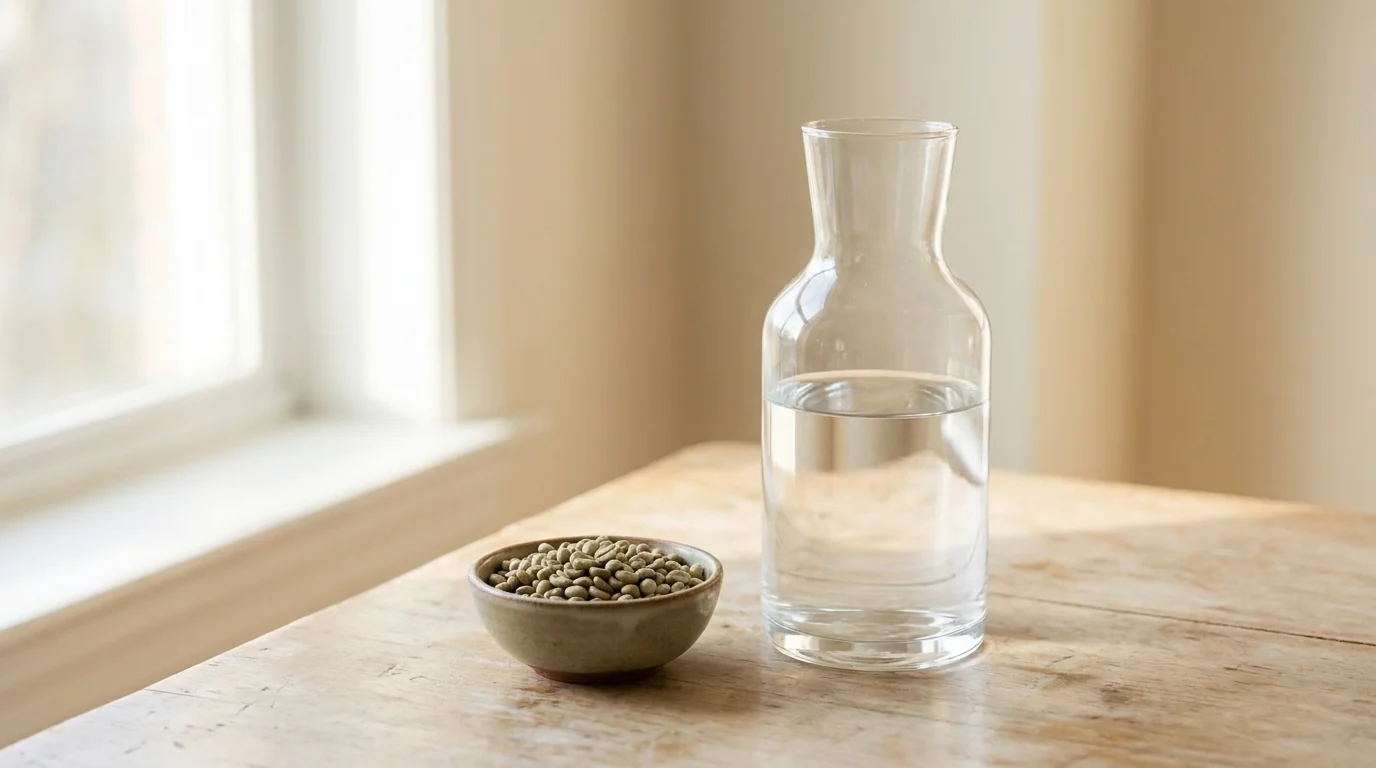
Water is the single largest ingredient in coffee, and the mineral content of your brewing water matters more than most people realise. It's a variable that outranks brewer choice, grind consistency, or bean freshness in some cases — bad water can make excellent beans taste mediocre, and good water can elevate mediocre beans significantly. Yet it's the variable most home brewers never consider.
98-99% water
brewed coffee is almost entirely water — the water's mineral content shapes what ends up dissolved[1]
~150 mg/L TDS
SCA target for total dissolved solids in brewing water — most tap water is either well above or well below[2]
Ca + Mg
calcium and magnesium are the minerals that actively participate in flavour extraction from coffee grounds[1]
Why water matters so much
Coffee extraction is a chemistry problem. Water dissolves specific compounds out of coffee grounds — acids, sugars, oils, bitter compounds. But water isn't just a passive solvent. The minerals dissolved in the water actively participate in extraction.
Two key mechanisms:
Positively-charged ions (calcium, magnesium) bond to flavour compounds. Calcium and magnesium ions bind to specific coffee flavour compounds, pulling them into solution more effectively than pure water would. Extraction of desirable flavour compounds — particularly aromatic compounds and some acids — depends on adequate mineral content in the brewing water[1].
Buffering capacity (bicarbonate) neutralises acidity. Bicarbonate ions (from limestone dissolved in groundwater, or from added baking soda) buffer against pH changes. In brewing water, moderate bicarbonate softens the perceived acidity of coffee; excessive bicarbonate makes coffee taste flat and muted.
Practical implications:
- Water with no minerals (distilled, RO) extracts poorly — coffee tastes thin, hollow, sour.
- Water with too many minerals extracts everything — including harsh bitter compounds — and leaves scale in your equipment.
- Water with the right mineral balance produces the fullest, most balanced extraction of desirable flavour compounds.
The SCA water standard
The Specialty Coffee Association (SCA) publishes water standards developed with the Barista Guild and industry researchers. The core targets for brewing water[2]:
- Total Dissolved Solids (TDS): 75-250 mg/L, target 150.
- Calcium hardness: 17-85 mg/L as CaCO₃, target 51-68.
- Total alkalinity: 40-75 mg/L as CaCO₃, target 40.
- pH: 6.5-7.5, target 7.0 (neutral).
- Chlorine: 0 mg/L (any detectable amount is too much).
- Sodium: 10 mg/L max.
- Odour: clean, no scent.
These numbers matter less as prescriptions and more as targets for understanding what "good brewing water" looks like:
- Not too pure (needs minerals to extract properly).
- Not too hard (excess minerals mute flavour and produce scale).
- Buffered but not too buffered (bicarbonate softens acidity; too much makes coffee flat).
- Free of chlorine and off-odours (they come through in the cup).
Figure
Total dissolved solids across common brewing water sources
Values in mg/L TDS
What's in your tap water
Most municipal tap water in North America falls into one of these general patterns:
Soft municipal water
Soft municipal water (Vancouver, Seattle, much of the Pacific Northwest): naturally low mineral content, often close to ideal for coffee. Usually just needs a carbon filter for chlorine removal.
Hard municipal water
Hard municipal water (much of the Midwest, US Southwest, southern Ontario, Alberta): high calcium and magnesium, often above 300 mg/L TDS. Extracts too aggressively; produces scale in equipment. May need softening or dilution with RO water.
High-alkalinity water
High-alkalinity water (many groundwater-fed systems): lots of bicarbonate. Coffee tastes flat and muted. Hard to fix without RO + remineralisation.
Chlorinated water
Chlorinated water (most municipal systems): active chlorine or chloramines added for disinfection. Comes through in coffee flavour. Removed by activated carbon filters (Brita, ZeroWater, etc.).
Softened water
Softened water (home water softeners): calcium and magnesium replaced with sodium. Terrible for coffee — high sodium ruins the flavour and doesn't extract properly. Never brew coffee with softener output; bypass to unsoftened tap or use a separate source.
How to know what you have: your municipal water utility publishes an annual water quality report (search your city
- "water quality report"). Or use a TDS meter ($15-30 on Amazon) to measure total dissolved solids at your tap.
Common solutions
Approach 1: Filter your tap water
Approach 1: Filter your tap water.
- Basic activated carbon filter (Brita, ZeroWater) removes chlorine, chloramines, and some heavy metals.
- Doesn't remove minerals — TDS stays about the same.
- Good enough if your tap water is naturally within range; not enough if it's too hard.
Approach 2: Buy bottled water
Approach 2: Buy bottled water.
- Some bottled waters are ideal for coffee (Volvic, Highland Spring, Poland Spring in the right range).
- Others are terrible (very hard mineral waters, seltzer, distilled).
- Check the label: TDS in the target range (75-250 mg/L), moderate mineral content, low sodium.
- Expensive at scale.
Approach 3: Start pure and add minerals
Approach 3: Start with pure water and add minerals. This is the specialty-coffee-community solution and produces the most consistent results:
- Third Wave Water — commercial product, small mineral- content packets you add to a specific volume of distilled or RO water. Available in "classic" and "espresso" formulations. About $0.50 per gallon.
- Homemade recipe — dissolve specific amounts of magnesium sulfate (epsom salt) and sodium bicarbonate (baking soda) into distilled water. Recipes vary; a common starting point: 0.5 g epsom salt + 0.3 g baking soda per gallon of distilled water. Costs pennies per gallon.
Approach 4: Home RO + remineralisation
Approach 4: Home reverse osmosis + remineralisation.
- Install an RO system under your sink.
- Configure a remineralisation cartridge downstream (adds controlled calcium/magnesium back to the RO water).
- Higher upfront cost but essentially unlimited perfect brewing water at low ongoing cost.
Third Wave Water and similar
Third Wave Water is the reference commercial solution. It's a small packet of dry mineral salts that you dissolve into a gallon of distilled water. The formulation is designed to hit SCA target water composition.
Variants:
- Classic — general brewing water for filter methods.
- Espresso — different mineral balance more suited to espresso brewing.
Similar products exist (Aquacode, various homemade recipes published by specialty roasters). They all work on the same principle: distilled water is a blank canvas; controlled minerals turn it into ideal coffee water.
Water hardness is also what sets how fast a machine scales, and therefore how often it needs descaling.
 Mineral packets for distilled waterThird Wave Water Classic Light Roast For Brewing The Best Coffee, Classic Profile, 12 Single Gallon Sticks, As Seen On Shark TankBrewing water is a reagent, not a solvent: magnesium and calcium are what bind to the flavour compounds being extracted, and bicarbonate buffers the acids. These packets let you build water to a known mineral profile from distilled, which is the only way to take water out of the variables when something tastes off.amazon.com $18.00 USDamazon.ca $24.71 CADPrice and availability as of View on Amazon
Product prices and availability are accurate as of the date/time indicated and are subject to change. Any price and availability information displayed on Amazon at the time of purchase will apply to the purchase of this product. Certain content that appears on this site comes from Amazon. This content is provided ‘as is’ and is subject to change or removal at any time.
The homemade recipe
If you want the DIY approach, a widely-used starting recipe called the "Rao/Perger formula" or "Third Wave-like" is:
Per gallon (3.78 L) of distilled water:
- 0.5 g magnesium sulfate heptahydrate (epsom salt)
- 0.3 g sodium bicarbonate (baking soda)
Dissolve fully, use immediately or refrigerate.
Notes:
- Magnesium is often preferred to calcium in coffee-water recipes — it participates in extraction similarly but contributes less to scale.
- Sodium bicarbonate provides mild buffering without over- buffering.
- Precision matters — a 0.1 g scale ($10-15 on Amazon) is worth having if you make coffee water at home regularly.
Alternative recipes (Melo, Pieter, various baristas) vary slightly but all target similar composition: moderate mineral content, moderate buffering, mostly magnesium rather than calcium.
What water changes and what it doesn't
Water quality affects:
- Extraction efficiency (how much flavour comes out of the same grounds).
- Flavour balance (bright vs muted, sweet vs bitter).
- Body and mouthfeel.
- Equipment lifespan (scale buildup in kettles, espresso boilers).
- Scale on the surface of finished coffee.
Water quality doesn't fix:
- Bad grinder (uneven particles — see Burr vs Blade Grinder).
- Stale beans.
- Wrong grind size for the brewing method.
- Bad brewing technique.
Water is one variable in a stack of variables. Getting it right can meaningfully improve coffee; getting the other variables wrong first will make water changes hard to detect.
Practical priority order
If you're improving your coffee, the order that gives most benefit:
- Fresh, high-quality beans — nothing rescues stale or bad beans.
- Burr grinder — grind consistency is foundational.
- Correct brewing method for your bean and taste preference — matching brewer to bean matters.
- Water within the SCA range — the last major variable.
- Kettle, technique, refinements — incremental optimisations.
Water is item 4 not item 1 because you can make good coffee with tap water and great beans; you can't make good coffee with perfect water and stale beans.
Common misconceptions
- "Distilled water is best for coffee — it's pure." Wrong. Distilled water is a blank canvas that produces thin, hollow coffee without added minerals. Purity isn't the goal; controlled composition is.
- "Bottled water is always better than tap." Depends entirely on which bottled water and your local tap. Some bottled waters (like Fiji or Voss) are actually pretty good; others (like distilled or very-hard mineral waters) are worse than most tap.
- "Softened water is fine for coffee — my house has a softener." No — water softeners replace calcium and magnesium with sodium. Sodium-rich water ruins coffee and doesn't extract properly. Bypass your softener for coffee brewing.
- "Water quality is a minor variable." Coffee is 98-99% water by volume. It's not a minor variable — it's just invisible until you change it and taste the difference.
- "You need a chemistry PhD to understand coffee water." You need to know that pure water is bad, tap water may or may not be OK, and controlled mineral additions to distilled water produce excellent results. That's about it.
Practical rules
Casual coffee drinker:
- Filter your tap water with a basic carbon filter (Brita, Berkey, ZeroWater).
- If your tap water tastes obviously chlorinated or bad, that's your priority fix.
Serious home brewer:
- Test your tap water (utility report or TDS meter).
- If tap water is in the SCA range (75-250 TDS, moderate hardness), filter for chlorine and use it.
- If tap water is out of range, buy distilled or RO water and add minerals (Third Wave Water or homemade recipe).
Espresso enthusiast:
- Consider Third Wave Water Espresso formulation or homemade recipe with slightly higher mineral content.
- Scale prevention matters more with espresso equipment; low-alkalinity water is critical.
Cold brew or cold drip:
- Same water principles apply, though cold water is more forgiving of moderate hardness than hot water.
Never:
- Use softened water for coffee.
- Use pure distilled or RO water without added minerals.
- Brew with heavily chlorinated water — filter first.
The honest summary
Water quality is one of the largest under-appreciated variables in coffee brewing. Coffee is 98-99% water by volume; the mineral content of your brewing water actively participates in flavour extraction. The SCA target of ~150 mg/L TDS with moderate calcium hardness and alkalinity produces the best extraction of most coffees. Most tap water is either well above or below this range; pure distilled or RO water is too low without added minerals. The two practical solutions are filtering tap water (if your municipal water is naturally close to range) or starting with distilled/RO water and adding controlled minerals via Third Wave Water or a homemade recipe. It's an invisible variable until you fix it and taste the difference.
Frequently asked questions
- Why does water matter for coffee?
- Coffee is roughly 98-99% water by volume. The dissolved minerals in your brewing water directly participate in extracting flavour compounds from coffee grounds — some minerals help pull out desirable flavour compounds, others create off-flavours or leave scale in your equipment. Even great beans and perfect technique can produce mediocre coffee with bad brewing water.
- What is the SCA water standard?
- The Specialty Coffee Association (SCA) publishes a target water composition for optimal coffee brewing: total dissolved solids (TDS) around 150 mg/L (acceptable range 75-250), calcium hardness 50-175 mg/L as CaCO₃, and alkalinity 40-75 mg/L as CaCO₃. Water within these ranges extracts coffee flavour effectively without adding off-flavours or excessive scale build-up.
- Is reverse osmosis water good for coffee?
- By itself, no — reverse osmosis water has almost no minerals, and coffee extracted with mineral-free water tastes thin and hollow. Minerals (particularly calcium and magnesium) actively participate in extraction. Reverse osmosis water becomes ideal for coffee when you add controlled minerals to it (either commercial products like Third Wave Water, or homemade recipes with magnesium sulfate and sodium bicarbonate).
- Should I use distilled water for coffee?
- Same answer as reverse osmosis — pure distilled water produces flat, thin coffee. You need mineral content. If you have distilled water available (cheap and available at pharmacies and grocery stores), adding a Third Wave Water packet or a small measured amount of magnesium sulfate + sodium bicarbonate transforms it into excellent brewing water.
- Is my tap water OK for coffee?
- It depends heavily on your local water supply. Some tap water is perfect (soft, moderate mineral content, low chlorine). Some tap water is problematic (very hard, high chlorine, high sodium, or full of scale-forming minerals). A basic water test kit or your municipal water quality report tells you where you stand. If tap water tastes noticeably chlorinated, that flavour comes through in your coffee — a basic carbon filter (Brita) removes chlorine and improves taste immediately.
References
Every factual claim in this article is drawn from the sources below. See the source library for how we grade evidence.
- [1]Mineral Composition and Antioxidant Potential of Coffee Beverages Depending on the Brewing MethodFoods · 2020 · Observational study · Tier 2 · Moderate
- [2]Brewing FundamentalsCoffee Science Foundation · Reference work · Tier 2 · Moderate
- [3]Coffee extraction kinetics in a well mixed systemJournal of Mathematics in Industry · 2016 · Review · Tier 2 · Moderate
- [4]Effects of brew strength, brew yield, and roast on the sensory quality of drip brewed coffeeJournal of Food Science · 2020 · Controlled trial · Tier 2 · Moderate
Related reading
- Brewing ScienceCoffee Extraction Explained: TDS, Solubles, and Yield→
- Brewing ScienceBest Water Temperature for Coffee→
- Brewing ScienceBurr vs Blade Grinder: Which Makes Better Coffee?→
- Brewing ScienceWhat Is Coffee Bloom? CO₂, Degassing, and Why It Matters→
- Brewing ScienceCoffee Cupping: How SCA Sensory Evaluation Works→
- Brewing ScienceCoffee pH Explained: What Acidity Means in the Cup→