Under-Extracted vs Over-Extracted Coffee
By Coffee Studies Editorial·Published July 15, 2026·6 min read
Quick answer
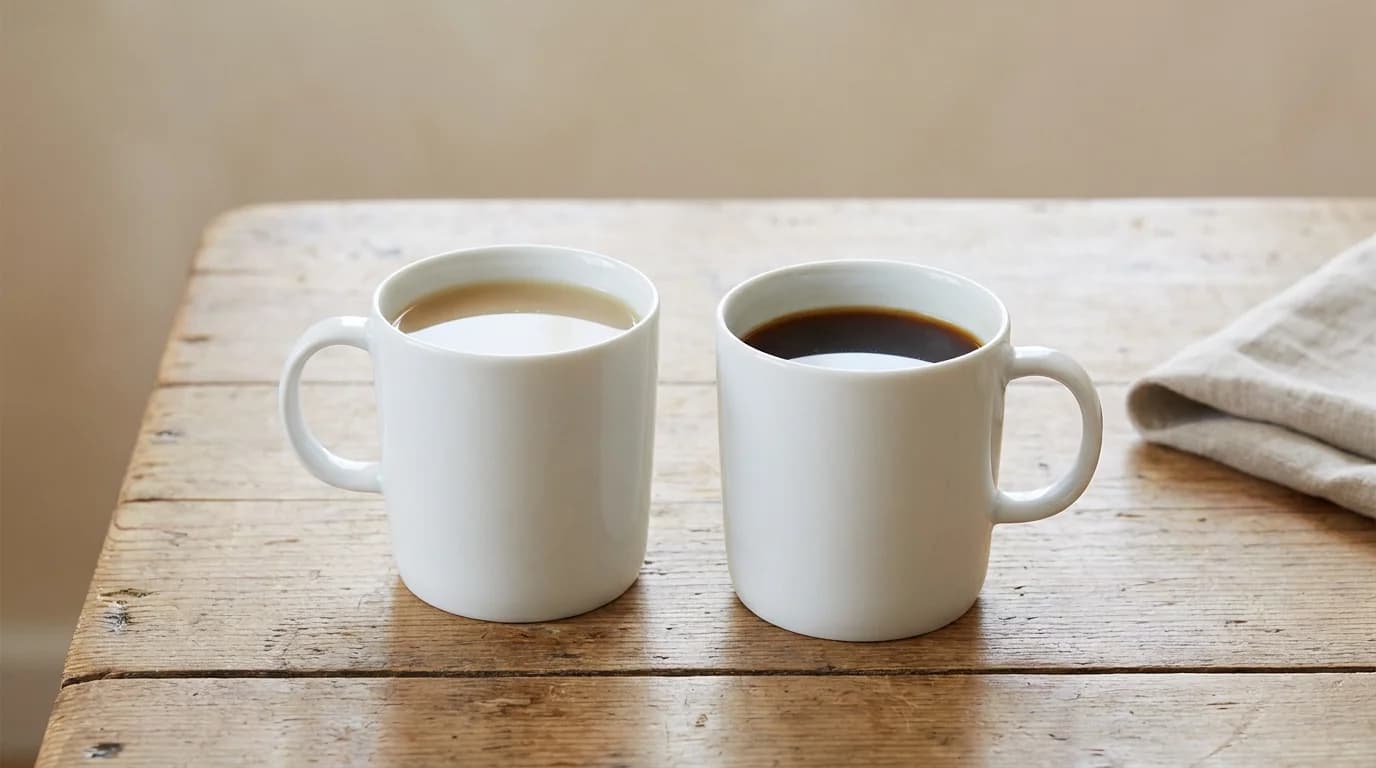
The two most common problems with home-brewed coffee are the same two problems: under-extraction (sour, weak) and over-extraction (bitter, harsh). Both are fixable in seconds once you can recognise them. Learning to identify these two flavour signals is the single most useful skill in home brewing.
Sour = under
under-extracted coffee tastes sour, weak, and thin because you didn't pull out enough soluble compounds[1]
Bitter = over
over-extracted coffee tastes bitter, harsh, and dry because you pulled out compounds that should stay behind[2]
18-22%
the classic 'golden cup' extraction range between the two problem zones[3]
The taste signals
Coffee's flavour is a chemical timeline. Different compounds extract at different rates during brewing, so the flavour of your finished cup reflects which compounds made it into the water.
Under-extracted coffee tastes:
- Sour or sharp — the fast-extracting fruit acids are there, but the sweeter compounds that should balance them aren't
- Thin or watery — low body, low mouthfeel
- Weak — under-developed, quick to swallow
- Salty or vegetal — some early-extracting minerals and vegetables notes without balance
- "Empty" — the cup finishes and you don't remember what you drank
Over-extracted coffee tastes:
- Bitter — the late-extracting bitter compounds have made it in
- Harsh or dry — astringent, chalky, drying mouthfeel
- Ashy — sometimes even acrid, especially with darker roasts
- "Woody" — a common note with dark roasts pushed too far in extraction
- Lingering aftertaste — often unpleasant, coating the tongue
Well-extracted (balanced) coffee tastes:
- Sweet — the middle range of extraction includes caramelised sugars and pleasant sweetness
- Clean — no unpleasant aftertaste
- Full but not heavy
- Complex — you can taste multiple things (fruit, chocolate, nut, spice) without any one dominating
- Satisfying — the cup completes and you want another sip
A 2021 ACS Food Science & Technology study examined titratable acidity, perceived sourness, and liking of drip brewed coffee across different brewing conditions. Sourness is a specific under-extraction indicator, and its relationship to liking is non-linear — some acidity is good, too much isn't[1].
Why some compounds extract early and others late
Coffee contains hundreds of soluble compounds, and they dissolve into water at different rates depending on their molecular structure. A simplified timeline:
First minute (early extraction):
- Fruit acids and citric-type acids
- Some caffeine
- Simple sugars
- Fast-extracting aromatic compounds
Middle extraction:
- Melanoidins (brown pigments, moderate sweetness and bitterness)
- Body compounds
- Balanced flavour development
Late extraction (past ideal):
- Larger, less soluble bitter compounds
- Tannins (astringency)
- Woody, dry, harsh notes
The 2016 Journal of Mathematics in Industry paper on coffee extraction kinetics models this as a rate problem — different compounds have different dissolution rate constants, and the finished cup depends on how far along each is when you stop brewing[4].
The golden cup target of 18-22% extraction lands in the middle of this timeline — you've captured the early and middle compounds without pulling much of the late-extracting bitters.
The fixes
Once you can identify sour or bitter, the fixes are direct.
Under-extraction (sour, weak): pull more out
Three levers, any one of which will help:
- Grind finer — more surface area, faster extraction. Usually the biggest, quickest fix.
- Hotter water — extraction rate scales with temperature. Aim for 92-96°C for hot brewing.
- Longer contact time — slower pour, longer immersion, longer espresso shot.
Change one at a time so you can attribute the improvement.
Over-extraction (bitter, harsh): pull less out
Same levers, reversed:
- Grind coarser — less surface area, slower extraction
- Cooler water — turn off the boil for 30-45 seconds before pouring
- Shorter contact time — faster pour, shorter immersion, shorter espresso shot
Uneven extraction (both sour and bitter): fix the mechanics
If your coffee has both flavours in the same cup:
- Grind uniformity — the problem is usually a blade grinder producing dust and boulders. A cheap burr grinder is a huge upgrade.
- Channeling — water finding a fast path through the coffee bed. Fixed by better puck preparation: even distribution, level tamping (for espresso), gentle central pouring (for pour-over).
- Turbulence — French press pressed too fast, pour-over pushed with too much force. Slower is usually better.
 Scale with a timer, 0.1gMaestri House S2 Espresso Coffee Scale with Timer 0.1g Precision Shot Scale | USB-C Rechargeable, Dual Timing Modes, 2kg/0.1g Digital Scale with Borosilicate Glass Top for Espresso and Pour-Over BrewingDose and ratio are the two variables you can fix for free, and neither is fixable by eye: a scoop of beans varies by several grams depending on bean size and how it was filled. A timer on the same device means you are reading one instrument instead of two.amazon.com $30.39 USDamazon.ca $34.19 CADPrice and availability as of View on Amazon
 Entry-level conical burr grinderBaratza Encore Coffee Grinder ZCG485BLK, Black | Beginner-friendly grinder with powerful motor and 40mm conical steel burrs for consistent, brew-ready performanceThe usual answer to "the cheapest grinder worth owning" for filter coffee. Conical burrs, forty steps, and — the part that matters over years — every wear part is a listed spare, so it is repairable rather than disposable.amazon.com $149.95 USDamazon.ca $199.00 CADPrice and availability as of View on Amazon
Product prices and availability are accurate as of the date/time indicated and are subject to change. Any price and availability information displayed on Amazon at the time of purchase will apply to the purchase of this product. Certain content that appears on this site comes from Amazon. This content is provided ‘as is’ and is subject to change or removal at any time.
Method-specific expressions
Different brewing methods manifest under- and over-extraction differently:
Espresso:
- Under: shot runs fast (< 20 sec), pale crema, sour and thin
- Over: shot runs slow (> 40 sec), dark thin crema, bitter and ashy
- Fix: adjust grind before dose or time
Pour-over:
- Under: total brew time under 2:30, sour and weak
- Over: total brew time over 4:30, bitter and dry
- Fix: adjust grind, then evaluate pour technique
French press:
- Under: rare with 4-min steep unless very coarse grind
- Over: common if left steeping past 5-6 min, or with too-fine grind
- Fix: coarser grind if bitter, longer steep if sour
Cold brew:
- Under: pulled at under 12 hours, weak
- Over: past 24 hours, bitter and heavy
- Fix: 18-hour steep is a solid default; adjust from there
A 2024 Food Chemistry study specifically investigated coffee acidity across eight different brewing methods, providing detailed chemistry that explains why extraction problems manifest differently in different methods[5].
Ratio doesn't fix extraction
The most common mistake home brewers make is trying to fix extraction problems by changing ratio.
- "My coffee is weak, I'll add more coffee" — if the cup tastes sour, adding more coffee at the same wrong grind gives you more sour coffee, not better coffee. Fix the grind first.
- "My coffee is bitter, I'll use less coffee" — if the cup tastes bitter, less coffee at the same wrong grind gives you weaker bitter coffee, not balanced coffee.
Extraction (grind, temperature, time) and strength (ratio) are separate variables — a 2020 Journal of Food Science study explicitly documented that varying them independently produces distinct sensory outcomes[2].
Rules of thumb:
- Bitter → fix extraction, not ratio. Grind coarser first.
- Sour → fix extraction, not ratio. Grind finer first.
- Weak but balanced → increase ratio. More coffee, same grind.
- Strong but balanced → decrease ratio. Less coffee, same grind.
Common misconceptions
- "Weak coffee means I need to grind finer." Only if it also tastes sour. If it tastes balanced but not strong enough, you need more coffee, not finer grind.
- "Bitter coffee means I roasted too dark." Not necessarily. Even light-roast coffee can be bitter if over-extracted; even dark-roast coffee can be balanced if extracted properly.
- "Adding cream fixes over-extraction." It masks bitterness but doesn't fix the problem. If you can only enjoy your coffee with heavy cream, your extraction is probably off.
- "Sour coffee always means bad beans." Sometimes it means under-extracted. Try grinding finer before blaming the beans.
The honest summary
Sour means you under-extracted; bitter means you over-extracted; balanced means you got it right. The fix in both directions is grind, water temperature, and contact time — not ratio. Change one variable at a time in small steps. Learning to hear this signal from your coffee is the single most useful home-brewing skill, and it applies to every method from espresso to cold brew.
Frequently asked questions
- How do I tell if my coffee is under or over-extracted?
- Sour, weak, or thin means under-extracted — you did not pull out enough of the coffee's soluble compounds. Bitter, harsh, dry, or astringent means over-extracted — you pulled out too much, including compounds that produce unpleasant flavours. Balanced coffee is in the middle: sweet, clean, satisfying.
- What causes under-extraction?
- Grind too coarse (not enough surface area), water too cool (slower extraction), or contact time too short (not enough time to dissolve compounds). Espresso running too fast is a common example — under 20 seconds usually means under-extraction.
- What causes over-extraction?
- The opposite: grind too fine (too much surface area, water can extract more too quickly), water too hot (fast, aggressive extraction), or contact time too long. Espresso running over 40 seconds often means over-extraction; French press left steeping too long is another common cause.
- Can coffee be both under and over-extracted?
- Yes — this happens with uneven brewing. If your grind has too much variation (dust and boulders from a blade grinder) or your brewing method has channeling (water finding a fast path through the coffee bed), some coffee over-extracts while other coffee under-extracts in the same cup. You get bitter and sour at once.
References
Every factual claim in this article is drawn from the sources below. See the source library for how we grade evidence.
- [1]Titratable Acidity, Perceived Sourness, and Liking of Acidity in Drip Brewed CoffeeACS Food Science & Technology · 2021 · Controlled trial · Tier 2 · Moderate
- [2]Effects of brew strength, brew yield, and roast on the sensory quality of drip brewed coffeeJournal of Food Science · 2020 · Controlled trial · Tier 2 · Moderate
- [3]Brewing FundamentalsCoffee Science Foundation · Reference work · Tier 2 · Moderate
- [4]Coffee extraction kinetics in a well mixed systemJournal of Mathematics in Industry · 2016 · Review · Tier 2 · Moderate
- [5]Comprehensive investigation of coffee acidity on eight different brewing methodsFood Chemistry · 2024 · Controlled trial · Tier 2 · Moderate
Related reading
- Brewing ScienceCoffee Extraction Explained: TDS, Solubles, and Yield→
- Brewing ScienceCoffee Grind Size Guide: Which Grind for Which Method→
- Brewing ScienceCoffee-to-Water Ratio Explained→
- Brewing ScienceSalt in Coffee: Does It Actually Reduce Bitterness?→
- Brewing ScienceHow Long Does Coffee Last? Freshness and Shelf Life→
- Brewing ScienceLow Acid Coffee: Best Varieties for Sensitive Stomachs→