Salt in Coffee: Does It Actually Reduce Bitterness?
By Coffee Studies Editorial·Published July 18, 2026·5 min read
Quick answer
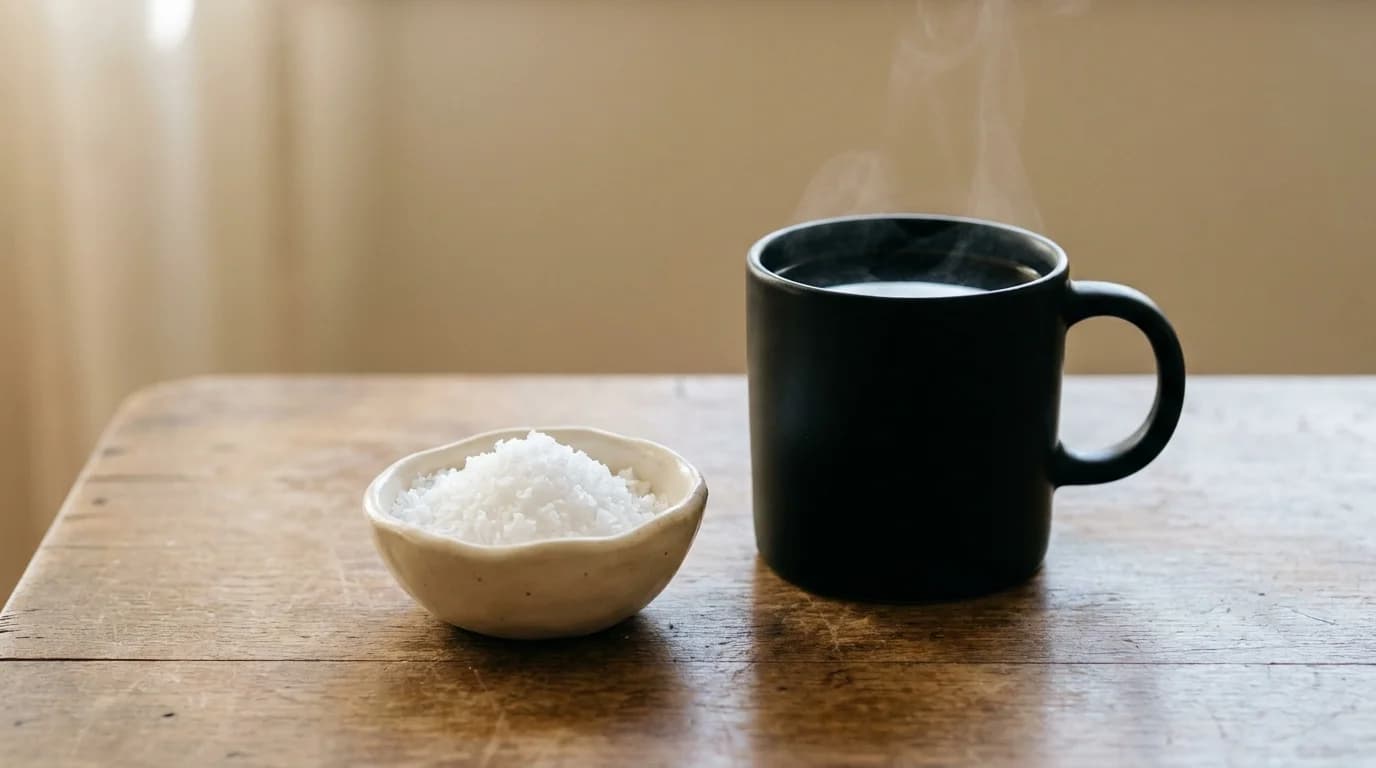
Salt in coffee sounds wrong. Coffee is bitter; salt is salty. Adding one to the other should produce something worse, not better.
It doesn't. A small amount of salt — below the threshold you'd register as salty — measurably reduces the perceived bitterness of coffee. The mechanism is specific and documented. It is not a folk myth.
Sodium suppresses bitterness
sodium ions directly interfere with bitter taste signalling at the receptor level — reducing perceived bitterness without removing bitter compounds from the cup[1]
~1/16 tsp per 6–8 oz
the effective dose is sub-threshold — small enough that you should not taste salt at all, only less bitterness; too much tips the balance and the coffee tastes salty[2]
Works best on bitter coffee
the effect is most noticeable on dark roasts, over-extracted coffee, and low-quality or instant coffee — it is less useful for well-balanced coffee that isn't excessively bitter[1]
The science
Coffee bitterness comes from several compounds:
- Caffeine: a significant bitter contributor (~30% of perceived bitterness in some estimates).
- Quinic acid and caffeic acid: breakdown products of chlorogenic acids during roasting; responsible for the harsh, lingering bitterness of dark roasts and stale coffee.
- Melanoidins: complex brown compounds formed during the Maillard reaction in roasting; contribute body and some bitterness.
- Trigonelline degradation products: bitter compounds formed during roasting[3].
Salt does not remove any of these compounds. What it does is interfere with how the taste receptor cells register them.
In a landmark paper published in Nature, Breslin and Beauchamp demonstrated that sodium ions selectively suppress bitter taste — not by blocking bitter receptors directly, but by interfering with the ion channel signalling pathway that transduces the bitter signal from receptor to nerve. The result is that the same concentration of bitter compounds in solution produces a weaker perception of bitterness in the presence of sodium[1].
The effect is specific to sodium — other cations (potassium, calcium) do not suppress bitterness in the same way. And it is specific to bitterness — sodium does not suppress sour, sweet, or umami taste in the same fashion.
How much to use
The correct amount is sub-threshold: small enough that the coffee does not taste salty. A pinch — roughly 1/16 to 1/8 teaspoon for a 6–8 oz cup — is the practical range.
At this dose, you should notice:
- Less harsh, lingering bitterness
- A slightly rounder, fuller flavour
- No perception of saltiness
If the coffee tastes salty, you have added too much. Back off to a smaller pinch.
When to add it: directly to the dry coffee grounds before brewing, or directly to the brewed cup. Adding to grounds is slightly more uniform; adding to the cup allows adjustment per serving.
What type of salt: regular table salt (sodium chloride) works fine. Flaky sea salt or kosher salt works the same way — the size of the flakes affects how quickly it dissolves, not the mechanism. Avoid iodised salt if you are sensitive to the taste of iodine; in coffee the difference is negligible.
When it helps the most
Salt is most useful for bitter coffee:
Over-extracted coffee: if you ran the extraction too long, ground too fine, or used too-hot water, the result is bitter and astringent. Salt reduces the perception of that bitterness without requiring you to re-brew[2].
Dark roast: dark roasting produces more quinic acid and melanoidins, which are intensely bitter. A pinch of salt takes the edge off without otherwise changing the character.
Low-quality or instant coffee: the single most practical application. Instant coffee, commodity-grade dark roast, stale office coffee — all are improved by a small amount of salt. This is a more reliable rescue than milk or sugar for pure bitterness.
Hard water: water with high mineral content (high calcium and magnesium) can produce a harsh, bitter coffee. Some of this harshness overlaps with the bitterness that sodium suppresses, though the mechanism is different.
When it doesn't help much
Well-made specialty coffee that isn't bitter: if the bitterness in the cup is intentional balance rather than a flaw, salt may flatten rather than improve it. Light-to-medium roast pour-over from quality beans brewed correctly does not need salt and may taste slightly duller with it.
Sour/acidic coffee: salt suppresses bitterness, not sourness. Under-extracted coffee that tastes sour and sharp is not improved by salt — the problem is not bitterness, it is under-extraction. Fix the grind or water ratio instead.
The history
Adding salt to coffee has documented traditional use in several cultures:
Scandinavia: in coastal Norway, Denmark, and parts of Sweden, adding a pinch of salt to coffee was a traditional practice, particularly in rural and fishing communities. The practice is thought to have origins in both the salinity of the water used and deliberate seasoning.
Ethiopia: in some regional Ethiopian coffee traditions, salt, butter, or spices (rather than sugar) are added to coffee. The Guji and parts of Sidama regions have traditions of coffee with salt.
Cowboy coffee: the American tradition of camp coffee — grounds boiled directly in a pot — sometimes included a pinch of salt, historically attributed to helping settle the grounds rather than for bitterness suppression, though the effect is the same.
Modern revival: Alton Brown popularised the practice in the US through his cooking television programme Good Eats and subsequent social media, framing it explicitly as a bitterness-suppression technique. The advice spread widely because it works.
Common misconceptions
- "Salt makes coffee taste salty." At the correct sub-threshold dose, salt does not make coffee taste salty. If it does, you have used too much.
- "Salt is a gimmick with no real effect." The bitterness suppression is chemically documented and perceptually real. It is not placebo.
- "Any salt works the same." Essentially yes — the mechanism is sodium chloride (NaCl). Type of salt (sea salt, kosher, table salt) makes no material difference in the cup.
- "Salt fixes bad coffee." It reduces bitterness — one specific flaw. It does not fix sour coffee, stale coffee, or coffee with off-flavours unrelated to bitterness.
The honest summary
Adding a small pinch of salt — roughly 1/16 to 1/8 teaspoon per 6–8 oz — measurably reduces perceived bitterness in coffee. The mechanism is sodium ions suppressing bitter taste signalling at the receptor level, a documented chemical effect. The correct dose is sub-threshold: you should not taste salt, only a less bitter version of the same cup. The technique is most useful for dark roast, over-extracted, or low-quality coffee. It does not fix sourness, staleness, or other coffee flaws. Traditional use in Scandinavian and Ethiopian coffee culture predates the modern revival; the food science validation is not new.
Frequently asked questions
- Does salt really reduce bitterness in coffee?
- Yes, and the mechanism is well-documented. Sodium ions suppress bitter taste transduction at the receptor level — they directly interfere with the cellular signalling pathway that registers bitter compounds, reducing the perceived intensity of bitterness without removing the bitter compounds from the cup. Research by Breslin and Beauchamp published in Nature demonstrated this sodium-specific bitterness suppression. A small amount of salt (sub-threshold for salty taste) is enough to measurably reduce bitter perception in coffee.
- How much salt should I add to coffee?
- Very little — roughly a pinch, or about 1/16 to 1/8 teaspoon per 6–8 oz of coffee. The goal is a sub-threshold amount that reduces bitter perception without making the coffee taste salty. At the right amount, you should not taste salt at all — you should taste a less bitter version of the same coffee. If the coffee tastes salty, you have used too much. Start with a tiny pinch and adjust.
- Why does salt suppress bitterness?
- Sodium ions appear to act on bitter taste by blocking the signalling pathway in taste receptor cells — specifically interfering with the ion channels involved in transducing bitter taste signals. The result is that the same concentration of bitter compounds in the cup produces a weaker bitter signal at the taste receptor. The effect is specific to sodium (not all salts work equally) and is independent of dilution — the salt doesn't dilute the bitter compounds, it reduces the perception of them.
- Does it work for all coffee?
- Salt has the biggest effect on very bitter coffee — dark roasts, over-extracted coffee, low-quality instant coffee, or stale coffee where bitterness is dominant. For well-balanced specialty coffee that is not excessively bitter, the effect is smaller and may not be noticeable. The technique is most useful as a rescue for coffee that has gone wrong (over-extraction, poor quality) rather than as a routine addition to well-made coffee.
- Is adding salt to coffee traditional anywhere?
- Yes. Adding salt to coffee has historical roots in several cultures. In parts of Scandinavia and Northern Europe, salt was added to coffee as a matter of course — particularly in coastal communities. In some Ethiopian coffee ceremony traditions, salt or butter is added. Cowboy coffee and camp coffee made with boiling grounds sometimes included a pinch of salt. The modern revival of the practice in the US was popularised by Alton Brown on his cooking television programme Good Eats.
References
Every factual claim in this article is drawn from the sources below. See the source library for how we grade evidence.
- [1]Sodium ions selectively suppress bitter tasteNature (Breslin & Beauchamp) · 1997 · Controlled trial · Tier 2 · Moderate
- [2]Brewing FundamentalsCoffee Science Foundation · Reference work · Tier 2 · Moderate
- [3]Coffee chlorogenic acids: a reviewPMC / NIH · 2022 · Review · Tier 2 · Moderate
Related reading
- Brewing ScienceCoffee Acidity: pH, Sourness, and What Affects It→
- Brewing ScienceUnder-Extracted vs Over-Extracted Coffee→
- Instant & Decaf CoffeeHow to Make Instant Coffee Taste Better→
- Brewing ScienceCoffee Grind Size Guide: Which Grind for Which Method→
- Brewing ScienceWhy Is Coffee Bitter? The Chemistry of Coffee Bitterness→
- Brewing ScienceWhat Is Coffee Bloom? CO₂, Degassing, and Why It Matters→