Low Acid Coffee: Best Varieties for Sensitive Stomachs
By Coffee Studies Editorial·Published July 18, 2026·7 min read
Quick answer
Not all coffee is equally acidic, and the difference matters to a significant number of drinkers. Coffee's acidity comes from a specific set of compounds — not from a single dial you can turn — and understanding which factors raise or lower it tells you exactly what to choose if your stomach, your teeth, or your palate prefers a gentler cup.
Dark roast → lower acid
roasting degrades chlorogenic acids and organic acids — the darker the roast, the lower the titratable acidity; this is the single biggest variable you control at purchase[1]
Cold brew: ~67% of hot's acidity
cold water extracts organic acids far less efficiently than hot water — cold brew is measurably and significantly less acidic than drip coffee from the same beans[3]
Altitude matters
high-altitude origins (Ethiopia, Kenya, Colombia highlands) develop more organic acids; low-altitude origins (Brazil, Sumatra, Uganda) start with fewer — a difference that survives roasting[4]
What makes coffee acidic
Coffee contains dozens of organic acids. The dominant ones that contribute to perceived acidity are:
- Chlorogenic acids — the most abundant, present at 6–10% dry weight in green beans; they degrade during roasting into quinic acid and caffeic acid, both of which are bitter rather than sour.
- Quinic acid — a degradation product of roasting; bitter and astringent, associated with stale or over-extracted coffee more than with sourness.
- Malic acid — associated with apple/stone fruit sourness; higher in high-altitude arabica.
- Citric acid — bright, sharp acidity; highest in certain East African coffees.
- Acetic acid — vinegar character; can be desirable in small amounts in fermented/natural process coffees, unpleasant in larger amounts.
- Lactic acid — smooth, creamy sourness; often appears in fermented coffees.
When you taste "brightness" in a specialty light roast, you're tasting primarily malic and citric acid in balance. When coffee tastes "harsh" or "sour" in a less flattering way, you're often tasting excess acetic or quinic acid[2].
The four factors that reduce acidity
1. Roast level
Roasting is the most powerful lever. As green coffee is heated through 200–240 °C, chlorogenic acids degrade rapidly — a medium roast retains roughly 50% of green bean chlorogenic acids; a dark roast may retain as little as 10–20%. Citric and malic acids also degrade at high roast temperatures[1].
Figure
Relative titratable acidity by roast level (same origin)
Values in relative index (light roast = 100)
The tradeoff: dark roasting destroys the aromatic compounds, sweetness, and origin character that specialty roasters prize. The fruity complexity of an Ethiopian light roast is gone in a dark roast of the same coffee. For acid-sensitive drinkers, this is often the right tradeoff.
2. Coffee origin and altitude
High-altitude arabica coffees — Ethiopia (1,800–2,200 m), Kenya (1,500–2,100 m), Colombia highlands (1,500–2,000 m) — develop higher concentrations of organic acids (particularly malic and citric) than low-altitude coffees. This is a function of slower bean maturation in cooler temperatures, which allows more complex acid development.
Low-altitude origins are inherently lower in acid:
- Brazil (most at 800–1,200 m): mild, low-acid profile, naturally sweet, nut and chocolate notes.
- Sumatra (1,000–1,500 m, wet-hulled): earthy, low-acid, heavy body — the wet-hulling process (giling basah) also reduces acidity.
- India — Monsooned Malabar: exposed to monsoon humidity for months before export, which drives off most organic acids; among the lowest-acid coffees available.
- Robusta in general: lower in organic acids than arabica; higher in bitterness from chlorogenic acids and caffeine, but less of the bright sour character[4].
3. Brew method
Cold brew is the single biggest brew-method variable for acidity. Cold water extracts organic acids far less efficiently than hot water — not because it extracts nothing, but because the kinetics of acid extraction are temperature-dependent[3].
Figure
Titratable acidity by brew method (same coffee, same dose)
Values in relative index (drip = 100)
Among hot brew methods, differences are smaller. Espresso and AeroPress extract over shorter times, which can reduce some organic acid extraction compared to long-contact French press or drip. But the differences between hot methods are modest compared to the hot-vs-cold distinction.
4. Processing method
Wet (washed) processing — where the coffee cherry's fruit is removed before drying — tends to produce a cleaner, brighter acid profile. Natural processing (dried with fruit intact) can introduce acetic acid from fermentation, which some find harsh[4].
For lowest acidity, wet-processed or wet-hulled (Sumatran giling basah) coffees are the better choice. However, processing effects are smaller than roast or brew method effects.
Stacking low-acid factors
The lowest-acid cup combines multiple factors:
| Factor | High-acid choice | Low-acid choice |
|---|---|---|
| Origin | Ethiopia, Kenya, Rwanda | Brazil, Sumatra, India, Uganda |
| Altitude | 1,800–2,200 m | 600–1,200 m |
| Processing | Natural / honey | Washed / wet-hulled |
| Roast | Light | Dark |
| Brew method | Drip / pour-over (hot) | Cold brew |
| Additives | Black | With dairy or plant milk |
A dark-roasted Sumatran or Brazilian coffee made as cold brew, with a splash of whole milk, is the practical floor for coffee acidity. Each step down the table multiplies the effect[5].
Low-acid coffee brands and products
Several brands specifically market low-acid coffee, typically using some combination of:
- Low-altitude origin beans (Brazil, Sumatra, low-grown Central America)
- Dark or medium-dark roast
- Steam or acid-reduction treatment (some brands use steam to further neutralise acids in green beans)
- Cold brew concentrate formats
Common low-acid products include Puroast, Lucy Jo's, Lifeboost, and similar. Most supermarket dark-roast blends (e.g., dark Arabica or Robusta blends) also qualify as low-acid without the premium marketing. The least expensive low-acid option is often a standard dark-roast grocery brand — its low price reflects the economics of dark roasting, not lower quality in the acid-reduction sense.
Measured pH is the number people reach for here and it is not the one that matters most, which is worth understanding before paying a premium for it: coffee pH explained.
 Marketed low-acid, dark roastPuroast Low Acid Organic Ground Coffee, French Roast, 12 oz | USDA Organic, Low Acid Organic Ground Coffee, Full Caffeine, Time-Honored Roasting. 5X Less Acid, 5X AntioxidantsThe brand the category is usually named after. Worth reading alongside the section above rather than instead of it: the roast level is doing most of the work here, and a supermarket dark roast gets you much of the same effect without the premium. Buy this if you want it decided for you.amazon.com $23.20 USDnot sold on amazon.caPrice and availability as of View on Amazon
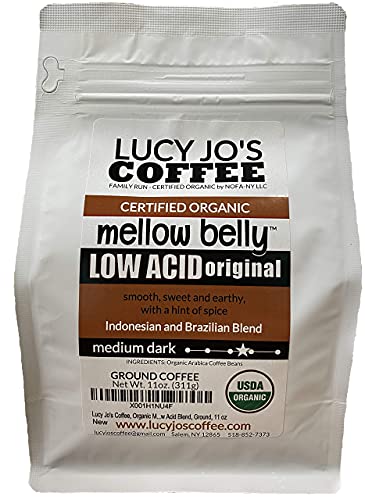 Marketed low-acid, medium roastLucy Jo's Coffee Roastery, Organic Mellow Belly Low Acid Blend, Medium Dark, Ground, 11 oz (11 OZ)The more interesting of the two, because a medium roast claiming low acid is making a sourcing claim rather than a roasting one. Treat the claim as the roaster's own, not as a measurement anybody has published.amazon.com $17.39 USDnot sold on amazon.caPrice and availability as of View on Amazon
Product prices and availability are accurate as of the date/time indicated and are subject to change. Any price and availability information displayed on Amazon at the time of purchase will apply to the purchase of this product. Certain content that appears on this site comes from Amazon. This content is provided ‘as is’ and is subject to change or removal at any time.
Adding milk: a practical buffer
Adding dairy or plant milk raises coffee's pH modestly and binds some acidic compounds. This is a simple, effective intervention for acid-sensitive drinkers who prefer not to switch beans or brew method entirely[2].
Whole milk provides the strongest buffering due to higher protein content. Among plant milks, oat milk and almond milk provide mild buffering; soy milk is somewhat stronger. The effect is real but not transformative — if black dark-roast cold brew still bothers you, milk can help; it cannot rescue a bright light-roast drip coffee for a very acid-sensitive stomach.
For acid reflux specifically
Coffee's relationship with acid reflux (GERD) is more complex than just pH. The stomach acid stimulation triggered by coffee — via gastrin release and direct action on parietal cells — matters more than coffee's own acidity in most cases. A very low-pH coffee does not necessarily trigger more reflux than a higher-pH one; the stomach's response to coffee compounds is the primary factor, not coffee's measurable acidity[5].
That said, cold brew and dark roast are empirically better tolerated by many people with acid sensitivity and GERD — this is consistent with both the reduced acid content and the reduced gastric stimulation associated with dark roast and cold brew preparations.
See Coffee and Acid Reflux for the reflux-specific evidence.
Common misconceptions
- "Low acid coffee has no acid." Coffee always contains organic acids — "low acid" means measurably less than average, not zero. The pH of cold brew is typically 5.0–5.5, which is still acidic (neutral is 7.0).
- "Expensive low-acid brands are the only option." Any dark-roast Brazilian or Sumatran coffee, brewed as cold brew, achieves similar results. Premium "low-acid" marketing often describes effects achievable with standard dark-roast beans.
- "Light roast is lower in acid because it's roasted less." The opposite is true — less roasting preserves more of the green bean's organic acids. Dark roast has lower acid.
- "Espresso is lower in acid because it's concentrated." Espresso uses less total water, but it uses very hot water under pressure with extended contact — it is not significantly lower in titratable acidity than drip coffee, and may be higher in some compounds.
The honest summary
The least acidic coffee comes from stacking several factors: low-altitude origin (Brazil, Sumatra, India), dark roast (which destroys organic acids during roasting), cold brew preparation (which extracts far fewer acids than hot water), and optionally adding dairy or plant milk (which buffers pH). No single factor alone transforms a high-acid coffee into a low-acid one — but cold brew from a dark-roasted low-altitude bean is the practical floor. Commercial "low-acid" coffee brands typically rely on the same combination of origin and roast. For acid reflux, dark roast and cold brew are the most consistently better-tolerated options, though coffee's effect on the stomach involves more than just its measurable pH.
Frequently asked questions
- What coffee has the least acid?
- The least acidic coffee comes from combining multiple low-acid factors: dark roast (which destroys chlorogenic acids and their breakdown products during roasting), low-altitude origins like Brazil, Sumatra, or Uganda (whose beans naturally contain fewer organic acids), and cold brew preparation (which extracts far fewer acidic compounds than hot water). A dark-roasted Brazilian or Sumatran coffee brewed as cold brew is about as low-acid as coffee gets. Many brands market 'low acid' coffee specifically — these typically use a combination of dark roast, low-altitude beans, and sometimes steam treatment.
- Is dark roast lower in acid than light roast?
- Yes, measurably. Roasting degrades chlorogenic acids — the primary acidic compounds in coffee — and destroys some of the organic acids (malic, citric, acetic) that contribute to perceived sourness. The longer and hotter the roast, the more acids are destroyed. A dark roast can have significantly lower titratable acidity than a light roast from the same green coffee. The tradeoff: dark roasting also destroys many of the aromatic compounds that specialty roasters prize.
- Is cold brew lower in acid than hot coffee?
- Yes, significantly. Cold water extraction (cold brew) produces coffee with lower titratable acidity and lower concentrations of acidic compounds than hot water extraction, because cold water extracts organic acids less efficiently than hot water. Studies have measured cold brew at approximately 67% of the titratable acidity of hot drip coffee made from the same beans. This is a real, measurable difference — not a marketing claim.
- Which coffee origins are lowest in acid?
- Low-altitude origins (below 1,200 m) produce lower-acid coffee because the beans develop fewer organic acids at warmer temperatures. The most reliably low-acid origins: Brazil (most production at 800–1,200 m, wet- or natural-processed, mild acidity), Sumatra (1,000–1,500 m, often wet-hulled/giling basah processed, earthy low-acid profile), Uganda (primarily robusta, very low acid), and India (Monsooned Malabar in particular, a uniquely low-acid processed coffee). Ethiopian and Kenyan coffees at 1,800–2,200 m are among the most acidic.
- Does adding milk reduce coffee acidity?
- Yes, in two ways. Milk raises the pH of coffee slightly (buffering effect) and the proteins in milk bind some acidic compounds. Whole milk has a stronger buffering effect than skimmed milk due to its higher protein content. Plant milks vary — oat milk and almond milk have a mild buffering effect; soy milk is somewhat stronger. The reduction in perceived acidity is real but modest — adding milk makes coffee gentler on the stomach, but it does not transform a highly acidic coffee into a low-acid one.
- What is Monsooned Malabar coffee?
- Monsooned Malabar is an Indian coffee from the Malabar Coast (Karnataka/Kerala) that is exposed to monsoon humidity for 12–16 weeks before being shipped. The process swells the green beans, drives off much of their acidity, and produces a coffee with a uniquely low-acid, heavy-bodied, musty-earthy character. It was originally an accidental effect of the long sea voyage around Africa in sailing ships; now it is deliberately reproduced. It is one of the lowest-acid coffees in the world.
References
Every factual claim in this article is drawn from the sources below. See the source library for how we grade evidence.
- [1]Comprehensive investigation of coffee acidity on eight different brewing methodsFood Chemistry · 2024 · Controlled trial · Tier 2 · Moderate
- [2]Titratable Acidity, Perceived Sourness, and Liking of Acidity in Drip Brewed CoffeeACS Food Science & Technology · 2021 · Controlled trial · Tier 2 · Moderate
- [3]Acidity and Antioxidant Activity of Cold Brew CoffeeScientific Reports · 2018 · Controlled trial · Tier 2 · Moderate
- [4]Physiochemical Characteristics of Hot and Cold Brew Coffee Chemistry: The Effects of Roast Level and Brewing Temperature on Compound ExtractionFoods · 2020 · Controlled trial · Tier 2 · Moderate
- [5]Measurement of the Intracellular pH in Human Stomach Cells: Gastric Acid Secretory Potential of Coffee BeveragesJournal of Agricultural and Food Chemistry · 2010 · Observational study · Tier 2 · Moderate
Related reading
- Brewing ScienceCoffee Acidity: pH, Sourness, and What Affects It→
- Caffeine & HealthCoffee and Acid Reflux: What Actually Causes It→
- Brew MethodsCold Brew Coffee Guide: Ratios, Steep Time, Technique→
- Beans, Roasts & OriginsLight vs Medium vs Dark Roast: Flavour, Caffeine, Facts→
- Beans, Roasts & OriginsCoffee Processing Methods Explained→
- Brewing ScienceWater for Coffee: TDS, Minerals, and Why It Matters→