Your First Espresso Machine: The One Rule and Three Honest Starts
By Coffee Studies Editorial·Published October 17, 2026·6 min read
Quick answer
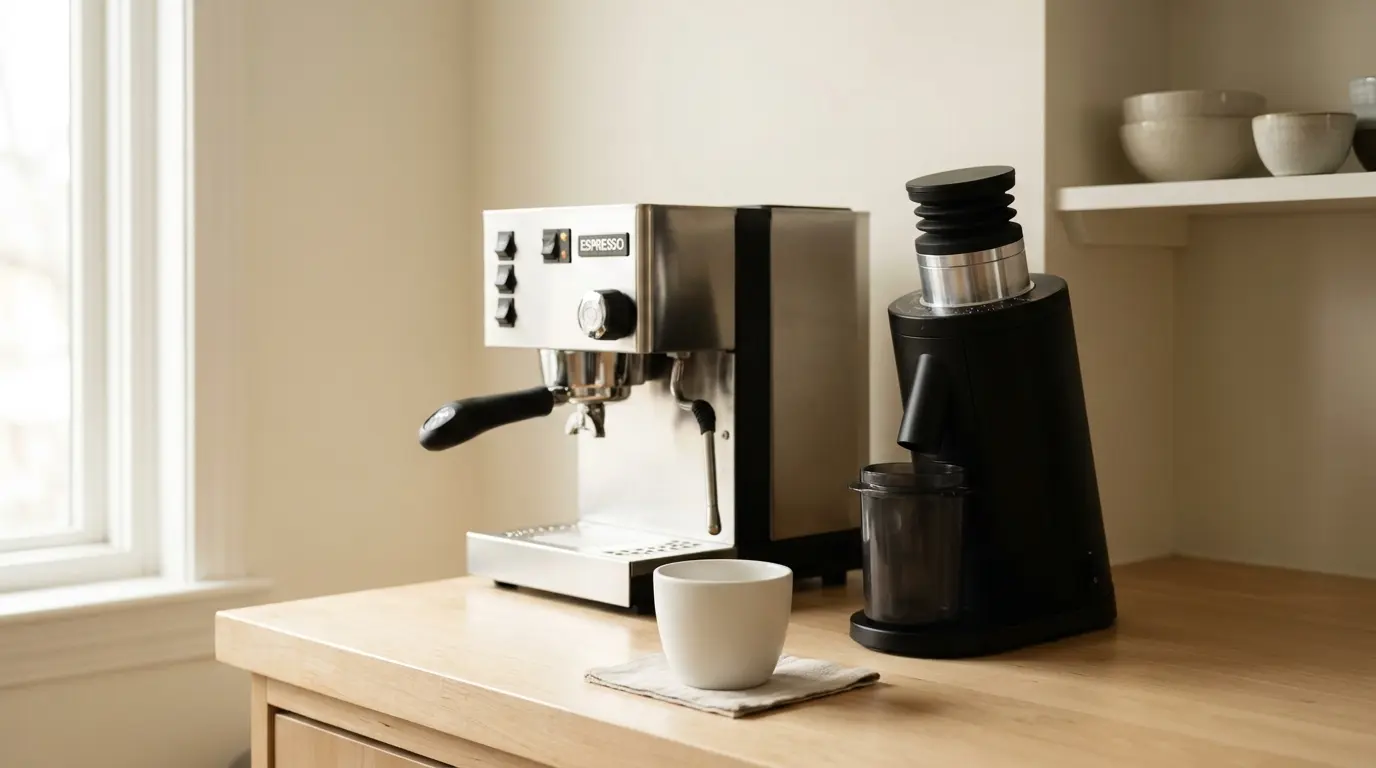
Choosing a first espresso machine feels like choosing between models. It is not. The decision that shapes your results is how you split the money, and the decision that shapes your enjoyment is what kind of learner you are. Models come third, and by then they almost choose themselves.
The rule: grinder first
Espresso is coffee forced through a compacted bed at around nine bar of pressure. For that to work, the grind has to be fine enough and even enough to resist the water for twenty-five seconds without either blocking solid or letting it rush through.
Grind particle distribution affects extraction more than any machine variable[1], which is why a good grinder with a modest machine beats a good machine with a weak grinder every time. Blade grinders chop rather than mill and cannot produce the distribution espresso needs. Most grinders sold for drip coffee cannot go fine enough, or cannot hold a setting once they do.
So budget as a whole: a third to a half of your total on grinding. Someone with a thousand dollars is better served by a five hundred dollar machine and a five hundred dollar grinder than by an eight hundred dollar machine and a two hundred dollar grinder. The tiers are set out in how much to spend on a coffee grinder.
If space or money forces one compromise, a hand grinder costs little, takes almost no counter and out-grinds most built-in units. It costs you a minute of turning per shot.
Then pick by temperament
If you want a drink, not a hobby. Buy a machine that removes variables: a built-in grinder, assisted or automatic tamping, automatic milk. You will make a decent flat white in week one and you will never learn what changed when something goes wrong, which is a fair trade if you did not want to know. The Breville line is built around exactly this and the models differ less than they look, as set out in Breville espresso machines compared.
If you want to learn espresso. Buy a single boiler with a 58 mm commercial group and a real steam wand, and accept a few weeks of bad shots. The Gaggia Classic Evo Pro is the cheapest machine where that sentence is true. Nothing is hidden from you, every error is legible, and the parts are replaceable for a decade.
If you are impatient and short on space. A compact thermoblock machine is ready in seconds and fits anywhere, with weaker steam as the trade. The options by width are in compact espresso machines.
A first setup, three ways
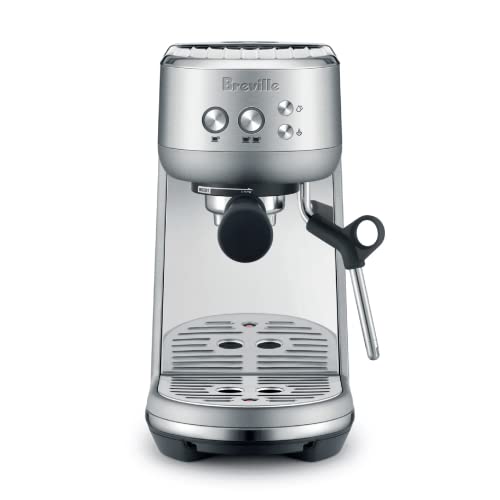 No grinder, manual steam wandBreville BES450BSS Bambino Espresso Machine, Brushed Stainless Steel | Make café-quality espresso, lattes and cappuccinos at home with this compact, manual coffee maker | Beginner-friendlyThe entry point, and the one that assumes you already own a grinder. Heats in a few seconds rather than minutes because it heats water on demand instead of keeping a boiler hot. You texture the milk yourself.amazon.com $299.95 USDamazon.ca $449.99 CADPrice and availability as of View on Amazon
 Single boiler, 58 mm, stainless boilerGaggia RI9380/51 Classic Evo Pro Espresso Machine, Industrial Grey, SmallA small commercial machine at a consumer price: a 58 mm group, a three-way solenoid and a real steam wand on a boiler. The Evo Pro ships at nine bar with a stainless boiler. No temperature control, so plan on timing the shot or adding a PID, and budget for a grinder.amazon.com $529.99 USDamazon.ca $733.15 CADPrice and availability as of View on Amazon
 Entry-level conical burr grinderBaratza Encore Coffee Grinder ZCG485BLK, Black | Beginner-friendly grinder with powerful motor and 40mm conical steel burrs for consistent, brew-ready performanceThe usual answer to "the cheapest grinder worth owning" for filter coffee. Conical burrs, forty steps, and — the part that matters over years — every wear part is a listed spare, so it is repairable rather than disposable.amazon.com $149.95 USDamazon.ca $199.00 CADPrice and availability as of View on Amazon
 Single boiler, large brass boilerRancilio Silvia Espresso Machine, Stainless SteelThe heavier single boiler: a 0.3 litre brass boiler, an iron frame and the same 58 mm commercial group, built from parts a technician will still be fitting in fifteen years. Wants a PID and steams after the shot, not during it.amazon.com $995.00 USDamazon.ca —Price and availability as of View on Amazon
Product prices and availability are accurate as of the date/time indicated and are subject to change. Any price and availability information displayed on Amazon at the time of purchase will apply to the purchase of this product. Certain content that appears on this site comes from Amazon. This content is provided ‘as is’ and is subject to change or removal at any time.
What not to buy first
A machine with a pressurised basket. Below roughly two hundred dollars, machines use a basket with a restricting valve that whips up crema artificially regardless of what the coffee is doing. It cannot teach you anything, because every shot looks the same leaving the spout. If that is the budget, a moka pot or an AeroPress will give you better coffee and cost a tenth as much.
A capsule machine, if espresso is the goal. It is a fine drink and a completely different hobby, with no grind, no dose and no variables.
The most expensive machine you can afford. A prosumer heat exchanger as a first machine is not wrong, but it will not make better espresso than a Gaggia until you can already pull a decent shot, and the money is better placed in the grinder at the start.
A used machine with no history, unless you are comfortable replacing gaskets and descaling something that may be badly scaled. The exception is a machine from a dealer who has serviced it.
What the first weeks actually look like
Expect bad shots. Not a few, a run of them. The variables are grind size, dose, distribution and tamp, and they interact, so changing two at once teaches you nothing.
Change one thing at a time, weigh the dose rather than eyeballing it, and use fresh coffee with a roast date on the bag, because stale beans move the target while you are aiming at it. Pressure at the puck is fixed by the machine[3], which means everything else that varies is in your hands, and that is the point of learning on a transparent machine.
A reasonable target is a double shot running somewhere around twenty-five to thirty seconds and tasting balanced rather than sour or harsh. The shot clock matters less than the taste; the numbers are a guide to get you close[2].
What you will outgrow
The grinder, if you economised there. It is the first ceiling you hit and the most frustrating, because it limits what every other improvement can do.
The waiting, if you bought a single boiler and make several milk drinks in a row. That is what pushes people to a heat exchanger or a dual boiler, and the difference between those designs is laid out in dual boiler vs heat exchanger.
Rarely the brew group. On a decent first machine the group will still be making good espresso long after you have replaced everything around it, which is why the design of the machine matters more than its brand.
Common misconceptions
"More expensive machines make better espresso." Above a basic standard, more expensive machines make espresso more conveniently and more consistently. The ceiling is set by grind and coffee.
"I will upgrade the grinder later." Nearly everyone says this and it costs them the first year of results.
"Fifteen bar is better than nine." Nine bar at the puck is the target. A pump rated at fifteen is a specification about the pump, not about the shot.
"A built-in grinder is one less thing to buy." It is one less thing to buy and one more thing to replace when either half fails.
What we have and have not checked
The budget guidance, the grinder requirement and the behaviour of pressurised baskets are general to espresso rather than specific to any model. The machines on the product cards are chosen as representative starting points in each category, and their prices and availability are live. We have not bench-tested them against each other, and no claim is made that any one of them is the best machine at its price.
The honest summary
Split the budget before you choose a model: a third to a half on the grinder, every time. Then pick by what you want from the process, not by a ranking. A machine that does the work for you gets you a good drink immediately and teaches you nothing. A simple machine with a commercial group teaches you everything and asks for a few weeks of patience. Both are right answers. Buying a weak grinder is the only clear wrong one.
Frequently asked questions
- What is the best first espresso machine?
- There is no single answer, because the two common starting points suit opposite temperaments. A machine that grinds, tamps and textures for you gets a beginner to a decent flat white in week one and hides the variables. A single boiler with a commercial group teaches you those variables and will make a better shot once you have learned them. Decide which of those you actually want before comparing models, because the two lists barely overlap.
- How much should I spend on my first espresso machine?
- Think in terms of a total budget split rather than a machine price. A third to a half of what you spend should go on the grinder, because grind consistency governs extraction more than any part of the machine. A setup where the machine costs four times the grinder is the most common and most expensive beginner mistake, and it produces worse coffee than the same money split sensibly.
- Do I really need a separate grinder?
- You need an espresso-capable grinder, which almost always means a separate one. Blade grinders cannot produce the particle size espresso requires, and most grinders sold for drip coffee cannot go fine enough or stay consistent enough. Machines with a built-in grinder solve this neatly for beginners, but the grinder inside is sized to fit the cabinet, so a dedicated unit at the same total price will grind better and can be kept when the machine is replaced.
- Should my first espresso machine have a built-in grinder?
- It is a reasonable trade for a first machine if counter space is tight and you want fewer decisions, and it is the main reason the Breville Barista line sells so well. The costs are that the built-in grinder is a compromise, that you cannot upgrade it separately, and that a failure in either half takes out both. If you expect espresso to become a hobby rather than a convenience, buying the two separately ages better.
- Is a cheap espresso machine worth buying to try it out?
- Machines under roughly two hundred dollars generally use a pressurised basket, which forces crema artificially rather than extracting properly, so they cannot teach you what a real shot does and the result rarely resembles cafe espresso. If the budget is genuinely that tight, a moka pot or an AeroPress will make better coffee than a pressurised-basket machine and cost a fraction of it. Save toward a real setup rather than buying a placeholder.
- What will I outgrow first?
- The grinder, if you bought a weak one, because it limits everything else. Then the waiting, if you bought a single boiler and make several milk drinks in a row, which is what pushes people toward a heat exchanger or a dual boiler. Very few people outgrow the brew group itself on a decent first machine, which is why the grinder and the boiler design are the two things worth thinking about hardest at the start.
References
Every factual claim in this article is drawn from the sources below. See the source library for how we grade evidence.
- [1]The effect of bean origin and temperature on grinding roasted coffeeScientific Reports · 2016 · Controlled trial · Tier 2 · Moderate
- [2]Brewing FundamentalsCoffee Science Foundation · Reference work · Tier 2 · Moderate
- [3]Influence of Water Pressure on the Final Quality of Arabica Espresso CoffeeJournal of Agricultural and Food Chemistry · 2002 · Controlled trial · Tier 2 · Moderate
Related reading
- Brewing ScienceEspresso Machine Buying Guide: Choosing the Right Type→
- Coffee EquipmentGaggia Classic Pro and Evo Pro: What You Get for the Money→
- Coffee EquipmentCompact Espresso Machines: What Fits, and What You Give Up→
- Coffee EquipmentHow Much to Spend on a Coffee Grinder→
- Coffee EquipmentBreville Espresso Machines Compared: What Actually Differs→
- Coffee EquipmentBreville Espresso Machine Problems: What Actually Goes Wrong→