Fellow Espresso Series 1: Pressure Profiling at a New Price
By Coffee Studies Editorial·Published October 17, 2026·5 min read
Quick answer
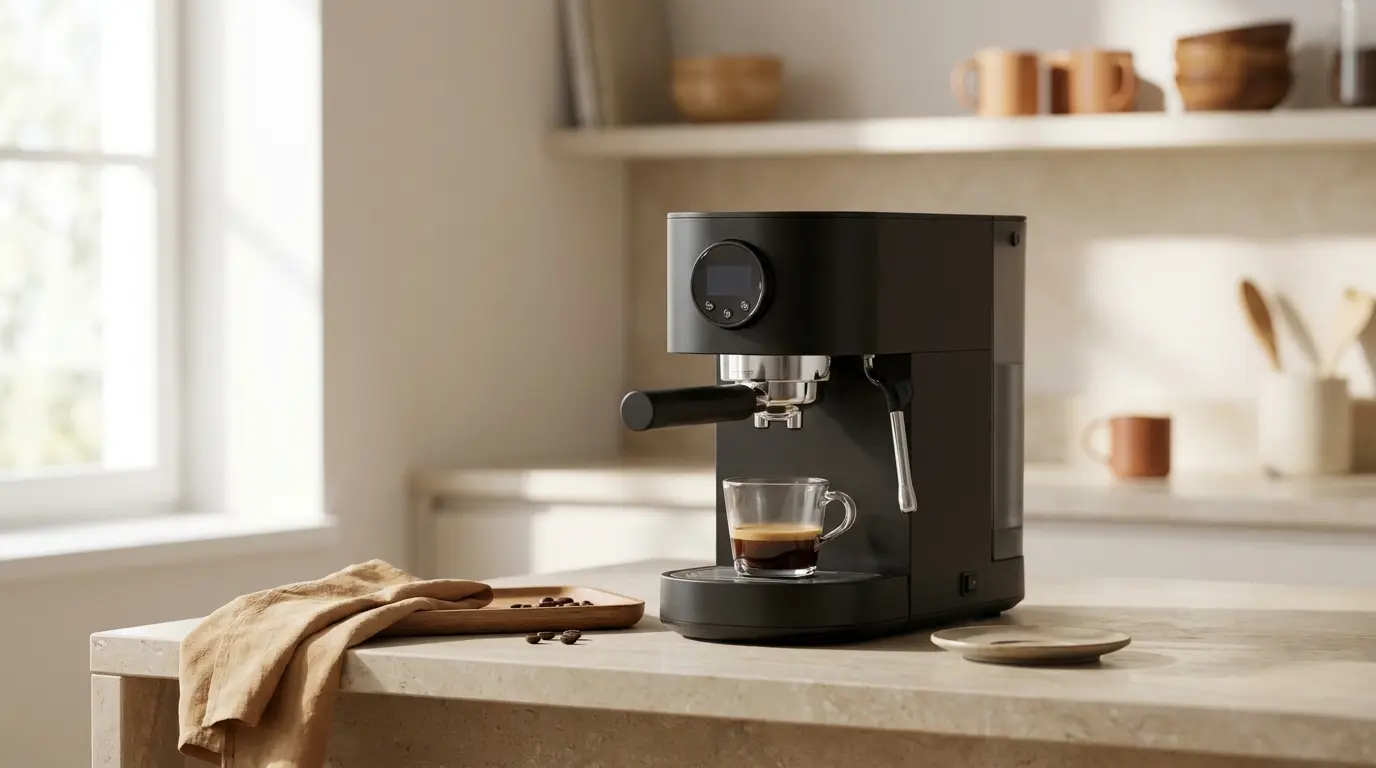
Most espresso machines give you two variables and hide a third. You set the grind, you set the dose, and the pressure is decided for you by a valve at the factory. The Fellow Espresso Series 1 hands you the third one. A lever on the front raises and lowers brewing pressure while the shot is running, and a display shows you the pressure and the flow as you move it.
That is the entire reason the machine exists, and it is worth being clear about who that helps.
What pressure profiling actually is
A conventional pump machine holds roughly nine bar from the moment the pump starts until you stop it. Profiling means shaping that instead: a low-pressure soak to wet the puck evenly, a ramp up to peak as extraction gets going, and a decline toward the end of the shot.
The reason anyone bothers is that pressure at the puck governs extraction more directly than any other machine variable[1], and a flat line is not always the best shape. Light, dense roasts in particular tend to channel under an abrupt full-pressure start and respond well to a gentle beginning. A declining finish tends to pull sweeter and leave harsher late-extraction compounds in the puck, which is the same effect lever machines produce by physics.
Until recently, shaping pressure at home meant a lever machine, a spring piston, or a prosumer machine with flow control hardware bolted to an E61 group. The Series 1 is notable because it puts a manual pressure control on a compact machine at a price well below the usual entry to that capability.
What it is not
It is not a machine that makes espresso easier. Nothing about profiling removes a decision; it adds one, on top of grind and dose, and those two still matter more. Grind consistency drives extraction ahead of anything the machine does[2], so a profiled shot on a bad grinder is just a differently wrong shot.
It is not a boiler machine. It heats fast, which means it heats water on the way through rather than holding a tank of it, the same trade the Breville Oracle Jet makes. You get a machine ready in under a minute and a small footprint; you give up the thermal reserve a large boiler gives you during a long run of drinks, and steaming is a step after the shot rather than during it. The design trade-offs are laid out in dual boiler vs heat exchanger.
And it is not an all-in-one. There is no grinder. The 58 mm portafilter is the commercial standard, so your baskets and tampers carry over, but the grinder is a separate purchase and should be a serious one.
Who it is for
The dialled-in home barista. Someone who has been pulling shots on a Gaggia, a Silvia or a Breville, has a grinder they trust, and has run out of things to change. Profiling is the next variable, and this is the cheapest honest way to reach it.
The light-roast drinker. If you buy from roasters who roast light and your shots run sour or channel at a flat nine bar, a soft start is the tool for that problem.
Not the first-time buyer. If this would be your first espresso machine, the money is better spent on a simpler machine and a better grinder. Come back to profiling when the simpler machine has stopped teaching you anything.
Not the convenience buyer. If what you want is a flat white before work with no decisions, a machine that tamps and textures for you will serve you better every single morning.
The Series 1, and the two machines people cross-shop it against
 Pressure profiling, compactFellow Espresso Series 1 - Espresso Machine, Pressure Profiling | 58mm Portafilter, Heats Under 2 Min, Temperature Control, Steam Wand, for Lattes & Cappuccinos, Matte BlackA newer design built around pressure profiling rather than a boiler type, in a narrow body. Worth reading the maker's specification closely, because it does not sit in the single, heat-exchanger or dual-boiler categories the older machines do.amazon.com $1,499.95 USDamazon.ca $1,999.95 CADPrice and availability as of View on Amazon
 Automated, on-demand heating, cold modesBreville BES985BSS Oracle Jet Espresso Machine, Brushed Stainless Steel | Automatically brew barista-quality lattes, cappuccinos and cold brew at home with this coffee maker with built-in grinderGrinds, doses, tamps and textures milk from a touchscreen, and is ready in seconds because it heats on demand rather than holding a boiler. The trade is steaming after the shot with a little less power. The only Breville with cold extraction modes.amazon.com $1,979.99 USDamazon.ca $2,999.99 CADPrice and availability as of View on Amazon
 Single boiler, 58 mm, stainless boilerGaggia RI9380/51 Classic Evo Pro Espresso Machine, Industrial Grey, SmallA small commercial machine at a consumer price: a 58 mm group, a three-way solenoid and a real steam wand on a boiler. The Evo Pro ships at nine bar with a stainless boiler. No temperature control, so plan on timing the shot or adding a PID, and budget for a grinder.amazon.com $529.99 USDamazon.ca $733.15 CADPrice and availability as of View on Amazon
Product prices and availability are accurate as of the date/time indicated and are subject to change. Any price and availability information displayed on Amazon at the time of purchase will apply to the purchase of this product. Certain content that appears on this site comes from Amazon. This content is provided ‘as is’ and is subject to change or removal at any time.
Buying notes
Fellow lists the Series 1 in more than one configuration, and they are sold as separate listings at different prices. The differences are in finish and in how much of the milk work the machine does for you rather than in the brew group. Read the specific listing you are buying rather than assuming the cheapest one is the one reviewed, because the assisted-milk and manual-wand versions are genuinely different machines to live with.
As with every machine on this site, the product card shows the live price and availability at the moment you read it.
Common misconceptions
"Profiling makes better espresso." It makes different espresso, and in specific cases better. It makes worse espresso in the hands of someone who has not settled grind and dose first.
"Fast heat-up means a weak machine." It means no boiler. The limitation shows up in steam power and in long sessions, not in a single shot.
"It replaces a lever machine." It gives you deliberate control over roughly the same shape a lever produces by feel. Which you prefer is a question of whether you want to draw the curve or feel it.
"58 mm means commercial quality." It means commercial accessories fit. It is a size, not a grade.
What we have and have not checked
The capability described here, manual pressure profiling with live pressure and flow readout on a 58 mm single-group machine with fast heat-up and no built-in grinder, is from the maker's published specification and from the listings themselves. We have not bench- tested the machine, have not measured its temperature stability, and make no claim about how it compares in the cup with specific alternatives. Because Fellow sells several variants under one model name, check the configuration on the listing you open.
The honest summary
The Fellow Espresso Series 1 sells one thing: a hand on the pressure curve, at a price where that has not previously been available in a compact machine. For someone who has already run out of adjustments on a simpler setup and owns a grinder worth the name, it is a genuinely new variable. For someone who wants a good drink with fewer decisions, it is an expensive way to add one.
Frequently asked questions
- What is pressure profiling and does it matter?
- Pressure profiling means changing the brewing pressure during the shot instead of holding one figure throughout. A common profile soaks the puck at low pressure, ramps up to peak, then declines as the shot runs. Pressure at the puck is the machine variable that governs extraction most, so being able to shape it is a real lever on the cup, particularly with light roasts that resist a flat nine bar. It matters if you are already controlling grind and dose carefully. If you are not, it is one more variable to get wrong.
- Is the Fellow Espresso Series 1 better than a Breville?
- They are built for different people. A Breville automates dosing, tamping or milk and aims to get you a good drink with fewer decisions. The Series 1 removes none of those jobs and adds one: shaping pressure through the shot. If you want the machine to do more for you, Breville. If you want a variable that the Breville line does not expose at all, the Fellow. Neither has a higher ceiling on espresso quality from the brew group alone.
- Does the Fellow Espresso Series 1 have a grinder?
- No. It takes a standard 58 mm portafilter and expects a separate espresso grinder, which is the right arrangement at this price because a built-in grinder is sized to fit the cabinet rather than to perform. Budget for a dedicated burr grinder alongside it; profiling pressure on top of an inconsistent grind will not produce a better shot, it will produce a differently bad one.
- How long does the Fellow Espresso Series 1 take to heat up?
- It is designed to be ready in well under a minute, which is the behaviour of a machine that heats water on the way through rather than holding a boiler at temperature. That is the same trade the Breville Oracle Jet makes: you get speed and a smaller body, and you give up the thermal mass that a large boiler provides during long back-to-back sessions. For a household making a few drinks it is a good trade.
- Can you steam milk on the Fellow Espresso Series 1?
- Yes, through a steam wand, and the machine is sold in configurations that differ in how much milk work it does for you. Check which variant you are buying, because the assisted-milk version and the manual-wand version are listed separately and at different prices. As with any machine that heats on demand rather than from a pressurised boiler, expect steaming to be a sequential step after the shot rather than something you do during it.
- Who should not buy the Fellow Espresso Series 1?
- Anyone who wants fewer decisions in the morning. The whole proposition is an extra control, and an extra control is only valuable to someone who has run out of things to adjust on a simpler machine. A first-time espresso buyer will get better drinks sooner from a Gaggia Classic Evo Pro with a good grinder, or from a Breville that tamps and textures for them, and can come back to profiling later.
References
Every factual claim in this article is drawn from the sources below. See the source library for how we grade evidence.
- [1]Influence of Water Pressure on the Final Quality of Arabica Espresso CoffeeJournal of Agricultural and Food Chemistry · 2002 · Controlled trial · Tier 2 · Moderate
- [2]Brewing FundamentalsCoffee Science Foundation · Reference work · Tier 2 · Moderate
- [3]Effects of brew strength, brew yield, and roast on the sensory quality of drip brewed coffeeJournal of Food Science · 2020 · Controlled trial · Tier 2 · Moderate
Related reading
- Brewing ScienceEspresso Machine Buying Guide: Choosing the Right Type→
- Coffee EquipmentDual Boiler vs Heat Exchanger: Which Espresso Machine Design Fits You→
- Coffee EquipmentCompact Espresso Machines: What Fits, and What You Give Up→
- Coffee EquipmentBreville Oracle Jet vs Oracle Touch: Fast Heater or Two Boilers→
- Coffee EquipmentGaggia Classic Pro and Evo Pro: What You Get for the Money→
- Coffee EquipmentHow Much to Spend on a Coffee Grinder→