Dialing In Espresso: How to Adjust Your Shot
By Coffee Studies Editorial·Published July 18, 2026·5 min read
Quick answer
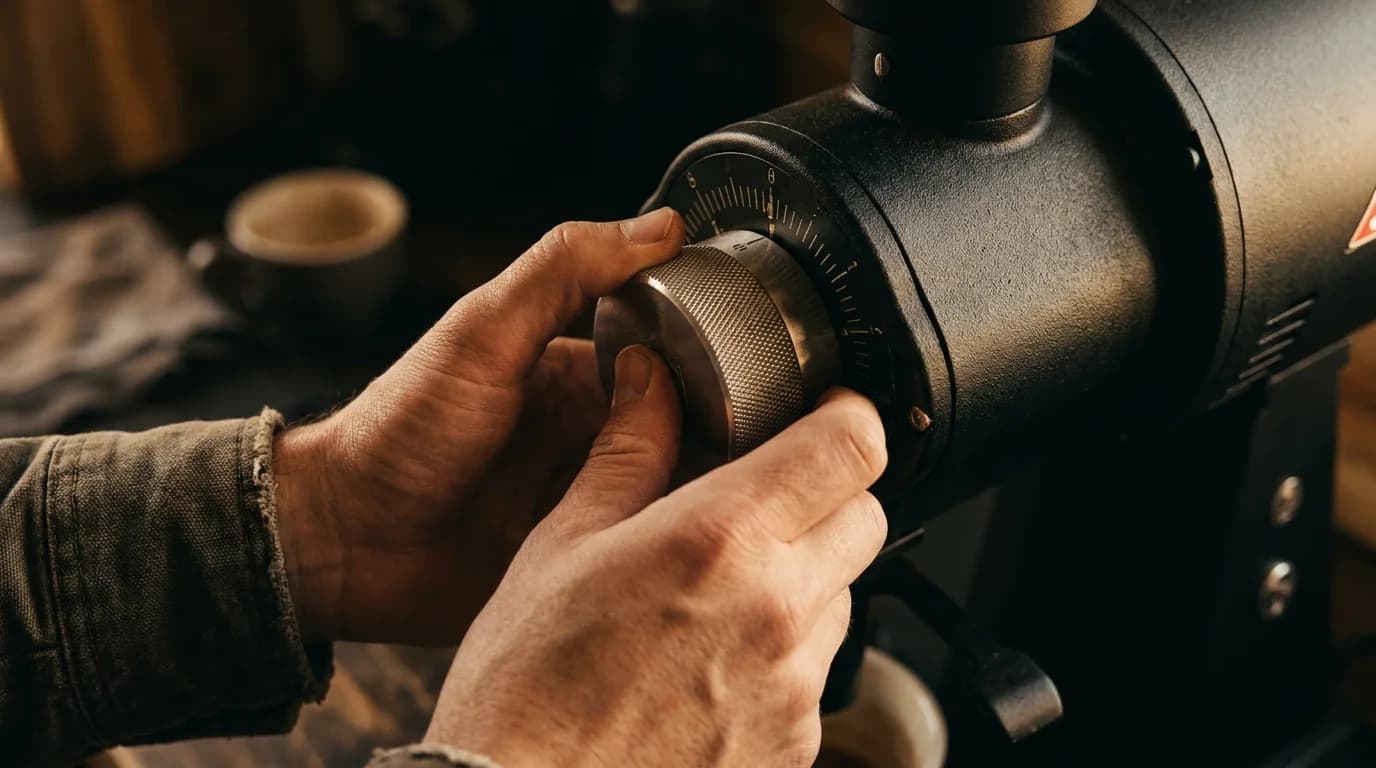
Dialling in is the process of adjusting a small number of variables in a systematic order until an espresso shot hits a defined target — and then tastes right. It is not guesswork; it is a diagnostic process with a logical sequence. Once you understand what each variable does, the process becomes predictable.
Three variables: grind, dose, yield
espresso is controlled by grind size (flow rate and contact time), dose (how much dry coffee), and yield (how much liquid extracted) — these three variables interact, and changing one affects the others[1]
1:2 ratio, 25–30 seconds
the standard specialty espresso target: 18 g coffee in, 36 g espresso out, in 25–30 seconds — a starting point, not a law; different beans and roast levels often call for adjustment[2]
Sour = under-extracted; bitter = over-extracted
the taste tells you which direction to adjust — a sour, thin shot ran too fast (grind finer or increase dose); a harsh, bitter shot ran too slow (grind coarser or reduce dose)[3]
The three variables
Grind size
Grind size controls how much resistance the water encounters as it passes through the coffee puck. Finer grinding = more surface area = more resistance = slower flow = longer contact time = more extraction.
This is the primary dial. Most other adjustments happen only after the grind is close to correct.
Finer grind → slower shot → more extraction Coarser grind → faster shot → less extraction
Grind adjustment on most commercial burr grinders is made in small increments. One click of adjustment changes the shot time by 2–5 seconds. Espresso is sensitive — do not make large adjustments.
Dose
The amount of dry coffee (in grams) placed in the portafilter basket. Standard doses are 14–21 g depending on basket size (single, double, triple basket).
More dose → denser puck → more resistance → slower flow → more extraction. Less dose → opposite.
Dose is typically set first (weigh your dose consistently) and adjusted only after grind has been optimised. A 0.5 g dose change is meaningful in espresso.
Yield
The amount of liquid espresso produced (in grams). Measured by placing a scale under the portafilter.
More yield → more water through the coffee → higher extraction and more volume → lighter, less concentrated shot. Less yield → shorter, more concentrated, less extracted.
Yield is often adjusted to dial in flavour after grind and dose are set. A longer yield (e.g. 1:2.5) extracts more sweetness; a shorter yield (e.g. 1:1.5) produces more concentrated, intense espresso[1].
Target parameters
| Parameter | Specialty standard | Traditional Italian |
|---|---|---|
| Dose | 18–20 g (double) | 7–9 g (single) |
| Yield | 36–40 g (1:2 ratio) | 25–30 mL (1:1.5 ratio) |
| Time | 25–30 seconds | 20–30 seconds |
| Temperature | 90–96°C | 88–92°C |
| Pressure | 9 bar | 9 bar |
The 1:2 ratio and 25–30 seconds are starting points — different origins, roast levels, and processing methods often find their best expression at different ratios[2].
The dialling-in process
Step 1: Set your dose. Weigh the same amount of coffee each time. Inconsistent dosing makes it impossible to isolate what is changing. 18 g is a common starting point for a 58 mm double basket.
Step 2: Pull a shot on your current grind. Time it and taste it.
Step 3: Diagnose by time and taste:
Figure
Espresso shot diagnosis by extraction time
Values in seconds
Step 4: Make one adjustment. Change only the grind. Move one or two increments in the direction indicated by the diagnosis. Do not change dose and grind simultaneously.
Step 5: Pull another shot immediately. Grinders retain some old coffee between adjustments — pull and discard the first shot after any grind change before pulling the evaluation shot.
Step 6: Repeat until the shot hits the target time and tastes balanced. Balanced espresso tastes sweet, with some bitterness present but not dominant, and with acidity present but not sharp. The finish should be clean.
Step 7: Lock in the dose and yield. Once the grind is correct, confirm that dose and yield are where you want them. If the shot tastes correct but is too concentrated, increase yield slightly. If it tastes correct but thin, reduce yield slightly[3].
Diagnosing by taste
Everything below assumes the machine itself is working. If the shot is not just tasting wrong but running oddly, leaking or refusing to heat, that is hardware rather than extraction, and the common faults are in Breville espresso machine problems.
Time is a proxy. Taste is the actual signal.
Sour, sharp, thin: under-extracted. The shot ran too fast. Organic acids (citric, malic, acetic) extract early; the sweetness and balancing compounds did not have time to extract. Fix: grind finer, or slow down via increased dose.
Bitter, harsh, drying (astringent): over-extracted. The shot ran too long and extracted late-stage compounds including harsh caffeine bitterness and tannic astringency. Fix: grind coarser, or speed up via decreased dose.
Hollow, papery, no sweetness: often a freshness issue — stale beans extract flat and flavourless even at correct timing. Or too light a roast for the machine temperature.
Balanced: some sweetness (the primary target), present but not sharp acidity, some bitterness integrated rather than dominant, a finish that lingers cleanly. This is what correct extraction tastes like.
Dialling in is a measurement exercise, so the tools that matter are the ones that remove variables rather than add features: a scale that reads to 0.1 g with a timer, a tamper that applies the same force every time, and a blind basket for the backflush that keeps the group clean enough for the shots to be comparable week to week.
What dialling in actually needs
 Scale with a timer, 0.1gMaestri House S2 Espresso Coffee Scale with Timer 0.1g Precision Shot Scale | USB-C Rechargeable, Dual Timing Modes, 2kg/0.1g Digital Scale with Borosilicate Glass Top for Espresso and Pour-Over BrewingDose and ratio are the two variables you can fix for free, and neither is fixable by eye: a scoop of beans varies by several grams depending on bean size and how it was filled. A timer on the same device means you are reading one instrument instead of two.amazon.com $30.39 USDamazon.ca $34.19 CADPrice and availability as of View on Amazon
 Spring-loaded 58mm tamperKNODOS Calibrated Espresso Tamper 58mm Walnut Spring Loaded Design | Auto-Leveling and Stainless Steel Ripple Base Coffee Tamper with 20lb / 25lb / 30lbs Replacement Springs (58.3mm)A calibrated tamper applies the same force every time, which removes one variable while you are trying to isolate the others. It does not make better espresso than a steady hand; it makes a less steady hand repeatable, which is what dialling in requires.amazon.com $43.99 USDamazon.ca $59.99 CADPrice and availability as of View on Amazon
 Backflush insertGLOGLOW 54mm Metal Backflush Insert Stainless Steel Blind Filter | Backflush Filter Basket Espresso, Coffee Machine Accessories for Sage8 SeriesA portafilter basket with no holes. Backflushing only works if the water has nowhere to go but back through the three-way solenoid valve, so this is the part that makes the weekly clean possible at all. Match the diameter to your machine — 54mm on most Breville models, 58mm on commercial-size group heads.amazon.com $6.38 USDamazon.ca $11.90 CADPrice and availability as of View on Amazon
Product prices and availability are accurate as of the date/time indicated and are subject to change. Any price and availability information displayed on Amazon at the time of purchase will apply to the purchase of this product. Certain content that appears on this site comes from Amazon. This content is provided ‘as is’ and is subject to change or removal at any time.
When to re-dial
New bag of beans: always. Every bag is different — freshness, density, and roast level all affect extraction.
Same bag, different batch: sometimes. Coffee changes as it ages off roast (degassing CO₂ means the puck resistance changes). Very fresh coffee (within 5 days of roast) is gassy and often needs a coarser grind than the same coffee at 14 days.
Change in temperature or humidity: café ambient conditions affect grind — hot humid days may require a coarser grind; cold dry days may need finer.
After equipment maintenance: a cleaned grouphead or replaced shower screen changes flow behaviour slightly.
The honest summary
Dialling in espresso means adjusting grind size, dose, and yield until the shot hits a target brew ratio (typically 1:2 in 25–30 seconds) and tastes balanced — sweet, with integrated acidity and bitterness. Change one variable at a time, pull a shot, evaluate by taste and time, and adjust. Sour shots need finer grind or more dose; bitter shots need coarser grind or less dose. Grind is the primary variable — adjust it first before touching dose or yield. Each new bag of beans requires re-dialling. The process is systematic and repeatable; it is not intuition-based once you understand what each variable does.
Frequently asked questions
- What does dialling in espresso mean?
- Dialling in means making systematic adjustments to grind size, dose, and yield to produce a shot that hits your target recipe consistently. Because espresso extraction is sensitive to small changes — in grind, bean freshness, ambient humidity, and machine temperature — a recipe that worked yesterday may run differently today. Dialling in is the process of making small, methodical adjustments until the shot looks, times, and tastes right again.
- What is the target espresso brew ratio?
- The most common specialty espresso target is 1:2 — for every gram of dry coffee going in, 2 grams of liquid espresso coming out. An 18 g dose produces a 36 g yield; a 20 g dose produces a 40 g yield. This ratio typically produces a balanced shot in 25–30 seconds on a well-calibrated machine. Traditional Italian espresso is often shorter (1:1.5 or less); modern specialty often runs 1:2.5 to 1:3 for a lighter, sweeter profile.
- Should I adjust grind or dose first?
- Adjust grind first. Grind size is the primary variable — it controls how much resistance the water meets as it passes through the coffee bed, which determines flow rate and extraction time. Dose affects density of the puck and influences flow, but grind is more sensitive. Once the grind is in range (shot timing is close to target), fine-tune with dose adjustments. Change one variable at a time and pull a shot between each adjustment — changing both simultaneously makes it impossible to know what caused the change.
- Why does my espresso taste sour?
- Sour espresso is under-extracted — not enough soluble compounds were pulled from the coffee. The most common cause is a grind that is too coarse: water flows through too quickly, contact time is too short, and the acids in the coffee extract before the sweetness and balancing compounds do. Fix: grind finer (one click or increment at a time), which slows the flow and extends contact time. The shot will run longer and extraction will increase. Alternatively, increase dose (more coffee = more resistance = slower flow).
- Why does my espresso taste bitter?
- Bitter espresso is over-extracted — too many compounds were pulled, including bitter compounds that extract late in the process. The most common cause is a grind too fine: water moves too slowly, contact time is too long, and late-extracting bitter compounds dominate. Fix: grind coarser (one increment at a time), which speeds flow and shortens contact time. Alternatively, reduce dose (less coffee = less resistance = faster flow). Old or stale beans also extract bitter and flat — freshness matters.
- How often do you need to re-dial espresso?
- Every new bag of beans requires re-dialling — roast date, origin, and processing all affect how the coffee extracts. Freshly roasted beans (0–7 days off roast) degas rapidly and often need a coarser grind than the same beans at 14–21 days. Significant changes in ambient humidity or temperature can shift extraction enough to require adjustment. In a café setting, experienced baristas check the shot timing and taste the first few pulls of each shift.
References
Every factual claim in this article is drawn from the sources below. See the source library for how we grade evidence.
- [1]Brewing FundamentalsCoffee Science Foundation · Reference work · Tier 2 · Moderate
- [2]Influence of Water Pressure on the Final Quality of Arabica Espresso CoffeeJournal of Agricultural and Food Chemistry · 2002 · Controlled trial · Tier 2 · Moderate
- [3]Coffee extraction kinetics in a well mixed systemJournal of Mathematics in Industry · 2016 · Review · Tier 2 · Moderate
Related reading
- Barista SkillsHow to Steam and Froth Milk for Coffee→
- Barista SkillsHow to Make Latte Art: Beginner's Guide to Milk Pouring→
- Barista SkillsHow to Become a Barista: Skills, Training, First Jobs→
- Barista SkillsBarista Salary in Canada: What Baristas Actually Earn→
- Barista SkillsSCA Barista Certification: Is the Programme Worth It?→
- Brewing ScienceUnder-Extracted vs Over-Extracted Coffee→