The Origin of Espresso: How Italy Invented the Shot
By Coffee Studies Editorial·Published July 15, 2026·8 min read
Quick answer
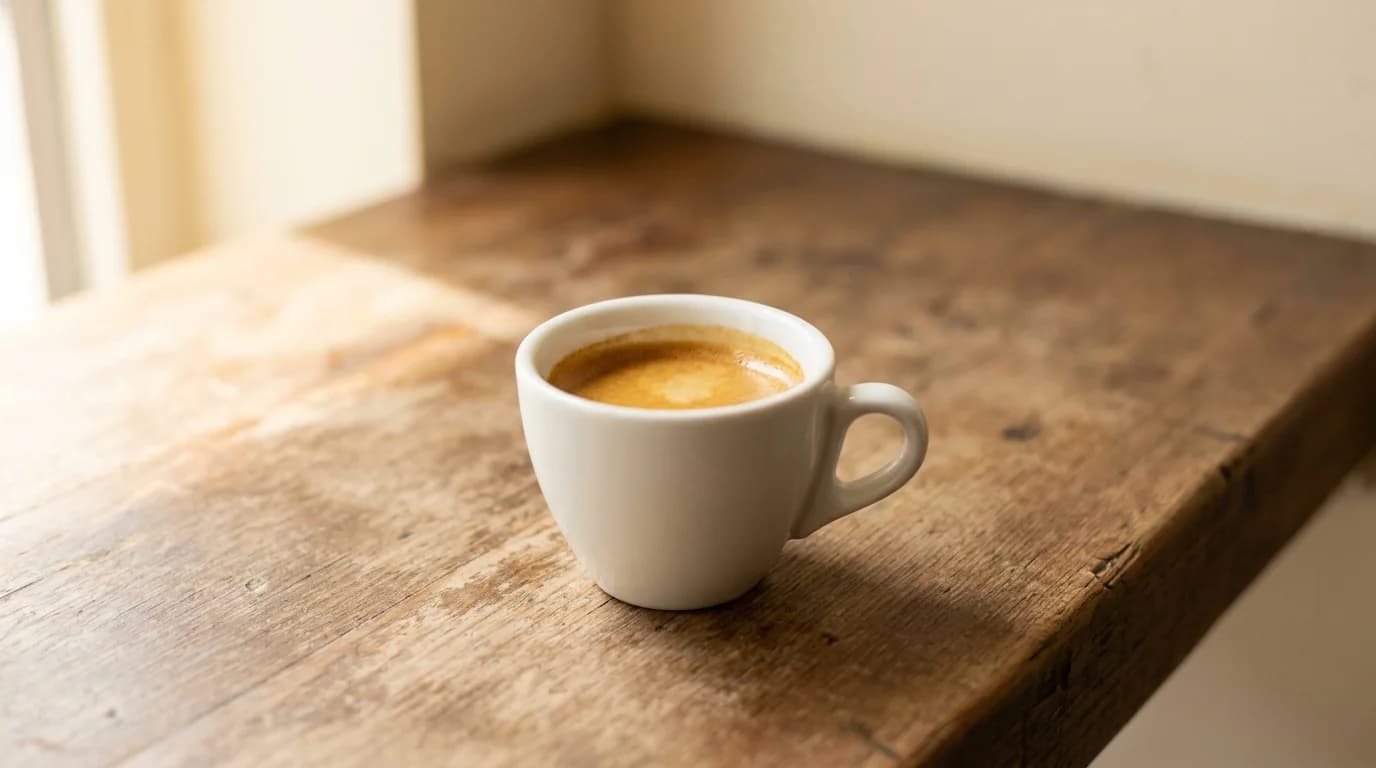
Espresso is often thought of as ancient, but in fact it's one of the youngest ways coffee is made — the modern espresso shot, with its golden-brown crema on top and its characteristic concentrated body, dates only from 1948. The path to that 1948 moment runs through 60 years of Italian machine engineering, from Turin steam experiments to Milanese lever-piston mechanisms. It's a story of specific inventors, specific patents, and specific incremental improvements — a useful reminder that the drink at your local espresso bar has a much more recent history than the coffee it's made from.
1884
first patented steam-powered espresso-adjacent machine — Angelo Moriondo, Turin[4]
1901
Luigi Bezzera patents the per-cup espresso machine — the drink becomes a beverage[5]
1948
Achille Gaggia's lever machine reaches ~9 bar pressure and produces crema for the first time[1]
The problem espresso was solving
Late 19th-century Italian coffee had a specific commercial problem: cafés brewed coffee in bulk and kept it warm on stoves. This meant slow service and stale coffee — quality deteriorated within an hour or two of brewing.
Italian inventors began working on machines that could brew coffee on demand, individually, quickly — matching the pace of a working café. The engineering path went through several iterations, gradually converging on a specific solution: fine-grind coffee, hot water forced through under pressure, delivered in a small cup within roughly 30 seconds.
1884: Moriondo's Turin steam machine
Angelo Moriondo, an entrepreneur from Turin, filed the first known patent for an espresso-adjacent machine in 1884 (patent no. 33/256). His machine used steam pressure from a boiler to force water through a coffee bed and into a cup.
Moriondo's machine was designed for use at the General Exposition of Turin in 1884, where it won a bronze medal. Only a few were built. Moriondo didn't commercialise the design widely and the machine didn't become common outside Turin.
Moriondo's design is nonetheless the first documented example of the fundamental espresso idea: brew coffee faster, per-cup, by using pressure rather than gravity[4].
1901: Bezzera's commercial espresso machine
Luigi Bezzera, a Milanese engineer, filed the more influential patent in 1901 (Italian patent no. 61707). Bezzera's machine improved on Moriondo's design in several important ways:
- Per-cup group heads — Bezzera's machine had multiple brewing points (group heads) so several cups could be brewed simultaneously, each with its own portafilter of coffee.
- Faster brewing — approximately 30 seconds per cup vs the several minutes of older methods.
- On-demand operation — no pre-brewed batch; each cup was made fresh when ordered.
This is when "espresso" acquired its name. The word came from the same root as the English "express" — meaning both "pressed out" (referring to the pressure-brewing method) and "expressly for you" (referring to the on-demand service model).
1905: Pavoni commercialises the design
Bezzera was an engineer, not a marketer, and had limited commercial success with his patent. In 1905, Desiderio Pavoni bought Bezzera's patent rights and began commercial manufacture of espresso machines under the La Pavoni brand.
Pavoni's contributions:
- Manufacturing scale — La Pavoni built machines in quantity, making them accessible to cafés across Italy.
- Pressure release valve — a small technical improvement that prevented steam from hissing over customers.
- Marketing — Pavoni established espresso as a distinctive Italian café product, not just a technical brewing method.
By the 1920s-30s, espresso machines were common in Italian urban cafés. But the coffee they produced would still not be recognised as modern espresso by contemporary standards — because they used steam pressure, which is limited by the physics of boilers to roughly 1.5-2 bar. That pressure was enough to brew coffee quickly but not enough to produce crema[5].
1938-1948: Gaggia and the invention of crema
The final and most important invention moment came from Achille Gaggia, a barista and inventor working in Milan. Gaggia patented a lever-piston mechanism in 1938 (Italian patent 365726), but wartime disruptions delayed commercial production. His fully realised machine went into commercial production in 1948.
How the Gaggia lever mechanism worked:
- A large spring was compressed by the barista's downward pull on a lever handle.
- The spring, released, pushed a piston through a chamber of hot water.
- This forced water through the coffee bed at pressures much higher than steam alone could produce — approximately 8-9 bar.
Why this mattered so much:
- Crema emerged. At roughly 8-9 bar of pressure, coffee oils and dissolved CO₂ emulsify into microbubbles, producing the golden-brown foam on top of a shot. Below this pressure threshold, there's no crema. Modern research on the physics of espresso extraction has characterised this pressure-dependence in detail[1].
- Higher extraction yield in a shorter time. The higher pressure enabled the ~25-30 second, ~30 mL shot format that became standard.
- A new sensory profile. Espresso became sweeter, more aromatic, and more body-forward than the pre-Gaggia version.
This is why 1948 is treated as the birth date of modern espresso, even though machines were being called "espresso" for the previous 47 years. The drink Gaggia's machine produced is what people mean today when they say espresso.
What the science confirms
Modern research on espresso extraction has quantified what Gaggia demonstrated experimentally:
- Pressure-crema relationship: the golden-brown crema layer on a properly pulled shot is an emulsion of coffee oils, dissolved CO₂, and other extracted compounds. It forms reliably at around 8-9 bar and either doesn't form or is very thin below about 6 bar[1].
- Temperature sensitivity: modern espresso is typically brewed at 90-96°C. Small temperature changes meaningfully shift the flavour balance between acidity, bitterness, and sweetness[2].
- Extraction variability: espresso is among the most variable brewing methods — small changes in grind, dose, temperature, and pressure produce large flavour changes. Studies of commercial espresso variance have documented substantial variability in even carefully- operated commercial shops[3].
See Espresso Explained and What Is Crema? for more detail on the modern extraction physics.
Figure
Crema thickness by brewing pressure
Values in mm crema on 30 mL shot
From lever to pump machines
Gaggia's lever machines were physical to operate — pulling the lever required real force, and consistent shots required practice. Over the 1950s-70s, espresso machines gradually transitioned from lever to pump designs:
- Pump machines use an electric pump (rotary or vibratory) to generate pressure continuously.
- Advantages: consistent pressure without barista effort; easier to operate at high volume; more compact.
- Trade-off: some espresso enthusiasts argue lever machines produce a distinctive shot profile because the pressure decays during extraction (starts high, tapers down) rather than staying constant.
Modern high-end machines include lever designs (La Pavoni Europiccola, Elektra Micro Casa a Leva), traditional pump machines (nearly all commercial machines), and increasingly sophisticated pressure profiling machines that electronically vary pressure during a shot — bringing back some of the pressure-decay behaviour of lever machines with electronic precision.
Espresso's global spread
Espresso remained largely Italian until the mid-20th century. It spread outward via several vectors:
- Italian immigration carried espresso to communities worldwide — particularly in Argentina, Australia, and parts of North America — during and after the war.
- The 1970s Italian coffee bar aesthetic became an international style influence, adopted by European cafés outside Italy.
- Second-wave chains from the 1970s-80s — Starbucks and its competitors — built their business model on espresso-based drinks (lattes, cappuccinos, mochas), spreading espresso as a global consumer product.
- Third-wave specialty coffee from the 2000s returned attention to espresso quality specifically — high-end machines, careful barista work, single-origin espresso shots.
Today, espresso is arguably the world's most influential coffee format. Most café menus outside Italy are still predominantly espresso-based (americanos, lattes, cappuccinos, mochas, cortados, flat whites — all built on the espresso shot as a base[4].
What the research says
The 2002 Journal of Agricultural and Food Chemistry paper on espresso pressure characterises the pressure-emulsion relationship that Gaggia's 1948 machine enabled[1].
The 2003 JAFC paper on espresso temperature quantifies the temperature-flavour sensitivity that makes espresso such a demanding brewing method to keep consistent[2].
The 2015 JSFA paper on espresso variance documents the practical variability in commercial espresso even under careful control — the mechanical precision of modern machines doesn't fully solve espresso's inherent sensitivity[3].
Pendergrast's Uncommon Grounds covers the Italian inventor sequence and the global spread of espresso in narrative depth[4].
The history, at length
 Long-form history of coffeeUncommon Grounds: The History of Coffee and How It Transformed Our WorldThe book this site cites whenever a historical claim needs a source, and the one worth reading if the history is what interests you rather than the brewing. Pendergrast covers six centuries at length, including the commercial and colonial parts that shorter histories skip.amazon.com $11.48 USDamazon.ca $30.99 CADPrice and availability as of View on Amazon
Product prices and availability are accurate as of the date/time indicated and are subject to change. Any price and availability information displayed on Amazon at the time of purchase will apply to the purchase of this product. Certain content that appears on this site comes from Amazon. This content is provided ‘as is’ and is subject to change or removal at any time.
Encyclopaedia Britannica's coffee entry and the National Coffee Association's history summary both cover the key patents and commercialisation milestones[5][6].
Common misconceptions
- "Italians have been drinking espresso for centuries." Espresso as a drink dates from 1901 (as a technical brewing method) and 1948 (with crema, as we recognise it). Coffee has been in Italy since the 17th century, but modern espresso is a 20th-century product.
- "Gaggia invented espresso." Gaggia invented modern crema-topped espresso. The machine, brewing method, and name were all pre-existing when Gaggia's lever mechanism entered production.
- "Crema is what determines a good espresso." Crema is a marker of pressure and freshness, not necessarily quality. Some excellent shots have thin crema (older beans); some mediocre shots have thick crema (very fresh beans, poor extraction). It's a useful signal, not a quality guarantee.
- "Espresso has more caffeine than drip coffee." By volume yes, per serving usually less — a typical single shot is ~30 mL / ~63 mg caffeine; a typical drip cup is ~240 mL / ~95 mg caffeine. See How Much Caffeine Is in Coffee?.
The Portuguese word for this drink is a bica, and the acronym everyone repeats for it is a backronym — see bica.
The honest summary
Modern espresso is a 20th-century invention that came together over three main patents: Moriondo's 1884 steam- powered brewing machine, Bezzera's 1901 per-cup on-demand espresso concept (with Pavoni commercialising it from 1905), and Gaggia's 1948 lever-piston mechanism that produced enough pressure (~8-9 bar) to create crema for the first time. The drink we call espresso today — small, dark, high- extraction, crema-topped, served in about 30 seconds — is the direct descendant of Gaggia's post-war Milanese café innovation. Everything before 1948 was a precursor; everything after has been a refinement of the extraction envelope Gaggia opened.
Frequently asked questions
- Who invented espresso?
- There isn't a single inventor. Angelo Moriondo of Turin patented the first steam-powered coffee-brewing machine in 1884. Luigi Bezzera refined it into a per-cup brewing device in 1901. Desiderio Pavoni commercialised Bezzera's design from 1905. But modern espresso — with proper crema, the golden-brown emulsion on top — arrived only in 1948 when Achille Gaggia's lever-piston mechanism delivered high enough pressure (~8-9 bar) to produce it.
- When was espresso invented?
- It depends what you mean. The first espresso-adjacent machine dates from 1884 (Moriondo). The per-cup on-demand espresso machine dates from 1901 (Bezzera) and became commercial from 1905 (Pavoni). The modern high-pressure espresso with crema dates from 1948 (Gaggia). Most espresso historians treat 1901 as the birth of espresso as an idea and 1948 as the birth of espresso as we recognise it today.
- Why is it called espresso?
- Espresso comes from Italian meaning 'expressed' or 'pressed out' — referring to the way the coffee is forced through fine grounds under pressure. It also has a secondary implication of 'made expressly for the customer' — i.e., a fresh, individual portion brewed on demand rather than pre-brewed. Both senses were probably intended in the early 20th-century Italian commercial context.
- What did Gaggia's lever machine change?
- Gaggia's lever-piston design (patented 1938, commercialised from 1948) used a spring-loaded lever operated by the barista to build pressure to roughly 8-9 bar — much higher than earlier steam-only machines could achieve (typically 1.5-2 bar). This higher pressure emulsified the coffee oils into the crema layer we recognise today. Before Gaggia, espresso didn't have visible crema.
- Do modern espresso machines use lever pistons?
- Some do — traditional lever machines like the La Pavoni Europiccola or larger commercial spring-lever machines are still made and used. But most modern espresso machines use electric pumps (rotary or vibratory) to generate pressure. These pumps can hit and maintain 9 bar consistently and are much easier to operate at scale than lever machines.
References
Every factual claim in this article is drawn from the sources below. See the source library for how we grade evidence.
- [1]Influence of Water Pressure on the Final Quality of Arabica Espresso CoffeeJournal of Agricultural and Food Chemistry · 2002 · Controlled trial · Tier 2 · Moderate
- [2]Influence of extraction temperature on the final quality of espresso coffeeJournal of the Science of Food and Agriculture · 2003 · Controlled trial · Tier 2 · Moderate
- [3]How the variance of some extraction variables may affect the quality of espresso coffees served in coffee shopsJournal of the Science of Food and Agriculture · 2015 · Observational study · Tier 2 · Moderate
- [4]Uncommon Grounds: The History of Coffee and How It Transformed Our World (revised edition)Basic Books (Mark Pendergrast) · 2010 · Reference work · Tier 2 · Moderate
- [5]CoffeeEncyclopaedia Britannica · Reference work · Tier 3 · Contextual
- [6]The History of CoffeeNational Coffee Association · Reference work · Tier 3 · Contextual
Related reading
- Espresso & Coffee DrinksWhat Is Espresso? Pressure, Extraction, the Shot→
- Espresso & Coffee DrinksWhat Is Crema? The Golden Foam on Espresso→
- Espresso & Coffee DrinksRistretto vs Espresso vs Lungo→
- Brew MethodsBica: Portugal's Espresso, and the Acronym That Isn't True→
- Espresso & Coffee DrinksMacchiato: Espresso Marked with a Spot of Milk→
- Espresso & Coffee DrinksCarajillo: The Spanish Coffee Cocktail→