What Is Crema? The Golden Foam on Espresso
By Coffee Studies Editorial·Published July 15, 2026·6 min read
Quick answer
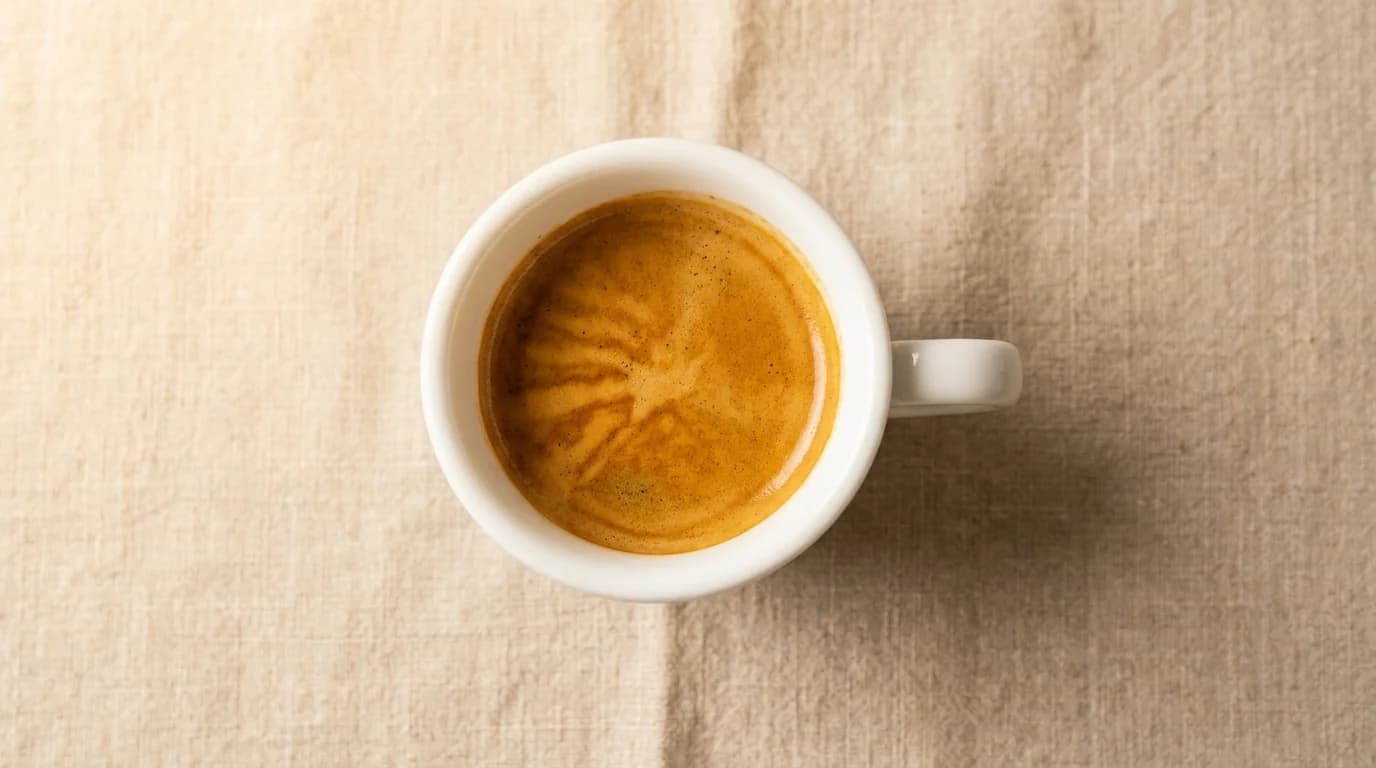
Crema is the visual signature of espresso — the light-brown foam layer that sits on top of a fresh shot. Espresso without crema looks unfinished; a shot with beautiful crema looks like the platonic ideal of coffee. But crema is more misunderstood than most parts of espresso culture, and understanding what it actually is separates cosmetic appeal from real quality.
Oil + CO2 + heat
crema is an emulsion of coffee oils, CO2 gas from freshly roasted beans, and roasting pigments, formed under high pressure[1]
~9 bar
the espresso extraction pressure that makes crema formation possible — no pressure, no crema[2]
30-60 sec
typical lifespan of a fresh crema layer before it starts fading and reintegrating with the espresso[4]
What crema actually is
Crema is not "just foam." It's a specific colloidal emulsion — an even mixture of gas bubbles, oil droplets, and dissolved compounds — held together by the physics of espresso extraction.
The main components:
1. Coffee oils. Roasted coffee contains oils that sit inside the bean and migrate to the surface as beans age past the roast date. Under high pressure, these oils get forced through the grounds and emulsified with water into microscopic droplets.
2. CO2 gas. Roasting is a chemical process that produces carbon dioxide, and freshly roasted coffee retains this CO2 within the bean structure. A 2005 Journal of Food Science study documented how CO2 evolution during roasting continues to release over time — most CO2 leaves within days to weeks of roasting[1]. Under espresso pressure, this CO2 comes out of the coffee as tiny bubbles.
3. Melanoidins. Brown pigment compounds formed during roasting via Maillard reactions. They give crema its distinctive light- brown to hazelnut colour.
4. Micro-particles of coffee. Tiny bits of ground coffee that pass through the filter — they help stabilise the foam.
When all four combine under ~9 bar of pressure, they form the crema layer that rises to the surface as the espresso is extracted[2].
Why only espresso has crema
You will never see crema on drip coffee, pour-over, French press, or cold brew. All those methods lack one or both of the two ingredients crema requires:
- High pressure. Only espresso and espresso-adjacent methods (moka pot to a small degree, capsule machines that reach true pressure) generate enough pressure to emulsify coffee oils with water.
- Fresh CO2 in the coffee. Even with pressure, you need freshly roasted coffee that still contains meaningful CO2 to produce bubbles. Coffee more than 3-4 weeks past roast date won't produce much crema regardless of brewing pressure.
What thick, persistent crema signals — and doesn't
Thick crema is a genuine positive signal for:
- Fresh coffee. CO2 dissipates over weeks; fresh beans produce more, more persistent crema[1].
- Proper extraction pressure. Under-pressure shots (from a machine that isn't reaching 9 bar) produce thinner, less stable crema.
- Correct grind and dose. A well-prepared puck extracts evenly and produces uniform, tight crema. Channeling or uneven extraction shows up as patchy or thin crema.
Thick crema is not proof of quality by itself:
- Robusta produces more crema than arabica at the same freshness and preparation. Robusta contains more chlorogenic acids and retains CO2 differently — so a robusta blend can have gorgeous crema and taste like burnt cardboard, while a pure specialty arabica can taste amazing with thinner crema[3].
- Some stale coffees still produce reasonable crema — especially robusta-heavy blends, which retain crema- producing chemistry even as flavour degrades.
- Excessive crema can indicate over-extraction in some cases — very high pressure or very fine grind can produce foam without proportional flavour development.
The rule of thumb: thick, persistent crema is one signal among several. It correlates with quality but doesn't guarantee it.
What crema looks like when things are right
A good espresso shot's crema:
- Uniform in colour — light golden brown to hazelnut, no dark or pale patches.
- About 2-3 mm thick on a fresh single shot.
- Persistent — still there after 30 seconds; starting to dissolve after 60.
- Textured — may show "tiger stripes" (darker streaks through lighter foam) from the extraction, which is a good sign of even puck saturation.
- Slightly reddish-brown at the edges is normal for arabica; deeper brown with more amber is common in robusta-inclusive blends.
What crema looks like when things are wrong
Very pale, almost white crema:
- Under-extracted shot — grind was too coarse, or ran too fast
- Fix: grind finer, extend contact time
Very dark, thin crema:
- Over-extracted shot — grind too fine, ran too slow
- Fix: grind coarser, faster shot
No crema at all:
- Coffee too old (stale, out of CO2)
- Machine not reaching pressure
- Fix: fresher beans, check equipment
Crema disappears within 5-10 seconds:
- Coffee is stale
- Fix: fresher beans
Big irregular bubbles instead of fine microfoam-like crema:
- Channeling in the puck (water finding a fast path through uneven grounds)
- Fix: better distribution, tamper more evenly, level the grounds first
Whether to stir crema or drink it separately
Traditional Italian practice: stir the crema into the espresso before drinking, so the flavour distributes evenly. The crema alone is more bitter and denser than the espresso underneath.
Some third-wave and specialty coffee approaches leave the crema intact until the last sip, letting it dissolve gradually.
Both are legitimate. The stir-first approach gives more even flavour throughout the shot; the leave-alone approach preserves the layered visual experience. If you're drinking with milk (in a latte or cappuccino), the crema gets integrated with the milk regardless.
Common misconceptions
- "No crema means bad espresso." Not necessarily. Very old beans, no matter how well brewed, won't produce crema. A crema-less shot from stale beans might still be technically well-extracted; it just won't look right.
- "More crema is always better." Not always. Robusta produces more crema than arabica; some stale coffee produces reasonable crema. Volume alone isn't a quality signal.
- "Crema is where all the caffeine is." No — caffeine is dissolved throughout the shot, not concentrated in the crema.
- "Real crema needs a specific coffee variety." True espresso crema forms from any freshly roasted coffee under proper extraction pressure, arabica or robusta.
- "You can add crema-boosting powder." Some products claim this, but real crema is a physical result of pressure + fresh coffee — it can't be added artificially.
Machines and crema
Not all "espresso" machines produce real crema:
Real espresso machines (9-bar semi-automatic, automatic, manual lever): produce authentic crema when using fresh coffee and correct technique.
Pod/capsule machines (Nespresso, similar): reach true extraction pressure through mechanical assist. Crema is authentic; the coffee quality is the limit.
"Cheap espresso makers" (steam-driven, low-pressure electric): often can't reach 9 bar and produce foam that isn't true crema — more like whipped coffee.
Moka pot: reaches about 1.5-2 bar — well below espresso pressure. Some foam forms, but it's not real crema.
The one tradition that deliberately builds a second foam on top of crema is cafe cubano, where sugar is whipped into the first drops of the extraction.
Thin or absent crema is as often a stale-beans or grinder problem as a machine one, but when it is the machine it is usually pressure — see Breville espresso machines compared, and cleaning an espresso machine for the group-head side of it.
The honest summary
Crema is a specific emulsion of coffee oils, roasting CO2, and pigments, produced by high-pressure extraction of fresh coffee. It's a real quality signal — thick, persistent crema correlates with freshness and proper brewing — but not a guarantee of a good shot on its own. Robusta produces more; stale coffee produces less. What crema looks like is one of several inputs you use to evaluate an espresso, not the whole answer.
Frequently asked questions
- What is crema made of?
- Crema is an emulsion of coffee oils, CO2 gas released from freshly roasted coffee under pressure, brown pigments (melanoidins) formed during roasting, and micro-particles of coffee. The high pressure of espresso extraction forces these into microscopic bubbles that rise to the surface as foam.
- Why doesn't drip coffee have crema?
- Crema requires two things drip coffee lacks — high pressure (about 9 bar for espresso) and freshly roasted coffee with retained CO2. Without pressure, coffee oils don't emulsify. Without CO2, no bubbles form. So drip, French press, and pour-over never produce crema.
- Is thick crema always good?
- Not always. Fresh coffee produces more crema, which is a real quality signal. But robusta produces more crema than arabica regardless of freshness, and some stale coffees still produce reasonable crema. Thick crema is a positive signal, not proof of a good shot on its own.
- How long does crema last?
- Typically 30-60 seconds after pouring the shot before it starts to fade and dissolve back into the espresso. Very fresh beans can produce crema that lasts longer; older beans may have crema that dissipates almost immediately. The staying power is another rough freshness signal.
References
Every factual claim in this article is drawn from the sources below. See the source library for how we grade evidence.
- [1]Carbon Dioxide Evolution and Moisture Evaporation During Roasting of Coffee BeansJournal of Food Science · 2005 · Observational study · Tier 2 · Moderate
- [2]Influence of Water Pressure on the Final Quality of Arabica Espresso CoffeeJournal of Agricultural and Food Chemistry · 2002 · Controlled trial · Tier 2 · Moderate
- [3]Chemical Discrimination of Arabica and Robusta Coffees by Fourier Transform Raman SpectroscopyJournal of Agricultural and Food Chemistry · 2005 · Observational study · Tier 2 · Moderate
- [4]CoffeeEncyclopaedia Britannica · Reference work · Tier 3 · Contextual
Related reading
- Espresso & Coffee DrinksWhat Is Espresso? Pressure, Extraction, the Shot→
- Espresso & Coffee DrinksLatte vs Cappuccino vs Flat White→
- Espresso & Coffee DrinksAffogato: Espresso Poured Over Ice Cream→
- Espresso & Coffee DrinksCappuccino: The Classic Italian Espresso Drink→
- Coffee EquipmentBreville Espresso Machines Compared: What Actually Differs→
- Coffee EquipmentHow to Clean an Espresso Machine: The Full Guide→