Affogato: Espresso Poured Over Ice Cream
By Coffee Studies Editorial·Published July 18, 2026·6 min read
Quick answer
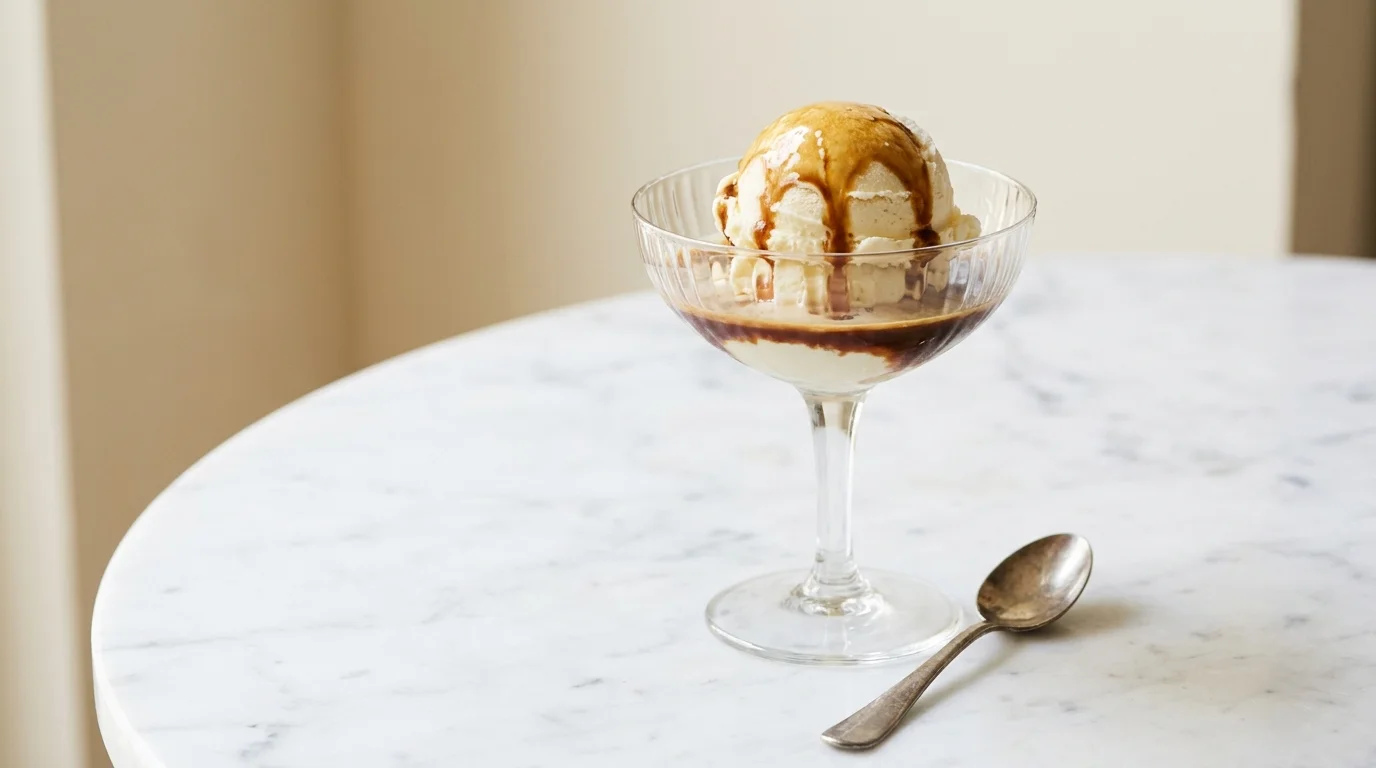
The affogato may be the highest ratio of payoff to effort in all of coffee. Two ingredients, no technique, under two minutes — and the result is a legitimate restaurant dessert: cold, dense vanilla gelato collapsing slowly under a hot shot of espresso, bitter crema streaking into sweet cream. The name is Italian for "drowned" — affogato al caffè, drowned in coffee — and the entire dessert is engineered around one moment: the first spoonful, where hot and cold, bitter and sweet, liquid and solid all coexist briefly in the same glass.
"Drowned"
affogato is Italian for drowned — short for affogato al caffè, gelato drowned in hot espresso[1]
~100 g : 30–60 mL
the standard build — one to two scoops of gelato under a single or double espresso; the gelato should dominate[2]
~150–250 calories
a light dessert by dessert standards — vanilla ice cream runs about 200 kcal per 100 g and espresso adds almost none[3]
What an affogato is
An affogato is a scoop (or two) of gelato — classically plain vanilla or fior di latte (sweet cream, no vanilla) — served in a small glass, coupe, or bowl, with a freshly pulled shot of hot espresso poured directly over the top, ideally at the table, eaten immediately with a spoon.
That's the whole dessert. The reason it works is contrast, and every element serves it:
- Temperature: espresso leaves the machine at roughly 65–70 °C; gelato is served around −12 °C. The pour creates an instant hot-cold gradient that neither ingredient could deliver alone[2].
- Flavour: espresso's bitterness and roast character against the flat sweetness of cream and sugar. This is why plain bases work best — the espresso is the flavouring.
- Texture: the espresso melts a thin layer of gelato on contact, creating three simultaneous textures: hot liquid coffee, cold melting cream, and still-solid gelato underneath.
The dessert is time-sensitive by design. Two or three minutes after the pour, an affogato is a glass of sweet lukewarm coffee-milk. This is not a defect; it's the clock the dessert runs on, and it's why the espresso is poured at the table rather than in the kitchen.
Figure
Affogato: standard build by weight
Getting each ingredient right
The gelato
Gelato beats ice cream here for a physical reason: overrun — the air churned into a frozen dessert during production. American-style ice cream typically carries substantially more churned-in air and more butterfat than Italian gelato; gelato is denser, slightly warmer-served, and softer. Under hot espresso, a dense scoop melts gradually from the outside in, holding its core; a high-overrun scoop collapses quickly[1].
Practical rules:
- Flavour: vanilla or fior di latte. The espresso is the flavouring agent. Chocolate, caramel, and nut bases fight it (though see variations below).
- Quality matters and is audible. An affogato has two ingredients; each is half the dessert.
- Serve it properly frozen. Soft, half-melted gelato loses the temperature contrast that is the entire point.
The espresso
The espresso must be hot and fresh — pulled seconds before pouring. As espresso sits it cools, its crema collapses, and its aromatics fade; a shot that has waited five minutes produces a flat, merely-warm pour.
- Single (30 mL) or double (60 mL) both work. A single preserves more gelato longer; a double gives a stronger coffee presence and melts faster.
- No machine? A moka pot is the traditional Italian home substitute and works well. An AeroPress pulled tight (fine grind, small water volume) also gets close. Drip coffee does not — it's too dilute and turns the dessert watery. See Espresso Explained for what espresso concentration actually means.
- Decaf works perfectly — the physics of the dessert don't care, and an after-dinner affogato is exactly where decaf makes sense.
How to make an affogato
- Chill the glass — a few minutes in the freezer. A warm glass melts the gelato from below before the espresso arrives.
- Scoop the gelato — one to two scoops (~100 g) into the chilled glass. Return it to the freezer while the espresso brews if your machine is slow.
- Pull the espresso — single or double, fresh, hot.
- Pour at the table — over the gelato, all at once.
- Eat immediately — with a spoon, starting from the melting boundary where coffee meets cream.
Total active time: under two minutes. The only failure modes are soft gelato, stale coffee, and hesitation.
Variations
| Variation | What changes | Verdict |
|---|---|---|
| Classic (vanilla / fior di latte) | Nothing — the reference | The one to master first |
| Chocolate or gianduja gelato | Base competes with espresso | Works, but closer to a mocha float |
| Hazelnut / pistachio gelato | Nut sweetness pairs with roast notes | The best-regarded deviation |
| Affogato corretto | Add a small pour of amaretto, Frangelico, or sambuca | Dessert-cocktail territory; excellent |
| Affogato with Kahlua | Coffee liqueur added | Doubles down on coffee; sweet |
| Iced / cold affogato | Cold brew or chilled espresso instead of hot | Loses the temperature contrast — a float, not an affogato |
| Vegan affogato | Plant-based gelato (oat and coconut work best) | Fully functional; oat holds texture well |
The affogato corretto deserves the same note the carajillo's mezcal float gets: a half-ounce of amaretto poured with the espresso turns the dessert into a two-minute after-dinner cocktail. The Italian corretto ("corrected") naming convention is the same one applied to espresso itself — see Carajillo for the Spanish and Mexican side of that family.
One warning from the table above: pouring cold coffee over gelato produces a perfectly pleasant coffee float, but it is not an affogato. Without the melting boundary the dessert has no clock, no contrast, and no drama.
Affogato vs other coffee desserts
| Affogato | Tiramisu | Coffee milkshake | |
|---|---|---|---|
| Ingredients | 2 | 6+ | 3–4 |
| Prep time | ~2 min | Hours (set overnight) | ~5 min |
| Coffee state | Hot, fresh espresso | Soaked into ladyfingers | Blended, cold |
| Caffeine | ~60–130 mg | Modest | Varies |
| Calories | ~150–250 | ~400+ per slice | ~400+ |
| Character | Contrast, immediacy | Rich, layered, make-ahead | Sweet, uniform |
The affogato is the lightest and fastest of the three by a wide margin — roughly 150–250 calories for a standard build, since vanilla ice cream runs about 200 calories per 100 g and espresso contributes essentially none[3].
Caffeine and timing
An affogato is a genuine caffeine dose at a traditionally late hour: roughly 60–130 mg depending on the shot size — anywhere from half to a full cup of coffee's worth — usually consumed after dinner. If evening caffeine disrupts your sleep, this is exactly the dessert to order with decaf espresso; the dessert loses nothing.
Common misconceptions
- "An affogato is a coffee drink." It's a dessert — eaten with a spoon, served after meals in Italy. If it arrives with a straw, something has gone wrong.
- "More espresso is better." The gelato should dominate. Doubling the espresso against a single small scoop produces lukewarm coffee soup on an accelerated schedule.
- "Any ice cream flavour works." The espresso is the flavouring. Plain bases (vanilla, fior di latte, sweet cream) are traditional because they contrast with the coffee instead of competing with it.
- "Cold brew makes an iced affogato." It makes a coffee float — pleasant, but without the hot-cold contrast that defines the dessert.
- "It's indulgent." By dessert standards it's one of the lighter options on any menu — typically under 250 calories.
The honest summary
The affogato is a two-ingredient Italian dessert — gelato drowned in hot, fresh espresso — whose entire design is contrast: hot against cold, bitter against sweet, liquid against solid, all on a two-minute clock that starts at the pour. The build is roughly 100 g of plain vanilla or fior di latte gelato under a 30–60 mL shot, glass chilled, espresso poured at the table, eaten immediately. It requires no skill, hides no technique, and depends entirely on ingredient quality and timing. For the effort involved — under two minutes — nothing else in coffee comes close.
Frequently asked questions
- What is an affogato?
- An affogato — 'drowned' in Italian, short for affogato al caffè, 'drowned in coffee' — is an Italian dessert made by pouring a shot of hot, freshly pulled espresso over a scoop of gelato or ice cream, traditionally vanilla or fior di latte (sweet cream). It is eaten immediately with a spoon while the hot espresso melts into the cold gelato.
- What is the ratio for an affogato?
- The standard build is one to two scoops of gelato (roughly 100 g) with a single or double shot of espresso (30–60 mL). The gelato should clearly outweigh the espresso — the coffee is a hot sauce over a cold dessert, not a beverage with a scoop floating in it. A double shot over a single small scoop drowns the dessert too literally and turns it into lukewarm coffee soup.
- Do you use gelato or ice cream for affogato?
- Traditionally gelato — Italian-style, denser and lower in overrun (churned-in air) than American ice cream, which makes it melt more slowly and evenly under hot espresso. Good vanilla ice cream works fine. The flavour should be plain: vanilla or fior di latte (sweet cream). Strongly flavoured bases compete with the espresso instead of contrasting with it.
- Is an affogato a drink or a dessert?
- In Italy it is unambiguously a dessert — served in a glass or coupe with a spoon, eaten after a meal. Outside Italy, cafés sometimes serve it as a novelty coffee order. The eating method settles the debate: you eat an affogato with a spoon; if you're drinking it through a straw, it has melted too far or was built wrong.
- How do you make an affogato at home?
- Chill a small glass or coupe. Add one or two scoops of good vanilla gelato or ice cream, straight from a properly cold freezer. Pull a fresh single or double espresso (a moka pot or tightly pulled AeroPress works if you have no machine). Pour the hot espresso directly over the gelato at the table and eat immediately. Total active time is under two minutes; the only failure modes are melted gelato, stale coffee, or waiting too long to eat it.
- How many calories are in an affogato?
- Roughly 150–250 calories for a standard build: vanilla ice cream runs about 200 calories per 100 g serving and espresso contributes essentially none. It is a light dessert by dessert standards — significantly lighter than a slice of cake or a milkshake — while still delivering roughly 60–130 mg of caffeine depending on whether a single or double shot is used.
References
Every factual claim in this article is drawn from the sources below. See the source library for how we grade evidence.
- [1]CoffeeEncyclopaedia Britannica · Reference work · Tier 3 · Contextual
- [2]Brewing FundamentalsCoffee Science Foundation · Reference work · Tier 2 · Moderate
- [3]FoodData CentralU.S. Department of Agriculture · Official dataset · Tier 1 · Strong
Related reading
- Espresso & Coffee DrinksWhat Is Espresso? Pressure, Extraction, the Shot→
- Espresso & Coffee DrinksCarajillo: The Spanish Coffee Cocktail→
- Espresso & Coffee DrinksWhat Is Crema? The Golden Foam on Espresso→
- Espresso & Coffee DrinksLungo: The Long Espresso Shot Explained→
- Espresso & Coffee DrinksMocha: Espresso, Chocolate, and Steamed Milk→
- Espresso & Coffee DrinksStanding Egg Coffee: The Korean Viral Drink Explained→