Standing Egg Coffee: The Korean Viral Drink Explained
By Coffee Studies Editorial·Published July 19, 2026·5 min read
Quick answer
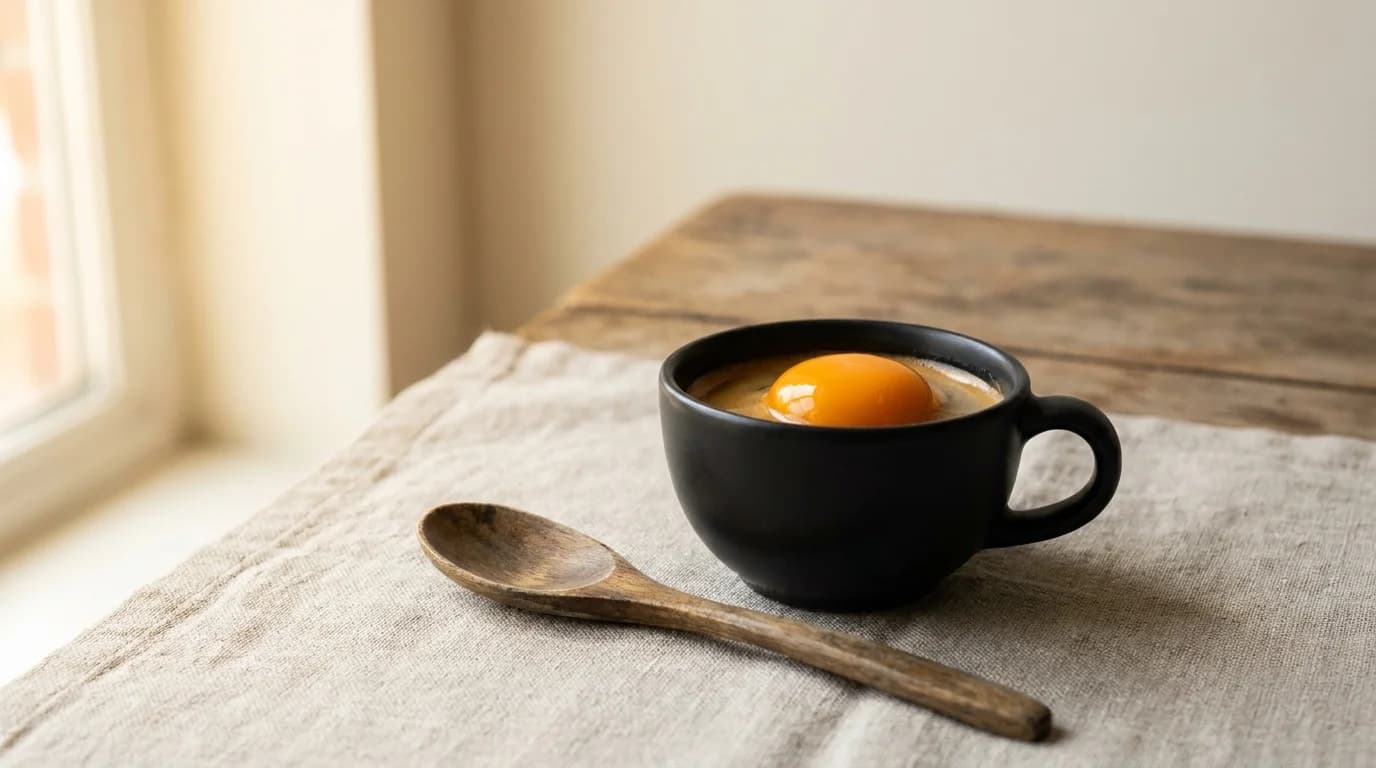
Standing egg coffee is a visual spectacle that became a social media moment: a raw egg yolk balanced upright on the surface of black espresso, defying the obvious expectation that it should spread and sink. The drink originated in South Korea, went viral internationally through platforms like TikTok and Instagram around 2022–2024, and prompted enough curiosity about the underlying physics to merit an explanation beyond the obvious "how do I drink this."
Vitelline membrane — the structural reason
the egg yolk's ability to stand upright depends on the vitelline membrane — a thin transparent protein film that encases the yolk and maintains its spherical structure; a very fresh egg has a strong membrane capable of holding the yolk's shape on a surface under tension[1]
Surface tension of hot coffee supports the yolk
the surface of hot coffee has sufficient surface tension to partially support the weight of an egg yolk placed carefully on top — the yolk sits in a slight depression in the coffee surface rather than floating freely[2]
Distinct from Vietnamese egg coffee
Vietnamese egg coffee (cà phê trứng) uses the yolk whipped with condensed milk into a thick cream, placed as a separate layer; standing egg coffee places the raw intact yolk unmodified on the surface — different technique, different texture, different flavour[1]
What standing egg coffee is
The drink is simple in composition: a shot (or double shot) of espresso, an Americano, or a strong drip coffee is poured into a small cup or bowl, and a raw egg yolk — carefully separated from the white — is placed on the coffee's surface with precision.
Done correctly, the yolk sits upright on the surface, appearing to balance on the coffee like a small orange sphere. Done incorrectly — with an older egg, rough handling, or a careless pour — the yolk breaks on placement or immediately spreads flat across the surface.
The visual impact is the point: the drink was designed for the camera as much as for the palate, and the standing yolk photograph became a widely replicated social media format in South Korean café culture before spreading internationally.
The science of the standing yolk
Three physical phenomena contribute to the standing effect:
The vitelline membrane: Every egg yolk is enclosed in a thin transparent protein film called the vitelline membrane. This membrane maintains the yolk's spherical shape when the egg is separated from the white. In a very fresh egg (ideally 1–3 days old), the membrane is strong and taut, capable of holding the yolk together under moderate stress. As an egg ages, the membrane weakens — the yolk of a week-old egg will flatten more readily than a day-old egg's.
The membrane is the primary reason the yolk can be placed on a surface and retain its shape rather than immediately collapsing. The fresher the egg, the stronger the membrane, the more successfully the yolk will stand[1].
Surface tension of the coffee: Hot coffee has measurable surface tension — the cohesive force between water molecules at the liquid-air interface. When the egg yolk is placed on the surface, the surface tension partially supports the weight of the yolk, preventing it from immediately sinking. The yolk sits in a shallow depression in the surface, held from below by the tension and from within by the membrane.
The surface tension is sufficient for support but not impenetrable — a heavy or rough placement will pierce the surface and sink or break the yolk.
Placement technique: The barista (or home preparer) places the yolk by:
- Separating the egg, discarding or reserving the white
- Tilting the cup and sliding the yolk gently onto the surface, minimising impact force
- Some preparers briefly rest the yolk in a spoon first and lower it slowly to minimise disturbance
The standing effect is not indefinite. As the membrane warms from the hot coffee beneath it and the hot air around it, it softens. A standing yolk may hold for 30–60 seconds before beginning to visibly flatten. The drink is meant to be photographed and then consumed quickly.
How the yolk changes the coffee
When the yolk is stirred into the espresso or Americano, the fat and protein in the yolk partially emulsify with the hot coffee. The result[2]:
- Increased viscosity: egg yolk lecithin acts as an emulsifier, binding water and fat and thickening the liquid slightly
- Richness: the fat content of the yolk (~5g per yolk) adds a perceptible richness to the cup
- Mild egg flavour: a subtle egg-custard note is detectable, though the espresso's own flavour dominates
- Reduced bitterness: the fat partially coats the palate, similar to how milk reduces espresso's perceived bitterness
The standing egg coffee is generally unsweetened — the yolk adds richness but not sweetness, producing a savoury-rich rather than sweet cup. Some Korean cafés add a small amount of sugar to the yolk before placement, creating a slightly sweetened version.
Standing egg vs Vietnamese egg coffee
The two drinks share an ingredient but are otherwise quite different[1]:
| Standing egg coffee | Vietnamese egg coffee | |
|---|---|---|
| Origin | South Korea | Hanoi, Vietnam (1946) |
| Egg preparation | Raw yolk, intact, unmodified | Yolk whipped with condensed milk or sugar |
| Texture | Raw, silky when stirred in | Thick, mousse-like cream layer |
| Sweetness | Typically unsweetened | Sweet from condensed milk |
| Temperature | Hot espresso base | Hot coffee base |
| Flavour | Rich, subtle egg note | Custard, sweet, prominent egg cream |
| Visual | Yolk standing on surface | Cream layer on top of dark coffee |
Vietnamese egg coffee (cà phê trứng) was invented by Nguyễn Văn Giảng at Cafe Giang in Hanoi around 1946, reportedly as an alternative when milk was scarce. The yolk is whipped vigorously with condensed milk or sugar until it becomes a stable, dense foam — a room-temperature custard — which is then spooned onto Vietnamese-style drip coffee.
The honest summary
Standing egg coffee is a Korean café drink — a hot espresso or Americano with a raw egg yolk placed on the surface to stand upright. The standing effect depends on the strength of the egg's vitelline membrane (freshest eggs work best), the surface tension of the hot coffee, and careful placement technique. The yolk is broken and stirred into the coffee before drinking, adding richness, viscosity, and a mild custard note through yolk fat emulsification. It is distinct from Vietnamese egg coffee, where the yolk is whipped with condensed milk into a thick cream before serving. The drink's viral spread was primarily visual — designed for social media before flavour — though the resulting cup is genuinely more complex than plain espresso.
Frequently asked questions
- What is standing egg coffee?
- Standing egg coffee is a Korean coffee drink consisting of a hot espresso or Americano with a raw egg yolk placed on the surface of the coffee in a way that the yolk stands upright rather than spreading flat. The drink became popular in South Korea and spread internationally through social media around 2022–2024. The standing yolk is the visual centrepiece — the drinker stirs it into the coffee before drinking, which adds richness and an egg-custard quality to the cup.
- Why does the egg yolk stand upright in the coffee?
- The egg yolk's ability to stand upright depends on three factors: the structural integrity of the vitelline membrane (the thin transparent film surrounding the yolk), the surface tension of the hot coffee which supports the yolk from below, and the careful placement technique of the barista. A fresh egg has a strong, intact vitelline membrane that can bear the yolk's weight briefly on a surface with sufficient tension. The standing is temporary — as the membrane begins to soften from the heat and the yolk warms, it will eventually flatten. Most drinkers break the yolk immediately before drinking.
- How do you drink standing egg coffee?
- Once the standing egg coffee is served, most cafés instruct you to stir the yolk into the coffee yourself. The yolk breaks and mixes with the hot coffee, emulsifying slightly and adding richness, fat, and a mild egg flavour to the cup. Some drinkers like to eat part of the yolk with a spoon before mixing the rest. The resulting coffee is noticeably richer and more viscous than black espresso or Americano.
- What is the difference between standing egg coffee and Vietnamese egg coffee?
- The technique and result are quite different. Vietnamese egg coffee (cà phê trứng) from Hanoi uses the yolk whipped with sweetened condensed milk or sugar into a thick, custard-like foam, which is spooned on top of coffee as a separate cream layer. The yolk in Vietnamese egg coffee is cooked by the whipping process and is not raw. Standing egg coffee places the raw, intact yolk directly on the coffee surface unwhipped. The textures and flavour profiles are distinct: Vietnamese egg coffee is sweet and creamy; standing egg coffee is richer and more subtle.
- Is it safe to drink raw egg in coffee?
- Raw eggs carry a small risk of Salmonella contamination. The hot coffee in standing egg coffee does not reach a temperature sufficient to fully cook or sterilise the egg yolk — the yolk sits on the surface, not submerged in boiling liquid. People who are pregnant, immunocompromised, elderly, or otherwise at higher risk from Salmonella should approach raw egg drinks with caution. Some cafés use pasteurised eggs specifically for this drink.
References
Every factual claim in this article is drawn from the sources below. See the source library for how we grade evidence.
- [1]Brewing FundamentalsCoffee Science Foundation · Reference work · Tier 2 · Moderate
- [2]Coffee volatile compounds and roast markersPMC / NIH · 2016 · Review · Tier 2 · Moderate
Related reading
- Espresso & Coffee DrinksVietnamese Egg Coffee: The Hanoi Original→
- Espresso & Coffee DrinksWhat Is Espresso? Pressure, Extraction, the Shot→
- Espresso & Coffee DrinksAffogato: Espresso Poured Over Ice Cream→
- Brew MethodsVietnamese Coffee Guide: Phin, Cà Phê Sữa, Robusta→
- Espresso & Coffee DrinksIced Latte: Cold Espresso with Milk Explained→
- Espresso & Coffee DrinksLatte Art: How to Pour Designs in Milk Foam→