Carajillo: The Spanish Coffee Cocktail
By Coffee Studies Editorial·Published July 18, 2026·7 min read
Quick answer
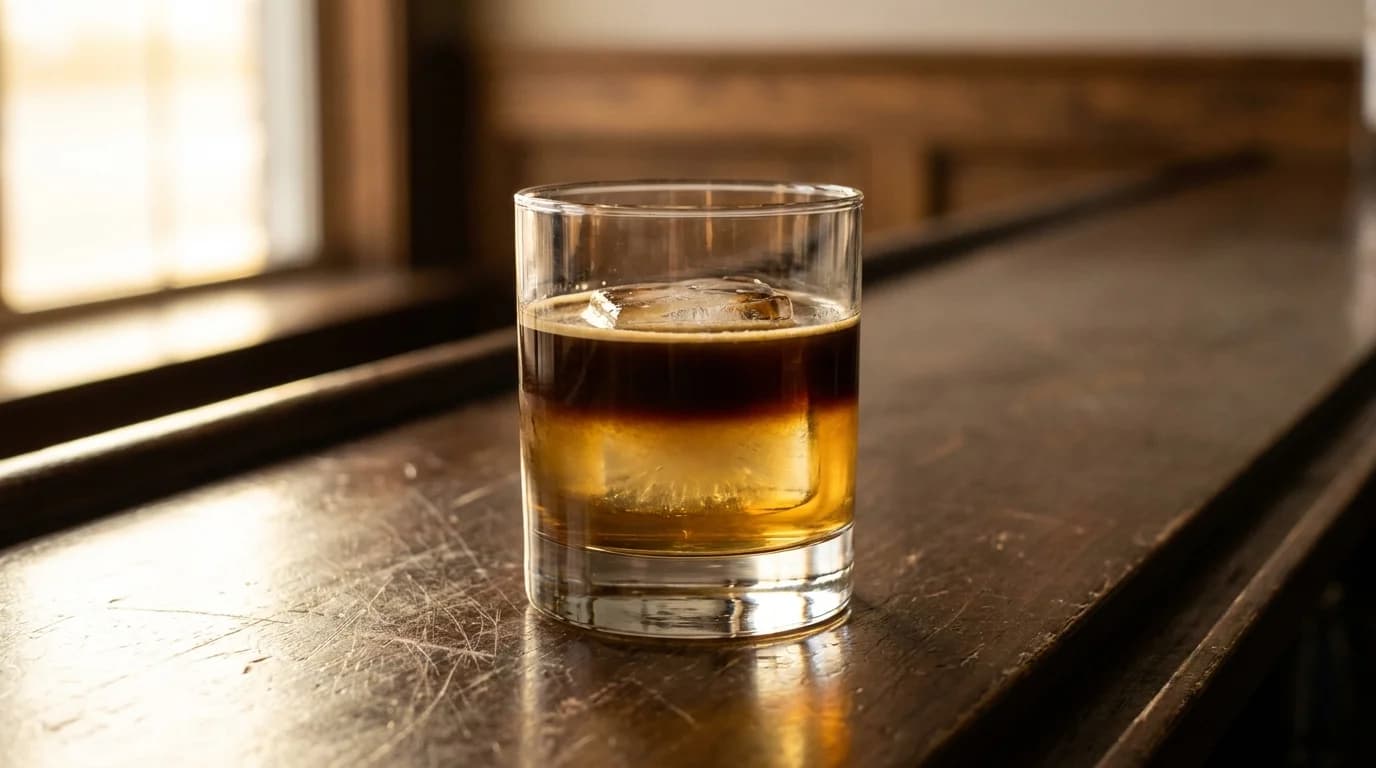
The carajillo is two drinks that share one name. The original is Spanish: a small hot coffee with a shot of brandy, rum, whisky, or anisette — an unfussy after-meal ritual you can still order in any café in Spain. The one conquering cocktail menus internationally is Mexican: espresso and Licor 43 over ice, roughly equal parts, often shaken until a dense foam sits on top like crema. Both are legitimately "carajillo." Knowing which one a menu means — and how each is built — is most of what there is to understand about the drink.
Spanish original
coffee 'corrected' with brandy, rum, whisky, or anisette — an everyday after-meal drink in Spanish café culture[1]
Licor 43
the Mexican carajillo is defined by this sweet Spanish vanilla-citrus liqueur (31% ABV), typically in equal parts with espresso[2]
~1 standard drink + a double espresso
a Mexican carajillo delivers both a full serving of alcohol and roughly 120–140 mg of caffeine[3]
The Spanish carajillo
The carajillo begins as a Spanish café staple: a small strong coffee with a spirit added directly to the cup.
The classic forms:
- Carajillo de brandy — the most common: espresso or strong coffee with a short pour (roughly 15–30 mL) of Spanish brandy. The default meaning of "carajillo" in most of Spain.
- Carajillo de ron — with rum instead of brandy; common along the Mediterranean coast.
- Carajillo de whisky — with whisky; a standard option on café menus.
- Carajillo de anís — with anisette (sweet anise liqueur); a distinctly Spanish variation with a licorice edge.
- Carajillo quemado — "burned" carajillo: the spirit is warmed and flamed with sugar (and sometimes coffee beans or citrus peel) before the coffee is added. Common in Catalonia and Valencia, where the drink is sometimes called a cremaet.
The Spanish carajillo is not a dessert cocktail. It is served hot, usually in a small glass, usually after lunch or dinner, and it is closer in spirit to an espresso with a correction than to a mixed drink. In Italy the same idea exists as caffè corretto — espresso "corrected" with grappa or sambuca[1].
The name
The popular origin story says Spanish soldiers or workers in colonial Cuba added rum to their coffee for coraje — courage — and "coraje" softened into "carajillo." It's a good story, and it may even be true, but it is folk etymology: repeated everywhere, reliably documented nowhere. What is well established is that coffee-with-brandy has been an ordinary Spanish café order since at least the late 19th century, part of the same European café culture that produced the Irish coffee and the caffè corretto[2].
The Mexican carajillo
The version most people mean today. At some point in the 20th century the carajillo crossed to Mexico with Spanish emigrants, and Mexican restaurant culture gradually standardized it around one specific liqueur: Licor 43 (Cuarenta y Tres), a sweet golden Spanish liqueur — reportedly built on 43 ingredients — with dominant vanilla and citrus notes, bottled at 31% ABV.
The Mexican carajillo became a fixture of long restaurant lunches and after-dinner rounds, and over the past decade it has spread onto cocktail menus across North America, usually listed as "carajillo" or "carajillo 43."
The standard build:
- 1.5 oz (45 mL) Licor 43
- 1 double espresso (~1.5 oz / 45 mL), freshly pulled
- Large ice cube(s), rocks glass
Figure
Mexican carajillo: standard ratio by volume
Two ways to serve it:
- Built (layered) — pour Licor 43 over ice, then pour the espresso slowly over the top. The drink arrives visibly two-toned — golden below, dark above — and the drinker stirs it. Prettier presentation.
- Shaken — shake Licor 43 and espresso hard with ice, then strain over fresh ice. Shaking aerates the espresso into a dense foam cap, like an espresso martini's. Better texture, more integrated flavour.
Espresso quality matters more than it might seem: the drink is half coffee, and a stale or over-bitter shot reads clearly through the sweetness. A fresh double shot with intact crema is the difference between a balanced cocktail and a sweet mess[3].
Regional and modern variants
| Variant | Coffee | Spirit | Served | Where |
|---|---|---|---|---|
| Carajillo de brandy | Hot espresso / strong coffee | Spanish brandy | Hot, small glass | Spain (default) |
| Carajillo de anís | Hot espresso | Anisette | Hot | Spain |
| Carajillo quemado / cremaet | Hot coffee | Flamed rum or brandy + sugar | Hot | Catalonia, Valencia |
| Carajillo 43 (Mexican) | Double espresso | Licor 43 | Cold, over ice | Mexico → international |
| Carajillo with mezcal | Double espresso | Licor 43 + mezcal float | Cold | Modern Mexican bars |
| Carajillo with Kahlua | Double espresso | Kahlua (substitution) | Cold | Casual substitution |
| Caffè corretto | Espresso | Grappa / sambuca | Hot | Italy (cousin, not a carajillo) |
The mezcal carajillo deserves a note: adding a half ounce of mezcal against the Licor 43 cuts the sweetness with smoke and is probably the most common "bartender's twist" on the drink in modern Mexican restaurants.
Carajillo vs espresso martini vs Irish coffee
The carajillo sits in a family of coffee-plus-alcohol drinks that are often confused:
| Carajillo 43 | Espresso martini | Irish coffee | |
|---|---|---|---|
| Temperature | Cold, on ice | Cold, strained (no ice in glass) | Hot |
| Alcohol | Licor 43 only | Vodka + coffee liqueur | Irish whiskey |
| Sweetener | The liqueur itself | Liqueur + optional syrup | Brown sugar |
| Ingredients | 2 | 3–4 | 4 |
| Effort | Very low | Medium (shake + strain) | Medium (float cream) |
| Character | Sweet vanilla-citrus dessert | Boozy coffee cocktail | Warming cream-topped classic |
The carajillo's appeal is its simplicity — two ingredients, no syrup, no cream, no garnish beyond the ice. It is the lowest-effort "real" coffee cocktail there is, which is a large part of why restaurants love it.
See Spanish Coffee for the flambéed American cocktail that shares the Spanish naming confusion, and Irish Coffee for the hot classic.
Making a carajillo at home
Mexican carajillo (the one to start with):
- Fill a rocks glass with ice — one large cube is ideal.
- Pour 1.5 oz (45 mL) Licor 43 over the ice.
- Pull a fresh double espresso (or brew ~45 mL of very strong coffee — a moka pot works acceptably).
- Either pour the espresso gently over the liqueur for the layered look, or shake everything with ice and strain over fresh ice for the foam cap.
- No garnish needed. Some bars add an orange twist or three coffee beans; neither is required.
No espresso machine? A moka pot or an AeroPress pulled tight (fine grind, low water) gets close enough. Standard drip coffee is too dilute — the drink turns watery and thin. See Espresso Explained for what makes espresso concentration different.
Spanish carajillo: small hot strong coffee, 15–30 mL of brandy stirred in, optionally a little sugar. That's the whole recipe. For the quemado, warm the brandy with a teaspoon of sugar, flame it briefly, let the flame die, then add the hot coffee.
Alcohol, caffeine, and timing
A standard Mexican carajillo contains:
- Alcohol: ~1 standard drink (1.5 oz at 31% ABV).
- Caffeine: roughly 120–140 mg from a double espresso — a full coffee's worth[3].
- Sugar: substantial — Licor 43 is a sweet liqueur; expect roughly 15–20 g of sugar per serving.
- Calories: roughly 200–250.
Two practical consequences. First, caffeine masks the perception of alcohol impairment without reducing it — you feel more sober than you are. Second, an after-dinner carajillo delivers a full espresso's caffeine at exactly the time of day when caffeine most disrupts sleep. Neither makes the drink a problem; both are worth knowing before ordering a second.
Common misconceptions
- "A carajillo is espresso with Kahlua." Close but no — the Mexican classic is specifically Licor 43 (vanilla-citrus), not Kahlua (coffee liqueur). Kahlua makes a fine drink; it's just a different one.
- "The carajillo is Mexican." The drink and the name are Spanish; the Licor 43 serve is the Mexican evolution. Both countries have a fair claim to the version they drink.
- "It's served hot." The Spanish original is hot; the internationally popular Mexican version is cold, over ice.
- "The 'coraje' origin story is documented history." It's folk etymology — plausible, widely repeated, and unverified.
- "Any coffee works." The drink is half coffee by volume. Weak or stale coffee is fully audible in the result.
The honest summary
The carajillo is Spain's everyday coffee-with-a-spirit that grew a second, internationally famous identity in Mexico: equal parts espresso and Licor 43 over ice, built or shaken. The Spanish version is a hot, modest, after-meal ritual; the Mexican version is a two- ingredient dessert cocktail with genuine balance — espresso bitterness against vanilla-citrus sweetness — and essentially zero technique barrier. If you can pull a decent espresso, you can make a carajillo indistinguishable from a restaurant's. Just remember it is simultaneously a full drink and a full coffee, and time it accordingly.
Frequently asked questions
- What is a carajillo?
- A carajillo is coffee with a spirit added. The Spanish original is a small hot coffee 'corrected' with brandy, rum, whisky, or anisette, drunk after meals. The Mexican carajillo — the version that has spread internationally — is a cold dessert cocktail of espresso and Licor 43 (a sweet Spanish vanilla-citrus liqueur), usually shaken or built over ice in roughly equal parts.
- What alcohol is in a carajillo?
- It depends on the tradition. Spanish carajillos most commonly use brandy (Brandy de Jerez), but rum, whisky, and anisette are all traditional. The Mexican carajillo is defined by Licor 43 (Cuarenta y Tres), a 31% ABV Spanish liqueur with vanilla and citrus notes. Substitutions like Kahlua, amaretto, or Baileys make a similar drink but are not the classic recipe.
- What is the ratio for a carajillo?
- The standard Mexican carajillo is roughly equal parts: about 1.5 oz (45 mL) Licor 43 and one double espresso (about 1.5 oz / 45 mL), served over ice. Some bars shake it with ice for a foamy top; others build it layered in the glass. Spanish hot carajillos are less standardized — typically a small espresso or strong coffee with 0.5–1 oz of spirit.
- Where does the carajillo come from?
- Spain — the drink and the name are Spanish, and coffee-with-brandy has been an everyday Spanish café order for well over a century. A popular folk etymology traces the name to Spanish soldiers in colonial Cuba taking coffee with rum for 'coraje' (courage), but this story is anecdotal and not reliably documented. The Licor 43 version became a signature of Mexican restaurant culture and spread internationally from there.
- Is a carajillo served hot or cold?
- Both exist. The traditional Spanish carajillo is hot — coffee with a spirit, sometimes with the spirit warmed or flamed first (carajillo quemado). The Mexican carajillo 43 is almost always served cold, over ice in a rocks glass, often shaken to produce a foam layer. If you order a carajillo in North America today, you will usually get the cold Mexican version.
- How strong is a carajillo?
- A standard Mexican carajillo with 1.5 oz of Licor 43 (31% ABV) contains roughly one standard drink of alcohol, plus the caffeine of a double espresso (roughly 120–140 mg). The caffeine can mask how much the alcohol is affecting you, so treat it as both a real drink and a real coffee — not ideal late at night, and not a drink to stack casually.
References
Every factual claim in this article is drawn from the sources below. See the source library for how we grade evidence.
- [1]CoffeeEncyclopaedia Britannica · Reference work · Tier 3 · Contextual
- [2]Uncommon Grounds: The History of Coffee and How It Transformed Our World (revised edition)Basic Books (Mark Pendergrast) · 2010 · Reference work · Tier 2 · Moderate
- [3]Brewing FundamentalsCoffee Science Foundation · Reference work · Tier 2 · Moderate
Related reading
- Espresso & Coffee DrinksSpanish Coffee: The Flambéed Rum Cocktail→
- Espresso & Coffee DrinksIrish Coffee: Whiskey, Cream, and Hot Coffee→
- Espresso & Coffee DrinksWhat Is Espresso? Pressure, Extraction, the Shot→
- Espresso & Coffee DrinksLungo: The Long Espresso Shot Explained→
- Espresso & Coffee DrinksStanding Egg Coffee: The Korean Viral Drink Explained→
- Espresso & Coffee DrinksLatte Art: How to Pour Designs in Milk Foam→