Ristretto vs Espresso vs Lungo
By Coffee Studies Editorial·Published July 15, 2026·6 min read
Quick answer
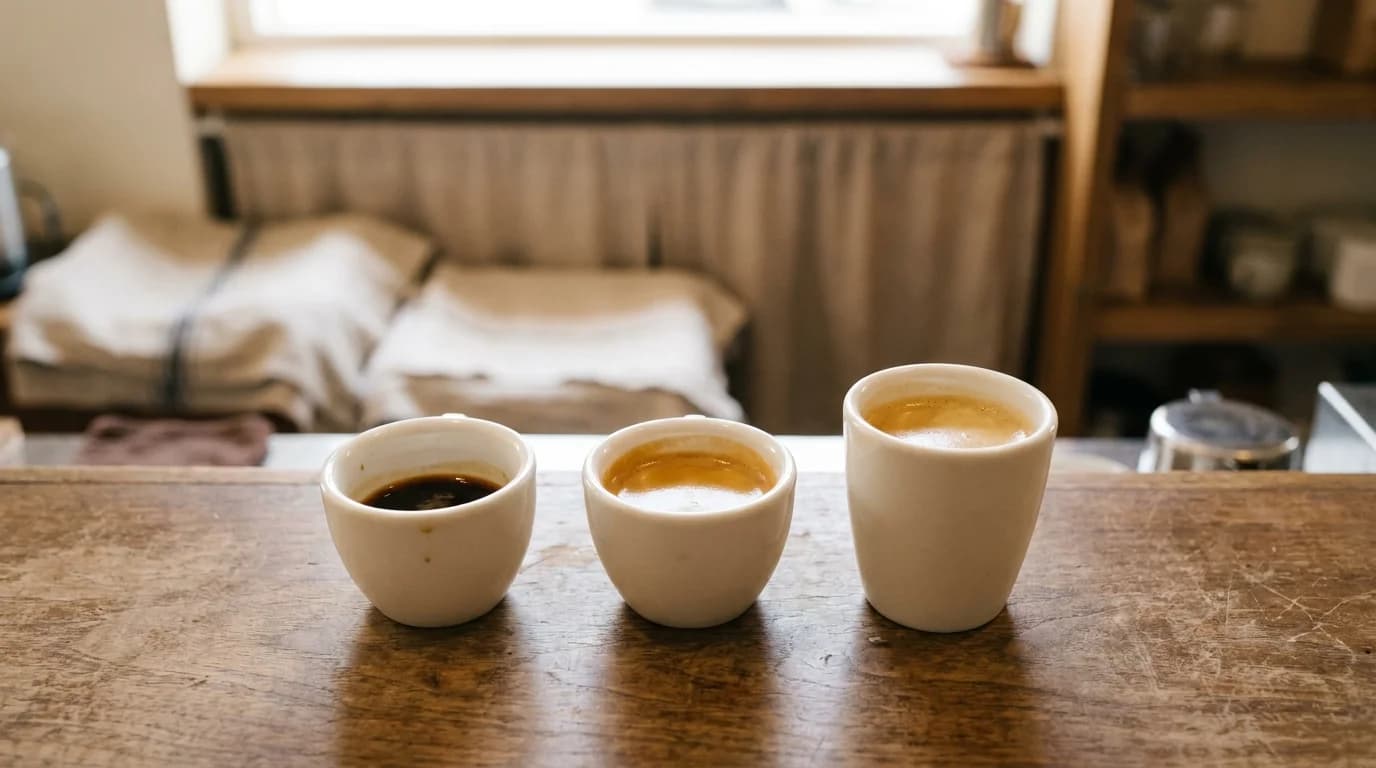
Ristretto, espresso, and lungo are three different pours from the same espresso setup — same beans, same dose, same grind. What changes is how long you let water run through the puck. That single variable produces three genuinely different drinks.
1:1 · 1:2 · 1:3+
the classic dose-to-yield ratios: ristretto, standard espresso, and lungo[4]
15 → 60 sec
the extraction time increases across the three pour sizes, from short ristretto to long lungo[1]
Same dose
all three use the same ~18 g of ground coffee — only the yield (finished liquid) changes[4]
The three pours, defined
All three are pulled from the same espresso machine, with the same fine grind and the same coffee dose. What changes is when the barista stops the extraction.
Ristretto ("restricted" in Italian):
- Ratio: about 1:1 (18 g coffee in, 18 g espresso out)
- Time: 15-20 seconds
- Volume: about 0.6 oz (15-20 mL)
- Flavour: intense, concentrated, sweeter, less bitter
- Purpose: to capture only the earliest, most concentrated extraction
Espresso (the standard):
- Ratio: about 1:2 (18 g coffee in, 36 g espresso out)
- Time: 25-35 seconds
- Volume: about 1.2 oz (30-40 mL)
- Flavour: balanced, the reference default
- Purpose: full flavour development in a small, concentrated shot
Lungo ("long" in Italian):
- Ratio: 1:3 or higher (18 g coffee in, 54-60+ g espresso out)
- Time: 40-60 seconds (sometimes more)
- Volume: about 2 oz (60 mL)
- Flavour: more diluted, more bitter, more caffeine
- Purpose: to extend extraction, pulling more compounds into the cup (including some that are only supposed to stay behind)
Why extraction timing matters
Espresso extraction is a rapidly evolving chemistry problem. In the first few seconds, water pulls out the most soluble compounds — sweet sugars, delicate aromatics, some caffeine. Later in the shot, larger and less soluble compounds dissolve — including many of the bitter and astringent ones.
A 2015 Journal of the Science of Food and Agriculture study looked at how variance in espresso extraction variables (grind, dose, pressure) affects finished cup quality. Small differences in extraction produce measurable differences in the drink, including which compounds end up in it[1].
Practically:
- Ristretto stops the shot before the bitter late-extraction compounds fully dissolve — resulting in a sweeter, more concentrated cup with less caffeine per shot.
- Standard espresso captures a balanced mid-extraction — the sweet spot where most drinkers find the best balance.
- Lungo extends into the late-extraction phase — extracting more total mass (including more caffeine), but also pulling in compounds that produce bitterness.
Caffeine — the counterintuitive part
Because the same dose of coffee is used for all three, but water extracts caffeine more thoroughly with longer contact time:
- Ristretto ≈ 40-50 mg of caffeine per shot
- Espresso ≈ 60-65 mg per shot
- Lungo ≈ 80-100 mg per shot
Ristretto is stronger tasting (more concentrated flavour per ounce) but contains less total caffeine than standard espresso. Lungo is weaker tasting (more dilute) but has more caffeine.
This is the opposite of what most drinkers assume. The intensity of a shot is not the same as its caffeine content.
The flavour trade-offs
Ristretto:
Pros:
- Sweetest of the three — best pull for enjoying sweetness in specialty coffees
- Least bitter
- Concentrated aromatic impact
Cons:
- Very small serving (some drinkers want more)
- Can be too intense for people who prefer balanced or milder coffee
- Requires very precise grind and dose (small variations show up dramatically)
Standard espresso:
Pros:
- Balanced — the default reference for a reason
- Well-studied optimal extraction range
- Works well with milk-based drinks (lattes, cappuccinos)
Cons:
- If you specifically want sweeter or more concentrated, ristretto is better
- If you want more volume or more caffeine per shot, lungo is better
Lungo:
Pros:
- More caffeine per shot
- Larger volume — more drinkable as a standalone cup
- Often preferred by people who want espresso volume closer to drip coffee
Cons:
- More bitter than the shorter pulls
- Extends into over-extraction territory
- Some argue you're better off with a stronger drip coffee for a larger cup
When to choose each
Choose ristretto when:
- Drinking a high-quality single-origin espresso beans
- The beans are sweet, delicate, or particularly nuanced
- You want intensity without volume
- You're using dark-roasted coffee (ristretto reduces the bitterness that dark roasts push at longer extraction)
Choose standard espresso when:
- Default — this is what almost every recipe assumes
- Making milk drinks (lattes, cappuccinos, flat whites)
- Any situation where you're not sure
Choose lungo when:
- You want a larger espresso-style cup without switching to drip
- You specifically want more caffeine per shot
- The beans handle extended extraction well (some do; some don't)
- You're using an automatic machine that offers a lungo button and you want a bigger cup
The Nespresso lungo question
Nespresso machines popularised the lungo pour in home espresso — the machines have specific "lungo" capsules and buttons for a longer extraction. Nespresso lungo capsules use slightly larger coffee doses than espresso capsules to compensate for the extended extraction and make the finished cup less bitter than a lungo from an espresso-dose capsule would be.
This is a good reminder that lungo doesn't have to be worse than espresso — with the right dose and grind adjustments, a lungo can be quite pleasant. It's when you extend a shot that was optimised for standard espresso extraction that you get the classic "lungo is bitter" experience.
Common misconceptions
- "Ristretto has more caffeine." No — less. Concentration is not the same as total amount.
- "Lungo is weaker." In one sense (dilution) yes, but in caffeine terms it's higher.
- "All three should extract at the same rate." No — each targets a different range of the extraction curve. You may need to grind slightly finer for ristretto (to achieve the same short-time extraction quality) or slightly coarser for lungo (to slow water flow enough to avoid too much over-extraction).
- "Ristretto is just espresso for weak drinkers." No — many serious coffee drinkers prefer ristretto specifically for its sweetness and concentration. It's a different flavour target, not a milder version.
A 2013 comparison across brewing methods
The European Food Research and Technology study of nine extraction methods included multiple espresso pull sizes (different espressi and lunghi) and confirmed that pull-size differences produce distinct compound profiles[2]. Chemistry catches up with intuition — the same beans produce meaningfully different drinks depending on how long extraction runs.
Hitting any of these three deliberately rather than by accident needs a machine that holds pressure and temperature steadily, which is the real dividing line between price tiers — see Breville espresso machines compared.
The honest summary
Ristretto, espresso, and lungo are three pour sizes from the same espresso setup. Ristretto is short and sweet with less caffeine. Standard espresso is the balanced default. Lungo is long, more caffeinated, and more bitter. Same beans, same dose — only the extraction time changes. Choose based on what you want from the cup, and don't let intuition about "strength" fool you about caffeine content.
Frequently asked questions
- Does a ristretto have more caffeine than an espresso?
- No — per shot, less. Ristretto uses the same dose of ground coffee as espresso but stops the pour earlier, extracting less total caffeine. Standard espresso extracts more caffeine than ristretto because more water passes through the puck. Lungo extracts the most caffeine per shot because water runs longest.
- Is ristretto sweeter than espresso?
- Often, yes. The earliest phase of espresso extraction pulls out more of the sweet, aromatic compounds and less of the bitter late-extraction compounds. Ristretto captures mostly this early extraction — resulting in a shot that tastes more concentrated, sweeter, and less bitter than a normal shot from the same beans.
- Why is lungo more bitter?
- Because you're extending water contact into the phase where late-extracting bitter compounds start dominating. Beyond about 40 seconds of extraction, you're past the golden zone and pulling out tannins and larger bitter molecules — which is why lungo is typically the most bitter of the three pours.
- What ratio should I use for each?
- Ristretto: about 1:1 (18 g coffee, 18 g liquid espresso). Standard: 1:2 (18 g in, 36 g out). Lungo: 1:3 or higher (18 g in, 54+ g out). These are starting points — small adjustments depend on your beans and machine.
References
Every factual claim in this article is drawn from the sources below. See the source library for how we grade evidence.
- [1]How the variance of some extraction variables may affect the quality of espresso coffees served in coffee shopsJournal of the Science of Food and Agriculture · 2015 · Observational study · Tier 2 · Moderate
- [2]Comparison of nine common coffee extraction methods: instrumental and sensory analysisEuropean Food Research and Technology · 2013 · Controlled trial · Tier 2 · Moderate
- [3]Influence of Water Pressure on the Final Quality of Arabica Espresso CoffeeJournal of Agricultural and Food Chemistry · 2002 · Controlled trial · Tier 2 · Moderate
- [4]Brewing FundamentalsCoffee Science Foundation · Reference work · Tier 2 · Moderate
Related reading
- Espresso & Coffee DrinksWhat Is Espresso? Pressure, Extraction, the Shot→
- Espresso & Coffee DrinksWhat Is Crema? The Golden Foam on Espresso→
- Espresso & Coffee DrinksThe Origin of Espresso: How Italy Invented the Shot→
- Espresso & Coffee DrinksRistretto: The Short Concentrated Espresso Shot→
- Coffee EquipmentBreville Espresso Machines Compared: What Actually Differs→
- Espresso & Coffee DrinksLungo: The Long Espresso Shot Explained→