Ristretto: The Short Concentrated Espresso Shot
By Coffee Studies Editorial·Published July 18, 2026·5 min read
Quick answer
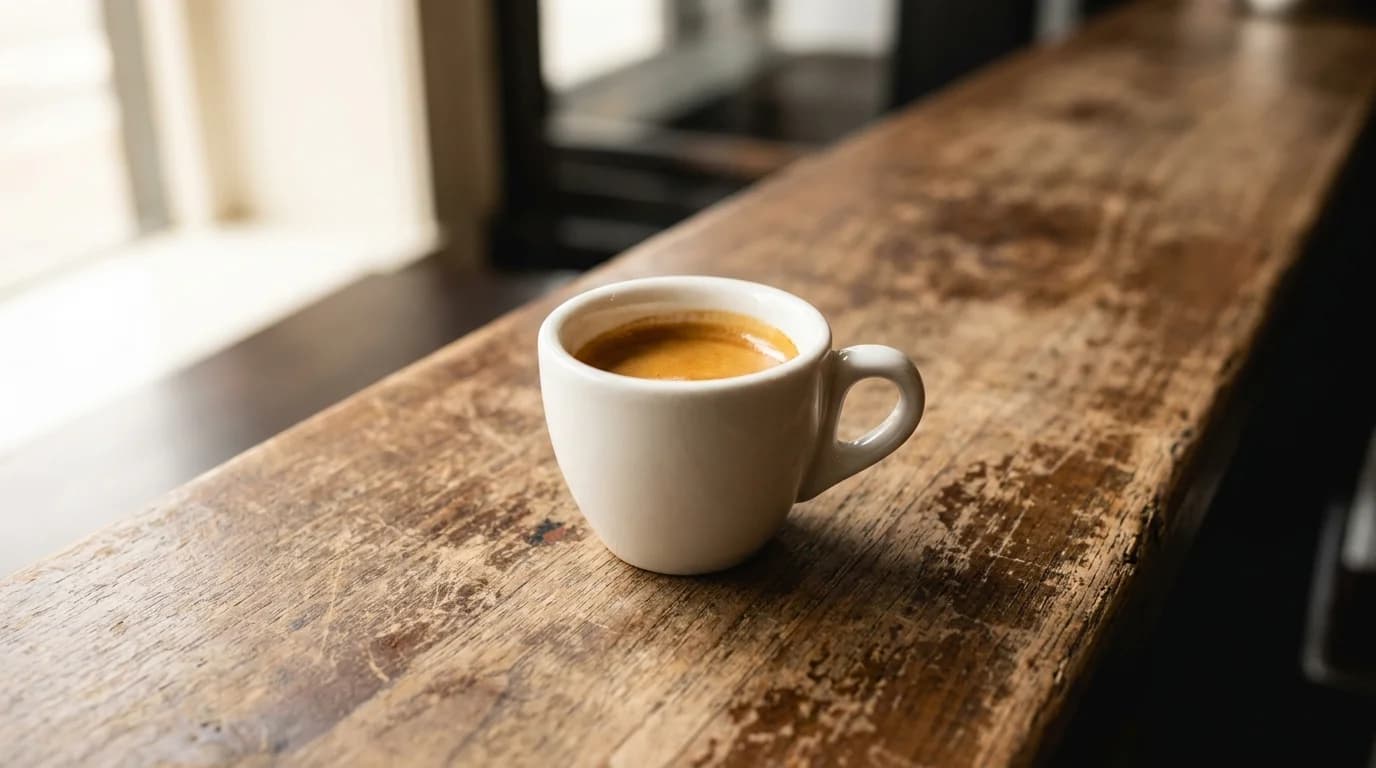
The word ristretto means "restricted" in Italian — and the drink is exactly that: a standard espresso dose pulled with less water, stopping the extraction before the bitter compounds that arrive late in the shot. What comes out first, the research shows, is sweeter and more aromatic; what comes out last is more bitter and astringent. A ristretto simply takes the first half and stops.
It is the smallest, most concentrated form of espresso in everyday use, and it splits coffee opinion: some find the intense sweetness revelatory, others miss the familiar bitterness of a full shot. Understanding why the extraction sequence works this way resolves the debate.
15–20 mL
standard single ristretto output — roughly half the water volume of a single espresso (30 mL), pulled from the same coffee dose[1]
Sweeter, less bitter
the restricted extraction captures early-extracting sugars and fruit acids before the later-extracting bitter phenolic compounds reach the cup[3]
Standard base for milk drinks at specialty cafés
many third-wave cafés pull double ristrettos as their espresso base — the sweetness and intensity carry through milk better than a standard shot[1]
Why extraction order matters
Espresso extraction is sequential: different compounds dissolve at different rates as hot water passes through the coffee puck. The first liquid through the grounds is the richest and most aromatic; as more water follows, later-extracting compounds — including bitter chlorogenic acid derivatives and certain phenolics — begin to dominate[3].
A ristretto exploits this sequence by halting extraction early. In rough terms:
- Early extraction (0–15 mL): sugars, fruity organic acids, early aromatic compounds. High concentration, sweet, complex.
- Mid extraction (15–30 mL): the core espresso flavour zone. Balanced bitterness, sweetness, body.
- Late extraction (30+ mL): increasingly bitter, astringent, with harsh phenolic notes. This is why a lungo (pulled long) tastes thin and bitter despite more water.
A ristretto stops at the first window; a lungo runs through all three. Neither is "better" — they are different expressions of the same coffee.
Figure
Espresso extraction: output volume comparison (single dose)
Values in mL
The parameters
| Parameter | Ristretto | Standard espresso | Lungo |
|---|---|---|---|
| Dose (single) | 9–10 g | 9–10 g | 9–10 g |
| Output | 15–20 mL | 25–35 mL | 50–60 mL |
| Ratio (coffee:water) | ~1:1.5 | ~1:2.5 | ~1:5+ |
| Brew time | 20–25 sec | 25–30 sec | 30–40 sec |
| TDS (concentration) | Higher | Standard | Lower |
| Caffeine per shot | ~60–70 mg | ~65–75 mg | ~75–85 mg |
| Character | Sweet, syrupy, intense | Balanced | Thin, bitter |
One counterintuitive number in that table: caffeine per shot is lower in a ristretto than a lungo despite the higher concentration. Caffeine is relatively slow to extract; the restricted water simply doesn't have time to pull as much of it out. If you're ordering a ristretto to get less caffeine, the effect is modest and you'd be better off with a smaller drink overall. If you're ordering it for flavour, the case is clear[2].
How to pull a ristretto
On an espresso machine:
- Dose and grind the same as espresso. Use your standard single (9–10 g) or double (18–20 g) dose. Grind can be fractionally finer than your usual espresso setting to compensate for the shorter brew time, but often no change is needed.
- Tamp normally. Standard tamp pressure; no special technique required.
- Stop the shot early. Target 15–20 mL for a single, 30–40 mL for a double. Use a shot glass with volume markings, a timer, or a scale under the cup — most modern machines allow you to stop the pull manually.
- Aim for 20–25 seconds total extraction time. If you're hitting 15 mL in 15 seconds, grind finer. If it takes 35 seconds to reach 20 mL, grind coarser.
- Taste and adjust. A good ristretto is intensely sweet and complex, not sour. Sourness means under- extraction (too fast); bitterness means the grind or dose is off.
No espresso machine? A ristretto can be approximated with an AeroPress: use a high dose (15–18 g), fine grind, minimal water (around 30–40 mL), and a short press time. Not identical — the pressure dynamics are different — but in the same flavour direction[1].
Ristretto in milk drinks
The double ristretto is where the format earns most of its commercial relevance. Many specialty cafés use a doppio ristretto — 18–20 g of coffee pulled to 30–40 mL — as their standard espresso base for flat whites, cappuccinos, and lattes instead of a standard double.
The reasoning: steamed milk is sweet and fatty. It competes with espresso bitterness but amplifies espresso sweetness. A double ristretto brings forward the sweet, fruity character of the espresso and cuts the bitter edge that can taste sharp through milk. The drink reads as more chocolatey, more caramel, and more complex than the same drink built on a standard double shot.
See Flat White and Cappuccino for how the espresso base interacts with the milk build specifically.
Ristretto vs espresso vs lungo
A full three-way comparison is in Ristretto vs Espresso vs Lungo. In brief:
Choose ristretto when:
- You want maximum espresso intensity with minimum bitterness.
- You are drinking it straight (no milk) and want a short, sweet experience.
- You are making a milk drink and want the coffee to carry through richly.
Choose standard espresso when:
- You want the balanced benchmark — the classic espresso flavour profile.
- You are less familiar with ristretto and want a reliable reference point.
Choose lungo when:
- You want a longer, larger coffee that still comes from an espresso machine, with more volume and slightly more caffeine per serving.
- Note that lungo is not equivalent to Americano — Americano dilutes a standard espresso with hot water after brewing; lungo is pulled through the puck with more water during brewing.
Common misconceptions
- "Ristretto has less caffeine per serving." Slightly less than a lungo, roughly similar to a standard espresso from the same dose. The concentration is higher but the total dissolved caffeine is not dramatically different.
- "Ristretto is too sour." Sourness in a ristretto usually means the extraction ran too fast — grind finer, or check the dose. A correctly pulled ristretto is sweet, not sour.
- "It's just a small espresso." The volume is smaller but the extraction ratio is what defines it. A small espresso pulled to the standard ratio is just a short shot; a ristretto is specifically the early extraction fraction.
- "Only specialty cafés do this." A ristretto setting is standard on most commercial machines and many home machines. It is not a niche technique.
The honest summary
A ristretto is a short, restricted espresso shot — half the water, same coffee dose, roughly 15–20 mL of output — that captures the sweet, aromatic early extraction before the bitter compounds arrive. The result is more concentrated, more syrupy, and perceptibly sweeter than a standard espresso, with less bitterness. It is not a novelty or an affectation: it is a deliberate extraction choice with a specific flavour rationale, widely used as the milk-drink base in specialty coffee. Pulling one well is a grind and yield calibration exercise; understanding why it tastes the way it does is a one-paragraph chemistry lesson about extraction sequence.
Frequently asked questions
- What is a ristretto?
- A ristretto is a short espresso shot pulled with the same coffee dose as a standard espresso but roughly half the water volume — about 15–20 mL of output versus a standard single espresso's 30 mL. 'Ristretto' is Italian for 'restricted.' The shorter extraction captures the early, sweeter solids from the grounds while leaving behind more of the bitter, astringent compounds that extract later in the shot.
- Is ristretto stronger than espresso?
- Ristretto is more concentrated than espresso — more dissolved solids per millilitre — but the total amount of caffeine per shot is roughly the same or slightly less, since there's simply less water to extract it. If 'stronger' means more intense flavour, then yes. If it means more caffeine per serving, not necessarily — a standard double espresso delivers more caffeine than a ristretto pulled from the same dose.
- What does ristretto taste like?
- Sweeter, more intense, and less bitter than a standard espresso. The restricted extraction pulls sugars, fruity acids, and early aromatics without pushing into the later bitterness window. The body is thicker and more syrupy. Many specialty cafés prefer ristretto as the espresso base for milk drinks because the sweetness carries through steamed milk better than the bitterness of a long espresso.
- How do you make a ristretto?
- Use the same dose and grind as a standard espresso (typically 9–10 g for a single). Pull the shot to approximately 15–20 mL output instead of the usual 30 mL — stopping the extraction early, ideally in 20–25 seconds. Some machines have a preset ristretto setting; on others, watch the volume and stop the shot manually. The grind can be very slightly finer than your espresso setting to compensate for the shorter pull.
- What is a double ristretto?
- A double ristretto (doppio ristretto) uses a double dose of coffee (typically 18–20 g) but pulls to roughly 30–40 mL — double the water of a single ristretto, which still yields a shorter, more concentrated shot than a standard double espresso pulled to 60 mL. This is the base shot used by many specialty cafés for lattes and cappuccinos, delivering intense espresso character that holds up through milk.
References
Every factual claim in this article is drawn from the sources below. See the source library for how we grade evidence.
- [1]Brewing FundamentalsCoffee Science Foundation · Reference work · Tier 2 · Moderate
- [2]Influence of Water Pressure on the Final Quality of Arabica Espresso CoffeeJournal of Agricultural and Food Chemistry · 2002 · Controlled trial · Tier 2 · Moderate
- [3]Coffee extraction kinetics in a well mixed systemJournal of Mathematics in Industry · 2016 · Review · Tier 2 · Moderate
Related reading
- Espresso & Coffee DrinksRistretto vs Espresso vs Lungo→
- Espresso & Coffee DrinksWhat Is Espresso? Pressure, Extraction, the Shot→
- Espresso & Coffee DrinksWhat Is Crema? The Golden Foam on Espresso→
- Espresso & Coffee DrinksWhat Is Café Cubano? Cuban Espresso with Sugar→
- Espresso & Coffee DrinksCarajillo: The Spanish Coffee Cocktail→
- Espresso & Coffee DrinksEspresso Tonic: The Sparkling Coffee Drink→