Cold Drip Coffee: How Slow Drip Differs from Cold Brew
By Coffee Studies Editorial·Published July 15, 2026·8 min read
Quick answer
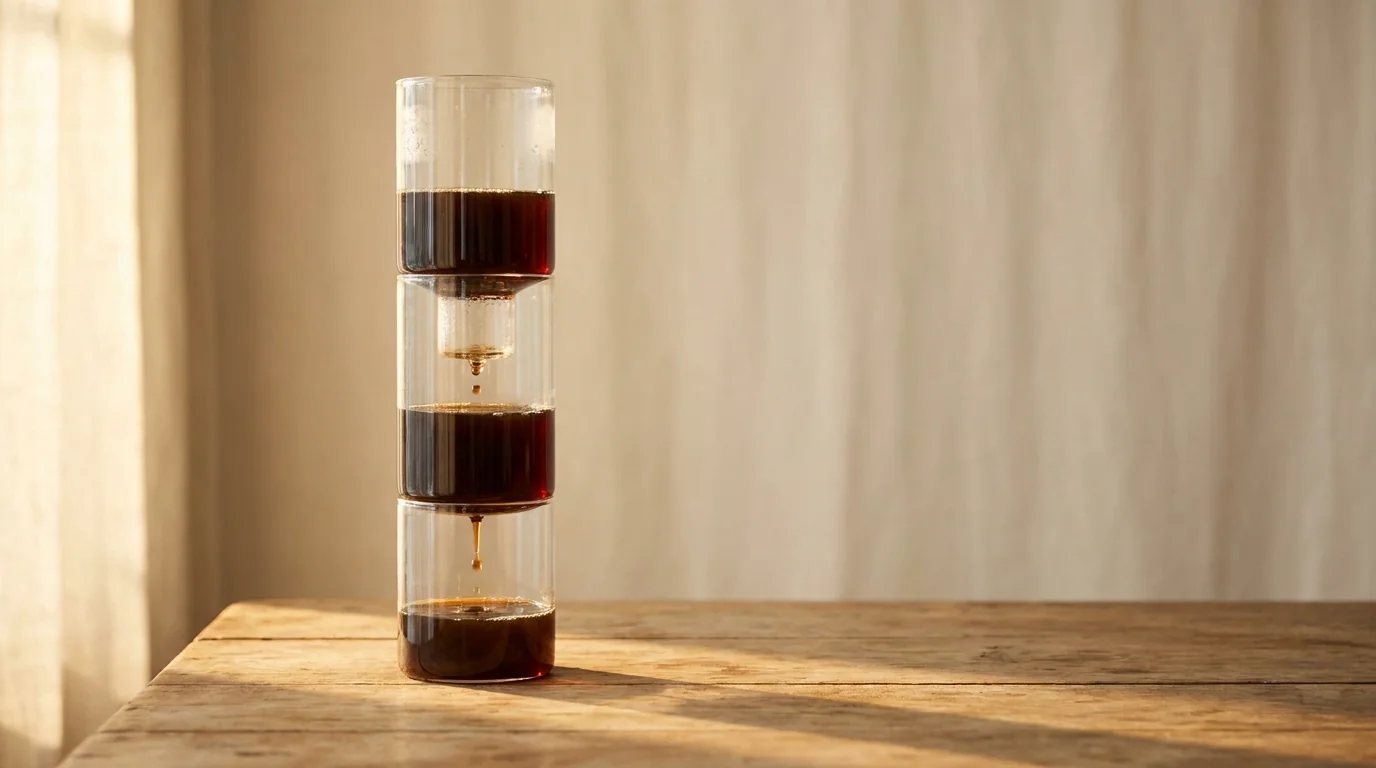
Cold drip coffee occupies a specific niche in the cold-coffee world — one that most people who love cold brew have never tried. Where cold brew is immersion (soak, then filter), cold drip is percolation (drop water through grounds slowly). The mechanical difference produces surprisingly different coffee: where cold brew is smooth and muted, cold drip is bright and articulated. Different answer to what cold coffee can be.
Percolation
cold water drips through coffee grounds slowly, producing a percolated cold brew rather than an immersion soak[1]
3-12 hours
typical brewing time range — home towers 3-6 hours, commercial towers 8-12 hours[5]
Concentrated
typically served straight as an espresso-like shot or diluted 1:1 — much stronger per sip than cold brew[4]
What cold drip actually is
Cold drip coffee is percolation cold brewing. Cold water is dripped slowly, one drop at a time, through a bed of ground coffee. As each drop moves through the coffee bed, it extracts flavour compounds; the extracted liquid drips out the bottom into a collection vessel.
The method is variously called:
- Cold drip — most common English name.
- Kyoto-style cold brew — after the Japanese city where the method was refined and where the elaborate tower- style equipment was developed.
- Dutch coffee — used in Korean and some other Asian contexts, reflecting the belief that the method was introduced by Dutch traders in the 17th century (the history is disputed).
- Slow drip cold brew — descriptive alternative.
The key contrast with regular cold brew:
- Cold brew (immersion): coffee grounds sit submerged in cold water for 12-24 hours. Extraction happens throughout the water; grounds are filtered out at the end. Simple equipment (a jar or bucket with a filter).
- Cold drip (percolation): cold water drips continuously through coffee grounds. Extraction happens as water passes through. Requires specialised equipment (a drip tower)[1].
Both use cold water. Both produce cold coffee with less perceived acidity and bitterness than hot brewing (thanks to the temperature effect on solubility). But the mechanical difference produces distinctly different flavour profiles.
The equipment
A cold drip tower has three main sections stacked vertically:
Upper chamber (water reservoir). Holds cold water, typically 500 mL to several litres depending on tower size. At the bottom of this chamber is a valve or dripper that controls drip rate — usually adjustable to 30-90 drops per minute.
Middle chamber (coffee bed). A cylindrical vessel holding ground coffee, with a filter at the bottom (paper, cloth, or metal mesh). Water drips onto the coffee bed from above; extracted coffee flows out the filter below.
Lower chamber (collection). Usually a glass carafe or beaker that collects the finished cold drip coffee.
The whole tower is usually mounted on a wooden or metal stand, often elaborately designed. Traditional Kyoto-style towers can be spectacular objects — glass structures 60-90 cm tall with brass fittings, effectively kitchen sculptures.
Common home tower brands:
- Yama — glass towers in various sizes, mid-price ($100-300).
- Hario Water Dripper — compact Japanese design, entry- level ($80-150).
- Iwaki — high-end Japanese glassware brand.
- Bruer — a compact, simplified cold drip design (roughly $75) that produces cold drip coffee at smaller scale with less spectacular equipment.
The classic recipe
Setup:
- Cold drip tower with medium-mesh filter.
- 60-80 g of medium-fine ground coffee (slightly finer than V60, coarser than espresso).
- Water: use enough for your tower size — typically 600-1000 mL for a small home tower.
- Ice cubes in the water reservoir (helps keep water cold during long brewing).
Process:
- Place coffee in the middle chamber. Level it and optionally pre-wet with a small amount of cold water to ensure even initial saturation.
- Add water (with ice) to the upper reservoir.
- Set drip rate. For a 6-hour brew of 500 mL, aim for about 40 drops per minute. Slower drips extract more per drop; faster drips extract less. Typical range is 30-90 drops per minute.
- Walk away. The tower needs no attention during brewing.
- Return in 3-8 hours depending on tower size and drip rate. Coffee should be fully collected in the lower chamber.
- Rest. Cold drip is typically rested in the fridge for 12-24 hours after brewing. Flavour develops noticeably during rest — the raw drip is grassy and flat; rested drip is complex and articulate.
- Serve. Small pour (30-60 mL) neat over one large ice cube, or diluted 1:1 with cold water or milk over ice, or built into cocktails.
Why the flavour is different from cold brew
The distinctive character of cold drip comes from the percolation dynamics:
Each drop is fresh water hitting the top of the coffee bed. In immersion cold brew, water becomes progressively saturated with coffee compounds and extraction slows throughout the brew. In cold drip, every drop is fresh water, so extraction rate per drop stays more consistent.
Concentration builds vertically. The first drops to fall through the coffee are highly extracted at the bottom and build up as more water passes through. This produces a progressively concentrating drip — the last drops to collect are the most concentrated.
Aromatic compounds are preserved. The slow, quiet extraction (no stirring, no agitation) allows delicate aromatic compounds to be extracted without being volatilised away. Cold drip often has notably more nose than either cold brew or hot brewing[2].
Bright acidity. Some acidic compounds that would be subdued in immersion cold brew are more prominent in cold drip — the different extraction dynamics affect the extraction ratio of different flavour compounds[3].
The typical tasting result:
- Cold brew: smooth, mellow, chocolatey, low acidity, heavy body, forgiving and drinkable in large quantities.
- Cold drip: brighter, more articulated, more aromatic, higher perceived acidity, less body, more like a fine tea or a wine — designed to be sipped rather than gulped.
Beans for cold drip
Cold drip highlights certain characteristics:
- Bright single-origin coffees — Ethiopian, Kenyan, Colombian — often shine spectacularly.
- Light-to-medium roasts — dark roasts can taste hollow because the concentration exaggerates any roast-derived flatness.
- Freshly roasted beans — cold drip's aromatic emphasis rewards freshness.
Less ideal for:
- Very dark roasts — the concentration highlights bitterness.
- Lower-quality beans — cold drip has nothing to hide behind. Defects will be prominent.
- Very cheap coffee — the elaborate brewing method doesn't rescue mediocre beans.
The rest is critical
One of the biggest mistakes new cold drip brewers make is serving fresh drip immediately. Freshly brewed cold drip often tastes flat, muted, and grassy — nothing like the articulated brew you'd expect.
The fix: rest the finished cold drip in the fridge for 12-24 hours before serving. During this time:
- Aromatic compounds develop and integrate.
- Flavours mellow and integrate.
- The finished character emerges.
Some cold drip preparations (particularly in Kyoto tradition) are rested for several days or even weeks before serving. The character continues to evolve, though most of the development happens in the first 24 hours.
Serving cold drip
Traditional and modern serving styles:
Neat. A small pour (30-60 mL) served straight in a small glass, no dilution, sipped slowly. This is the traditional Japanese specialty coffee service.
Over ice. Same volume served over one large clear ice cube. The ice slows dilution and provides visual appeal.
Diluted. A 1:1 dilution with cold water, cold milk, or oat/almond milk. Softens the concentration for larger drinks.
In cocktails. Cold drip works well in coffee cocktails — its bright articulated character plays well with spirits.
Sparkling. Cold drip topped with soda water and served in a highball glass — an increasingly popular Asian specialty café presentation.
Never heat cold drip — heating destroys the specific aromatic character that makes it distinctive. If you want hot coffee, brew hot.
Compared to other cold methods
- Vs cold brew immersion: cold drip is more articulated, more concentrated, more aromatic, less bodied. Requires specialised equipment; produces smaller quantities per brew.
- Vs Japanese iced pour-over (flash brew): Japanese iced is fast (5 minutes), hot-brewed onto ice, produces a brighter, sharper flavour. Cold drip is slow (3-12 hours), entirely cold-brewed, produces a smoother but still articulated flavour.
- Vs iced coffee (hot brewed and cooled): iced coffee is quick and easy but has all the acidity and bitterness of hot brewing plus dilution from ice. Cold drip is more refined but requires substantial equipment and time investment.
See Cold Brew vs Iced Coffee for the broader cold-coffee context.
Common misconceptions
- "Cold drip is just cold brew from a fancy machine." Different extraction dynamics produce meaningfully different flavour. The equipment isn't just aesthetics.
- "Serve cold drip immediately." No — the 12-24 hour rest is essential. Fresh cold drip tastes flat.
- "Cold drip has less caffeine than hot coffee." Actually often similar or slightly higher per volume, depending on drip rate and dose. Cold water extracts caffeine (which is water-soluble at all temperatures) reasonably well — the difference between cold and hot brewing is more about which non-caffeine compounds get extracted.
- "Any cold water drip works — I can just improvise." Drip rate control matters substantially. Improvised setups (a bag with holes above a container of grounds above a carafe) rarely produce good results because you can't regulate drip rate precisely.
Practical rules
Starting with cold drip:
- Buy a proper tower — the equipment matters. Entry-level Hario or Bruer at $75-150 is fine to start.
- Use good beans — cold drip has nothing to hide behind.
- Trust the rest — don't drink the fresh drip.
- Start with about 60 g of coffee to about 500 g of water as a baseline, adjust from there.
Adjusting:
- Slower drip rate → more extraction, more concentrated, more risk of over-extraction.
- Faster drip rate → less extraction, weaker, less risk of over-extraction.
- Finer grind → more extraction per drop, more body.
- Coarser grind → less extraction per drop, cleaner cup.
How a tower compares with the immersion makers most people own is covered in cold brew coffee makers.
The honest summary
Cold drip coffee is percolation-based cold brewing — cold water dripped drop by drop through medium-ground coffee over several hours. The mechanical difference from immersion cold brew produces meaningfully different results: more articulated flavour, brighter acidity, more aromatic complexity, less body, more concentration per sip. It requires specialised equipment (a drip tower) and time (both brewing time and post-brew resting time), so it isn't practical as an everyday cold coffee. But for bright single- origin beans served neat in small pours, cold drip is one of the most distinctive coffee experiences available — and one that most cold brew drinkers have never encountered.
Frequently asked questions
- What is cold drip coffee?
- Cold drip coffee is a slow brewing method where cold water drips drop by drop through a bed of medium-ground coffee, extracting over 3-12 hours. It's fundamentally different from cold brew immersion (which soaks grounds in cold water for 12-24 hours). Cold drip is percolation-based rather than immersion-based, and the result has a distinctly clearer, more concentrated, aromatically complex character.
- Cold drip vs cold brew — what's the difference?
- Cold brew is full immersion: grounds sit in cold water for 12-24 hours, then are filtered out. Cold drip is percolation: cold water drips slowly through grounds over 3-12 hours. Cold brew is smoother, less acidic, heavier-bodied, and more forgiving. Cold drip is more articulated, more aromatic, brighter, and more concentrated per volume — but requires specific equipment and produces smaller quantities.
- How long does cold drip take?
- Typical brew times are 3-6 hours for small home setups (300-500 mL yield) and 8-12 hours for larger commercial towers. The drip rate is usually set to about 40-60 drops per minute — slower gives more extraction but takes longer. You set it up, adjust the drip rate, and walk away.
- Do I need a special cold drip tower?
- Yes — cold drip requires purpose-built equipment. A cold drip tower has three main chambers: an upper chamber holding cold water with a valve controlling drip rate, a middle chamber holding coffee grounds with a filter, and a lower chamber (usually a glass carafe) collecting the finished brew. Yama, Hario, and Iwaki make popular home models ranging from $150-500+.
- Is cold drip stronger than cold brew?
- Cold drip is typically more concentrated per volume — usually served either straight (as an intense espresso-like shot) or diluted 1:1 with water or milk before serving. Cold brew is usually less concentrated but consumed in larger volumes. Total caffeine per drink is often similar; concentration per sip is higher with cold drip.
References
Every factual claim in this article is drawn from the sources below. See the source library for how we grade evidence.
- [1]Brewing FundamentalsCoffee Science Foundation · Reference work · Tier 2 · Moderate
- [2]The Effect of Time, Roasting Temperature, and Grind Size on Caffeine and Chlorogenic Acid Concentrations in Cold Brew CoffeeScientific Reports · 2017 · Controlled trial · Tier 2 · Moderate
- [3]Acidity and Antioxidant Activity of Cold Brew CoffeeScientific Reports · 2018 · Controlled trial · Tier 2 · Moderate
- [4]Physiochemical Characteristics of Hot and Cold Brew Coffee Chemistry: The Effects of Roast Level and Brewing Temperature on Compound ExtractionFoods · 2020 · Controlled trial · Tier 2 · Moderate
- [5]Coffee extraction kinetics in a well mixed systemJournal of Mathematics in Industry · 2016 · Review · Tier 2 · Moderate
Related reading
- Brew MethodsCold Brew Coffee Guide: Ratios, Steep Time, Technique→
- Brew MethodsCold Brew vs Iced Coffee: The Real Difference→
- Brew MethodsPour-Over Coffee Guide: Ratios, Bloom, and Technique→
- Brew MethodsPhin Coffee: How Vietnam's Single-Cup Filter Works→
- Brew MethodsSiphon Coffee: How Vacuum Brewing Works and Tastes→
- Brew MethodsMoka Pot Guide: How to Brew Stovetop Espresso at Home→