Chemex vs V60: Which Pour-Over Makes Better Coffee?
By Coffee Studies Editorial·Published July 15, 2026·7 min read
Quick answer
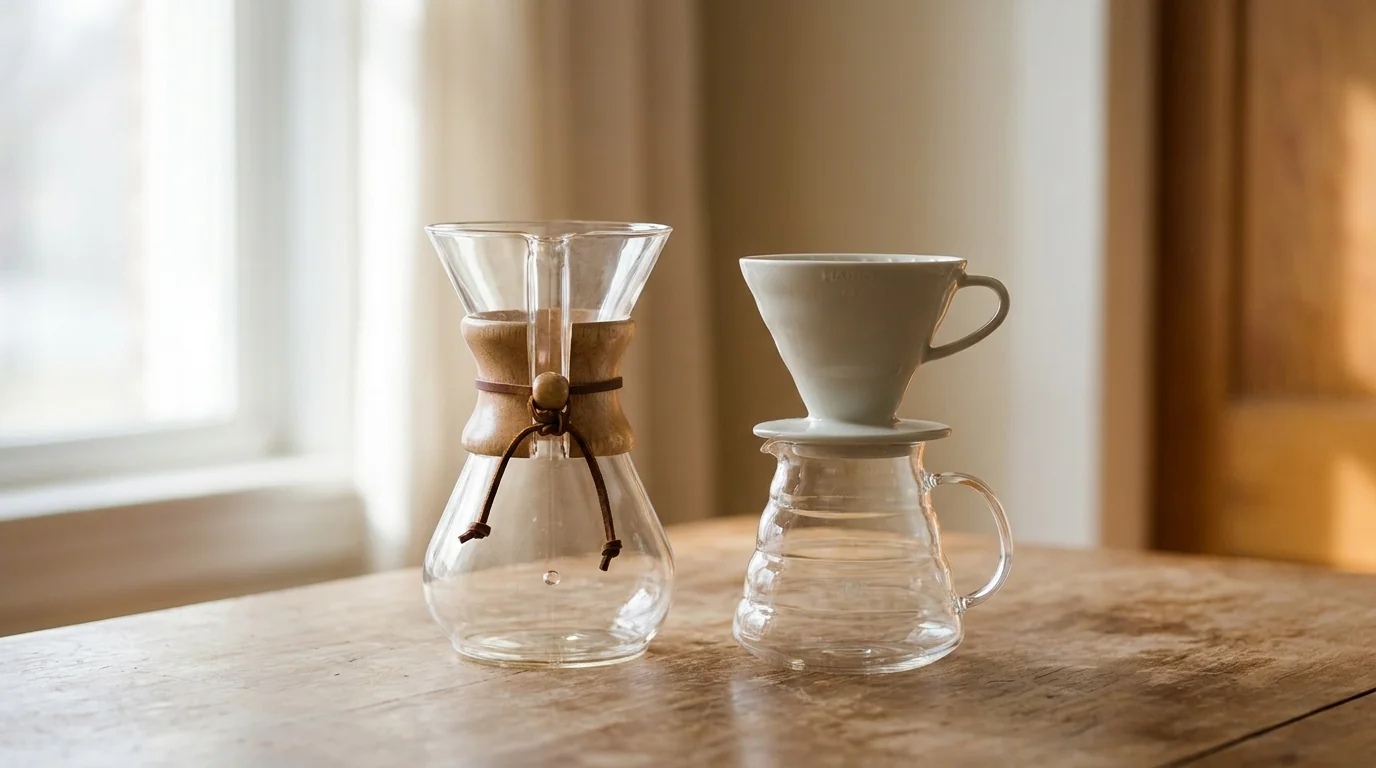
Chemex and V60 are the two most influential pour-over drippers of the specialty coffee era, and they answer opposite questions about what pour-over should do. Chemex is designed for maximum cup cleanliness through its distinctive thick filter. V60 is designed for maximum brewer responsiveness through its unrestricted drain geometry. They produce different cups from the same beans, and choosing between them is more about your taste and coffees than about one being objectively better.
Filter thickness
Chemex uses a 20-30% thicker bonded filter than V60 — the biggest functional difference[1]
Drain geometry
V60 has a single large hole (no flow restriction); Chemex has a large opening but the thick filter is the restrictor[2]
Cup character
Chemex produces the cleanest, most tea-like cup; V60 produces more body with more grind and pour control[3]
The two designs
Both are pour-over drippers — coffee grounds in a paper filter, water poured over, coffee drips into a vessel below. But the physical designs differ in ways that meaningfully change the brew.
Chemex:
- Hourglass-shaped glass carafe with wooden collar (integrated brewer and vessel).
- Distinctively thick bonded paper filter.
- Wide neck; large opening at the base of the filter.
- Flow rate primarily restricted by filter thickness, not dripper geometry.
- Designed by chemist Peter Schlumbohm in 1941; continuously produced since.
V60:
- Separate conical dripper (ceramic, glass, plastic, or metal) that sits over any vessel.
- Standard cone-shape paper filter (thinner than Chemex).
- 60-degree walls, single large drain hole.
- Spiral ribs on inner surface for air escape.
- Designed by Hario in 2004; the reference specialty pour- over of the third-wave era.
See Chemex Coffee Guide and V60 Pour-Over Guide for full articles on each.
What the filter actually does
The filter is the biggest functional difference between these two drippers. Everything else follows from it.
Chemex filters:
- Thick bonded paper — 20-30% heavier than standard cone filters[1].
- Multi-layer construction (usually four-fold when folded for use).
- Physical thickness restricts water flow through the filter itself.
- Traps more coffee oils and fine particles than any other paper filter used in pour-over.
V60 filters:
- Standard-weight paper filter, single layer.
- Cone-shape with a triple-folded seam.
- Doesn't restrict flow meaningfully — water flows through as fast as gravity and the coffee bed allow.
- Traps most oils and fines but less than Chemex.
Cup consequences:
- Body. V60 has more body because more oils pass through. Chemex has less body — often described as tea-like or wine-like.
- Clarity. Chemex produces a visually clearer cup — you can hold it up to light and see through it almost like tea. V60 has more sediment and cloudiness.
- Flavour separation. Chemex's cleanliness makes individual flavour notes more distinct. V60 blends flavours more integratedly.
- Cafestol retention. Chemex traps more of the LDL- raising diterpenes (cafestol, kahweol). Both are paper- filter methods so both are far better than French press or espresso for cholesterol; Chemex is at the top of the filtered scale[4].
What the drain geometry does
The other major design difference:
Chemex — wide opening at the base of the filter, into the vessel's neck. The filter is the restrictor; the dripper doesn't add restriction.
V60 — single large drain hole (~20 mm), no restriction from the dripper. The filter (thin) doesn't restrict much either. So flow rate is set almost entirely by the coffee bed itself — grind size and pour rate directly control flow.
Practical consequence: V60 is much more responsive to technique. Change your grind, your pour rate, or your pour technique and you see different results in the cup. Chemex is more forgiving — the thick filter smooths out technique variation.
For beginners: this makes Chemex somewhat easier to get consistent results with, provided you use coarse-enough grind. For advanced brewers who want to iterate on technique: V60 gives you more direct feedback loops.
Grind sensitivity
Both drippers care about grind, but in different ways.
Chemex grind:
- Medium-coarse — coarser than V60 or Kalita, closer to French press.
- If too fine, the thick filter clogs and brew time balloons (over 6 minutes), causing over-extraction.
- Grind evenness matters somewhat less than for V60 — the filter thickness smooths minor variation.
V60 grind:
- Medium — coarser than espresso, finer than French press.
- The unrestricted flow means grind size directly controls brew time. A slight grind change moves brew time noticeably.
- Grind evenness matters more than for Chemex — fines clog the filter and produce channelling; uneven grind produces uneven extraction more visibly[2].
Both benefit from a good burr grinder. See Burr vs Blade Grinder.
Pour technique sensitivity
Chemex — forgiving of pour rate. You can pour more quickly or more slowly and the thick filter regulates total flow. Basic even-pouring technique is enough; pursuing more sophisticated pour patterns has limited marginal benefit.
V60 — highly responsive to pour technique. Pour rate, pour height, pour pattern, and pour rhythm all affect extraction visibly. Rewards careful practice; punishes sloppy execution.
Which coffee for which dripper
Chemex suits:
- Light-to-medium single-origin coffees where you want clarity of individual flavour notes.
- Bright acidic origins — Ethiopian, Kenyan, high-altitude Colombian.
- Coffees with floral, fruity, or tea-like aromatic character.
- Situations where you're serving multiple people and want consistency.
V60 suits:
- Medium-roast everyday coffees where you want balance of clarity and body.
- Situations where you enjoy iterating on brew technique.
- Single-cup brewing where you want responsive control.
- People who like slightly more body than Chemex provides.
Neither is ideal for:
- Very dark roasts (both suffer — French press or espresso are usually better for dark).
- High-volume institutional brewing (both are hand-brewers by design).
Volume and practical differences
Chemex:
- Comes in 3-cup, 6-cup, 8-cup, and 10-cup sizes.
- Best for batch brewing 2-4 cups at once.
- 3-cup can single-brew but is fussier than V60 for solo cups.
V60:
- Comes in 01 (small, single cup), 02 (medium, 1-4 cups), and 03 (larger).
- 02 is the most versatile for home use — brews 1-3 cups well.
- Better for single-cup brewing than Chemex.
Price
Both are relatively cheap:
- Chemex 6-cup: roughly $50-60 for the brewer, plus filters (about $15 for 100 filters).
- V60 02 ceramic: roughly $25-35 for the dripper, plus filters (about $8-12 for 100 filters).
V60 is cheaper to acquire and maintain, but neither is a significant investment compared to grinders, kettles, or espresso equipment.
When to choose neither
For some brewers, the answer is a third option — Kalita Wave (see Kalita Wave Guide). Kalita's flat-bottom three-hole design regulates flow rate independently of grind and pour, making it the most forgiving pour-over overall. If consistency matters more than control or clarity, Kalita is often the practical winner over both Chemex and V60.
Which one to buy first
Choose Chemex first if:
- You mostly drink lighter-roast single-origin coffees.
- You want the cleanest cup possible.
- You enjoy the ritual and aesthetics of the brew process.
- You have a decent grinder capable of coarse-medium grind.
- You're concerned about cholesterol and want maximum cafestol removal.
Choose V60 first if:
- You brew a variety of roasts and origins.
- You want direct control over extraction.
- You enjoy learning brewing technique.
- You often brew single cups.
- You're on a tighter equipment budget.
Choose Kalita Wave first if:
- You want consistent results with less technique focus.
- Multiple people in the household brew coffee.
- You're new to pour-over and want an easy on-ramp.
Get both eventually if you enjoy filter brewing — the combined cost is under $100 and you'll use different brewers for different beans and moods.
Common misconceptions
- "Chemex is objectively better than V60." Not objectively — different characters. Third-wave cafés and barista champions use both.
- "V60 is more modern." V60 is more recent (2004 vs 1941) and became the specialty coffee default, but Chemex has had continuous specialty use for 80+ years and is having a renewed moment.
- "You can substitute Chemex filters in a V60." No — the shapes and sizes are different. Use the correct filter for each brewer.
- "Chemex is just for looks." The design is spectacular (MoMA collection since 1943), but the thick filter is a functional feature that meaningfully changes the cup.
Both sit alongside the flat-bottom drippers in pour-over coffee makers.
The honest summary
Chemex and V60 answer different questions about pour-over. Chemex's thick bonded filter produces the cleanest, most tea-like cup you can get from any pour-over method — best for bright light-roast single-origins. V60's thin filter and unrestricted drain give you direct control over extraction and more body — best for versatile everyday brewing and technique iteration. Neither is objectively superior; the choice depends on your bean preferences and how you want to relate to the brew process. Both are cheap enough that owning both is reasonable, and many enthusiast home brewers do.
Frequently asked questions
- Which is better — Chemex or V60?
- Different rather than better. Chemex has a thicker filter that produces a cleaner, brighter, more tea-like cup with almost no body. V60 has a thinner filter and a single large drain hole that lets grind and pour technique control extraction directly — producing more body and more control. Neither is objectively superior; they suit different tastes and different beans.
- What's the main difference between Chemex and V60?
- The filter and the drain geometry. Chemex uses a distinctively thick bonded filter (20-30% heavier than standard cone filters), which traps more oils and fines. V60 uses standard-weight paper filters and has a single large drain hole that doesn't restrict flow — so flow rate is determined by grind and pour rather than dripper geometry. This makes V60 more responsive and Chemex more forgiving.
- Does Chemex remove cafestol better than V60?
- Yes — Chemex's thicker filter traps more of the coffee oils containing cafestol and kahweol (the LDL-raising diterpenes). Both are paper-filter methods so both remove most cafestol, but Chemex is at the top of the paper-filter cleanliness spectrum. If you're managing cholesterol via brewing method, Chemex is a strong choice.
- Which is easier to brew?
- Chemex is more forgiving of pour technique but requires coarser and more consistent grind. V60 is more responsive to pour but tolerates a wider grind range. For beginners, Kalita Wave is arguably the most forgiving pour-over overall. Between Chemex and V60 specifically, Chemex is generally easier for consistent results if you already have a decent grinder.
- Should I buy both?
- If you brew filter coffee daily and enjoy the ritual, yes — they cost about the same and produce meaningfully different cups. Chemex for bright single-origin light roasts served clean; V60 for medium roasts and more everyday brewing with body. Many enthusiast home brewers rotate between them depending on the beans.
References
Every factual claim in this article is drawn from the sources below. See the source library for how we grade evidence.
- [1]Brewing FundamentalsCoffee Science Foundation · Reference work · Tier 2 · Moderate
- [2]Coffee extraction kinetics in a well mixed systemJournal of Mathematics in Industry · 2016 · Review · Tier 2 · Moderate
- [3]Effects of brew strength, brew yield, and roast on the sensory quality of drip brewed coffeeJournal of Food Science · 2020 · Controlled trial · Tier 2 · Moderate
- [4]The cholesterol-raising factor from coffee beansAnnual Review of Nutrition · 1997 · Review · Tier 1 · Strong
- [5]Comparison of nine common coffee extraction methods: instrumental and sensory analysisEuropean Food Research and Technology · 2013 · Controlled trial · Tier 2 · Moderate
Related reading
- Brew MethodsChemex Brew Guide: Ratios, Grind, and Technique→
- Brew MethodsV60 Pour-Over Guide: Ratios, Technique, Step by Step→
- Brew MethodsKalita Wave Brew Guide: Ratios, Technique, and Results→
- Brew MethodsAeroPress Brew Guide: Ratios, Inverted Method, Tips→
- Brew MethodsBica: Portugal's Espresso, and the Acronym That Isn't True→
- Brew MethodsCafé de Olla: Mexico's Traditional Spiced Coffee→