Greek Coffee: The Briki, the Frappe, and the Freddo
By Coffee Studies Editorial·Published July 19, 2026·5 min read
Quick answer
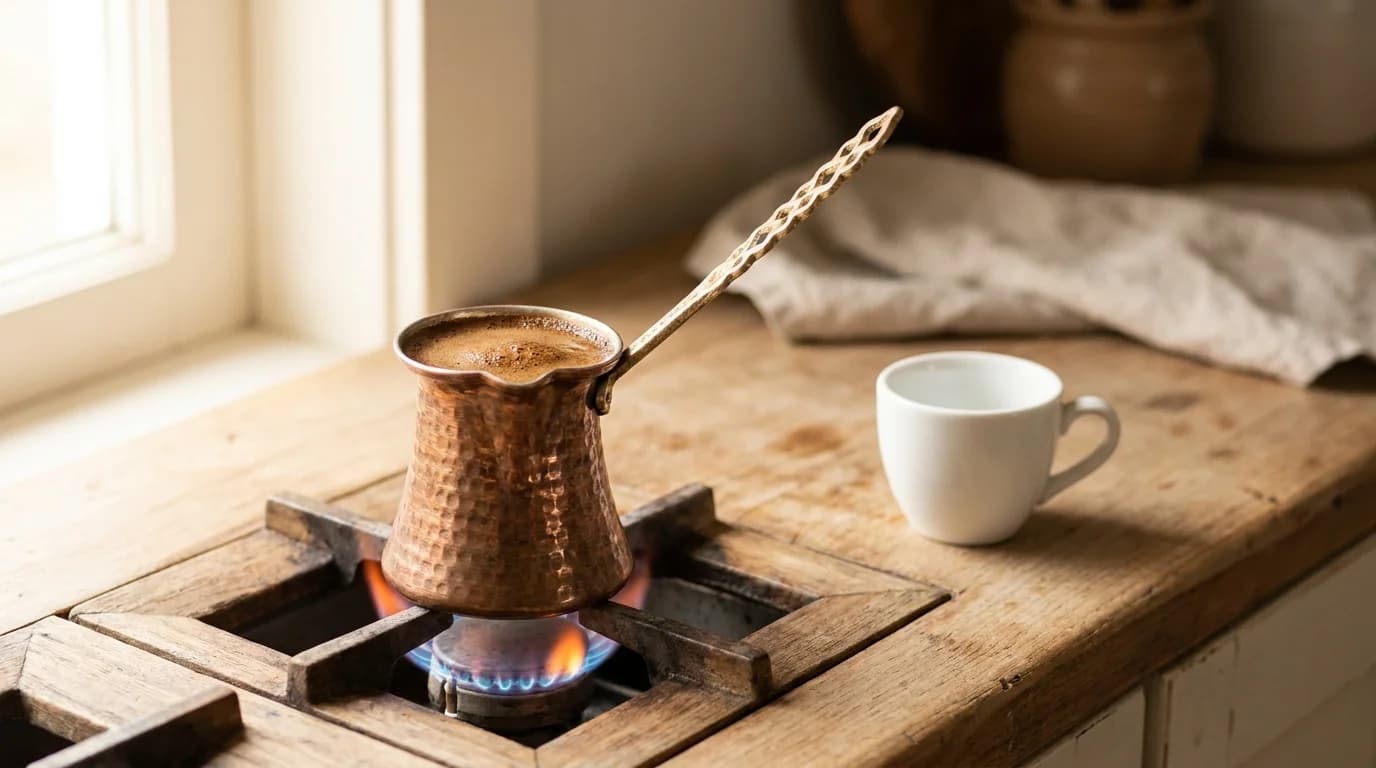
Greece is one of the world's most coffee-saturated cultures — per capita coffee consumption consistently ranks among the highest in Europe — and it has produced three completely distinct coffee traditions across different eras, each deeply embedded in how Greeks experience daily life. The briki tradition is centuries old. The frappe was an accident in 1957. The freddo was invented in the 1990s and has already become definitional to Greek café culture. All three coexist on the same café menu today.
1957 — the frappe's accidental invention
the Greek frappe was invented by Dimitris Vakondios at the Thessaloniki International Trade Fair when he improvised an iced drink by shaking Nescafé with cold water — one of the clearest examples of significant culinary invention by accident in the 20th century[2]
Kaimaki — the foam matters
in traditional Greek coffee, the kaimaki (the foam that rises as the briki heats) is considered the most valued part of the drink; an experienced briki user will stop heating precisely as the foam peaks and pour carefully to preserve it in each cup[1]
Freddo — Greek invention, unknown abroad
the freddo espresso and freddo cappuccino are Greek coffee inventions from the 1990s that became standard across all Greek cafés but remained almost completely unknown in the rest of Europe or North America[4]
Traditional Greek coffee: the briki method
Greek coffee is brewed in a briki (μπρίκι) — a small, long- handled pot typically made from copper, brass, or stainless steel, with a narrow neck that controls foam rise. The method:
- Measure cold water into the briki (typically 60–70 mL per person, using the cup itself to measure)
- Add very finely ground coffee (1 heaped teaspoon per cup) and sugar if desired — cold, not yet heated
- Stir once to combine
- Place over low heat — the key is low and slow
- Watch closely as the mixture heats; a foam (kaimaki) begins forming on the surface
- As the foam peaks and begins rising, remove from heat immediately — do not let it boil over
- Tap the briki base gently to settle the foam, then pour into small cups slowly, tipping the foam in first
The grounds settle to the bottom within a minute or two. Greeks do not stir after pouring — drinking the grounds is considered poor form[1].
The three sweetness levels:
| Greek term | Sugar | Character |
|---|---|---|
| Sketo (σκέτο) | None | Bitter, intense, pure coffee flavour |
| Metrio (μέτριο) | ~1 tsp | The "medium" — most commonly ordered |
| Glykos (γλυκός) | 2+ tsp | Sweet, softer, more rounded |
Ordering correctly matters: you specify sweetness when ordering ("έναν ελληνικό μέτριο" — one medium Greek coffee), not after it arrives, because the sugar is added to the briki before heating and cannot be adjusted.
The origins of Greek coffee
Coffee arrived in Greece with the Ottoman Empire, spreading from Istanbul through the Aegean. By the 18th century, coffee shops (kafeneion, καφενείο) were central social institutions throughout the Greek world — places for political discussion, backgammon, and socialising in a way comparable to the role of the coffeehouse in Ottoman and Arab culture[3].
The kafeneion culture persisted through independence and into the 20th century. The traditional kafeneion — older men playing backgammon, reading newspapers, drinking briki coffee and a glass of cold water — remains a fixture in Greek villages and older urban neighbourhoods, though it has largely been supplanted in cities by the modern café.
The name shift from "Turkish coffee" to "Greek coffee" was formalised in Greece following the 1974 Cyprus conflict, when Turkish-Greek relations deteriorated sharply. The preparation is unchanged — only the name changed in response to political circumstances[2].
The frappe: accidental invention, cultural institution
The Greek frappe is the most significant purely accidental coffee invention of the 20th century[2].
In 1957, Dimitris Vakondios, a Nescafé representative, was attending the Thessaloniki International Trade Fair. He wanted his habitual instant coffee but had no access to hot water. He put the instant coffee in a cocktail shaker with cold water and ice, shook it, and produced a frothy cold coffee. He served it to a colleague. Both found it excellent.
The frappe spread first through Thessaloniki, then across Greece, and within a generation had become the dominant cold coffee drink of the country. By the 1970s and 1980s, virtually every Greek café served frappe. The drink is strongly associated with Greek beach culture, summer, and socialising.
How to make a Greek frappe:
- Add 1–2 teaspoons of instant coffee to a shaker
- Add 1 teaspoon of sugar (if desired)
- Add 2–3 tablespoons of cold water
- Shake vigorously for 30–60 seconds until a thick, dense, stable foam forms
- Pour the foam into a tall glass
- Add ice cubes
- Top up with cold water and cold milk (optional)
The foam stability comes from the soluble proteins in instant coffee — this is why the frappe specifically requires instant coffee rather than espresso or brewed coffee. Espresso proteins do not foam the same way.
Figure
Greek coffee styles by approximate café popularity
Values in relative prevalence in Greek cafés (indexed)
The freddo: a modern Greek invention
The freddo espresso and freddo cappuccino emerged in the 1990s as espresso machines spread through Greek cafés, and Greeks applied their existing preference for cold, frothy coffee to the new espresso format[4].
Freddo espresso:
- Pull a standard espresso shot (or double shot)
- Immediately pour into a cocktail shaker with ice
- Shake vigorously — the espresso emulsifies with the ice, producing a cold frothy layer
- Strain over fresh ice in a glass
- Serve immediately
The shaking creates a characteristic cold coffee foam that is different from the hot espresso crema. The emulsification of espresso oils into the cold water produces a slightly thickened texture and rich flavour that is noticeably different from simply pouring espresso over ice.
Freddo cappuccino: The same as freddo espresso with one addition — cold milk is separately shaken or frothed to produce a cold foam, then placed on top of the cold espresso. The milk foam is lighter than standard cappuccino microfoam and distinctly cold throughout.
The kafeneion: coffee as social institution
The Greek kafeneion (coffee shop) is one of Europe's oldest unbroken civic social institutions[3]. The traditional kafeneion — typically small, with metal or marble tables, simple chairs, a backgammon set — functions not primarily as a beverage destination but as a social and civic space. Arguments about politics, local affairs, football, and philosophy unfold over cups of Greek coffee that take an hour to consume.
The modern café (kafé, using the French loan word) is a different institution — larger, espresso-focused, often playing music, serving the freddo and frappe generation. Both coexist in Greek cities, typically on the same street, serving different demographics.
The honest summary
Greek coffee has three distinct layers. Traditional Greek coffee uses the briki — fine grounds, cold water, and sugar heated together until foam rises, served unfiltered in small cups. The three sweetness levels (sketo, metrio, glykos) must be specified before brewing. The frappe was invented by accident in 1957 when a Nescafé representative improvised an iced drink; it became a cultural institution using instant coffee shaken into froth over ice. The freddo espresso and freddo cappuccino are Greek inventions from the 1990s — espresso shots shaken cold with ice, standard in every Greek café today and virtually unknown outside Greece. All three traditions remain active simultaneously in Greek café culture.
Frequently asked questions
- What is Greek coffee?
- Greek coffee (ελληνικός καφές) is coffee brewed from very finely ground coffee beans in a small long-handled pot called a briki, using the same method as Turkish coffee. Cold water, fine coffee grounds, and sugar (if desired) are combined in the briki and heated slowly until a foam (kaimaki) rises. It is served in small cups — grounds and all — and the drinker waits for the grounds to settle before drinking. The three sweetness levels are sketo (no sugar), metrio (medium — about one teaspoon), and glykos (sweet — two or more teaspoons).
- What is a Greek frappe?
- The Greek frappe (φραπέ) is an iced instant coffee drink invented in 1957 at the Thessaloniki International Trade Fair by Dimitris Vakondios, a Nescafé representative who improvised an iced drink by shaking instant coffee with cold water in a cocktail shaker when no hot water was available. The method became widely popular: 1–2 teaspoons of instant coffee are shaken or blended with a small amount of cold water until a thick, dense foam forms, then poured over ice and topped with cold water or milk. The frappe became the definitive Greek summer drink and remains one of the best examples of accidental food invention in the 20th century.
- What is a freddo espresso?
- The freddo espresso is a Greek cold coffee drink invented in the 1990s using the spread of espresso machines into Greek cafés. A shot or double shot of espresso is poured over ice in a cocktail shaker, shaken vigorously to create a cold emulsified foam, then served over fresh ice in a glass. The shaking produces a frothy, slightly thickened coffee with a distinct cold-espresso character. The freddo cappuccino adds cold milk foam (also shaken or whipped separately) on top. Both drinks are standard menu items in every Greek café and are virtually unknown outside of Greece.
- Is Greek coffee the same as Turkish coffee?
- The method is identical — the same fine grind, the same briki, the same unfiltered small cup with settled grounds. The historical relationship is direct: coffee arrived in Greece via the Ottoman Empire, and the preparation method came with it. The naming became politically charged after 1974 tensions between Greece and Turkey, and Greeks formally began referring to the drink as 'Greek coffee' rather than 'Turkish coffee.' The preparation is the same; the naming reflects geopolitics, not a difference in technique or flavour profile.
- What coffee is used for Greek frappe?
- Traditionally and overwhelmingly, Nescafé Classic (regular or Gold). The frappe was invented with Nescafé and has been made with Nescafé for nearly 70 years. The instant coffee's soluble proteins are responsible for the thick, stable foam that forms on shaking — whole-bean espresso will not produce the same texture. Some modern Greek cafés have experimented with specialty instant coffee for frappe, but the original formula remains the standard.
References
Every factual claim in this article is drawn from the sources below. See the source library for how we grade evidence.
- [1]Brewing FundamentalsCoffee Science Foundation · Reference work · Tier 2 · Moderate
- [2]Uncommon Grounds: The History of Coffee and How It Transformed Our World (revised edition)Basic Books (Mark Pendergrast) · 2010 · Reference work · Tier 2 · Moderate
- [3]Coffee and Coffeehouses: The Origins of a Social Beverage in the Medieval Near EastUniversity of Washington Press (Ralph S. Hattox) · 1985 · Reference work · Tier 2 · Moderate
- [4]CoffeeEncyclopaedia Britannica · Reference work · Tier 3 · Contextual
Related reading
- Brew MethodsHow to Make Turkish Coffee: Cezve, Grind, and Serving→
- Espresso & Coffee DrinksWhat Is Espresso? Pressure, Extraction, the Shot→
- Brew MethodsCold Brew vs Iced Coffee: The Real Difference→
- Beans, Roasts & OriginsCoffee Origins Around the World→
- Brew MethodsSiphon Coffee: How Vacuum Brewing Works and Tastes→
- Brew MethodsCafé de Olla: Mexico's Traditional Spiced Coffee→