Mold in Coffee: What the Tests Show
By Coffee Studies Editorial·Published November 16, 2026·7 min read
Quick answer
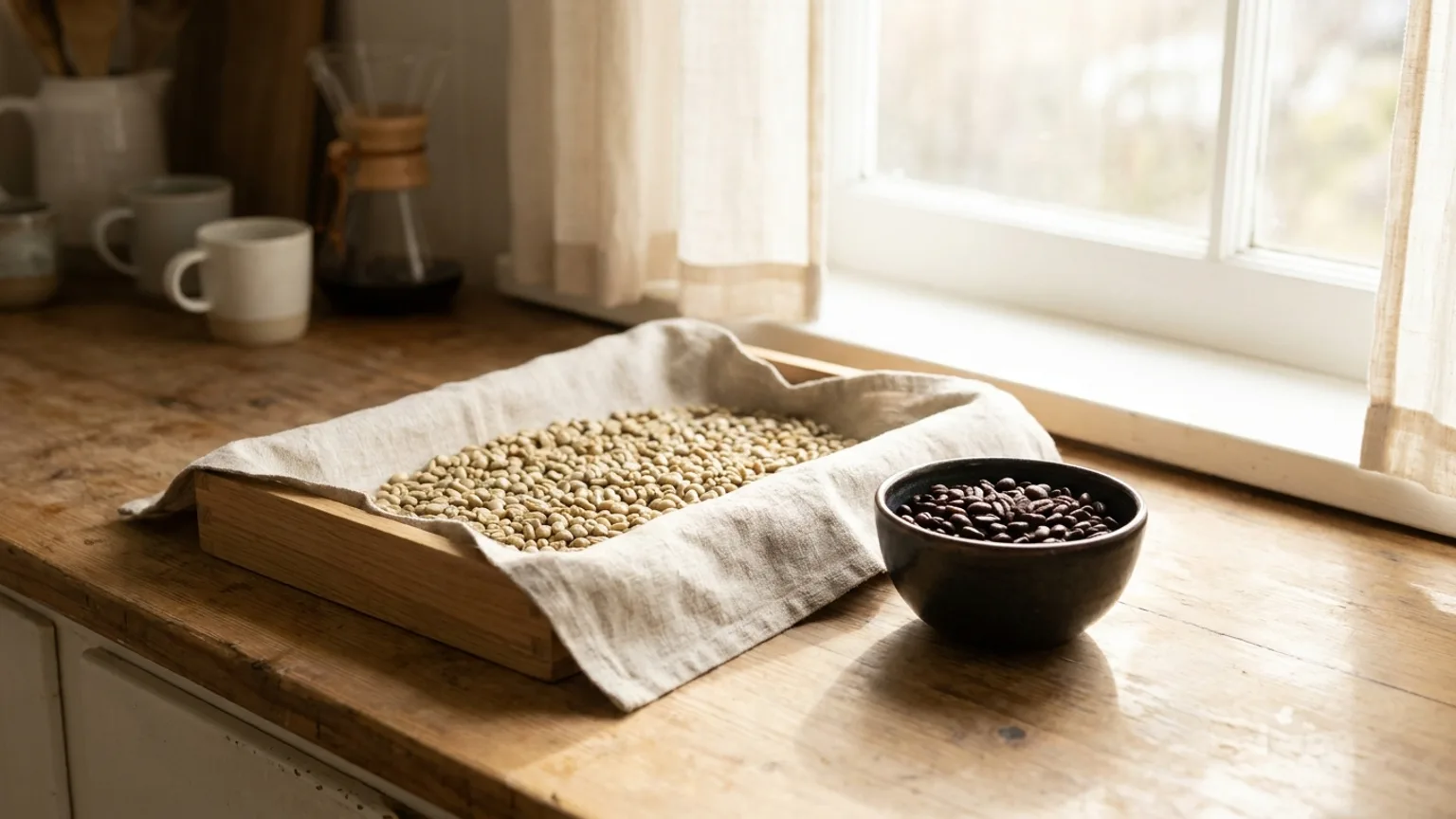
You saw an ad saying normal coffee is full of mold. Here's the short version: there is a mold toxin in some coffee, but only in tiny amounts, and roasting breaks most of it down. What reaches the shelf gets measured. It mostly sits under the European Union's legal limit.
The mold you can actually see is a different story. It grows on wet used grounds and inside coffee makers, and that part is real, ordinary and easy to deal with.
About half of samples
the share of coffee samples with any trace of the toxin, pooled from 36 studies and 3,182 samples[2]
69 to 96% removed
how much of the toxin roasting took out in seven of nine roasting studies[7]
3 parts per billion
the EU legal limit for roasted and ground coffee; instant coffee is allowed 5[6]
Is there really mold in coffee?
Sometimes, yes. Coffee is a farm crop, picked as cherries and then dried in the sun for days. The molds that grow on other damp crops can grow on coffee too.
Some of those molds make a toxin, and a toxin made by a mold is called a mycotoxin. In coffee, the one that matters is called ochratoxin A, or OTA for short. Europe's food safety agency, EFSA, ties the amount in roasted coffee to care at every stage, "from the farming to the roasting processes".
[1]How common is it? A 2019 review pooled 36 studies from around the world. About half of the coffee samples had a detectable trace of OTA, and the amounts varied considerably by country. [2]
So the honest answer is "often a little." That is not the same as "full of mold."
What is the mold toxin people worry about?
OTA is not just a coffee thing. EFSA lists the biggest sources in the European diet as preserved meat, cheese, and grains. Coffee is on the list of foods that carry it, but it is not the main one.
[1]Regulators do take OTA seriously, because in animal studies it harms the kidneys. EFSA's 2020 review found it may also damage DNA, though how it does that is unclear. [1] Looking at OTA from all foods combined, EFSA said there is a possible health concern for most groups of people. [3]
Two points keep that in proportion:
- EFSA's own summary says the uncertainty is high and the risk "may be overestimated". [1]
- The US Food and Drug Administration says OTA "may possibly cause cancer in humans", and that more research is needed. [4]
In short, this is a toxin worth limiting across the whole diet. It is not proof that your morning cup is harming you.
How much is in the coffee you actually buy?
Very little. A 2024 study tested 180 samples of instant coffee from Brazil, Colombia, Mexico and Peru. It found OTA in 85% of them, but the average amounts from every country were below the EU limit.
[5]The numbers are tiny, so here is a way to picture them. The EU limit for roasted coffee is 3 micrograms per kilo. A microgram is a millionth of a gram, so the limit is three millionths of a gram in an entire kilo of coffee.
[6]Figure
Toxin measured in instant coffee, against the EU legal limits
Values in micrograms per kilo
The review of 36 studies did find high outliers. The highest country average was 79 micrograms per kilo, in Turkey. Levels tended to be higher where rainfall was heavier and incomes lower.
[2]That's why limits and testing exist. They are the system working, not failing.
Does roasting kill the mold toxin?
It doesn't remove all of it, but it removes most. Coffee roasting runs above 180°C. At that heat, EFSA says losses of 70% to over 90% have been seen. [1]
A Dutch study roasted one batch of naturally contaminated beans in many different ways. It found a 69% drop on average. It also reviewed nine earlier roasting studies, and seven of them put the drop between 69% and 96%.
[7]An Italian study found that a typical espresso roast cut OTA by more than 90%. [8] Does a darker roast remove more? The Italian team found more heat removed more. The Dutch team found no clear difference between roasts. [7]
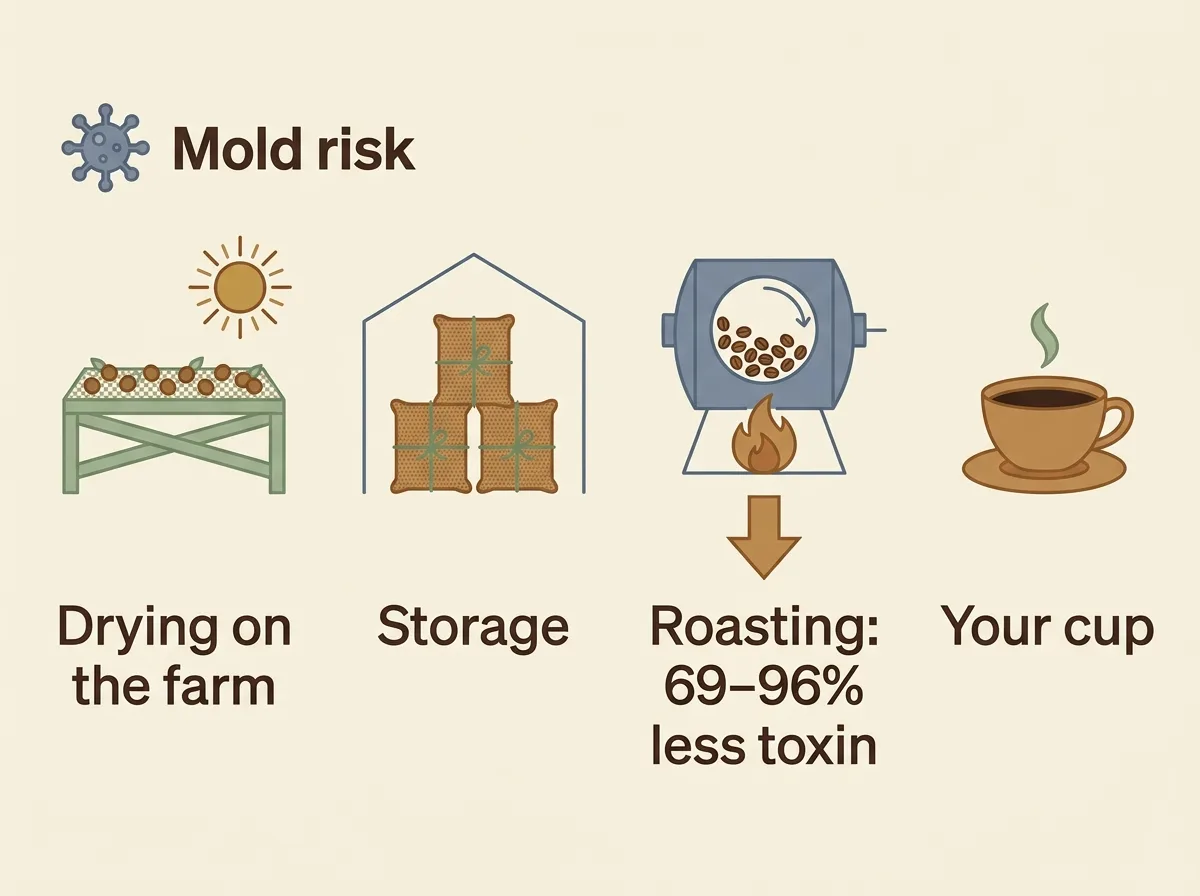
Where the toxin forms and where most of it goes. The 69–96% range is from seven of nine roasting studies reviewed in 2001.
Is "mold-free coffee" worth paying for?
Not as a separate kind of coffee. Every coffee sold in the EU has to stay under the same limits. [6] A "mold-free" label is a claim the seller makes about its own coffee. It doesn't mean other coffee is moldy.
The United States is different. The FDA has published official levels for several other mold toxins, such as aflatoxin. Its mycotoxin page lists none for OTA. [4] So a US label claim is the brand's own word, with no legal number behind it.
What does lower the risk, on any label:
- Fresh stock. Beans that move fast spend less time sitting in sacks.
- Good storage at home. Keep beans sealed, cool and dry.
- Roasted coffee over green beans, since roasting removes most OTA.
Why do used coffee grounds go moldy so fast?
Because they're wet, warm and full of food for mold. Leave a filter of used grounds sitting in the machine and you may see white fuzz within days. An extension expert put it at two to three days if grounds aren't dried or composted. [9]
This is a different thing from the toxin in beans. It's the same thing that happens to bread left in a bag. Brand doesn't matter here, either. Grounds from a big chain go moldy just as fast as grounds from your kitchen.
Don't brew with grounds that have gone fuzzy, and don't leave wet grounds in the basket overnight. If you save grounds for the garden, spread them out to dry first.
Are moldy coffee grounds OK for compost and plants?
Yes, for compost. Oregon State University's gardening service says mold on grounds is "harmless in compost" and helps them break down.
[10]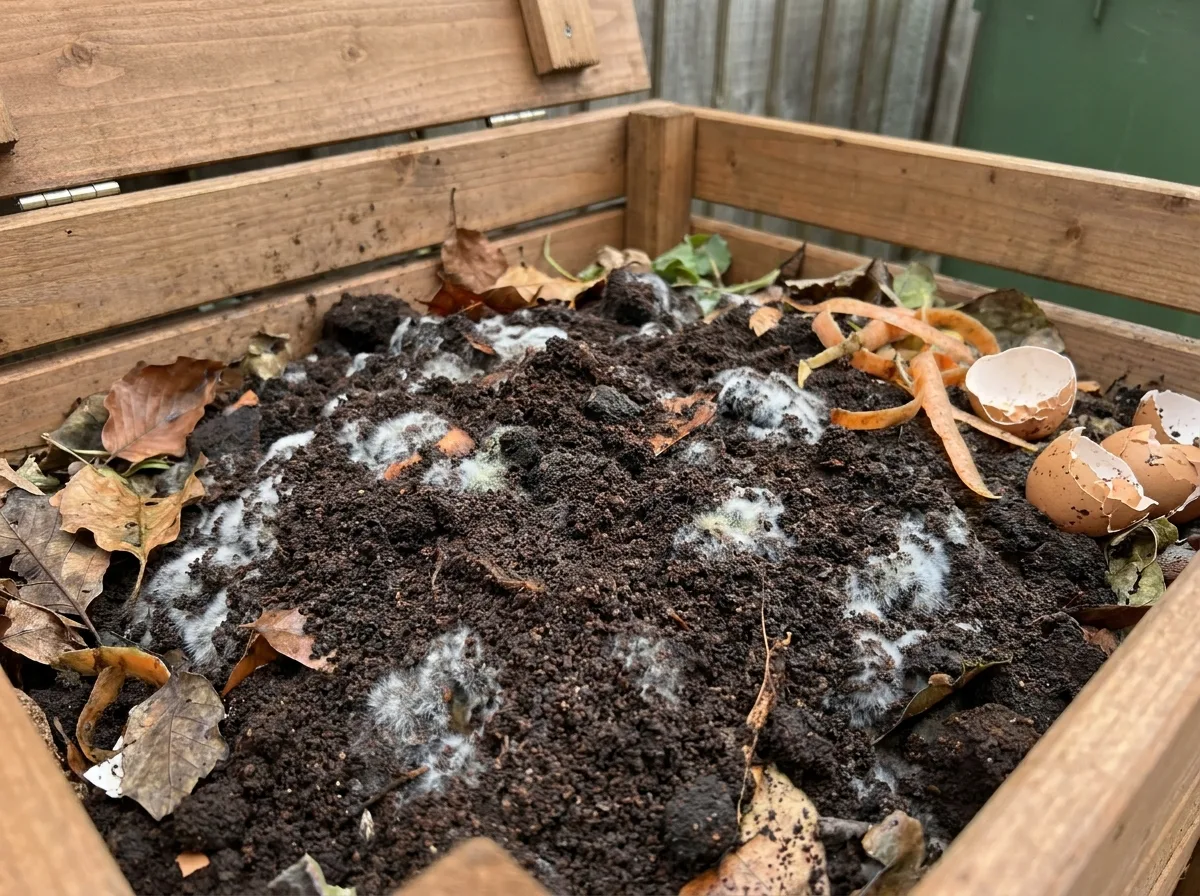
Washington State University adds a useful detail. The molds usually found on rotting grounds can stop harmful fungi from settling in.
[11]The limit is quantity. Keep grounds to no more than a fifth of the pile. More than that can harm plants. [10] Mix them in rather than heaping them thick on top of the soil.
Can mold grow inside your coffee maker?
Yes. Any part that stays damp and dark can grow mold. Think of the water tank, the drip tray, a pod machine's reservoir, or a moka pot put away wet. A moka pot packed away damp is a tiny greenhouse with a handle. Pod users have a second chore after the rinse: what to do with the used K-Cup, which depends on your town.
The fix is boring, which is good news:
- Empty the water tank at the end of the day and leave the lid open.
- Rinse and dry the drip tray and basket.
- Take a moka pot apart after use and let every piece dry.
- Descale and clean on the schedule your machine's manual gives.
For a full routine, see our guide to cleaning an espresso machine and our notes on descaling a coffee machine.
So should you worry about mold in your coffee?
Not much, going by the evidence. The toxin is real, but roasting removes most of it before the coffee reaches you. What's left is measured in parts per billion and kept under strict limits where limits exist. [7]
[6]The useful habits are simple. Buy freshly roasted coffee and keep it dry, then clean your machine regularly and let it dry out. Compost old grounds instead of leaving them in the basket. And treat a "mold-free" ad for what it is: a sales pitch built on a real but small risk.
Roasting also creates a different trace chemical, covered in our guide to acrylamide in coffee.
If you want the bigger health picture, start with whether coffee is healthy and how long coffee keeps before it goes stale. For what to do with grounds in the garden, see coffee grounds for plants.
Frequently asked questions
- How can you test coffee for mycotoxins at home?
- You can't, in any useful way. Labs measure ochratoxin A in parts per billion with lab equipment. You can't see it, smell it or taste it. Your real protection is the legal limit and roasting, plus keeping beans dry and sealed once they're home.
- Does Starbucks test its coffee for mold?
- We could not find a public test result or testing policy from Starbucks, or from Folgers. What we can say is that any coffee sold in the European Union, whatever the brand, must stay under the legal limit there. The US FDA lists no ochratoxin A level at all.
- Are there mycotoxins in instant coffee?
- Often, in small amounts. A study of 180 instant coffee samples from four countries found the toxin in 85% of them. Every average was well under the EU limit for instant coffee, which is a little higher than the limit for roasted beans.
- What coffee has the least mold toxin?
- No brand list holds up, because levels vary from batch to batch and brands don't publish enough results to compare. Roasted coffee carries far less than green beans. Fresh stock, kept sealed and dry at home, is the sensible choice.
- Can coffee grounds cause mold on plants?
- The fuzz you see on grounds spread on soil is mostly harmless breakdown mold. University gardening experts advise mixing grounds into compost, at no more than a fifth of the pile, rather than piling them thick on top of the soil.
References
Every factual claim in this article is drawn from the sources below. See the source library for how we grade evidence.
- [1]Risk assessment of ochratoxin A in food (EFSA CONTAM Panel scientific opinion)European Food Safety Authority (EFSA Journal) · 2020 · Agency guidance · Tier 1 · Strong
- [2]The concentration and prevalence of ochratoxin A in coffee and coffee-based products: a global systematic review, meta-analysis and meta-regressionFungal Biology · 2019 · Meta-analysis · Tier 1 · Strong
- [3]Ochratoxin A in food: public health risks assessedEuropean Food Safety Authority · 2020 · Agency guidance · Tier 1 · Strong
- [4]MycotoxinsU.S. Food and Drug Administration · 2026 · Agency guidance · Tier 1 · Strong
- [5]Instant coffee: a probabilistic risk assessment of metals, acrylamide and ochratoxin APMC / NIH · 2024 · Observational study · Tier 2 · Moderate
- [6]Commission Regulation (EU) 2023/915 on maximum levels for certain contaminants in food (Annex I, ochratoxin A in roasted and soluble coffee)European Commission (Official Journal of the European Union, via FAOLEX) · 2023 · Government data · Tier 1 · Strong
- [7]Effect of roasting conditions on reduction of ochratoxin A in coffeeJournal of Agricultural and Food Chemistry · 2001 · Observational study · Tier 2 · Moderate
- [8]Influence of roasting levels on ochratoxin A content in coffeeJournal of Agricultural and Food Chemistry · 2003 · Observational study · Tier 2 · Moderate
- [9]Coffee grounds: storing used grounds and mold (expert response)Ask Extension (Cooperative Extension) · 2016 · Reference work · Tier 3 · Contextual
- [10]Coffee grounds boost soil health, and help control slugsOregon State University Extension Service · Agency guidance · Tier 2 · Moderate
- [11]Using Coffee Grounds in Gardens and Landscapes (Home Garden Series)Washington State University Extension · Review · Tier 2 · Moderate
Related reading
- Caffeine & HealthIs Coffee Healthy? What Large Studies Actually Show→
- Caffeine & HealthCoffee and Liver Health: What Cohort Studies Show→
- Caffeine & HealthIs Coffee Bad for Your Kidneys?→
- Caffeine & HealthAcrylamide in Coffee: Should You Worry?→
- Caffeine & HealthHow Much Caffeine Is in an Espresso Shot? About 63 mg→
- Caffeine & HealthDoes Caffeine Raise Your Heart Rate? What Trials Measured→