Acrylamide in Coffee: Should You Worry?
By Coffee Studies Editorial·Published November 17, 2026·6 min read
Quick answer
You saw a warning sign in a café, or an ad for "low-acrylamide" beans, and now you're wondering about your morning cup. Here's the short version. Every roasted coffee has a trace of this chemical, and so do toast and fries. The amount in coffee is small, and the human evidence for harm at food levels is weak.
Two details matter. Instant and chicory drinks carry more. And your daily total comes from your whole plate, not just your mug.
7.9 micrograms
the total acrylamide from four cups of coffee in one day, in a study cited by a 2020 review[3]
9 to 29%
coffee's share of the acrylamide adults eat, depending on the country[3]
400 vs 850
the EU benchmark for roasted coffee against instant coffee, in micrograms per kilo[4]
What is acrylamide, and why is it in coffee?
Acrylamide is a chemical that forms when some plant foods are cooked hot. It comes from a reaction between natural sugars and asparagine. Asparagine is an amino acid, one of the building blocks of protein. Frying, baking and roasting all set off that reaction. [1]
Green coffee beans contain both ingredients. So when they hit the roaster, acrylamide appears. The FDA says where it happens. It forms "when coffee beans are roasted, not when coffee is brewed at home or in a restaurant". [2]
That means every roasted coffee has some. Ground, whole bean, pods, decaf and instant all start from roasted beans. Coffee is far from the only source, either. Researchers have found it in potato chips, fries, biscuits, bread and breakfast cereal. [3]
For the full chemistry of the roast, see our guide to coffee roasting chemistry.
How much acrylamide is in a cup of coffee?
Not much, in absolute terms. Acrylamide is measured in micrograms. A microgram is one millionth of a gram, so even a big number here is a tiny amount.
One study found that four cups of coffee a day added up to 7.9 micrograms in total. That's about 2 micrograms a cup. [3]
Adults take in an estimated 14 to 70 micrograms a day from all foods. That estimate covers studies from Europe, North America and Asia. Coffee makes up 9 to 29% of that for adults. Baked goods or chips make up 38 to 60%. [3]
So coffee is a real source, but rarely the biggest one. If you drink several cups a day, it may be a larger slice of your own total.
Which coffee has the most acrylamide?
The type of coffee is the clearest difference. Roasted beans sit at the low end, and some substitutes sit far higher. Measured levels in roasted coffee range from 210 to 960 micrograms per kilo. [3]
The European Union sets "benchmark levels" for food makers. The rule calls them "performance indicators". They check whether a maker's efforts to lower acrylamide are working. They are not health limits. Still, they show how different coffee types compare: [4]
Figure
EU acrylamide benchmark levels for coffee and coffee substitutes
Values in micrograms per kilo
Instant coffee is higher per kilo of powder. But you use less powder per cup. So the gap in the mug is smaller than the chart suggests. One study found 16.5 to 79.5 nanograms per millilitre in instant coffee drinks. That was a bit above other coffee drinks. The gap wasn't statistically significant. [5]
Bean type may play a part too. Robusta beans carry more of the building blocks that form acrylamide. Arabica can still end up high once roasted, though. [5]
If you mainly drink instant, our look at whether instant coffee is bad for you covers the rest of the picture. If you drink a chicory blend, see our chicory coffee guide.
Does a darker roast have less acrylamide?
Usually, yes. Acrylamide forms early in roasting, then breaks down as roasting goes on. That surprises most people, since darker usually means "more cooked".
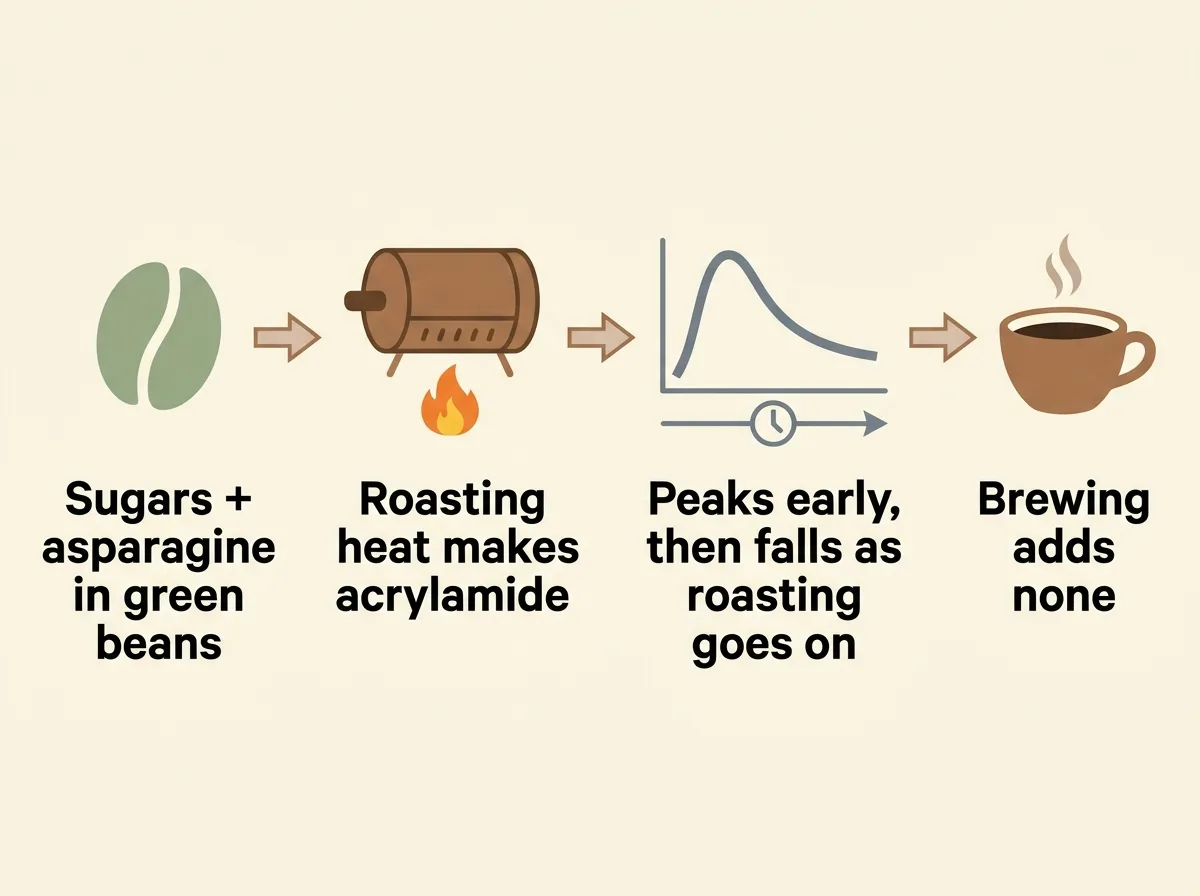
How acrylamide forms and falls during roasting. Based on the FDA and a 2023 review of coffee processing studies.
In one lab study, beans roasted at 200°C hit a peak of 468 micrograms per kilo after five minutes. After that, the level kept dropping. By 60 minutes, none could be detected. [5]
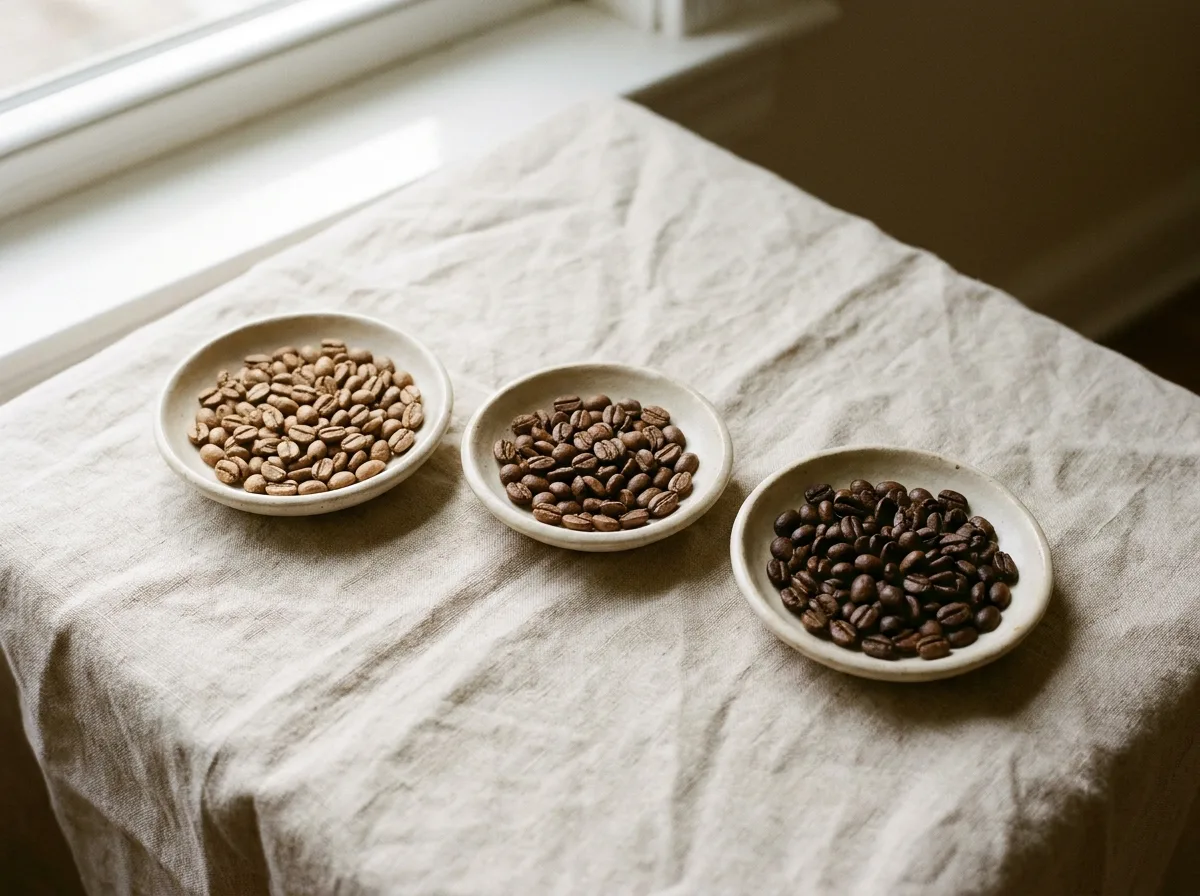
Real roasts don't last 60 minutes, so this is a trend, not a rule. A dark roast isn't acrylamide-free. Light roasts just tend to sit nearer the peak. Choose your roast by taste. Our guide to light, medium and dark roast covers what else changes.
Can acrylamide in coffee cause cancer?
Here is what the big agencies say, in their own words:
-
In animals: high doses caused cancer in lab animals. The FDA notes those doses were "much greater than those found in human food". [1]
-
In people: the FDA says there is "no consistent epidemiological evidence" linking acrylamide in food to cancer in humans. [1]
-
In Europe: EFSA is the EU's food safety agency. In 2015, it said acrylamide in food "potentially increases the risk of developing cancer". It called the human evidence "limited and inconclusive". [6]
-
The cancer agency: the International Agency for Research on Cancer lists acrylamide as "probably" causing cancer in humans. That rating is based mainly on high-dose rodent studies. [3]
So regulators want less of it in food overall, and they say so. That is not the same as showing your coffee causes cancer. Most studies of coffee drinkers and cancer are observational, which means they track people rather than test a cause.
Coffee is also a complex mix of many compounds. A 2020 review argues that this is why it shouldn't be judged by one ingredient alone. [3]
Why did California put cancer warnings on coffee?
California has a warning-label law called Proposition 65. It keeps a list of chemicals known to the state to cause cancer. Acrylamide has been on that list since 1990. [7]
The state's "safe harbor" level for acrylamide is 0.2 micrograms a day. [7] At about 2 micrograms, a single cup of coffee holds roughly ten times that.
In 2019, California changed course. A new rule covers chemicals made by roasting or brewing. It says they "do not pose a significant risk of cancer". It took effect on October 1, 2019. [8]
The rule covers coffee from every brand, Starbucks included. It doesn't mean acrylamide is harmless. It means the state decided the warning wasn't needed for coffee.
Is there acrylamide-free coffee?
No roasted coffee is free of it. The FDA says that, so far, "scientists have not found good ways to reduce acrylamide formation in coffee". [2]
There is one method that works in the lab. An enzyme called asparaginase breaks down asparagine in green beans before roasting. One study using it cut acrylamide by 77 to 85%. [5]
So when a brand sells "low-acrylamide" coffee, ask what it measured and against what. A low number on its own label is the brand's word, much like the "mold-free" claims we looked at in our mold in coffee guide.
How can you cut acrylamide from coffee, if you want to?
The evidence above doesn't say you need to. But if you'd like to trim it, these steps follow the research:
-
Favor roasted coffee over instant, and over chicory substitutes. [4]
-
Lean toward medium or dark roasts rather than very light ones. [5]
-
Try cold brew. Brewing with cold water for 3 hours gave the lowest level in one study. [5] Our cold brew guide shows how.
-
Look at the rest of your plate. Fries, chips and baked goods often add more than your coffee does. [3]
A paper filter won't help, since acrylamide dissolves into the coffee as it brews. [5] Switching to decaf probably won't help much either, because it's roasted the same way. [5]
For the wider health picture, start with whether coffee is healthy, or see the evidence on decaf.
Watch
See it, not just read it
3 videos picked for this page. They play right here, full screen on a phone, and you come straight back to the article.
Hosted on YouTube. Credit belongs to the channels named.
Frequently asked questions
- Does decaf coffee have acrylamide?
- Yes. Decaf beans are roasted just like regular beans, and roasting is what makes acrylamide. A 2023 review found that removing caffeine probably doesn't change the building blocks much, so decaf likely ends up with similar amounts.
- Do coffee pods have acrylamide?
- Yes, because pods hold ordinary roasted and ground coffee. We found no study showing that pods carry more or less than the same coffee brewed another way. What matters is the coffee inside: its roast, its bean type and whether it is instant.
- Does a paper filter remove acrylamide?
- No. Acrylamide dissolves easily in water, so it moves into the coffee as it brews and passes through a paper filter with the liquid. A filter catches grounds, not dissolved chemicals.
- Does Starbucks coffee have acrylamide?
- Like any roasted coffee, yes. We could not find published test results from Starbucks or Folgers. In 2019, California ruled that coffee from any brand does not need a cancer warning for chemicals made by roasting or brewing.
- What are the side effects of acrylamide in coffee?
- None have been shown at the levels in coffee. Acrylamide can harm nerves and fertility at high doses. A 2002 FAO/WHO review put the dose needed for nerve damage at about 500 times the average daily intake from food.
References
Every factual claim in this article is drawn from the sources below. See the source library for how we grade evidence.
- [1]AcrylamideU.S. Food and Drug Administration · 2024 · Agency guidance · Tier 1 · Strong
- [2]Acrylamide and Diet, Food Storage, and Food PreparationU.S. Food and Drug Administration · 2024 · Agency guidance · Tier 1 · Strong
- [3]The Coffee-Acrylamide Apparent Paradox: An Example of Why the Health Impact of a Specific Compound in a Complex Mixture Should Not Be Evaluated in IsolationNutrients (MDPI) / PMC · 2020 · Review · Tier 2 · Moderate
- [4]Commission Regulation (EU) 2017/2158: mitigation measures and benchmark levels for acrylamide in foodlegislation.gov.uk (EU regulation text) · 2017 · Government data · Tier 1 · Strong
- [5]Production and Inhibition of Acrylamide during Coffee Processing: A Literature ReviewMolecules (MDPI) / PMC · 2023 · Review · Tier 2 · Moderate
- [6]Acrylamide in food is a public health concernEuropean Food Safety Authority · 2015 · Agency guidance · Tier 1 · Strong
- [7]Acrylamide: chemical listing under Proposition 65California Office of Environmental Health Hazard Assessment · 2026 · Government data · Tier 1 · Strong
- [8]Cal. Code Regs. Tit. 27, § 25704: Exposures to Listed Chemicals in Coffee Posing No Significant RiskLegal Information Institute (Cornell Law School) · 2019 · Government data · Tier 1 · Strong
Related reading
- Caffeine & HealthMold in Coffee: What the Tests Show→
- Caffeine & HealthIs Coffee Healthy? What Large Studies Actually Show→
- Caffeine & HealthWhat 8,687 Coffee Studies Have Actually Tested in People→
- Caffeine & HealthWhat Drinks Have Caffeine? Every Common One, Ranked→
- Caffeine & HealthCoffee and Pregnancy: Safe Limits and What Research Shows→
- Caffeine & HealthDoes Coke Zero Have Caffeine? Yes, 34 mg a Can→