Chicory Coffee: A Complete Guide
By Coffee Studies Editorial·Published July 14, 2026·6 min read
Quick answer
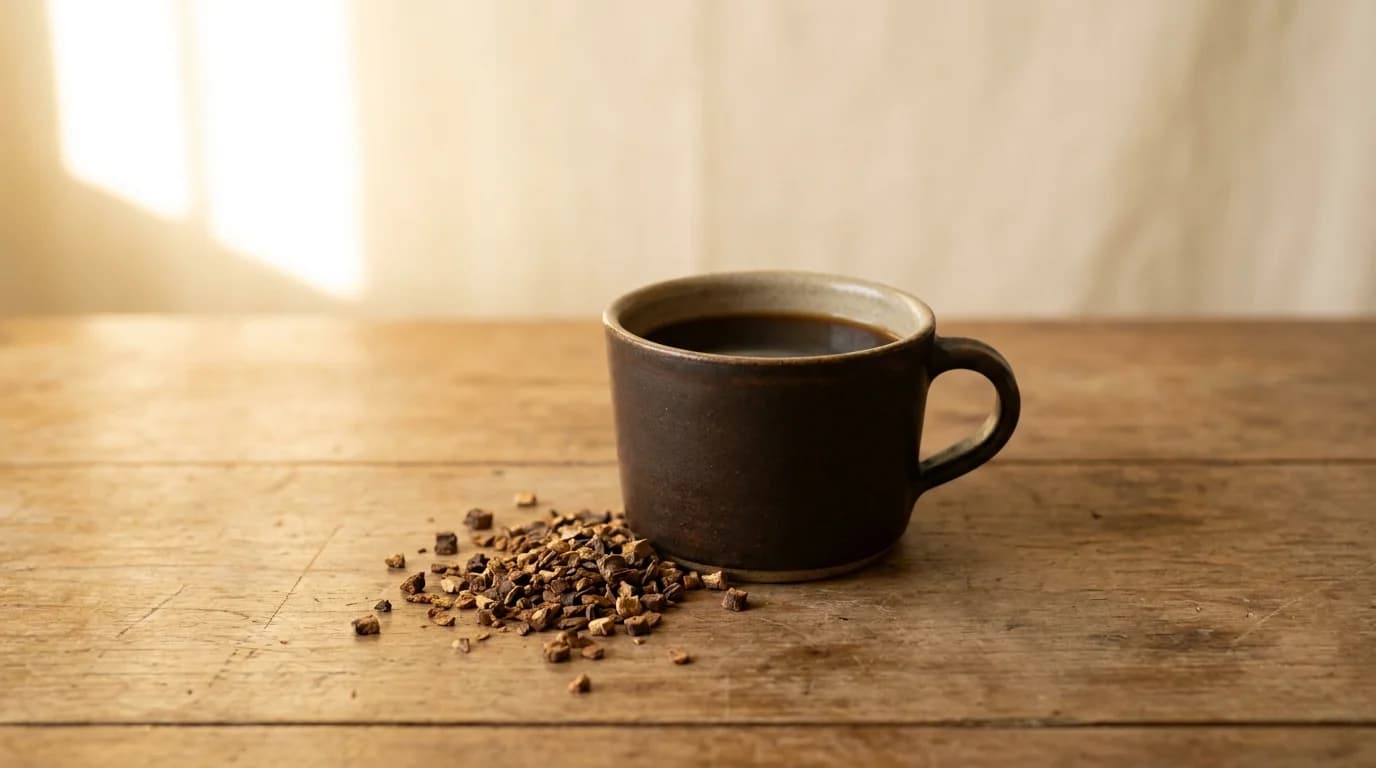
Chicory coffee predates modern coffee-drinking habits by a long way. It's what people in Europe drank when war and trade disruptions cut off real coffee — and what people in New Orleans still drink out of preference. It also happens to solve a modern problem: how to keep the ritual and flavour of coffee while getting rid of the caffeine.
0 mg
chicory root contains no caffeine — the flavour is coffee-like, the stimulant is not[1]
~68%
inulin content of dried chicory root — a prebiotic fibre that feeds beneficial gut bacteria[1]
Centuries
chicory has been used as a coffee substitute and blender across Europe and the American South[1]
What chicory actually is
Chicory (Cichorium intybus) is a flowering plant with blue daisy- like flowers, native to Europe and now widespread across temperate climates. The parts humans use vary: the leaves are eaten as a salad green (endive, escarole, radicchio are all cultivars), and the taproot — a long, pale, carrot-shaped root — is dried, roasted, and ground for chicory "coffee."
When you brew it, the ground roasted root behaves much like coffee does: hot water extracts flavour, colour, and aroma compounds. What comes out is dark brown, bitter, slightly caramel-and-earth in character, and — critically — contains no caffeine.
How chicory coffee is made
The manufacturing process runs parallel to instant coffee:
- Harvest — taproots are pulled after the first year of growth.
- Wash and slice — the roots are cleaned and cut into thin strips.
- Dry — moisture is reduced to storage-stable levels.
- Roast — typically at 140–180 °C for 20–60 minutes, which develops the coffee-adjacent flavour and colour through Maillard- type reactions on the sugars and inulin[1].
- Grind — the roasted root is ground to a coffee-like consistency.
- Brew — like coffee: drip, French press, moka pot, or steeped. Some products are spray-dried into instant chicory that dissolves like instant coffee.
Blends with real coffee are common — the classic New Orleans-style café au lait uses a chicory-heavy coffee blend, and many European products (Postum, Caro, Pero) blend chicory with roasted grains and sometimes small amounts of coffee.
Nutrition: what makes chicory interesting
The nutritional story of chicory is dominated by one compound: inulin, a soluble fibre that makes up roughly two-thirds of the dried root's weight[1]. Inulin is a prebiotic — it isn't digested in the small intestine, but is fermented by beneficial bacteria in the colon.
The 2020 review of chicory taproot uses in the food industry described it as anti-diabetic, immunomodulatory, antioxidant, and prebiotic across the available literature, with commercial inulin- based ingredients and root coffees noted as the most recognised applications of chicory[1].
A brewed cup of chicory coffee contains a small fraction of the inulin in the dry root (most stays behind in the grounds), but combined with the other bioactive compounds — chlorogenic acids and related phenolics — the drink contributes meaningfully to daily polyphenol intake.
Comparing chicory coffee to real coffee
| Chicory coffee | Brewed coffee | |
|---|---|---|
| Caffeine per 8 oz cup | 0 mg | 80–100 mg |
| Flavour | Dark, bitter, earthy | Roasted, bitter, complex |
| Acidity | Lower | Moderate to high (depends on bean) |
| Body | Similar or heavier | Variable |
| Antioxidants | Present (chlorogenic acids, phenolics) | Present (chlorogenic acids, other polyphenols) |
| Prebiotic fibre | Some (from residual inulin) | Minimal |
| Cost per cup | Higher than commodity coffee | Varies widely |
| Sleep impact | None (caffeine-free) | Depends on timing and dose |
For blood-pressure and sleep considerations, chicory is a straightforwardly caffeine-free substitute — an alternative worth comparing to matcha if you also want to keep some caffeine in the picture. For overall health, both drinks contribute similarly through their polyphenol content; neither is meaningfully "healthier"[4].
What the research says
Reviews of chicory as a food ingredient describe a plant with a long history of both dietary and medicinal use, with modern research identifying prebiotic (inulin-driven), antioxidant, and metabolic effects at typical dietary intakes[1].
Because chicory coffee is caffeine-free, it inherits none of the caffeine-related risk considerations (sleep disruption at high or late doses, anxiety in caffeine-sensitive people, small acute blood-pressure rises). It sits comfortably within the FDA and Health Canada frameworks that cap daily caffeine intake at 400 mg for healthy adults — zero contribution to that ceiling[2][3].
For most people, the practical upside of chicory is the fibre contribution from inulin plus the polyphenol profile from the roasted root — and the practical downside is limited to potential digestive effects in people not used to substantial prebiotic intake[1].
Who chicory coffee is a good fit for
- People eliminating caffeine. Pregnancy, medications that interact with caffeine, anxiety, sleep issues, or personal preference — chicory keeps the ritual and much of the flavour without the stimulant.
- People stepping down from coffee. A common approach is to blend chicory 25/75 with regular coffee for a week, then 50/50, then 75/25 — allowing gradual caffeine reduction with minimal headache.
- People with acid-reflux sensitivity to coffee. Chicory tends to be lower in perceived acidity than coffee. Individual results vary and it's not a guaranteed fix.
- People interested in prebiotic fibre. Not a primary reason to drink it (a supplement would be more efficient), but a real side benefit.
Who might want to avoid chicory
- People with ragweed allergies. Chicory is in the same plant family (Asteraceae) and can trigger cross-reactive symptoms in sensitive people.
- People with gallstones or gallbladder disease. Chicory has historically been noted to stimulate bile production; consult a healthcare provider before regular use.
- Pregnant women in large amounts. Traditional use suggests caution; while occasional use appears fine, high habitual intake during pregnancy is not well-studied.
- People just starting a high-fibre diet. Introduce chicory gradually — a full cup a day for someone unused to inulin can cause bloating and gas until the gut microbiome adjusts.
How to brew chicory coffee at home
- Drip or French press — use roughly the same ratio as coffee (10–15 g per cup) and the same water temperature.
- Blended with coffee — start at 20–30% chicory, adjust to taste. New Orleans-style blends typically run 30–50% chicory.
- Instant chicory — dissolves in hot water like instant coffee; typical serving is 1–2 teaspoons per cup.
- Cold brew — works well. Chicory's bitterness softens considerably in cold brew, producing a smoother, less roasty drink.
The honest summary
Chicory coffee isn't a novelty or a health product — it's a centuries-old drink that happens to solve modern problems well. If you want the coffee ritual without caffeine, it's the closest substitute in flavour and format that exists. If you want maximum caffeine, coffee itself is a better tool. The two aren't in competition; many long-time chicory drinkers use both, at different times of day, for different reasons.
Frequently asked questions
- Does chicory coffee have caffeine?
- No. Chicory root is naturally caffeine-free. A cup of pure chicory 'coffee' contains 0 mg of caffeine, which is why it works as a substitute for people cutting back or eliminating caffeine entirely.
- Does chicory coffee taste like real coffee?
- Closer than most people expect. It is dark, roasty, bitter, and slightly earthier than coffee — recognisably coffee-adjacent rather than tea-like. Traditional chicory-and-coffee blends (New Orleans style) mix the two and are barely distinguishable from all-coffee to casual drinkers.
- What is inulin and why does chicory contain it?
- Inulin is a naturally occurring prebiotic fibre that makes up about two-thirds of chicory root's dry weight. It feeds beneficial gut bacteria and contributes to digestive health. Chicory is one of the richest common dietary sources — much of the commercial inulin used in food is chicory-derived.
- Are there any downsides to chicory coffee?
- For most people, no. The inulin content can cause bloating or mild digestive discomfort at high intakes for people not used to prebiotic fibre. It's also not recommended for people with a ragweed allergy (chicory is in the same family) or during pregnancy in large amounts.
References
Every factual claim in this article is drawn from the sources below. See the source library for how we grade evidence.
- [1]Back to the Roots: Revisiting the Use of the Fiber-Rich Cichorium intybus L. TaprootsPMC / NIH · 2020 · Review · Tier 2 · Moderate
- [2]Spilling the Beans: How Much Caffeine Is Too Much?U.S. Food and Drug Administration · 2024 · Agency guidance · Tier 1 · Strong
- [3]Caffeine in foodsHealth Canada · 2022 · Agency guidance · Tier 1 · Strong
- [4]Coffee — The Nutrition SourceHarvard T.H. Chan School of Public Health · Reference work · Tier 2 · Moderate
Related reading
- Coffee AlternativesCoffee Alternatives: A Guide to What Actually Works→
- Coffee AlternativesMatcha vs Coffee: Caffeine, L-Theanine, and Differences→
- Espresso & Coffee DrinksCafé au Lait: French Coffee with Warm Milk→
- Coffee AlternativesDandelion Root Coffee: A Complete Guide→
- Coffee AlternativesYerba Mate vs Coffee: Caffeine, Effects, Differences→
- Coffee AlternativesRooibos Tea: The South African Alternative→