Dandelion Root Coffee: A Complete Guide
By Coffee Studies Editorial·Published July 16, 2026·9 min read
Quick answer
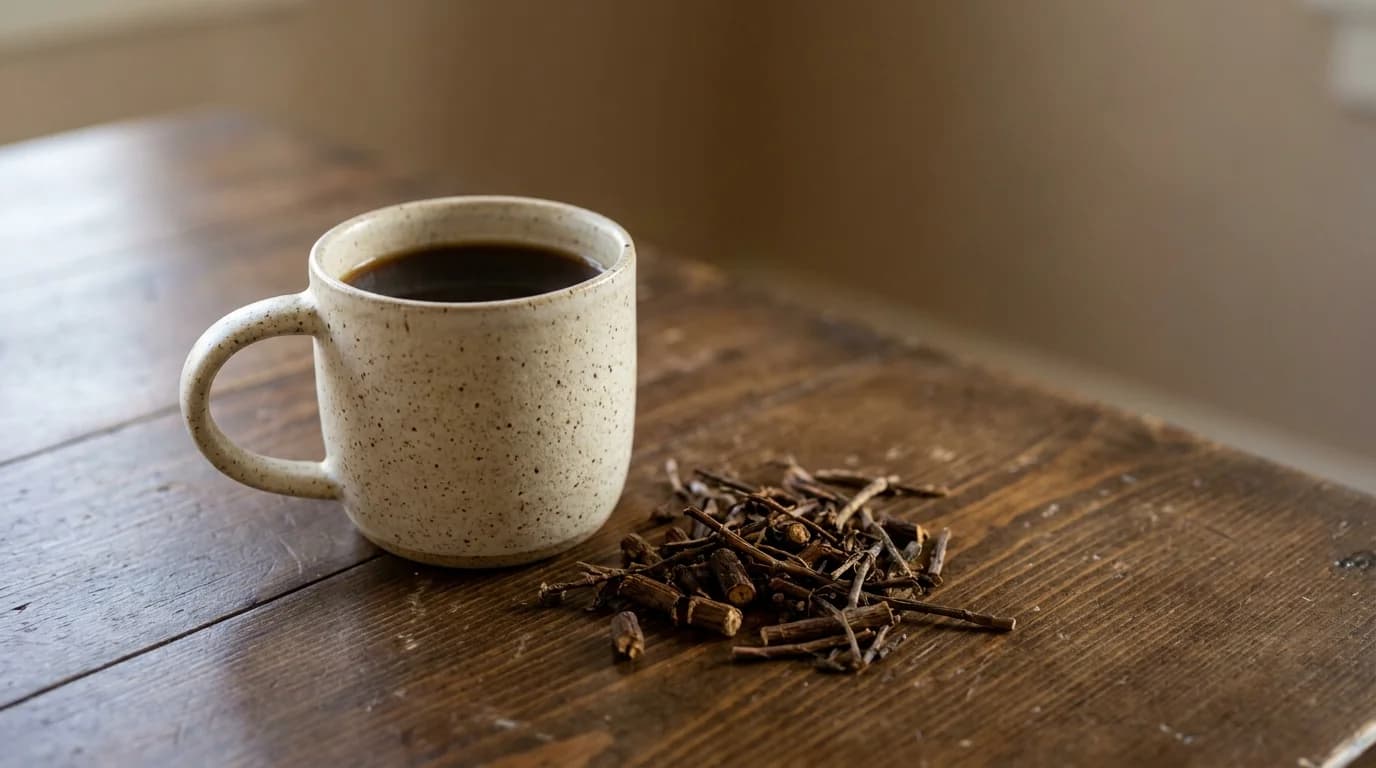
Dandelions are one of the most maligned plants in the average lawn and one of the more interesting sources of a coffee substitute in the average pantry. Roasted dandelion root produces a dark, nutty, mildly bitter drink that has been used as a coffee stand-in for about as long as European settlers have been growing dandelions in North America — and continues to be sold today under a handful of familiar brands as a caffeine-free alternative to coffee.
0 mg
dandelion root is naturally caffeine-free, like chicory[1]
~40%
inulin content of dried dandelion taproot — a prebiotic soluble fibre[2]
1940s
dandelion root coffee peaked in popularity during WWII when real coffee was rationed[3]
What dandelion root coffee actually is
The common dandelion (Taraxacum officinale) is a hardy perennial in the Asteraceae family, native to Eurasia and now naturalised across most temperate regions of the world. Every part of the plant has been used culinarily or medicinally in some tradition — the leaves as a salad green, the flowers for wine, the taproot as both a vegetable and, when roasted, a coffee substitute.
The taproot is what matters for coffee. It's a long, off-white to brown, carrot-shaped root that can reach 15-30 cm into the soil. On a dry-weight basis, it's roughly 40% inulin (in autumn — content varies seasonally), plus sugars, phenolic acids (chlorogenic acid and related compounds), taraxacin (a bitter sesquiterpene lactone), and various minerals[2][1].
Roasting the dried root triggers Maillard-type reactions on the sugars, inulin, and amino acids — the same chemistry that gives coffee its colour and roasty aroma — producing a dark, caramelised, coffee-adjacent flavour[6]. Once ground and brewed, the extract looks like coffee, smells earthy and nutty, and drinks like a mild coffee without any of the caffeine.
A brief history of dandelion coffee
Dandelion root coffee is not a modern invention. Roasted-root coffee substitutes were used across 18th- and 19th-century Europe, especially when trade disruptions or high coffee prices squeezed supply. Chicory dominated (and still does in some regions), but dandelion, burdock, and roasted grains were common alternatives[3].
Two periods pushed dandelion coffee into wide use in North America and Britain:
- The Great Depression (1929-1939) — with money scarce and every household economising, foraging root coffees off waste lots and back gardens was a small but real household strategy.
- World War II (1939-1945) — Britain and continental Europe faced coffee rationing and blockade-driven shortages, and dandelion (like chicory) was actively promoted by government home-front messaging as a substitute.
Postwar, real coffee returned, and dandelion coffee retreated to the health-food shelf and the survivalist manual. It never fully disappeared, and the natural-foods boom of the 1970s onward — and the more recent caffeine-cutting wellness wave — has kept it commercially viable.
The inulin story
The most substantively interesting thing about roasted dandelion root as a beverage ingredient is the same thing that makes chicory interesting: inulin.
Inulin is a soluble fibre made of chains of fructose molecules capped with a glucose. Human digestive enzymes can't break it down, so it passes intact through the small intestine to the colon, where bacteria — particularly Bifidobacterium and Faecalibacterium species — ferment it into short-chain fatty acids. This is the textbook definition of a prebiotic: a substrate selectively used by beneficial gut microorganisms[4].
Dandelion taproot in autumn can be up to 40% inulin by dry weight — comparable to chicory, one of the richest common sources. Roasting partly degrades inulin into fructans of shorter chain length and into caramelised sugars, so a brewed cup delivers substantially less inulin than the whole root, but still contributes meaningfully as a beverage-based fibre source[6].
Two practical notes about this:
- The prebiotic benefit is real but not unique. If you want to hit prebiotic targets, dandelion coffee is a fine contributor, but it's not a substitute for whole-food fibre sources (vegetables, legumes, whole grains).
- Some people don't tolerate inulin well. Bloating and gas are common early on, especially for people not accustomed to fermentable fibres. FODMAP-sensitive people (particularly with IBS) may find high-inulin drinks uncomfortable.
Digestive and diuretic traditions — with hedging
Dandelion has been used medicinally for centuries, most consistently as a mild diuretic ("pissenlit" in French translates literally to "piss the bed") and a bitter digestive tonic.
What the research says
Modern reviews of Taraxacum officinale summarise a plant with a long ethnobotanical record — used across European, Chinese, Native American, and Middle Eastern traditions for digestive, hepatic, and diuretic complaints — and a small but interesting modern research literature[1][3].
The prebiotic contribution from dandelion's inulin is mechanistically well-established[4] and reasonable to attribute to the whole-root product, with the caveat that brewed coffee extracts less inulin than the dry root itself.
A small pilot study of dandelion leaf extract in healthy adults reported an increase in urination frequency over a single day, consistent with mild diuretic activity — but this was leaf, not root, and the sample was small[5]. Whether roasted root coffee shares this property at typical intakes is unclear.
Broader traditional claims — that dandelion "detoxes" the liver or "cleanses" the body — are not supported by controlled human evidence. The liver and kidneys already handle detoxification; the concept of a supplemental substance "detoxing" them is not physiologically well-defined and should be treated as marketing language rather than a health claim[9].
Dandelion is caffeine-free, so it inherits none of the caffeine considerations that apply to coffee — no contribution to the 400 mg daily caffeine ceiling that FDA and Health Canada set for healthy adults[7][8].
The honest position: dandelion is a mildly interesting bioactive plant with a long safe history of use as food and drink, and no strong human trials proving specific health benefits. Drink it because it's a decent caffeine-free coffee alternative, not because you expect it to fix a medical problem.
Making dandelion coffee from scratch
If you have access to a clean patch of dandelions (untreated with herbicides, away from roadsides), you can make dandelion coffee from raw materials. The process is straightforward but slow.
- Harvest — autumn is ideal; roots are largest and highest in inulin. Dig deep — the taproot goes 15-30 cm down. Discard plants from lawns treated with herbicide.
- Wash and chop — scrub thoroughly under running water to remove all soil. Chop into 1-2 cm pieces.
- Dry — spread on a baking sheet and dry at 65-80 °C for several hours, or air-dry in a warm dry space for several days, until the pieces snap cleanly.
- Roast — spread the dry pieces in a single layer on a baking sheet and roast at 175-200 °C for 30-60 minutes, stirring every 10-15 minutes, until deep brown and coffee-fragrant. Under- roasted dandelion tastes raw and vegetal; over-roasted tastes acrid.
- Cool and grind — cool fully, then grind in a burr grinder or spice grinder to a coarse-to-medium consistency.
- Brew — like coffee. French press, drip filter, or moka pot all work. Standard ratio: 10-15 g of ground roasted root per cup, hot water, 4-6 minute steep.
Homemade dandelion coffee tastes noticeably different from commercial blends — earthier, more forward on the bitter root character, less unified. Some people prefer it; others find the commercial products more coffee-like.
Popular commercial brands
Three products dominate the market for pre-made dandelion coffee- style drinks:
- Dandy Blend — an instant blend of roasted dandelion, chicory, beetroot, ramon nut, and barley. Dissolves in hot water like instant coffee. Widely available in North America. Fine-grained and nutty-sweet.
- Teeccino Dandelion — a coarse-ground brew (brewed like drip or French press) with dandelion, chicory, ramon, carob, barley, and various flavourings. Sold in ground bags and tea bags.
- Pero, Cafix, Caro — European-style roasted grain drinks that use dandelion in some blends; primarily grain-based (see our Postum and roasted grain coffee guide for the wider category).
Instant dandelion blends are the easiest entry point. Their convenience is genuine — no grinding, no brewing time, just hot water — but the flavour is smoother and blander than freshly- brewed ground product.
How dandelion compares to chicory and coffee
| Dandelion coffee | Chicory coffee | Real coffee | |
|---|---|---|---|
| Caffeine per 8 oz | 0 mg | 0 mg | 80-100 mg |
| Flavour | Nutty, earthy, mildly bitter | Dark, earthy, more bitter | Roasted, bitter, complex |
| Inulin content | High (autumn roots) | Very high (~68% dry weight) | None |
| Historical use | Depression, WWII, folk medicine | Napoleonic era, Louisiana | 1000+ years, global |
| Availability | Health-food shelf, forage | Wide (blends common) | Universal |
| Cost per cup | Moderate | Moderate | Varies widely |
Dandelion and chicory are close cousins in the caffeine-free-brewed-root category. Chicory is darker, more bitter, and more coffee-like; dandelion is a shade nuttier and softer. Many commercial blends use both, playing to each root's strengths.
Foraging safely
If you're going to harvest dandelions yourself, three rules matter:
- Identify carefully. Common dandelion has hollow, unbranched flower stems, deeply toothed leaves, and a single flower head per stem. Cat's ear (Hypochaeris radicata) and hawksbeard look similar but have branched stems and multiple flower heads. Use a plant ID guide or app, and cross-reference.
- Location matters. Never harvest from lawns treated with herbicides, from roadside verges (heavy metal contamination), from industrial areas, or from dog-walking hotspots. Prefer clean garden plots, meadows, or organic farm edges.
- Respect the plant. Dandelions are prolific and hard to overharvest, but be a considerate forager — leave enough plants for pollinators (dandelions are important early-spring nectar sources for bees) and for regrowth.
Who dandelion coffee is a good fit for
- People eliminating caffeine. A nutty, roasty, coffee-adjacent option without any caffeine.
- People who like variety in their coffee alternatives. A different flavour profile than pure chicory or grain-based drinks.
- People wanting a small prebiotic contribution from a beverage. Real but modest; not a replacement for whole-food fibre.
- Foragers and DIYers. Dandelion is one of the most accessible wild plants for a from-scratch coffee substitute.
Who might want to avoid dandelion coffee
- People with Asteraceae allergies. Ragweed, chrysanthemum, marigold, and daisy allergies can cross-react with dandelion. If any of those trigger you, approach carefully or avoid.
- People on lithium or diuretic medications. Traditional diuretic activity means dandelion could theoretically alter lithium excretion or compound diuretic effects. Consult a clinician before regular use.
- FODMAP-sensitive people (IBS). The inulin content can aggravate FODMAP-related bloating and gas.
- Pregnant or nursing people in large amounts. Occasional use appears fine; heavy habitual use during pregnancy is not well-studied.
- People with gallstones or bile-duct obstruction. Dandelion is traditionally noted to stimulate bile flow — usually a neutral or positive effect, but potentially problematic in the presence of stones.
The honest summary
Dandelion root coffee is a legitimate, historically well-worn, caffeine-free coffee alternative with a nutty-earthy flavour and a useful prebiotic contribution from its inulin content. It's not a detox, a cure, or a superfood — but it's an interesting drink, easily made from scratch if you have a clean patch of dandelions, and reliably available as instant or brew-format commercial products for people who don't want to forage.
Frequently asked questions
- Does dandelion root coffee have caffeine?
- No. Dandelion root is naturally caffeine-free. Pure dandelion root coffee contains 0 mg of caffeine per cup. Many commercial dandelion coffee blends (Dandy Blend, Teeccino) are also caffeine-free — always check the label if you want a fully caffeine-free product, since some blends include added yerba mate or green tea.
- What does dandelion root coffee taste like?
- Nutty, earthy, slightly bitter, and roasty. It's closer to coffee than most herbal alternatives — recognisably dark and roasted rather than tea-like. Compared to chicory, dandelion tends to be slightly less bitter and more nutty. Blends with chicory, roasted barley, or ramon nut (as in Teeccino) push the flavour closer to coffee.
- Is dandelion root coffee actually good for digestion?
- Roasted dandelion root contains inulin, a prebiotic fibre that feeds beneficial gut bacteria and is well-established as a functional food ingredient. In this narrow sense, dandelion contributes a prebiotic component. Broader traditional claims about liver 'detox' or systemic cleansing are not supported by controlled human evidence. Enjoy dandelion coffee for what it is — a caffeine-free, mildly prebiotic-contributing drink — not as a medical treatment.
- How do you make dandelion root coffee at home?
- If foraging: dig up mature dandelion roots (autumn is best), wash thoroughly, chop, and dry completely in a low oven or dehydrator. Roast the dry pieces at 175-200°C on a baking sheet for 30-60 minutes, stirring, until deep brown and fragrant. Grind and brew like coffee. If using commercial product: dissolve 1-2 teaspoons of Dandy Blend in hot water, or brew Teeccino like drip coffee.
- Are there any downsides to dandelion coffee?
- For most people, no. Because dandelion is in the Asteraceae family, people with ragweed, marigold, chrysanthemum, or daisy allergies may react to it. Dandelion has a traditional reputation as a mild diuretic — most people won't notice, but people on lithium or certain diuretic medications should consult a clinician. High inulin intake can cause bloating in people not used to prebiotic fibre. Pregnant or nursing people should moderate intake and consult their provider.
References
Every factual claim in this article is drawn from the sources below. See the source library for how we grade evidence.
- [1]Diverse biological activities of dandelionNutrition Reviews · 2012 · Review · Tier 2 · Moderate
- [2]Taraxacum—a review on its phytochemical and pharmacological profileJournal of Ethnopharmacology · 2006 · Review · Tier 2 · Moderate
- [3]Taraxacum officinale and related species—an ethnopharmacological review and its potential as a commercial medicinal plantJournal of Herbal Medicine · 2015 · Review · Tier 2 · Moderate
- [4]Inulin-type fructans: functional food ingredientsJournal of Nutrition · 2007 · Review · Tier 2 · Moderate
- [5]The diuretic effect in human subjects of an extract of Taraxacum officinale folium over a single dayJournal of Alternative and Complementary Medicine · 2009 · Observational study · Tier 3 · Contextual
- [6]Back to the Roots: Revisiting the Use of the Fiber-Rich Cichorium intybus L. TaprootsPMC / NIH · 2020 · Review · Tier 2 · Moderate
- [7]Spilling the Beans: How Much Caffeine Is Too Much?U.S. Food and Drug Administration · 2024 · Agency guidance · Tier 1 · Strong
- [8]Caffeine in foodsHealth Canada · 2022 · Agency guidance · Tier 1 · Strong
- [9]Coffee — The Nutrition SourceHarvard T.H. Chan School of Public Health · Reference work · Tier 2 · Moderate
Related reading
- Coffee AlternativesChicory Coffee: A Complete Guide→
- Coffee AlternativesPostum and Roasted Grain Coffee: The Cereal Beverage Story→
- Coffee AlternativesCoffee Alternatives: A Guide to What Actually Works→
- Coffee AlternativesGolden Milk (Turmeric Latte): The Complete Guide→
- Coffee AlternativesGuayusa: The Amazonian Caffeine Leaf→
- Coffee AlternativesRooibos Tea: The South African Alternative→