What Is Cascara? Tea Brewed from Coffee Cherry Husks
By Coffee Studies Editorial·Published July 15, 2026·9 min read
Quick answer
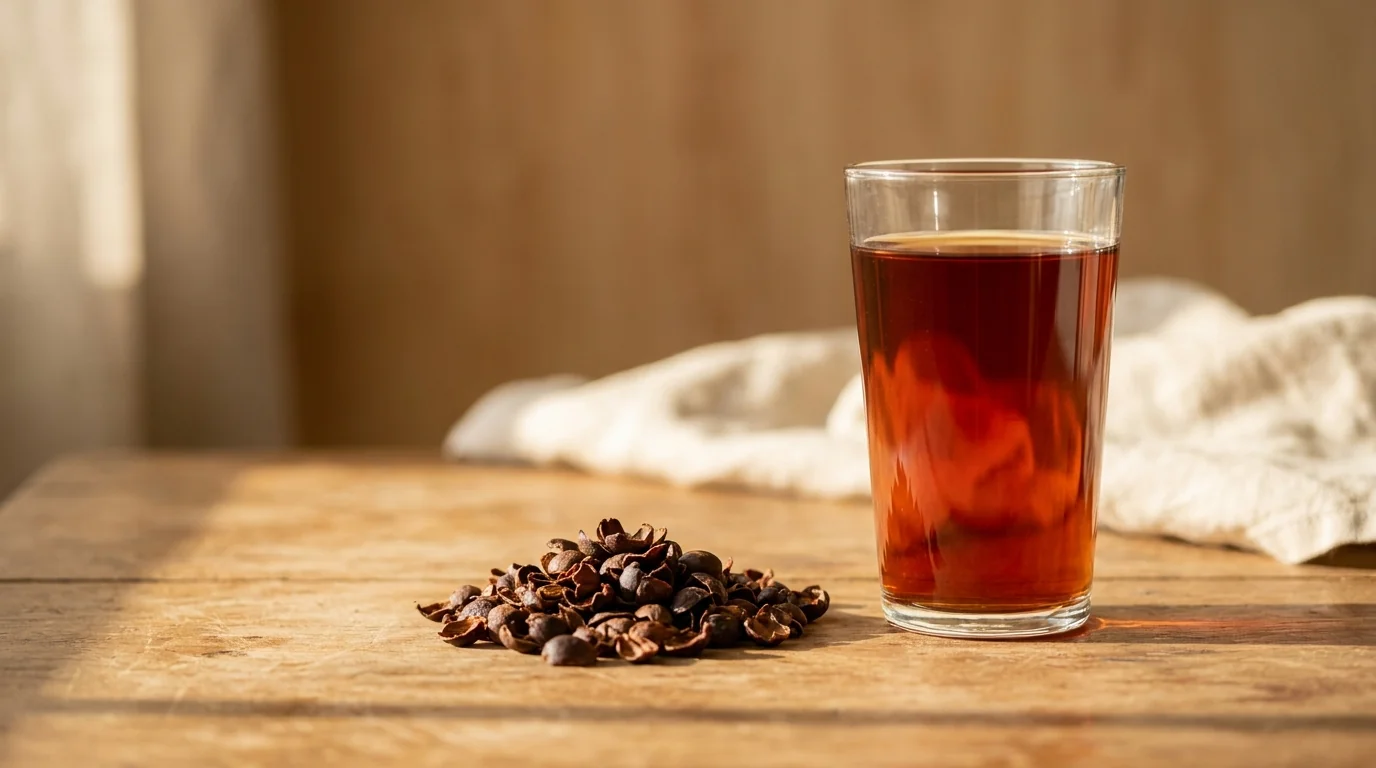
Cascara is one of the more interesting recent developments in coffee-adjacent beverages — a tea-like drink made from the part of the coffee cherry that everyone throws away. It's sustainable (uses a byproduct), delicious (bright fruity character unlike anything else), and connects modern specialty coffee to centuries-old drinking traditions in coffee's origin countries. And it's a great example of how "coffee" is really an entire fruit crop, most of which Western consumers have never tasted.
Cherry husk
cascara is the dried skin/fruit of the coffee cherry — the part discarded during normal coffee processing[1]
~40-100 mg caffeine
typical caffeine content per 8 oz cup — less than coffee (95 mg drip) but more than most teas[2]
Ancient tradition
Yemeni qishr and Ethiopian cherry infusions have used coffee cherry husks for centuries[5]
What cascara actually is
A coffee cherry has multiple layers:
- Skin (exocarp) — the outer red/yellow peel of the ripe cherry.
- Pulp (mesocarp) — the soft flesh underneath.
- Mucilage — the sticky sugary layer around the bean.
- Parchment (endocarp) — thin protective shell.
- Silverskin — very thin layer directly on the bean.
- Bean (seed) — what we roast to make coffee.
Cascara is the dried skin and pulp of the coffee cherry. After coffee cherries are pulped during processing, the skin and remaining pulp are usually treated as agricultural waste — composted, used as fertiliser, sometimes discarded. But if the skin/pulp is instead carefully dried, it can be brewed as a tea-like infusion.
The name "cascara" comes from the Spanish word for "husk" or "skin," reflecting the beverage's popularity in Latin American specialty coffee circles. Yemeni and Ethiopian traditions have used coffee cherry husks for centuries, though under different names ("qishr" in Yemen).
Historical context
Cascara isn't new. Coffee-producing communities have made beverages from coffee cherry husks for a long time:
Yemeni qishr
Yemeni qishr. Traditional Yemeni infusion made from dried coffee cherry husks. Often prepared with cardamom, sometimes ginger. Served hot in small cups. Predates the modern coffee bean beverage in some Yemeni traditions; qishr and coffee coexist as parallel beverages in Yemeni culture. The Yemeni context makes sense given Yemen's foundational role in coffee's commercial history — they had cherries to work with.
Ethiopian preparations
Ethiopian coffee leaf and cherry preparations. Various Ethiopian traditional preparations use coffee cherries and coffee leaves in tea-like infusions. Kuti (coffee leaf tea) is still made in some Ethiopian regions.
Bolivian and Andean
Bolivian and Andean traditions. Cherry-based infusions have local traditions in some Bolivian and Ecuadorian coffee-growing communities.
Modern specialty revival
Modern specialty cascara. Around 2010, US specialty coffee importers (particularly Aida Batlle, a well-known Salvadoran producer, and other Central American producers) began producing cascara for export to Western specialty markets. The Peet's Coffee "Cascara Latte" (2018) and Starbucks' Cascara Latte (2018) briefly brought cascara to mass-market awareness, though it remains largely a specialty category[5].
How cascara is made
Cascara production requires deliberate cherry-husk drying rather than composting.
The process:
- Ripe coffee cherries are picked and delivered to the processing station.
- Cherries are pulped (skin removed) as normal for producing the coffee beans.
- The removed cherry skin and pulp — normally discarded — is instead carefully spread on raised beds or patios.
- The husks are dried in the sun for 2-4 weeks, similar to natural process coffee drying but for the fruit rather than the bean.
- Once dried to storage moisture content, the husks are packaged and sold as cascara.
Quality factors:
- Ripeness of cherries — same as for coffee, ripe cherries produce better cascara.
- Drying speed — too fast produces papery texture; too slow risks mould.
- Cleanliness — cascara for beverage use must be food-grade clean (some coffee farm operations aren't set up for food-hygiene-grade processing of the husks).
- Storage — dried cascara should be stored dry and cool to preserve flavour.
Not all coffee farms produce cascara — it requires additional processing infrastructure and creates a new product line that must be sold. Many producers who make cascara are also producing high-end specialty coffee and view cascara as an additional revenue stream and sustainability improvement.
What cascara tastes like
Cascara doesn't taste like coffee — that's often the first thing new drinkers notice. Instead:
Classic cascara profile:
- Fruity, mildly sweet, tangy — often described as hibiscus-like.
- Red fruit character — cranberry, dried cherry, raisin, sometimes rosehip.
- Tropical fruit notes in some origins — tamarind, passion fruit.
- Light body — thinner than coffee, similar to fruit tea.
- Amber-red colour — visually like hibiscus tea.
- Long fruity finish — persistent aromatic aftertaste.
Variation by origin:
- Central American cascara (Costa Rica, El Salvador, Nicaragua, Guatemala) — often the most refined and cleanly-processed; balanced fruit character.
- Yemeni cascara/qishr — traditionally more intense, often prepared with cardamom.
- Ethiopian cascara — variable; often more aromatically complex.
- Bolivian and other Andean cascara — emerging category with distinctive profiles.
The best comparison for people who've never had cascara is hibiscus tea (agua de Jamaica) — the general body, colour, and tangy-fruity character are similar. But cascara has more complexity and often subtle coffee-adjacent notes that hibiscus lacks.
How to brew cascara
Cascara brews like tea, with some variation:
Hot brew
Hot brew (traditional):
- Amount: 5-10 g dried cascara per 8 oz cup.
- Water: near-boiling (90-95°C).
- Time: 4-5 minutes for standard brew; up to 10 minutes for stronger flavour.
- Vessel: any tea infuser, French press, or fine-mesh strainer works.
Cold brew
Cold brew:
- Amount: 20-30 g dried cascara per litre of cold water.
- Time: 12-24 hours in the fridge.
- Result: cleaner, less tannic, more refreshing than hot brew.
Cascara latte
Cascara latte:
- Hot cascara concentrate combined with steamed milk.
- Popularised briefly by Starbucks and Peet's; can be made at home with strong hot cascara + steamed milk + optional sweetener.
Qishr preparation
Yemeni qishr:
- Cascara boiled (not just steeped) with crushed cardamom pods, and sometimes ginger, for 5-10 minutes.
- Served hot in small cups.
- Sweetened to taste.
Cascara syrup
Cascara syrup:
- Reduced strong cascara + sugar makes an interesting cocktail ingredient — pairs particularly well with bourbon or rum.
Sweetening: cascara is naturally somewhat sweet-tangy; sweetener is optional. Traditional preparations often include sugar or honey. Modern specialty preparations often serve unsweetened.
Caffeine content
Cascara contains modest caffeine — the cherry husk retains some of the fruit's caffeine content even after the bean has been removed:
- Typical range: 40-100 mg caffeine per 8 oz cup.
- Compared to coffee: roughly half (drip coffee ~95 mg/cup).
- Compared to tea: more than most teas (black tea ~40-50 mg, green tea ~25-35 mg).
- Compared to hibiscus tea: cascara has caffeine; hibiscus is caffeine-free.
Cascara is a caffeinated beverage. Anyone monitoring caffeine intake (pregnancy, sensitivity, sleep protection) should count cascara as part of their daily caffeine load. See How Much Caffeine Is Too Much? for general caffeine limits.
Availability and cost
Cascara is a specialty-market beverage. Availability:
- Specialty coffee shops occasionally serve cascara — most commonly as an iced tea or in cold season as a hot drink.
- Specialty coffee roasters often carry cascara seasonally when their coffee producers have supply.
- Online specialty coffee retailers carry cascara from various origins year-round.
- Yemeni grocery stores and Middle Eastern specialty retailers carry qishr blends (cascara + cardamom).
- Mass-market grocery stores — rare, though Peet's and some larger chains have carried cascara products.
Pricing:
- Cascara typically costs $15-30 per pound at specialty retail — comparable to or slightly less than good loose-leaf tea.
- Per-cup cost is very low (5-10 g per cup means 40-90 cups per pound).
Regulatory status
Cascara has had a complicated regulatory history in some jurisdictions:
- US FDA: cascara was in a "Generally Recognized As Safe" (GRAS) grey area for years, then received formal GRAS status in 2020 based on industry submissions. Legal for commercial sale as a beverage ingredient.
- EU: classified as a "novel food" requiring specific approval before commercial sale. Cascara received EU novel food authorisation in 2021, opening broader European commercial availability.
- Producer countries: generally regulated as an agricultural product; no specific novel-food restrictions.
The FDA/EU delays slowed cascara's mainstream commercial adoption in Western markets. With regulatory clearance in place, availability is expanding.
Cascara vs cascara sagrada
Important distinction: cascara sagrada is a completely different plant (Rhamnus purshiana / Frangula purshiana — cascara buckthorn) whose bark has historically been used as a laxative. Cascara sagrada is NOT the same as coffee cherry cascara.
Coffee cherry cascara is a food/beverage; cascara sagrada is a herbal medicine (with some safety concerns for extended use). The confusion is unfortunate but the products are genuinely different.
When buying cascara for coffee cherry tea, look for "cascara" or "coffee cherry cascara" or "coffee cherry tea" specifically. Cascara sagrada would be sold as an herbal supplement, not as a beverage ingredient.
Sustainability angle
One appeal of cascara is that it uses an agricultural byproduct that would otherwise be discarded:
- ~50% of coffee cherry weight is bean; the other 50% is skin, pulp, mucilage, and other non-bean components.
- Traditional processing discards or composts most of this material.
- Cascara production uses the cherry skin and pulp as a food product, generating additional value from the same crop.
- Additional revenue for producers — cascara at $15-30/ lb wholesale plus additional processing effort provides a modest but meaningful supplemental income for coffee farms that produce it.
Cascara isn't going to single-handedly transform coffee sustainability, but it's a meaningful example of finding value in agricultural byproducts.
Common misconceptions
- "Cascara is coffee." No — cascara is the coffee cherry husk, not the bean. It tastes nothing like coffee.
- "Cascara is caffeine-free." It contains meaningful caffeine — less than coffee but more than most teas.
- "Cascara sagrada is the same thing." No — cascara sagrada is a different plant (buckthorn) used as an herbal laxative.
- "Cascara is a new discovery." Yemeni qishr predates the modern coffee bean beverage in some Yemeni traditions; cascara-style beverages have centuries of history in coffee-producing regions.
- "Cascara tastes like hibiscus." Similar family but cascara has more complexity and often subtle coffee- adjacent notes.
The honest summary
Cascara is a tea-like beverage made from dried coffee cherry husks — the fruit that surrounds the coffee bean and is typically discarded during coffee processing. It has centuries of history in coffee-origin countries (particularly Yemeni qishr) and became known in Western specialty coffee circles from around 2010. Cascara tastes fruity, tangy, and mildly sweet — similar to hibiscus tea but more complex, with characteristic red-fruit and cranberry notes. It contains modest caffeine (~40-100 mg/cup, less than coffee but more than tea). Cascara is a distinctive beverage in its own right and a small sustainability improvement in coffee production — using the 50% of the coffee cherry that would otherwise be waste.
Frequently asked questions
- What is cascara?
- Cascara is dried coffee cherry husk — the fruit that surrounds the coffee bean, dried and used to make a tea-like infusion. The name comes from the Spanish word for 'husk' or 'skin.' Cascara has been consumed in coffee-producing countries (particularly Yemen and Ethiopia) for centuries but became widely known in specialty coffee circles around 2010-2015 as a distinctive beverage using coffee's usually-discarded byproduct.
- What does cascara taste like?
- Cascara has a fruity, mildly sweet, tangy character often compared to hibiscus tea, dried cranberry, tamarind, or dried cherry. Well-made cascara has a distinctive tropical-fruit and berry character that doesn't taste like coffee at all. The colour is typically amber-red, similar to hibiscus tea. Body is light. Depending on the origin and drying method, cascara can range from delicately fruity to intensely tangy and complex.
- How much caffeine is in cascara?
- Modest — typically 40-100 mg per 8 oz cup, depending on brew strength and cherry origin. This is less than a cup of coffee (~95 mg for drip) but more than most teas (~30-50 mg for black tea, 20-40 mg for green tea). Cascara isn't caffeine-free, so drink it thoughtfully if you're monitoring caffeine intake.
- How do you brew cascara?
- Like tea, roughly. Standard recipe: 5-10 g of dried cascara per 8 oz cup of near-boiling water (about 90-95°C). Steep 4-5 minutes for a mild brew, longer for stronger flavour. Strain out the husks and serve hot or over ice. Some cascara is made specifically for cold brewing (12-24 hour cold steep) — produces a cleaner, sweeter beverage. Sweeteners aren't necessary but complement cascara's tangy character.
- Where does cascara come from?
- Historically, cascara has been consumed in Yemen and Ethiopia — often called 'qishr' in Yemen (frequently prepared with cardamom or ginger). Modern specialty cascara comes primarily from Costa Rica, El Salvador, Nicaragua, Panama, Guatemala, Bolivia, Ethiopia, and Yemen. Costa Rican and Salvadoran cascara have been particularly influential in bringing cascara to Western specialty markets.
References
Every factual claim in this article is drawn from the sources below. See the source library for how we grade evidence.
- [1]Coffee agronomyFood and Agriculture Organization of the United Nations · Reference work · Tier 2 · Moderate
- [2]Brewing FundamentalsCoffee Science Foundation · Reference work · Tier 2 · Moderate
- [3]International Coffee OrganizationInternational Coffee Organization · Official dataset · Tier 1 · Strong
- [4]Coffee volatile compounds and roast markersPMC / NIH · 2016 · Review · Tier 2 · Moderate
- [5]CoffeeEncyclopaedia Britannica · Reference work · Tier 3 · Contextual
Related reading
- Coffee AlternativesCoffee Alternatives: A Guide to What Actually Works→
- Coffee AlternativesMatcha vs Coffee: Caffeine, L-Theanine, and Differences→
- Beans, Roasts & OriginsYemen, the Port of Mocha, and Coffee's Commercial Birth→
- Coffee AlternativesGolden Milk (Turmeric Latte): The Complete Guide→
- Coffee AlternativesPostum and Roasted Grain Coffee: The Cereal Beverage Story→
- Coffee AlternativesYerba Mate: The South American Coffee Alternative→