Rooibos Tea: The South African Alternative
By Coffee Studies Editorial·Published July 16, 2026·8 min read
Quick answer
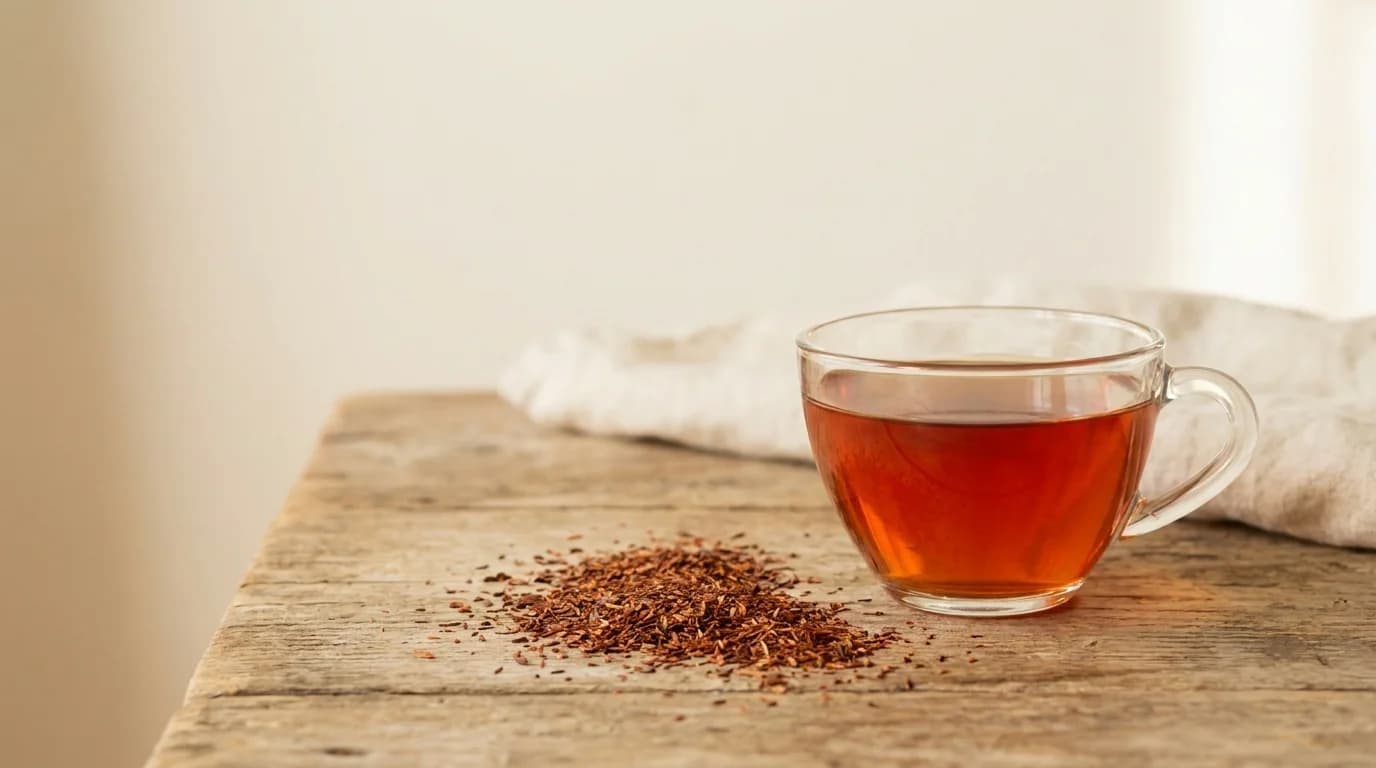
Rooibos is the drink that most obviously breaks the "tea comes from one plant" rule. It looks red-brown in the cup like a black tea. It brews like a tea. It's marketed alongside teas on grocery shelves. But it comes from a completely different plant, contains no caffeine, and grows in exactly one small corner of the world. For anyone looking for a warm, flavourful drink that won't interfere with sleep, rooibos is one of the most useful coffee alternatives in the herbal category.
0 mg
rooibos is naturally caffeine-free — it comes from a legume, not the tea plant[1]
1 region
virtually all commercial rooibos is grown in the Cederberg mountains of South Africa[7]
Very low
tannin content — rooibos does not turn astringent or bitter with long steeping[2]
What rooibos actually is
Rooibos comes from Aspalathus linearis, a needle-leafed shrubby legume in the pea family (Fabaceae). It's endemic to the Cederberg region of South Africa's Western Cape — a mountainous zone of hot, dry summers, cool wet winters, and sandy, acidic soils. The name "rooibos" is Afrikaans for "red bush," referring to the deep red- brown colour the leaves take on after oxidation.
Indigenous Khoisan people had used the plant as a beverage for centuries before Dutch settlers picked it up in the 18th century and before commercial cultivation began in the early 20th century. Aspalathus linearis has multiple wild ecotypes, but the commercial Rocklands (Nortier) type — a rehabilitated selection from the 1930s — accounts for most of what's grown today[1].
Legumes fix their own nitrogen, and rooibos in particular has extensive taproots that reach deep for water. This is part of why attempts to grow it commercially outside the Cederberg — in Australia, China, and elsewhere — have largely failed. The plant appears to require the specific combination of climate, soil, and microbial community present in its native range[7].
Red rooibos vs green rooibos
The two commercial types of rooibos differ in one processing step: oxidation.
Red rooibos (also called fermented rooibos) is the traditional product. After harvest, the fine needle-leaves and stems are bruised — historically by rolling under wooden rollers — and piled up in "fermentation" heaps. Despite the name, this isn't microbial fermentation; it's enzymatic and non-enzymatic oxidation, similar to what happens when you cut an apple. The greens turn brick red-brown, and characteristic aroma compounds develop, giving red rooibos its sweet, nutty, vanilla-tinged flavour and its distinctive amber-red brewed colour[2].
Green rooibos skips oxidation entirely. Freshly harvested plant material is steamed or heated to deactivate the polyphenol oxidase enzymes, then dried. It stays green, tastes grassier and more herbaceous, and brews to a pale golden colour. Green rooibos retains substantially more aspalathin — the plant's signature C-glycosyl flavonoid — because aspalathin is largely destroyed during oxidation[2].
Neither is "better." Red rooibos is what most people picture when they think of rooibos — familiar, comforting, mellow. Green rooibos is a more recent product, drier and more phenolic, favoured in functional-beverage circles for its higher aspalathin content.
Taste and mouthfeel
Red rooibos tastes sweet, faintly woody, nutty, and slightly vanilla-like. It's often described as having a honey-and-caramel character with none of the astringency of black tea. Because rooibos contains very little tannin, it doesn't produce the puckering, dry sensation that over-steeped black tea does — you can leave a bag in the cup for the entire drink without penalty[2].
Green rooibos tastes more grassy and green — closer to a mild green tea in profile but without the vegetal umami — and has a slightly brighter, drier finish.
The lack of tannin has practical consequences. Rooibos plays well with milk and sweeteners (which black tea can turn cloudy with), holds up to long cold-brewing without bitterness, and doesn't inhibit iron absorption as strongly as tannin-rich teas do — a factor for people managing iron levels[10].
Aspalathin, nothofagin, and the polyphenol story
Rooibos is unusual in the polyphenol world because two of its main compounds — aspalathin and nothofagin — are almost unique to Aspalathus linearis. Aspalathin is a C-glycosyl dihydrochalcone that has attracted research interest for its antioxidant activity and, in animal and cell studies, effects on glucose metabolism[5].
Rooibos also contains the more common flavonoids quercetin, rutin, orientin, isoorientin, luteolin, and chrysoeriol, plus phenolic acids. The total polyphenol content is comparable in magnitude to black tea, though the profile is quite different[3].
Green rooibos contains roughly 5-10 times more aspalathin than red rooibos on a dry-weight basis, since aspalathin is oxidised during red rooibos processing into related compounds[2].
What the research suggests
The rooibos health literature is smaller and less mature than the coffee or green tea literature. Here's a hedged summary of what's been observed.
What the research says
Reviews of rooibos identify antioxidant activity in both laboratory and animal studies, driven largely by aspalathin, nothofagin, and associated flavonoids[3][1].
A South African randomised trial in adults at cardiovascular risk found that consuming 6 cups of rooibos daily for 6 weeks was associated with modest reductions in LDL cholesterol and triglycerides and improvements in oxidative stress markers compared to baseline[4]. The trial was small and short; the findings suggest — but do not establish — a cardiovascular benefit.
Preclinical and mechanistic studies of aspalathin have shown effects on glucose uptake and insulin sensitivity in cell and animal models[5]. Human trials in people with diabetes or prediabetes are limited and have not produced consistent evidence of clinically meaningful glucose or HbA1c changes from rooibos consumption at typical intakes.
Because rooibos is caffeine-free, it inherits none of the caffeine- related considerations (sleep disruption, acute blood-pressure rise in caffeine-sensitive people, contribution to daily caffeine caps). The FDA and Health Canada 400 mg daily caffeine ceiling for healthy adults isn't relevant to a cup of rooibos[8][9].
Rooibos has an excellent safety profile at normal dietary intakes. Isolated case reports of hepatotoxicity exist but are rare and have not been linked to typical consumption patterns.
Nothing in the current research supports treating rooibos as a medical intervention. What the evidence does support is treating it as a low-risk, potentially beneficial beverage with a distinctive polyphenol profile.
How rooibos compares to coffee, tea, and chicory
| Rooibos | Coffee | Green tea | Chicory coffee | |
|---|---|---|---|---|
| Caffeine per 8 oz cup | 0 mg | 80-100 mg | 20-40 mg | 0 mg |
| Tannin | Very low | Low-moderate | Moderate | Low |
| Bitterness with long steeping | None | Yes | Yes | Some |
| Antioxidant profile | Aspalathin, nothofagin, flavonoids | Chlorogenic acids, melanoidins | Catechins (EGCG) | Chlorogenic acids, phenolics |
| Best evening drink? | Yes | No | Marginal | Yes |
| Cost per cup | Moderate | Varies widely | Moderate | Higher |
Rooibos and chicory coffee occupy adjacent but distinct roles as caffeine-free warm drinks. Chicory tastes more like coffee — dark, roasty, bitter — while rooibos tastes more like a mild, sweet, herbal tea. People often end up drinking both, at different times or moods.
Brewing rooibos properly
The lack of tannin gives you more latitude than tea.
- Standard hot brew — 1-2 teaspoons (2-4 g) per 8 oz cup, water at a rolling boil, steep 5-10 minutes. Longer is fine and often produces a fuller flavour.
- Traditional South African stovetop — simmer rooibos in a pot with water for 15-20 minutes. Produces the deepest colour and fullest flavour.
- Cold brew — 3-4 g per 8 oz cold water, refrigerate 8-12 hours. Smooth, clean, refreshing.
- Rooibos latte — brew strong (double the leaves), combine with steamed milk and a touch of honey or vanilla. Popular in South African cafés and increasingly worldwide.
- Iced — brew strong hot, pour over ice with lemon and honey.
Rooibos also works well with spices — cinnamon, cardamom, ginger, star anise, orange peel — which is why it appears in many chai- style blends as a caffeine-free base.
Sustainability, community, and geography
Rooibos is grown almost entirely in a single ecosystem, which creates both opportunity and risk.
Opportunity: the Cederberg is one of the world's five Mediterranean-climate botanical hotspots (the Cape Floral Kingdom) and rooibos is one of its signature crops. The industry supports thousands of families, and organised producers have introduced smallholder-oriented certifications and cooperatives[6]. In 2019, the industry agreed to a landmark benefit-sharing agreement with the Khoisan and San people acknowledging the plant's traditional-knowledge origins — one of the first such deals for a mass-market commodity.
Risk: climate change is projected to push suitable growing zones for rooibos toward the higher, cooler edges of the Cederberg, compressing the available area[11]. Extended droughts in the Western Cape (2015-2018 particularly) have stressed the industry. Attempts to establish rooibos elsewhere have mostly failed, which makes the geographic concentration a long-term concern for supply.
The 2021 EU Protected Designation of Origin recognition means only Cederberg-grown product can legally be sold as "rooibos" in the EU — a form of protection similar to Champagne or Parmigiano-Reggiano. This adds economic value but also concentrates dependence on a single region[7].
Who rooibos is a good fit for
- People eliminating caffeine. Rooibos gives you a warm, flavourful ritual drink with zero caffeine — useful in the evening, during pregnancy, or if caffeine causes anxiety or sleep issues.
- People with sensitive stomachs. The low tannin content means no astringency and typically less GI irritation than tea or coffee.
- Children. Rooibos is a common introductory hot drink for kids in South Africa because it's caffeine-free, mild, and low-tannin.
- People wanting variety. For anyone who's tired of the same handful of herbal teas (chamomile, peppermint, ginger), rooibos offers a distinct flavour profile that doesn't feel medicinal.
- People adding polyphenols to their diet. Rooibos contributes a distinctive polyphenol group (aspalathin, nothofagin) not found in tea or coffee.
Who might want to be cautious
- People on medications metabolised via the liver. Isolated hepatotoxicity case reports exist, though extraordinarily rare. Very high daily intakes (>10 cups/day sustained) have been associated with these cases; typical use is not.
- People with hormone-sensitive conditions. Rooibos contains small amounts of phytoestrogenic compounds; effects at dietary intakes are considered negligible, but people with concerns should consult a clinician.
The honest summary
Rooibos won't replace coffee's caffeine and won't replicate coffee's flavour. What it offers instead is a genuinely useful third category: a warm, flavourful, safe, low-tannin drink that works at any time of day, tastes noticeably different from both tea and coffee, and comes with a modestly interesting polyphenol profile. Try both red and green — most people prefer one distinctly — and give it a longer steep than you'd give a black tea.
Frequently asked questions
- Does rooibos tea contain caffeine?
- No. Rooibos is naturally caffeine-free. Unlike black, green, or white tea (all Camellia sinensis, which produces caffeine), rooibos comes from a completely different plant — Aspalathus linearis, a South African legume — that contains none. A cup of pure rooibos contains 0 mg of caffeine.
- What is the difference between red and green rooibos?
- Red rooibos is oxidised (fermented) — leaves are bruised and left to react with air, turning red-brown and developing the classic sweet, woody, vanilla-like flavour most people recognise. Green rooibos skips oxidation, staying green and tasting grassier and more herbaceous. Green rooibos retains more aspalathin, the plant's signature polyphenol, but red rooibos is more widely available.
- Where does rooibos come from and why only there?
- Rooibos is grown almost exclusively in the Cederberg mountain region north of Cape Town, South Africa — an area of Mediterranean climate, sandy soils, and hot dry summers. Multiple attempts to cultivate rooibos elsewhere have largely failed; the plant appears deeply adapted to this specific ecosystem. In 2021 the EU granted rooibos Protected Designation of Origin status, restricting the name to South African-grown product.
- Is rooibos actually good for you?
- Rooibos contains distinctive polyphenols (aspalathin, nothofagin) and has been associated in laboratory and small clinical studies with antioxidant activity and modest effects on cardiovascular markers. Human evidence is limited but suggestive. As a caffeine-free, tannin-low, hydrating drink with no known safety concerns at normal intakes, rooibos is a reasonable everyday choice — but it is not a treatment for any condition.
- How long should you steep rooibos?
- Longer than tea. Because rooibos has almost no tannin, it doesn't turn bitter with extended steeping. Standard recipe: 1-2 teaspoons per 8 oz cup, boiling water, 5-10 minutes. Some traditional South African preparations simmer rooibos in a pot for 15+ minutes to fully extract its flavour and colour. It can also be brewed as an iced tea or made into a rooibos latte with steamed milk.
References
Every factual claim in this article is drawn from the sources below. See the source library for how we grade evidence.
- [1]South African herbal teas: Aspalathus linearis, Cyclopia spp. and Athrixia phylicoides—A reviewJournal of Ethnopharmacology · 2008 · Review · Tier 2 · Moderate
- [2]Rooibos (Aspalathus linearis) beyond the farm gate: From herbal tea to potential phytopharmaceuticalSouth African Journal of Botany · 2011 · Review · Tier 2 · Moderate
- [3]A review of the bioactivity of South African herbal teas: rooibos (Aspalathus linearis) and honeybush (Cyclopia intermedia)Phytotherapy Research · 2007 · Review · Tier 2 · Moderate
- [4]Effects of rooibos (Aspalathus linearis) on oxidative stress and biochemical parameters in adults at risk for cardiovascular diseaseJournal of Ethnopharmacology · 2011 · Controlled trial · Tier 2 · Moderate
- [5]Aspalathin, a natural product with the potential to reverse hepatic insulin resistance by improving energy metabolism and mitochondrial biogenesisMolecules · 2018 · Review · Tier 3 · Contextual
- [6]SA Rooibos Council: Rooibos industry facts and sustainabilitySouth African Rooibos Council · 2023 · Reference work · Tier 3 · Contextual
- [7]Rooibos: EU grants Protected Designation of Origin statusEuropean Commission (DOOR database) · 2021 · Agency guidance · Tier 2 · Moderate
- [8]Spilling the Beans: How Much Caffeine Is Too Much?U.S. Food and Drug Administration · 2024 · Agency guidance · Tier 1 · Strong
- [9]Caffeine in foodsHealth Canada · 2022 · Agency guidance · Tier 1 · Strong
- [10]Inhibition of non-haem iron absorption in man by polyphenolic-containing beveragesBritish Journal of Nutrition · 1999 · Controlled trial · Tier 1 · Strong
- [11]Climate change impacts on coffee production: a systematic reviewPMC / NIH · 2023 · Systematic review · Tier 1 · Strong
Related reading
- Coffee AlternativesChicory Coffee: A Complete Guide→
- Coffee AlternativesCoffee Alternatives: A Guide to What Actually Works→
- Coffee AlternativesMatcha vs Coffee: Caffeine, L-Theanine, and Differences→
- Coffee AlternativesYerba Mate: The South American Coffee Alternative→
- Coffee AlternativesYerba Mate vs Coffee: Caffeine, Effects, Differences→
- Coffee AlternativesPostum and Roasted Grain Coffee: The Cereal Beverage Story→