Yerba Mate vs Coffee: Caffeine, Effects, Differences
By Coffee Studies Editorial·Published July 16, 2026·9 min read
Quick answer
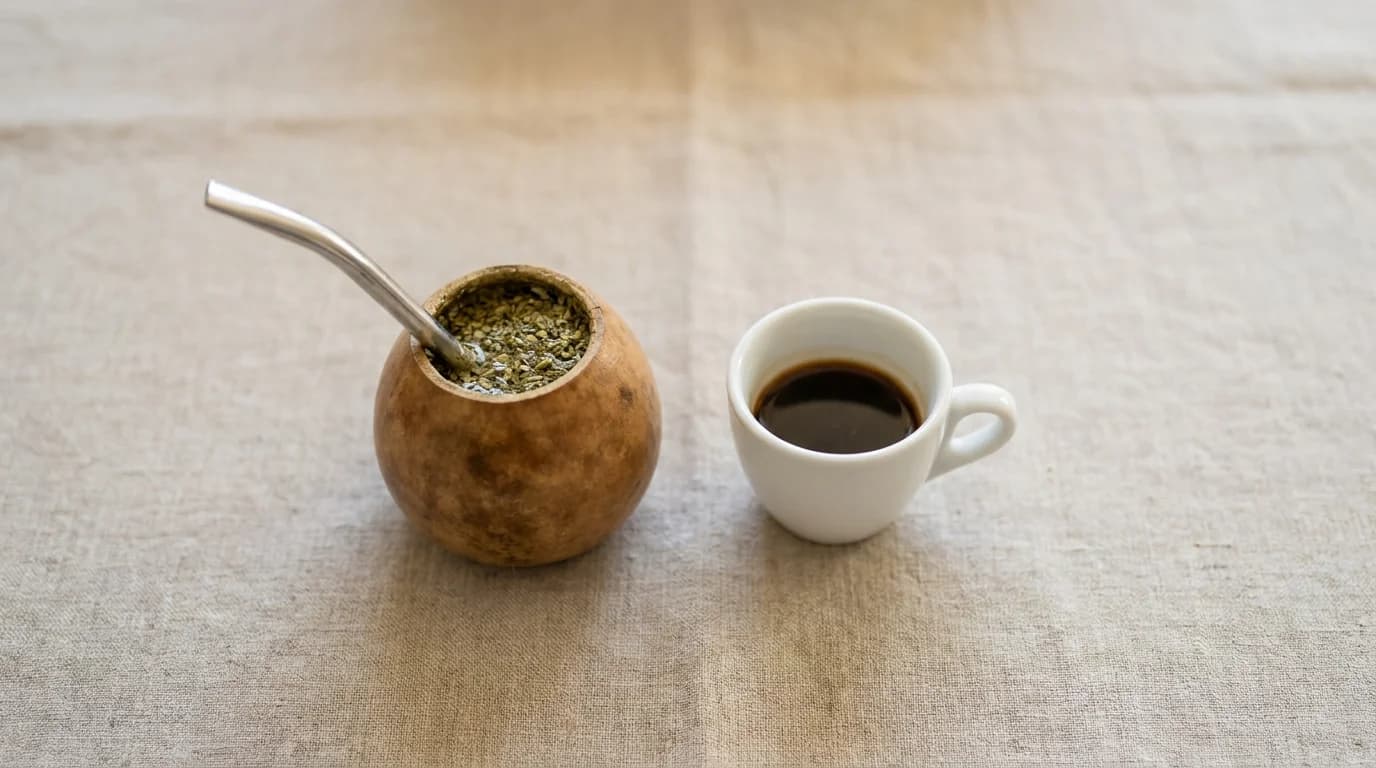
Yerba mate and coffee do the same job at the population level — deliver caffeine and a warm cup — but they land differently on the palate, in the body, and in daily life. If you're deciding between them, or thinking about switching, most of the meaningful differences come down to what else is in the cup besides caffeine and how the drink is prepared. For a broader map of options, see our overview of coffee alternatives.
80 vs 95 mg
typical caffeine in a prepared cup of mate vs 8 oz of drip coffee — closer than most people assume[1]
+ theobromine
mate contains theobromine and trace theophylline; coffee is essentially caffeine alone among the xanthines[2]
Both favourable
both drinks appear in neutral-to-favourable population health evidence at moderate intake[7]
Head-to-head: what's in a cup
Serving norms differ, so per-cup comparisons are more useful than per-gram or per-ounce ones.
| Yerba mate (prepared cup, ~8 oz) | Brewed coffee (8 oz) | Espresso (single, 1 oz) | |
|---|---|---|---|
| Caffeine | ~80 mg (30–180 range) | ~95 mg (80–120 range) | ~65 mg |
| Theobromine | Small but notable | Trace | Trace |
| Theophylline | Trace | Trace | Trace |
| Chlorogenic acids | High | High | High (concentrated) |
| Saponins | Notable | None | None |
| Calories (unsweetened) | ~5 kcal | ~2 kcal | ~1 kcal |
| Typical bitterness | Grassy, vegetal, herbal | Roasted, sharp | Intense, roasted |
| Preparation time | 5–30 min per session | 3–5 min per cup | ~30 seconds per shot |
Mate figures are drawn from composition studies of Ilex paraguariensis[1][2]; coffee figures are from USDA FoodData Central and standard beverage composition references[10]. Product-to-product variation is substantial for both.
The caffeine question, honestly answered
Per prepared serving, coffee wins on total caffeine — but only just. A cup of drip coffee typically delivers about 95 mg; a prepared cup of mate lands around 80 mg. That's a real difference but not a big one. Both are meaningfully caffeinated drinks in the same neighbourhood[1].
Per gram of dry material, they're closer than people expect. Both coffee grounds and dried yerba mate leaves sit in the 1–2% caffeine-by-weight range. Coffee uses more grams per cup (a typical brew uses ~10 g of grounds per 8 oz), which is why coffee-per-cup comes out slightly higher despite mate's leaves being similarly caffeine-dense.
The mate ritual changes the dose curve. A traditional gourd session refills the same yerba many times over an hour or more. Cumulative caffeine across that session often exceeds a single cup of coffee, but it's delivered as many small sips rather than one concentrated dose. For sleep timing and subjective jitteriness, that distinction can matter more than the totals.
Figure
Caffeine per typical serving
Values in mg caffeine per serving
Chemistry: not just caffeine
Both drinks are more than caffeine, and the "other stuff" is where they diverge most.
Yerba mate contains three of the major xanthines:
- Caffeine — the dominant stimulant, at roughly 1–2% by dry weight of the leaves[1].
- Theobromine — the same alkaloid dominant in chocolate. Milder than caffeine but contributes to the overall stimulant profile[2].
- Theophylline — trace amounts; too small to matter functionally at typical intakes but present.
Coffee is caffeine plus chlorogenic acids. Coffee is essentially a single-xanthine drink — theobromine and theophylline are present only in trace amounts. What coffee brings to the table besides caffeine is chlorogenic acids, a family of polyphenols that dominates coffee's antioxidant profile and appears to contribute to many of its associated metabolic effects.
Interestingly, mate also contains chlorogenic acids, at levels comparable to or exceeding coffee[2]. So the polyphenol side of the comparison isn't a clear win for either drink. Mate additionally contains saponins — mildly foaming compounds — that coffee does not.
The old folk term "mateine," which used to describe mate's stimulant as a separate isomer with different effects, has been chemically retired. Mate's caffeine is molecularly identical to coffee's caffeine[4]. Subjective differences drinkers report are more plausibly attributed to theobromine, the polyphenol profile, and the delivery pattern than to any different molecule.
Taste: barely comparable
Coffee tastes roasted, bitter, with acidity and body that vary widely across origins and brew methods. The bitterness is the flavour centre; milk, sugar, and dilution are common softeners. The flavour range across coffees — Ethiopian floral vs Brazilian nutty vs Sumatran earthy — is enormous.
Yerba mate tastes grassy, vegetal, herbal, and slightly bitter, with a fresh alfalfa-like quality unaged and a deeper tobacco-like depth when aged. Traditional Argentine styles that use wood-fire drying carry a light smoky note. Uruguayan yerba tends to be finer and more aged; Paraguayan tereré (cold-water) preparations often include fresh mint or citrus herbs.
They're not trying to taste like each other. Which one you prefer is a preference call, and taste is the single hardest thing to predict from reading about a drink. If neither is familiar to you, the honest recommendation is to try both prepared properly — not from a can or tea bag — before deciding.
Ritual: the biggest practical difference
This is where mate and coffee separate most cleanly, and where the choice often comes down to lifestyle rather than chemistry.
Coffee is a discrete-cup drink. You brew a cup (or a pot), drink it, and either you're done or you have another. A cup takes 5–15 minutes to consume; the ritual is preparation, not sharing.
Mate is a session drink. A gourd is loaded once and refilled many times over an hour or several. In its traditional form, the gourd is passed around a group — one person (the cebador) manages the water and the yerba while everyone else takes a full sip from the bombilla in turn. It is fundamentally more social than a solo morning coffee.
For the solo drinker at a desk, mate can also work well as a "keep sipping while I work" drink — refill your gourd through the morning rather than making four separate cups of coffee. The dose ends up similar; the pace and interruption pattern differ.
Cost
Coffee is cheap at commodity grade and moderately priced at specialty grade. A bag of good specialty coffee at $18–25 will yield 30–40 cups, putting per-cup cost well under $1 at home.
Yerba mate is also cheap in traditional-consuming countries and somewhat more expensive in North America. Loose yerba from major South American brands typically costs $8–15 per pound; a pound will last a heavy drinker a month or more. Ready-to-drink canned mate (Guayakí and similar) is much more expensive per serving — often $3–4 per can — and is closer in economics to an energy drink than to home-brewed mate.
Equipment cost differs. Coffee gear can escalate quickly (grinder, espresso machine, scales). Mate requires a $10–30 gourd and a $5–15 bombilla, and that's it for the traditional preparation.
Health: what the evidence supports
What the research says
Both drinks appear in broadly favourable population health literature at moderate habitual intake. Umbrella reviews of coffee find associations with lower risk of several chronic diseases at around 3–4 cups per day, with a neutral-to-favourable overall signal[7]. Harvard's Nutrition Source summary reflects the same overall picture — coffee is safe and possibly beneficial for most healthy adults[6].
The evidence base for mate is smaller but points in a similar direction. A systematic review of Ilex paraguariensis and cardiovascular disease found modestly favourable effects on lipid markers in a handful of small trials, though the authors emphasise that the trial evidence is preliminary and larger studies are needed[3]. Observational data from mate-drinking populations is broadly consistent with a neutral-to-favourable profile at moderate intake.
The best-supported concern is temperature. The International Agency for Research on Cancer classified drinking very hot beverages — above approximately 65°C — as probably carcinogenic to humans (Group 2A), based primarily on evidence linking very hot mate consumption to esophageal cancer in South American populations. Crucially, IARC classified mate itself as not classifiable (Group 3). The signal is about thermal injury, not the plant. Coffee was also classified as Group 3[5].
The practical implication for both drinks: let it cool a few minutes before drinking. Piping hot is where the evidence gets concerned; warm-but-not-scalding is fine.
The subjective "buzz" difference
This is the most-discussed and least-quantified difference between mate and coffee. Regular mate drinkers describe the effect as "cleaner," "smoother," or "more sustained" than coffee — less of a sharp peak, less jitteriness, less of a subsequent crash.
Three plausible contributors to that experience:
- Delivery pattern. Coffee delivers ~95 mg of caffeine in ~10 minutes; a mate session delivers a similar amount spread across an hour or more. The pharmacokinetic peak is lower.
- Theobromine. Mate contains meaningful theobromine, which has milder stimulant properties than caffeine and may soften the subjective profile[2].
- Expectation and ritual. A sipped-over-time drink used contemplatively feels different from a fast-morning-cup even when the chemistry is close. Set and setting matter.
The catch: individual responses vary widely. Some coffee drinkers who try mate report feeling more wired than usual because the total dose over a session ends up higher than they're used to. Others notice a real smoothness they can't reproduce with coffee.
When to pick each
Choose coffee if:
- You want a fast, concentrated caffeine dose in a discrete cup
- You love the roasted-bitter flavour range coffee offers
- Espresso, latte art, or specialty single origins are part of the appeal
- You're time-constrained in the morning
Choose yerba mate if:
- You want caffeine spread across a longer sipped session
- You find coffee jittery at the same caffeine dose
- Grassy, vegetal, herbal flavour appeals to you (or you're curious)
- You like the shared-gourd ritual, or "keep sipping while working" works for your day
Alternate them:
- Many people who discover mate keep coffee for morning and use mate as an afternoon lift — its lower per-sip dose and longer session format can be easier to time away from sleep.
Common misconceptions
- "Mate has way more caffeine than coffee." Not per single cup. A single prepared mate cup is slightly lower than a cup of drip coffee. Cumulative caffeine across a long refilled session can exceed a single cup of coffee, but per-cup, coffee is higher[1].
- "Mateine is different from caffeine." No. Same molecule. The distinction is historical[4].
- "Mate is dangerous / causes cancer." The evidence is about very hot beverages, not mate as a plant. IARC put mate itself in Group 3 (not classifiable) — the same category as coffee — and put very hot beverages generally in Group 2A[5].
- "Coffee is more of a drug than mate." Both drinks contain caffeine. The molecule doesn't care whether it came from a coffee bean or a holly leaf. Health Canada and the FDA cite the same 400 mg/day threshold as generally not associated with negative effects for healthy adults[8][9].
The honest summary
Yerba mate and coffee are more alike than the "coffee alternative" framing suggests. Both are meaningfully caffeinated. Both carry polyphenols and appear in broadly favourable population health literature at moderate intake. The molecule doing the stimulating is the same in both cups.
Where they genuinely differ is preparation, ritual, and subjective profile. Coffee is discrete cups and concentrated hits; mate is a sipped session with a supporting cast of theobromine and saponins that shift the feel. If you're deciding between them for practical reasons — dose per cup, quick vs sustained — the differences are real but small. If you're deciding between them for ritual and lifestyle — the shared gourd, the long session vs the quick cup — the differences are much bigger and worth thinking about concretely.
Try both prepared properly for a week each. Notice which one you reach for, and which one leaves you feeling better an hour later. That's the answer for you specifically, and it beats any generalisation.
Frequently asked questions
- Does yerba mate have more caffeine than coffee?
- Per typical prepared serving, no — mate lands around 80 mg per cup versus roughly 95 mg for an 8 oz cup of drip coffee. Both figures vary widely with preparation. A long mate session with many refills can exceed a single cup of coffee cumulatively, but that is dose over time, not per-serving strength.
- Why does yerba mate feel different from coffee?
- Mate contains theobromine and a small amount of theophylline alongside caffeine — coffee delivers caffeine essentially alone. The other bioactives, combined with the slow sipped-over-time delivery of a traditional gourd session, produce a subjective profile many drinkers describe as smoother or more sustained. The molecule doing the stimulating is the same caffeine in both cases.
- Is yerba mate healthier than coffee?
- The evidence base for mate is smaller than for coffee, but both appear favourably in observational studies for cardiovascular and metabolic outcomes at moderate intake. Neither is meaningfully 'the healthy choice' — the choice is largely a matter of preference. Very hot mate has been linked to elevated esophageal cancer risk, so drinking it warm rather than piping hot is the sensible caveat.
- Which has more antioxidants?
- Both are meaningful polyphenol sources. Coffee is dominated by chlorogenic acids; mate contains a similar chlorogenic-acid profile plus saponins and other compounds. Per typical serving, both contribute significantly to daily polyphenol intake — 'more antioxidants' is not a useful health question and neither wins in any health-relevant sense.
- Can I switch from coffee to mate for the caffeine?
- Yes — a prepared cup of mate delivers roughly coffee-level caffeine, so a direct swap works at typical doses. Some drinkers find the transition easier if they miss coffee's flavour but not its jitteriness. Others miss the fast, concentrated dose of espresso and find sipped-over-time mate feels different. Try a full week to know how it lands for you.
References
Every factual claim in this article is drawn from the sources below. See the source library for how we grade evidence.
- [1]Health properties of Yerba MateNutrients · 2020 · Review · Tier 2 · Moderate
- [2]Yerba Mate Tea (Ilex paraguariensis): a comprehensive review on chemistry, health implications, and technological considerationsJournal of Food Science · 2007 · Review · Tier 2 · Moderate
- [3]Ilex paraguariensis extracts and cardiovascular disease: results of a systematic reviewPhytotherapy Research · 2018 · Systematic review · Tier 1 · Strong
- [4]Recent advances on Ilex paraguariensis research: minireviewJournal of Ethnopharmacology · 2011 · Review · Tier 2 · Moderate
- [5]IARC Monographs on the Evaluation of Carcinogenic Risks to Humans, Volume 116: Drinking Coffee, Mate, and Very Hot BeveragesInternational Agency for Research on Cancer (WHO) · 2018 · Agency guidance · Tier 1 · Strong
- [6]Coffee — The Nutrition SourceHarvard T.H. Chan School of Public Health · Reference work · Tier 2 · Moderate
- [7]Coffee consumption and health: umbrella review of meta-analyses of multiple health outcomesBMJ · 2017 · Umbrella review · Tier 1 · Strong
- [8]Spilling the Beans: How Much Caffeine Is Too Much?U.S. Food and Drug Administration · 2024 · Agency guidance · Tier 1 · Strong
- [9]Caffeine in foodsHealth Canada · 2022 · Agency guidance · Tier 1 · Strong
- [10]FoodData CentralU.S. Department of Agriculture · Official dataset · Tier 1 · Strong
Related reading
- Coffee AlternativesYerba Mate: The South American Coffee Alternative→
- Coffee AlternativesCoffee Alternatives: A Guide to What Actually Works→
- Coffee AlternativesMatcha vs Coffee: Caffeine, L-Theanine, and Differences→
- Coffee AlternativesChicory Coffee: A Complete Guide→
- Coffee AlternativesRooibos Tea: The South African Alternative→
- Coffee AlternativesWhat Is Cascara? Tea Brewed from Coffee Cherry Husks→