What Is Chaga Coffee? The Birch Mushroom Drink
By Coffee Studies Editorial·Published July 15, 2026·7 min read
Quick answer
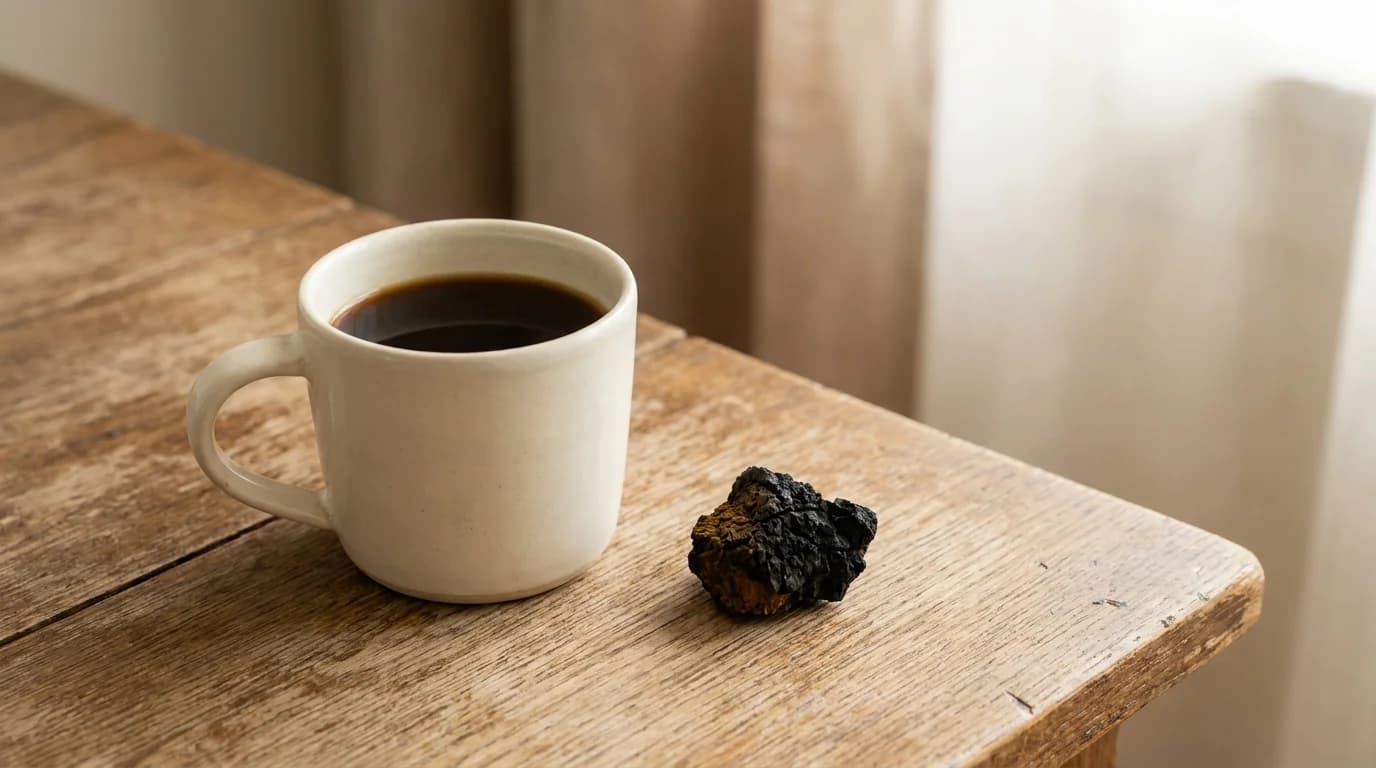
Chaga is one of the more visually distinctive functional mushrooms — a black, hard, charred-looking growth that clings to birch trees across cold northern forests. It has a long history of traditional use in Russia, Scandinavia, and Indigenous communities of the boreal north, and has become one of the more common ingredients in commercial functional coffee blends.
Inonotus obliquus
the scientific name for chaga — technically not a mushroom but a fungus that parasitises birch trees[1]
NHP-listed
Health Canada recognises chaga as a natural health product ingredient with pre-cleared permitted claims[1]
~40-60 mg
typical caffeine per serving of full-caffeine chaga coffee — less than a full cup of regular coffee[3]
What chaga actually is
Chaga (Inonotus obliquus) is a fungus, not technically a mushroom. It grows as a parasitic mass on the outside of birch trees, appearing as a hard, black, cracked-looking growth called a sclerotium — a compact mass of fungal tissue that develops under the birch's bark over years or decades.
The fungus is native to the boreal forests of Canada, Russia, Scandinavia, northern Europe, and the northern United States, and has been used for centuries in Russian and Eastern European folk medicine (typically as a tea or extract) for various purposes.
Key facts:
- Chaga is not a mushroom in the everyday sense (it doesn't produce a mushroom-like fruiting body); it's a fungal mass.
- The valuable material is the black outer sclerotium, not the interior wood.
- Chaga is slow-growing — mature sclerotia can be decades old.
- Harvesting is done wild in most cases; farmed chaga is becoming more common but produces somewhat different compounds.
- The traditional preparation is a long simmering to extract compounds; modern commercial preparations use hot water and sometimes ethanol extractions to concentrate specific compounds.
What's actually in chaga coffee
A typical chaga coffee blend contains two things:
1. Instant coffee — usually spray-dried or freeze-dried soluble coffee.
2. Chaga extract — dried, standardised chaga extract, often concentrated to specific beta-glucan or polysaccharide levels.
Typical dose ranges per serving:
- Low end: 200-500 mg of chaga extract (mixed blends)
- Middle: 500-1000 mg
- Higher end: 1000-1500 mg or more (chaga-focused products)
As with lion's mane and other functional mushroom coffees, most commercial chaga blends deliver smaller doses than clinical research typically uses (often 1000-3000 mg per day of concentrated extract). The chaga fraction is usually small relative to the total dry weight.
Health Canada's framework
Chaga appears in Health Canada's Natural Health Products Ingredients Database under the Mushrooms Product Monograph with pre-cleared permitted claim language based on evidence review[1].
Products with a Canadian Natural Product Number (NPN) have gone through review and are limited to specific narrow claims tied to available evidence — typically framing chaga as a source of specific compounds rather than as a treatment or cure. The permitted claims are considerably narrower than the marketing you'll often see on chaga products.
This framework is a reasonable guide for evaluating claims: if a chaga product is registered with an NPN and its claims align with the Health Canada permitted language, that's a stronger signal than a product making sweeping cognitive or immune claims outside regulatory-permitted language.
The research picture
Chaga has a substantial preclinical research literature — animal studies, cell-based studies, and in-vitro work documenting various bioactive compounds:
- Polysaccharides including beta-glucans
- Melanin compounds contributing to chaga's black colour and antioxidant activity
- Triterpenes including inotodiol and various sterols
- Phenolic compounds with antioxidant activity
Human clinical research is much more limited than preclinical work. There are relatively few well-designed randomised controlled trials in humans, and effect sizes reported in the research vary substantially. This is the key evidence gap that distinguishes chaga (and most functional mushrooms) from better-established interventions.
For context: caffeine has decades of large-scale human trials supporting its effects on alertness and cognition. Chaga has mostly preclinical evidence and small human studies. The research is scientifically interesting but doesn't yet support the kind of broad claims some marketing makes.
Caffeine content
Chaga coffee is typically lower in caffeine per cup than regular coffee, because the mushroom portion displaces some coffee. Typical ranges:
- Full-caffeine chaga coffee: ~40-60 mg per 8 oz cup, vs ~80-100 mg for regular brewed coffee[3]
- Decaf chaga coffee: 2-15 mg per cup — similar to regular decaf[2]
For sleep-sensitive drinkers or people cutting back on caffeine, this reduction is a genuine practical benefit independent of any mushroom-specific effects.
What chaga coffee tastes like
Chaga extract on its own is fairly neutral in flavour — somewhat earthy, slightly bitter, mineral. In a coffee blend, it typically adds a subtle earthy note without dominating. Most drinkers describe chaga coffee as coffee with a hint of something else, not as a distinctly mushroom-forward drink.
Some blends push the chaga proportion higher and produce a more overtly earthy cup. Others keep chaga low and lean on the coffee character; these taste essentially like normal instant coffee.
Chaga blends often work well with milk or milk alternatives — the fuller body from the mushroom extract pairs well with dairy, and the earthy notes complement chocolatey darker roasts.
Who chaga coffee is a good fit for
Reasonable fit if:
- You want a lower-caffeine cup that still tastes like coffee
- You're interested in functional mushrooms and prefer this format over pills or standalone powders
- You already like instant coffee for convenience
- You want the mineral, earthy character alongside your coffee
- You're diversifying your coffee habit with functional ingredients
Less good fit if:
- You want therapeutic-level doses of chaga — dedicated chaga supplements deliver larger amounts at controlled quality
- You dislike instant coffee (most chaga blends are instant-based)
- You have known mushroom or fungal allergies
- You're looking for evidence-backed cognitive enhancement — the human clinical evidence for chaga is limited compared to some alternatives
What to look for on a label
Signals of a trustworthy product:
- Explicit dose of chaga extract in mg per serving — 1000+ mg suggests a meaningful mushroom component
- Extraction method disclosed — dual-extraction (hot water
- ethanol) captures both water-soluble and lipid-soluble compounds
- Wild-harvested vs cultivated disclosure — wild-harvested chaga is traditionally preferred, though sustainability concerns are worth considering
- Regulatory disclosure — Canadian NPN, US FDA notification, or similar
- Narrow, evidence-linked claims — matching Health Canada permitted language rather than broad promises
Signals to be cautious about:
- Sweeping claims about immunity, cancer prevention, or cognitive enhancement without evidence citations
- No disclosure of chaga content per serving
- Very low chaga doses hidden in wellness blend marketing
- Chaga products from unfamiliar brands without any regulatory registration or third-party testing
Sustainability considerations
Wild chaga harvesting has become a sustainability concern in some regions. Chaga takes decades to mature, and overharvesting can damage host birch trees or deplete populations.
Ethical consumers may want to consider:
- Cultivated chaga — grown under controlled conditions rather than wild-harvested
- Traceable sourcing — where and how the chaga was harvested
- Certifications — some producers pursue organic or sustainability certifications
- Regional considerations — the volume of chaga that can be sustainably harvested varies by region
Common misconceptions
- "Chaga is a cancer treatment." No such claim is supported by clinical evidence, and it would be inconsistent with Health Canada's permitted product claims. Preclinical research has identified interesting compounds, but this has not translated into established medical therapies.
- "Chaga is a superfood." "Superfood" isn't a scientific term. Chaga contains bioactive compounds with some evidence of health-relevant effects, but this doesn't elevate it to a category that doesn't really exist scientifically.
- "Chaga coffee is caffeine-free." No — it contains meaningful caffeine from the coffee portion unless specifically decaffeinated.
- "Wild chaga is always better than cultivated." Wild chaga has traditional preference and does have different compound profiles, but cultivated chaga is more sustainable and quality-controlled.
The honest summary
Chaga coffee is coffee blended with extract of a distinctive birch-tree fungus that has a long traditional-use history and emerging modern research. Health Canada recognises specific narrow uses through its Natural Health Products framework; broader claims should be treated skeptically. The lower caffeine per serving is a practical benefit. If the format appeals and you can find a well-labelled product with disclosed doses, it's a legitimate category to explore — just calibrate your expectations to the actual evidence base rather than the marketing claims.
Frequently asked questions
- What does chaga coffee taste like?
- Slightly earthier and more mineral than plain instant coffee, sometimes with a subtle bitter-cocoa note. The chaga extract is fairly neutral in flavour on its own, so the coffee dominates the cup — most drinkers describe chaga coffee as coffee-with-a-hint-of-something-else rather than mushroom-forward.
- Is chaga coffee actually healthy?
- Chaga has a long history of traditional use and Health Canada recognises specific narrow uses in its Natural Health Products framework. Broader modern research is still limited — most studies are preclinical (animal, cell-based) rather than large human clinical trials. Chaga is generally considered safe for most healthy adults at typical dietary intakes.
- Does chaga coffee have caffeine?
- Yes — the caffeine comes from the coffee portion. Because chaga extract makes up part of every serving, typical chaga coffee has roughly 40-60 mg of caffeine per 8 oz cup, compared with 80-100 mg for regular brewed coffee. Decaf chaga blends exist and are much lower.
- Where does chaga come from?
- Chaga (Inonotus obliquus) is a fungus that grows on birch trees across the northern forests of Canada, Russia, Scandinavia, and other cold-climate regions. It appears as a black, cracked mass on the tree bark. Wild-harvested chaga is common; some producers cultivate it, though the wild-vs-farmed distinction affects available compounds.
References
Every factual claim in this article is drawn from the sources below. See the source library for how we grade evidence.
- [1]Mushrooms Monograph — Natural Health Products Ingredients DatabaseHealth Canada · 2018 · Agency guidance · Tier 1 · Strong
- [2]Spilling the Beans: How Much Caffeine Is Too Much?U.S. Food and Drug Administration · 2024 · Agency guidance · Tier 1 · Strong
- [3]FoodData CentralU.S. Department of Agriculture · Official dataset · Tier 1 · Strong
Related reading
- Functional & Mushroom CoffeeWhat Is Mushroom Coffee? Ingredients and Effects→
- Functional & Mushroom CoffeeLion's Mane Coffee: What It Is, Effects, and Evidence→
- Functional & Mushroom CoffeeAdaptogenic Mushroom Coffee: Reishi, Cordyceps, and Beyond→
- Functional & Mushroom CoffeeMushroom Coffee Brands in Canada: 6 Options Compared (2026)→
- Functional & Mushroom CoffeeProtein Coffee: How to Add Protein to Your Cup→
- Functional & Mushroom CoffeeWhat Is Keto Coffee? Fat-Fuelled Coffee Explained→