Reishi and Cordyceps Coffee: The Evidence
By Coffee Studies Editorial·Published July 14, 2026·Updated September 30, 2026·7 min read
Quick answer
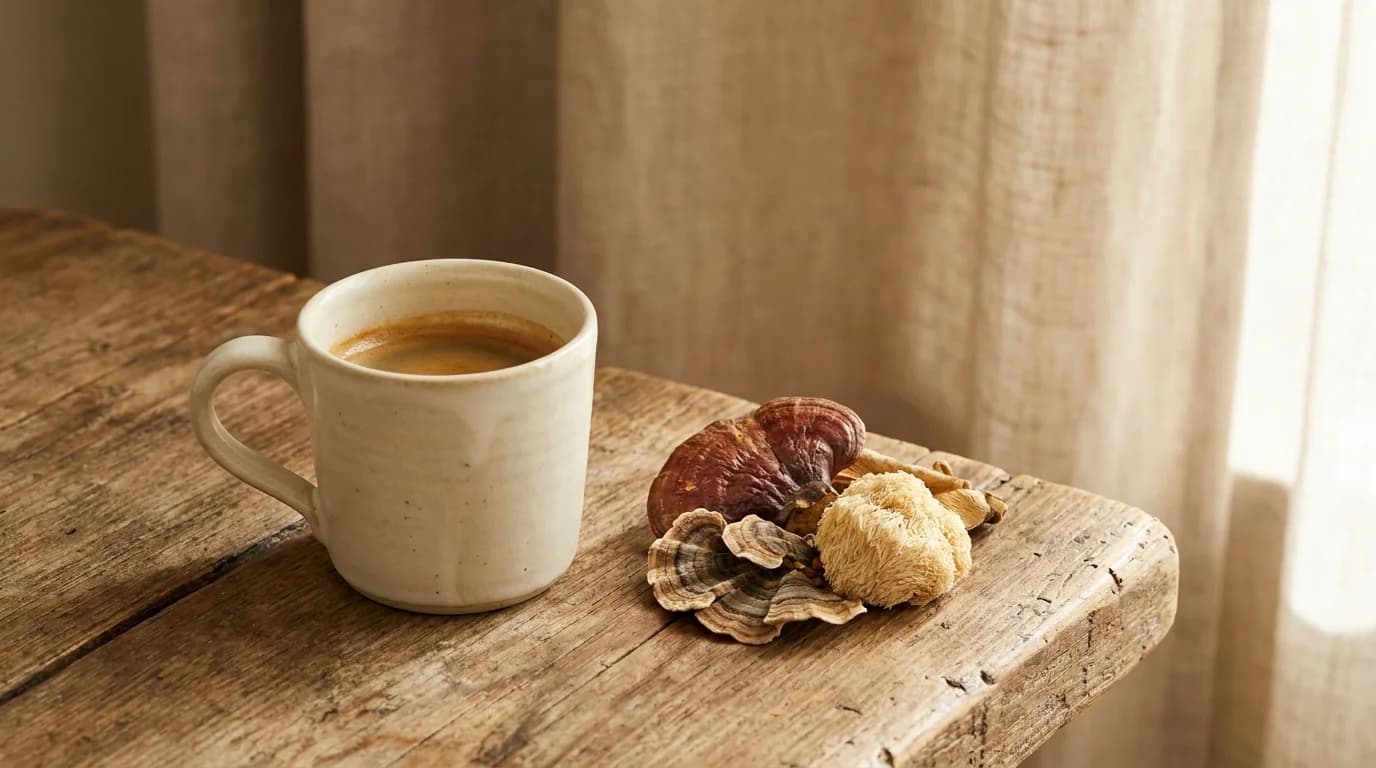
If lion's mane is the focus mushroom in these blends, reishi and cordyceps are the calm and the energy. They are the two species most responsible for mushroom coffee being sold as an adaptogenic drink rather than just a coffee.
They also happen to be the two with the most genuinely useful human trial literature in the category, which makes them a fair test of whether the marketing survives contact with the evidence. Partly it does. The trials are real, randomised and placebo-controlled. What does not survive is the dose.
Reishi, trial doses
Cordyceps, trial dose
Species in your sachet
Reishi: what it is
Ganoderma lucidum, reishi in Japanese and lingzhi in Chinese, is a hard, varnished, kidney-shaped bracket fungus that grows on hardwood. It is not a culinary mushroom in any ordinary sense. It is woody, inedibly tough, and intensely bitter, and it has always been prepared as a long decoction or an extract rather than eaten.
That bitterness is chemically informative. Reishi's distinctive compounds include triterpenes, which are bitter and are not meaningfully water-soluble. They need alcohol to extract. Its other studied fraction is beta-glucans, which are water-soluble and come out in hot water[6]. This is why reishi is the species where dual extraction genuinely matters, and why a water-only reishi extract is an incomplete product. Measured beta-glucan content also varies substantially with the extraction protocol used, so a percentage without a stated method is a weaker claim than it looks[7].
Practically: if a reishi product is not at all bitter, ask what was extracted.
Reishi: what the human trials found
Reishi has better clinical literature than most of this category, and it points somewhere slightly different from where the marketing points.
The most relevant trial for a wellness context is a 2005 randomised, double-blind, placebo-controlled study of a Ganoderma lucidum polysaccharide extract in patients with neurasthenia, a diagnosis covering persistent fatigue and malaise. Over eight weeks it reported improvements in sense of wellbeing and in fatigue scores against placebo[1]. A later pilot trial gave reishi spore powder, 1 g three times daily, to breast cancer patients undergoing endocrine therapy and reported reduced cancer-related fatigue and improved quality of life[2].
Both are fatigue studies. Neither is a sleep study, which matters because sleep is what reishi is most often sold for in coffee blends. And on the oncology question where reishi has the largest literature, Cochrane's systematic review concluded the available trials did not support using it as a first-line cancer treatment and described the evidence base as limited[3].
So the fair reading is: modest randomised evidence for reduced fatigue and better subjective wellbeing at gram-scale doses, thin evidence for sleep specifically, and a careful systematic review declining to endorse the bigger clinical claims.
Cordyceps: which species you are actually getting
This is the part almost every product page gets wrong, or quietly elides.
Cordyceps sinensis, now formally Ophiocordyceps sinensis, is the wild caterpillar fungus of the Tibetan plateau, which parasitises moth larvae. It is one of the most expensive biological commodities on earth, harvested by hand at altitude, and it is effectively never in a supplement, let alone a coffee sachet.
Cordyceps militaris is a different species entirely. It can be cultivated on a substrate in a facility, it grows as small orange club-shaped fruiting bodies, and it is what essentially every commercial cordyceps product uses.
The important point is that this is not a substitution scandal. C. militaris is also what the modern research uses, and it produces cordycepin, the nucleoside analogue most of the pharmacological interest centres on, in measurable amounts. A label saying Cordyceps sinensis on an affordable product is more concerning than one saying C. militaris, because the cheap version of the expensive species is usually mycelium grown on grain.
Cordyceps: what the human trials found
Thinner than reishi, and thinner than the marketing.
The trial worth knowing is a 2016 study in the Journal of Dietary Supplements reporting improved tolerance to high-intensity exercise after both acute and chronic supplementation with a Cordyceps militaris-containing blend[4]. The daily amount was about 4 g, it was a small study, and critically it tested a multi-ingredient blend rather than cordyceps in isolation, so attribution to the mushroom is not clean. Later mechanistic work has explored cellular energy production as a plausible route[5].
Beyond that, the cordyceps literature is largely preclinical. A great deal of the cordycepin research is cell-culture work on cancer lines, and the anti-fatigue studies most often cited are rodent forced-swim experiments. Those are legitimate early science. They are not evidence about a person drinking a coffee.
What the research says
Reishi is one of the few mushrooms in this category with randomised placebo-controlled human data pointing at a plausible everyday outcome: less fatigue, better subjective wellbeing, at 1.4 to 3 g per day[1][2]. Its sleep positioning is not what those trials measured. Cochrane declined to endorse the larger oncology claims[3].
Cordyceps has one small blend-based exercise trial at 4 g per day[4] and otherwise a mostly preclinical base.
Set against a multi-mushroom sachet that may carry under 200 mg of any single species, neither body of evidence is testing the product being sold. That is the honest position, and it is not a reason to avoid mushroom coffee. It is a reason to buy it for the cup rather than for the claim.
The dose gap, specifically
Reishi's neurasthenia trial used an extract at gram scale daily for eight weeks. The cordyceps exercise trial used about 4 g per day. A six-mushroom coffee blend declaring 500 mg total contains, if split evenly, about 83 mg of each.
That is not a small shortfall. It is roughly a twentieth to a fiftieth of what was tested, and the trials also ran for weeks on a single species rather than spreading a smaller total across six. If you genuinely want to test reishi for fatigue on yourself, a single-species extract at a studied dose is the honest way to do it, and mushroom coffee is not that.
There is one real and often-overlooked exception. The caffeine reduction in mushroom coffee is not a dose-gap problem, because it works by there simply being less coffee in the cup. If you feel calmer on mushroom coffee, that is the likeliest mechanism, and it is a genuine one. The FDA's reference point of 400 mg a day for healthy adults is useful context for judging your own intake[9].
Safety and interactions
Reishi is the species in these blends most worth a conversation with a clinician, for two specific reasons.
Anticoagulants and antiplatelet drugs. Reishi has documented effects on platelet function. Combined with warfarin, a DOAC, or even regular aspirin, that is a real pharmacological question rather than a theoretical one.
Immunosuppressants. The immune activity that makes reishi interesting is exactly what makes it a question for anyone on immunosuppressive therapy, including post-transplant patients and some autoimmune treatments.
Beyond that, reported side effects in trials are generally mild and gastrointestinal: nausea, dry mouth, loose stools. Pregnancy and breastfeeding are simply not well studied, which is a reason for caution rather than a known risk. Cordyceps has a cleaner interaction profile, though the same immunosuppressant caution applies.
Health Canada's natural health product monographs set out acceptable uses and permitted claims for several of these species, which is a useful reference point for what a regulator considers supportable[8].
What to look for on a reishi or cordyceps product
- Dual extraction on reishi. Water-only misses the triterpenes, which are much of the point. Some bitterness is a good sign.
- Cordyceps militaris, stated. It is the cultivable species, the one the research uses, and an affordable product claiming C. sinensis deserves scepticism.
- Fruiting body, stated. The same grain-substrate question applies here as everywhere in the category.
- A beta-glucan percentage rather than a total polysaccharide figure.
- A per-species amount, not just a blend weight, if you intend to compare anything to a trial.
The short version
Reishi and cordyceps are the best-evidenced mushrooms in mushroom coffee, and their evidence still does not reach the product. Reishi has randomised trials suggesting reduced fatigue and improved wellbeing at gram-scale doses, thin support for the sleep claim it is usually sold on, and a cautious Cochrane review on the bigger clinical questions. Cordyceps has one small blend-based exercise trial and a mostly preclinical literature behind it.
Drink the coffee because you like it and because the lower caffeine suits you. If you want to test what reishi does for your fatigue, buy reishi.
Frequently asked questions
- What does reishi actually do?
- The best human evidence concerns fatigue and general wellbeing rather than sedation. A 2005 randomised double-blind placebo-controlled trial in neurasthenia reported improvements in sense of wellbeing and fatigue scores over eight weeks, and a later pilot trial in breast cancer patients on endocrine therapy reported reduced cancer-related fatigue. Both used gram-scale daily doses. Cochrane's review of reishi for cancer treatment found the evidence did not support it as a first-line therapy.
- Does reishi make you sleepy?
- It is widely marketed for sleep, and the human trial evidence for that specific effect is thin. The better-conducted studies measured fatigue and wellbeing rather than sleep onset or duration. Reishi is not a sedative in the pharmacological sense, and if a blend is helping you sleep, the reduced caffeine in a mushroom coffee serving may be at least as plausible an explanation as the mushroom.
- Does cordyceps improve exercise performance?
- There is one small randomised trial worth knowing about: a 2016 study in the Journal of Dietary Supplements reported improved tolerance to high-intensity exercise after acute and chronic supplementation with a Cordyceps militaris-containing blend at 4 g per day. It was small, it tested a blend rather than cordyceps alone, and it has not been replicated at scale. Treat it as promising rather than established.
- What is the difference between Cordyceps sinensis and Cordyceps militaris?
- Cordyceps sinensis, now formally Ophiocordyceps sinensis, is the wild caterpillar fungus of the Tibetan plateau. It is extremely expensive and effectively never what is in your coffee. Cordyceps militaris is a different species that can be cultivated commercially, and it is what almost every supplement and coffee blend actually uses. It is also the one the modern research uses, so this is not a downgrade.
- Who should avoid reishi?
- Anyone taking anticoagulant or antiplatelet medication, because reishi has documented effects on platelet function, and anyone on immunosuppressants, given its immune activity. Pregnancy and breastfeeding are unstudied enough to warrant caution. Reported side effects in trials are generally mild and gastrointestinal, but the interaction question is the one that matters.
- Is ganoderma coffee the same as reishi coffee?
- Yes. Ganoderma lucidum is reishi's botanical name, and lingzhi is its Chinese name. Ganoderma coffee, sold widely across East and Southeast Asia since the 1980s largely through multi-level marketing, is reishi instant coffee and predates the Western mushroom coffee category by decades.
References
Every factual claim in this article is drawn from the sources below. See the source library for how we grade evidence.
- [1]A Randomized, Double-Blind and Placebo-Controlled Study of a Ganoderma lucidum Polysaccharide Extract in NeurastheniaJournal of Medicinal Food · 2005 · Controlled trial · Tier 2 · Moderate
- [2]Spore Powder of Ganoderma lucidum Improves Cancer-Related Fatigue in Breast Cancer Patients Undergoing Endocrine Therapy: A Pilot Clinical TrialEvidence-Based Complementary and Alternative Medicine · 2012 · Controlled trial · Tier 2 · Moderate
- [3]Ganoderma lucidum (Reishi mushroom) for cancer treatmentCochrane Database of Systematic Reviews · 2016 · Systematic review · Tier 1 · Strong
- [4]Cordyceps militaris Improves Tolerance to High-Intensity Exercise After Acute and Chronic SupplementationJournal of Dietary Supplements · 2016 · Controlled trial · Tier 2 · Moderate
- [5]Beneficial Effect of Cordyceps militaris on Exercise Performance via Promoting Cellular Energy ProductionMycobiology · 2020 · Observational study · Tier 3 · Contextual
- [6]Edible Mushrooms and Beta-Glucans: Impact on Human HealthNutrients · 2021 · Review · Tier 2 · Moderate
- [7]Compositional differences of beta-glucan-rich extracts from three relevant mushrooms obtained through a sequential extraction protocolFood Chemistry · 2023 · Observational study · Tier 2 · Moderate
- [8]Mushrooms Monograph — Natural Health Products Ingredients DatabaseHealth Canada · 2018 · Agency guidance · Tier 1 · Strong
- [9]Spilling the Beans: How Much Caffeine Is Too Much?U.S. Food and Drug Administration · 2024 · Agency guidance · Tier 1 · Strong
Related reading
- Mushroom CoffeeWhat Is Mushroom Coffee? A Deep, Cited Guide→
- Mushroom CoffeeLion's Mane Coffee: The Evidence and the Dose→
- Mushroom CoffeeChaga Coffee: The Birch Fungus, and the Oxalate Problem→
- Mushroom CoffeeFruiting Body vs Mycelium on Grain→
- Mushroom CoffeeMushroom Coffee Brands in Canada: Compared→
- Mushroom CoffeeReishi Side Effects, Doses and Interactions→