Bugs in Coffee: The Cockroach Myth, Checked
By Coffee Studies Editorial·Published November 23, 2026·6 min read
Quick answer

Are there bugs in coffee? Some coffee carries traces of insect damage. That part is true. The rest of the story, the tins full of ground-up cockroaches, has never been backed by a published test that we could find. It comes from one anecdote on the radio.
The insects that really reach coffee are small beetles. They tunnel into the bean long before it is roasted.
10% of green beans
the FDA acts once an average of 10% of green coffee beans, counted one by one, are insect-infested or insect-damaged[1]
No entry for ground coffee
the FDA handbook lists insect levels only for green beans; roasted, ground and instant coffee have none[1]
One professor, 2009
the cockroach claim began with a biologist on NPR describing a colleague who was allergic to roaches[2]
Are there really cockroaches in ground coffee?
Maybe a stray trace, now and then, but nobody has shown it is common. Coffee is an agricultural crop stored in big warehouses, and warehouses have pests. So a few insect bits in some batches would not be a shock.
What we could not find is a measurement. No study we read counted cockroach parts in ground coffee. The FDA's own coffee rule doesn't mention cockroaches at all. [1]
So the honest answer to "yes or no" is: insect traces, possible; a known amount of cockroach, no.
What does the FDA actually allow in coffee?
The FDA keeps a list called the Food Defect Levels Handbook. A defect level is the point where the agency can act against a food lot. The FDA sets these levels on the idea "that they pose no inherent hazard to health". [1]
The coffee entry is short. It covers green coffee, meaning the raw, unroasted beans that importers buy. It has two rules: [1]
- Insects: action when an average of 10% or more of the beans "by count" are insect-infested or insect-damaged.
- Mold: the same 10% line, counted the same way.
"By count" matters enormously. Inspectors count individual beans, not insect weight. If 10 out of 100 beans have a bore hole, the lot is in trouble. That is not the same as coffee being 10% bug. [1]
The FDA marks the insect defect as "aesthetic." In its glossary, that means "offensive to the senses." [1]
Where did the cockroach story come from?
From NPR's Fresh Air, on 4 May 2009. The guest was Douglas Emlen, a biologist who studies dung beetles. Near the end, he told a story about an old professor of his. [2]
That professor had handled lab cockroaches for years and became "really badly allergic to them." He would only drink coffee from whole beans, ground fresh. Emlen said bulk coffee sits in huge piles that "get infested with cockroaches." [2]
Then he guessed at the rule. "If I'm not mistaken," he said, the FDA limits the percent of insect parts "by dry weight." [2] That's the part that went wrong. The coffee rule counts damaged beans, not weight. [1] Many retellings since has mixed the two into "10% bugs."
Emlen called it "a true story" about one man. He also said he was not an expert on it. [2] A memorable anecdote with a national radio audience travels a remarkably long way.
Which insects actually get into coffee beans?
Beetles, mostly. Two species are worth recognizing.
The coffee berry borer. This is a tiny beetle, under 2 mm long. A review calls it "the most serious insect pest of coffee worldwide". [3]
The female drills into the coffee cherry and on into the bean. Her young then feed on the bean itself. [3] It costs growers more than $500 million a year. It now lives in nearly every coffee country. [3]
The coffee bean weevil. This one is a pest of stored coffee. It feeds on more than 100 kinds of plant. [4] Its larvae live and feed inside the beans. It does real damage above 28°C. [5] Below 22°C, it can't grow from egg to adult. [5]
So the bug most likely to have touched your coffee is a beetle smaller than a grain of rice. Not quite the poster image for a scare story.
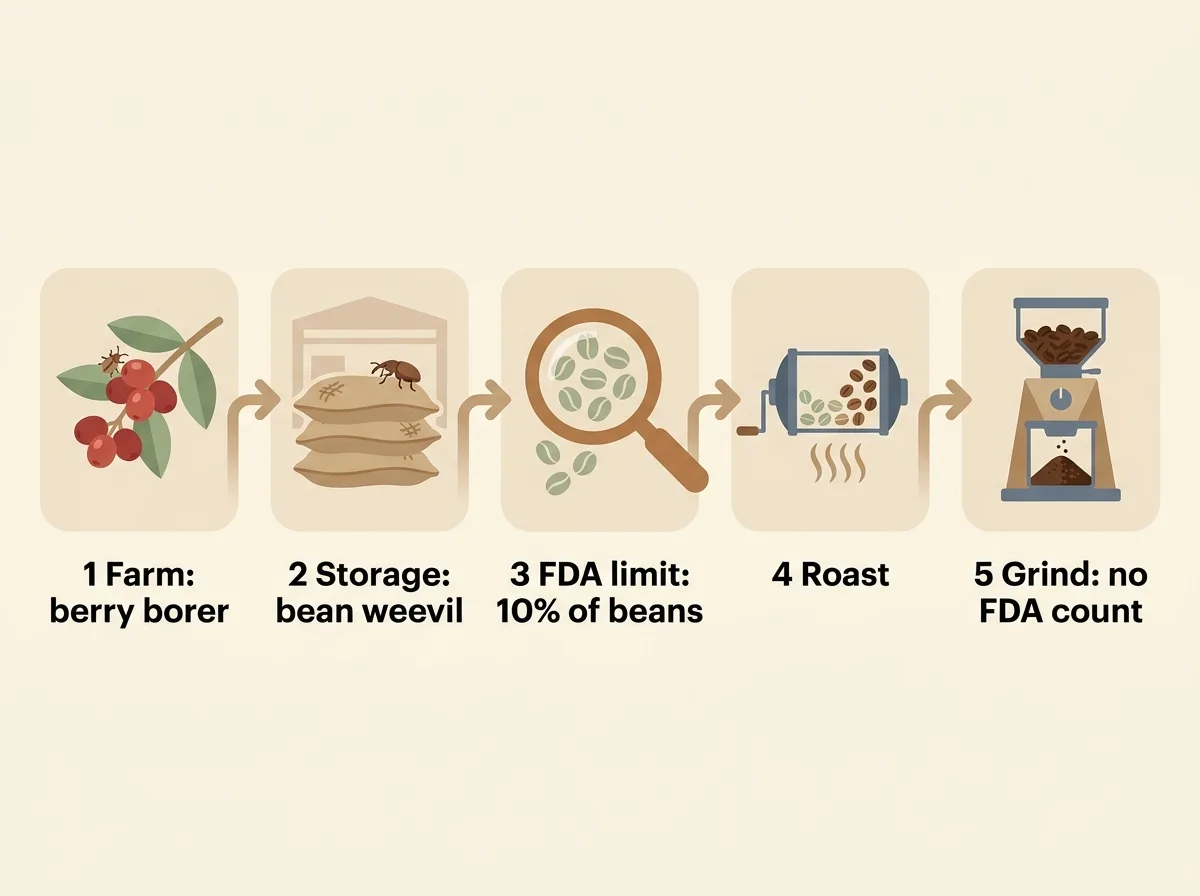
Where insects meet coffee and where the US rule applies. Pests and limits from the FDA handbook, a 2020 berry borer review and a California pest rating.
How does coffee compare with chocolate, flour and peanut butter?
Most ground foods are checked by counting insect fragments in a sample. Coffee is not. Here is how the FDA handbook sets the line for a few kitchen staples. [1]
| Food | What the FDA counts | When it can act |
|---|---|---|
| Green coffee beans | Beans infested or damaged by insects | 10% or more of beans, by count |
| Roasted or ground coffee | Nothing listed | No insect level |
| Chocolate | Insect fragments | 60 or more per 100 g, on average |
| Peanut butter | Insect fragments | 30 or more per 100 g, on average |
| Wheat flour | Insect fragments | 75 or more per 50 g, on average |
| Ground cinnamon | Insect fragments | 400 or more per 50 g, on average |
| Macaroni and noodles | Insect fragments | 225 or more per 225 g, on average |
Read from the FDA Food Defect Levels Handbook, last updated 7 September 2018. Each figure is the level where the FDA can act, not an amount found.
Two details stand out immediately. First, the numbers are action points, not the normal amount in the food. Second, coffee has no fragment count anywhere. Every headline that quotes "fragments in your coffee" is borrowing a number from somewhere else. [1]
Does whole bean coffee avoid bugs?
Not really. Whole beans and pre-ground coffee start as identical green beans, and they face the same 10% rule before roasting. [1]
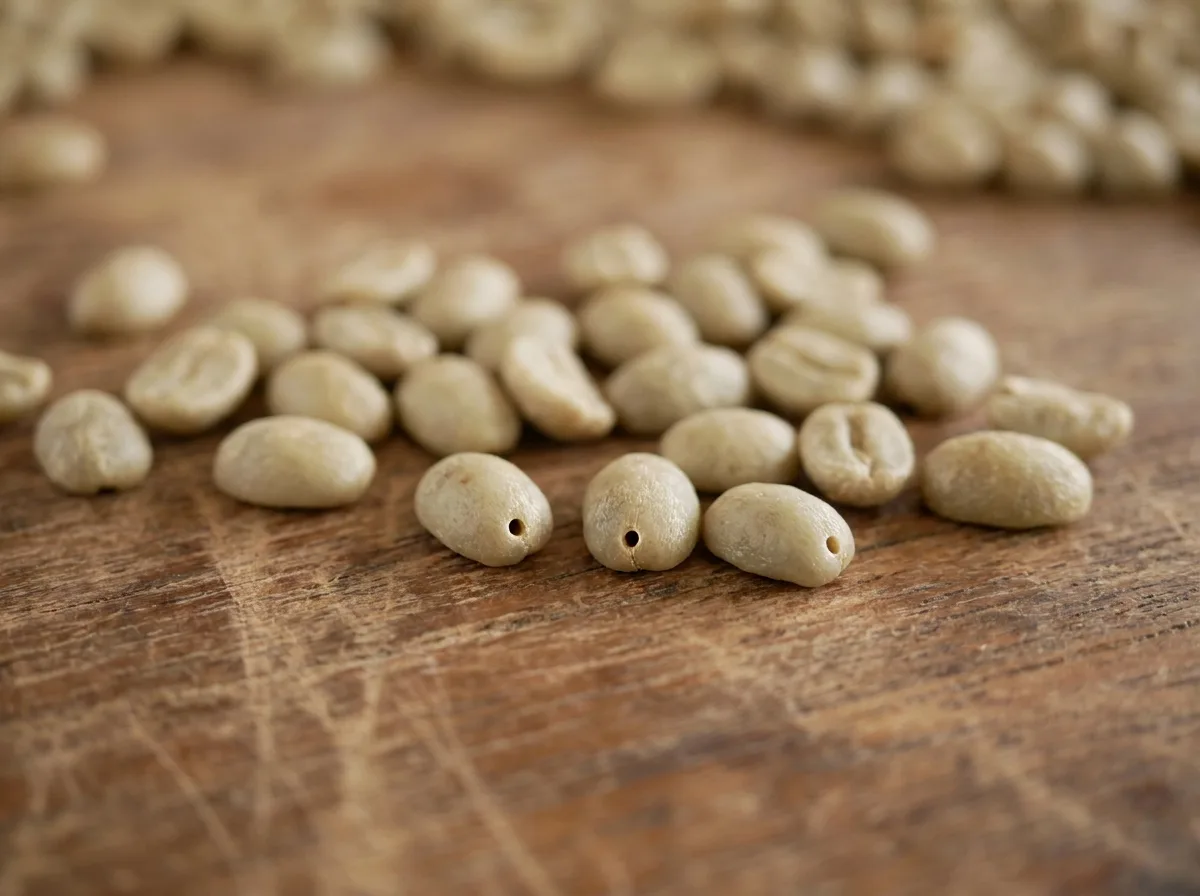
What whole beans do give you is a chance to inspect them. Berry borer damage is a small hole drilled into the bean. [3] You can sometimes spot that on a whole bean. Once ground, nothing shows.
A few habits help at home:
- Buy smaller bags that you finish in a few weeks.
- Keep beans sealed in a cool, dry cupboard. The weevil does its worst in heat. [5]
- Toss a bag if you ever see live insects or webbing in it.
For storage details, see our guide on how to store coffee beans.
Is there a rule in Canada?
Canada doesn't publish a coffee number like the FDA's. Its rule is broader. The Food and Drugs Act bans selling food that is, even in part, "filthy, putrid, disgusting, rotten" or decomposed. [6]
Much of the coffee sold in Canada is the same imported green coffee traded worldwide. The farm beetles above don't stop at the border.
Should insect traces in coffee worry you?
For most people, probably not much. The FDA sets these levels on the premise that they "pose no inherent hazard to health". [1]
Bored beans are mostly a farm problem: they cut both the yield and the quality of the crop. [3]
Allergy is the one genuine question mark. The original story was about a man allergic to cockroaches. But that was one person, told second-hand. We found no study showing that coffee triggers cockroach allergy. If you have a severe insect allergy and react to coffee, that's a question for an allergist, not a blog.
The mold rule in the same handbook is a closer cousin to a real concern. We cover it in mold in coffee. Roasting also makes a trace chemical of its own, explained in acrylamide in coffee.
Watch
See it, not just read it
3 videos picked for this page. They play right here, full screen on a phone, and you come straight back to the article.
Hosted on YouTube. Credit belongs to the channels named.
Frequently asked questions
- Are there bugs in instant coffee?
- Instant coffee starts as the same green beans, so the same US limit on insect-damaged beans applies before it is made. Like roasted and ground coffee, the finished instant powder has no insect count of its own in the FDA handbook.
- Is there an FDA cockroach limit for coffee?
- No. The FDA handbook never names cockroaches for coffee. Its only insect rule for coffee covers green beans, and it counts how many beans are infested or damaged. A lot is in trouble once that reaches an average of 10%.
- Does chocolate have more insect parts than coffee?
- They are measured differently, so they can't be ranked. Chocolate is checked by counting insect fragments, with action at 60 per 100 grams. Coffee is checked by counting damaged green beans, so there is no fragment figure to compare.
- Do big coffee brands test for cockroaches?
- We found no brand that publishes insect test results. In the US, every brand buys green beans under the same FDA defect level. A brand name tells you nothing extra about insect traces, either way.
References
Every factual claim in this article is drawn from the sources below. See the source library for how we grade evidence.
- [1]Food Defect Levels Handbook: levels of natural or unavoidable defects in foods that present no health hazards for humansU.S. Food and Drug Administration · 2018 · Agency guidance · Tier 1 · Strong
- [2]The Fascinating World Of The Dung Beetle (Fresh Air interview with Douglas Emlen, transcript)NPR · 2009 · Reference work · Tier 3 · Contextual
- [3]Coffee Berry Borer (Hypothenemus hampei), a Global Pest of Coffee: Perspectives from Historical and Recent Invasions, and Future PrioritiesInsects (MDPI), via PubMed Central · 2020 · Review · Tier 2 · Moderate
- [4]Micro-CT to Document the Coffee Bean Weevil, Araecerus fasciculatus (Coleoptera: Anthribidae), Inside Field-Collected Coffee Berries (Coffea canephora)Insects (MDPI), via PubMed Central · 2018 · Observational study · Tier 2 · Moderate
- [5]California Pest Rating for Araecerus fasciculatus: Coffee bean weevilCalifornia Department of Food and Agriculture · 2017 · Government data · Tier 2 · Moderate
- [6]Food and Drugs Act (R.S.C., 1985, c. F-27), section 4: Prohibited sales of foodJustice Laws Website, Government of Canada · 2026 · Government data · Tier 1 · Strong
Related reading
- Caffeine & HealthMold in Coffee: What the Tests Show→
- Caffeine & HealthAcrylamide in Coffee: Should You Worry?→
- Caffeine & HealthIs Coffee Healthy? What Large Studies Actually Show→
- Caffeine & HealthCoffee and Pregnancy: Safe Limits and What Research Shows→
- Caffeine & HealthDoes Caffeine Raise Your Heart Rate? What Trials Measured→
- Caffeine & HealthCaffeine Headache: Why Coffee Both Causes and Cures Them→