Does Coffee Ice Cream Have Caffeine?
By Coffee Studies Editorial·Published November 26, 2026·7 min read
Quick answer
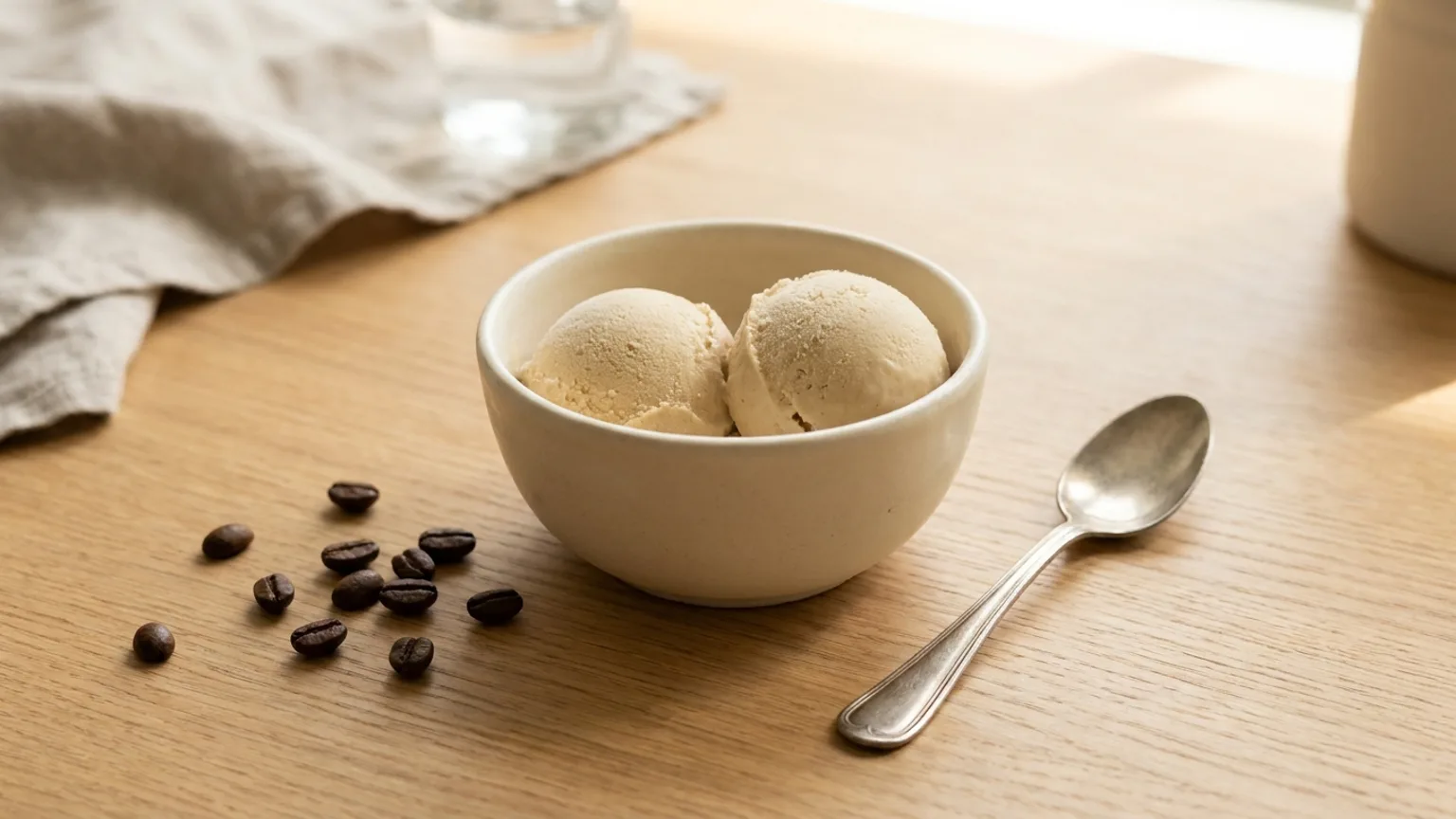
Yes, most coffee ice cream has caffeine, because most of it is made with real coffee. But a scoop is not a cup. Brands that publish a number put a 2/3 cup serving anywhere from zero to about 91 mg. A mug of brewed coffee carries about 95 mg. [1]
So the honest answer is some, and it depends on which tub is in your freezer. Below is every figure we could find on a brand's own page or in CSPI's caffeine chart. The brands that publish nothing are listed too.
Does coffee ice cream have caffeine, and how much?
It does, and the amount swings a lot. Most published figures land between 15 and 50 mg per 2/3 cup, the serving on a US label. That is a third to a half of a mug of coffee. One brand gets close to a whole mug. [2]
0 to 35 mg
the range Häagen-Dazs gives for its ice creams per 2/3 cup or bar, highest in the coffee and chocolate flavours[3]
15 mg
printed on the nutrition panel of Turkey Hill Colombian Coffee, per 2/3 cup[4]
95 mg
in a 237 g mug of brewed coffee, by USDA FoodData Central, for scale[1]
Why the spread? The caffeine rides in with the coffee, and every maker uses a different amount and a different form of it. The label lists coffee but almost never says how much.
What each brand says about its coffee ice cream
We checked each brand's own website on 26 November 2026. Where the brand gives no number, CSPI's chart sometimes does. CSPI builds it from figures that companies disclose. [2]
| Coffee ice cream | Caffeine per 2/3 cup | Where the number comes from |
|---|---|---|
| Talenti Coffee Chocolate Chip Gelato | 43 to 91 mg | CSPI chart |
| Talenti Cold Brew Coffee Sorbetto | 39 to 84 mg | CSPI chart |
| Ben and Jerry's Coffee Toffee Bar Crunch | 49 mg | CSPI chart |
| Ben and Jerry's Coffee, Coffee BuzzBuzzBuzz! | 47 mg | CSPI chart |
| Häagen-Dazs Coffee | 29 mg | CSPI chart; the brand says 0 to 35 mg across its range |
| Edy's or Dreyer's Coffee | up to 25 mg | CSPI chart; the brand says 0 to 25 mg |
| Breyers Coffee | 20 mg | CSPI chart; no figure on the Breyers page |
| Turkey Hill Colombian Coffee | 15 mg | the brand's nutrition panel |
| Tillamook Coffee Almond Fudge | rounds to 0 mg | the brand's product page |
| Straus Organic Coffee | no figure; made with decaf coffee | the brand's ingredient list |
| Blue Bell, Graeter's, Friendly's, Jeni's | no figure found | none of the four brand sites we checked |
The brand quotes behind the table are short. Häagen-Dazs says its levels "typically range from 0 - 35 milligrams per 2/3 cup or ice cream bar" across the line. [3] Edy's and Dreyer's say 0 to 25 mg per 2/3 cup. [6] Tillamook says its Coffee Almond Fudge "can effectively be considered 0.00mg per serving" and rounds down. [5]
We found no flavour figures on Ben and Jerry's own site. So its numbers here rest on CSPI alone, and a missing number is not a zero. If your tub is in the last row, assume it has some caffeine.
Where does the caffeine in coffee ice cream come from?
From the coffee itself. Makers flavour the base with brewed coffee, coffee extract or instant coffee. Some steep whole beans in the warm milk and cream, then strain them out. Each of those carries caffeine unless the coffee was decaffeinated first. Straus, for one, lists "organic decaffeinated freeze dried coffee" in its tub. [8]
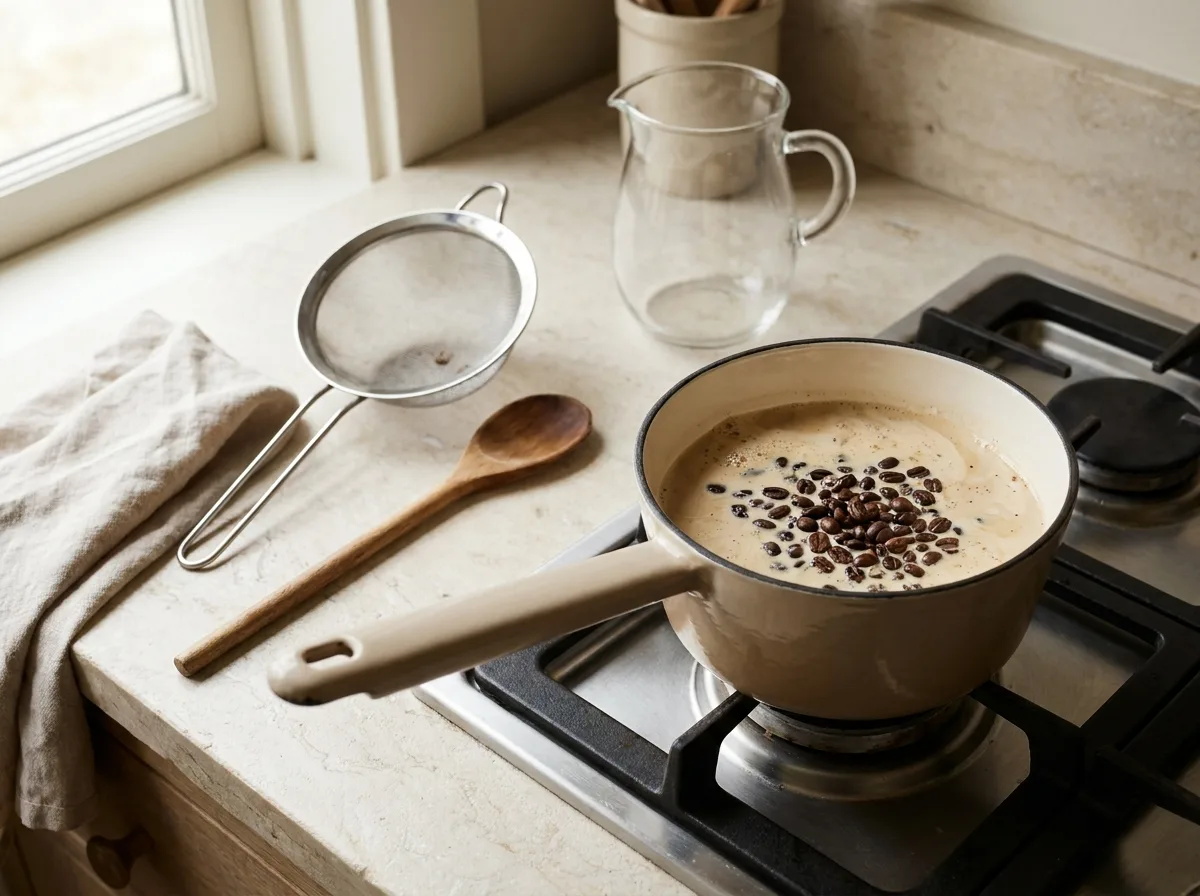
An ingredient list names the coffee but not the dose. So two tubs that taste alike can sit far apart on caffeine. Only the maker knows which is which, and Turkey Hill is unusual in printing its figure right on the panel. [4]
Caffeine can also go in on its own. The FDA names ice cream among products that may have caffeine added as an ingredient. It says your body handles added caffeine the same way as the caffeine in coffee. [9]
How does a scoop compare with a cup of coffee?
Most scoops are a fraction of a mug, using USDA's figure for brewed coffee of 40 mg per 100 g. That makes an 8 oz mug about 95 mg. [1]
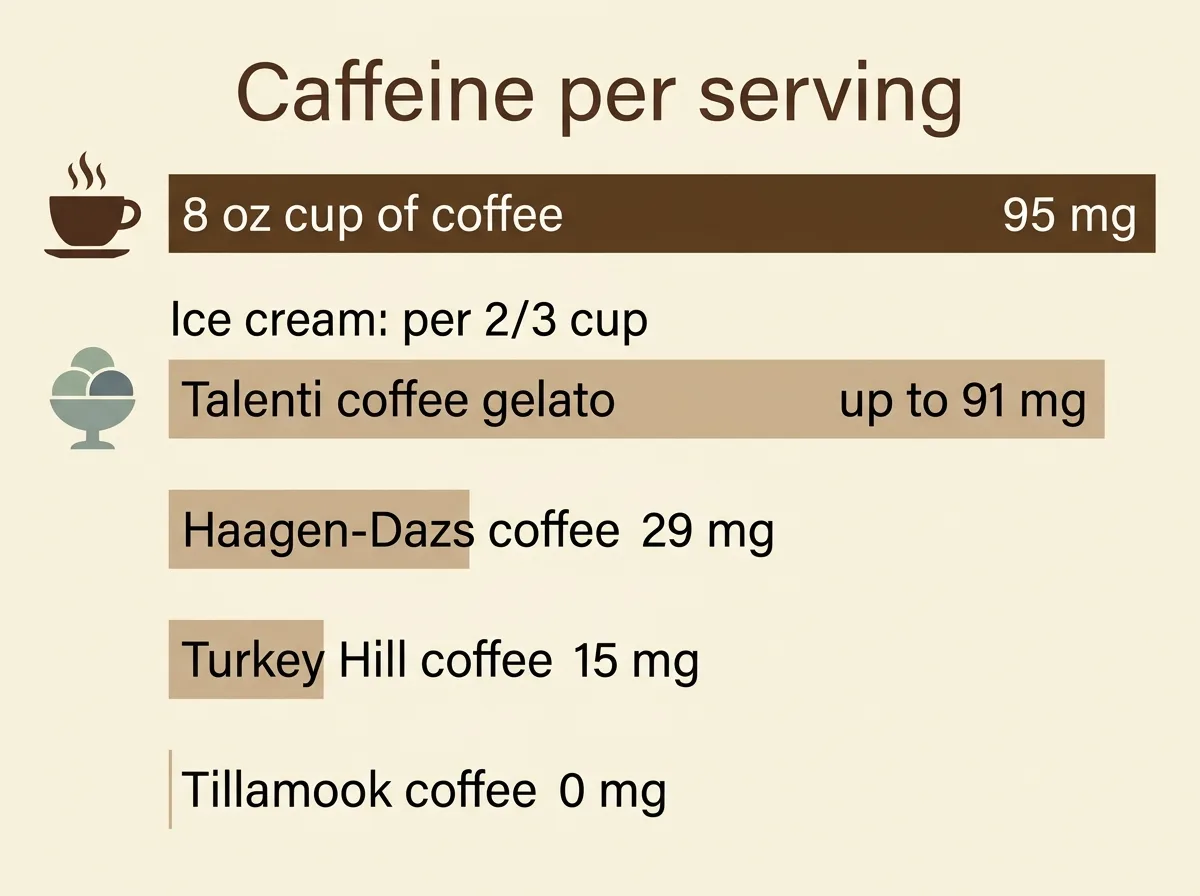
Caffeine per serving. Coffee from USDA FoodData Central; Talenti and Häagen-Dazs from CSPI's chart; Turkey Hill and Tillamook from the brands' own pages.
Turkey Hill's FAQ gives a rule of thumb for its own range. Coffee flavours generally carry 10 to 15 mg a serving, and chocolate flavours 5 to 10 mg. [7]
One catch: 2/3 cup is smaller than most bowls. A pint holds three of those servings. Finish a pint of Talenti at the top of its range and you are past two mugs of coffee. Nobody sets out to drink coffee by the pint, but plenty of people have eaten one.
Can coffee ice cream keep you awake at night?
A normal bowl probably won't, for most adults. In a 2024 trial, 23 young men took 100 mg or 400 mg of caffeine before bed. [10] They took it 4, 8 or 12 hours out.
The 100 mg dose made no measurable difference to their sleep, even at 4 hours. The 400 mg dose delayed sleep at every one of those times.
Most bowls of coffee ice cream sit well under 100 mg. But the trial was small, it only tested young men, and individuals metabolise caffeine at very different speeds. Our guide to caffeine half-life explains why one person sleeps fine after a late coffee and another lies awake.
Four things make a late bowl more likely to cost you sleep.
- A gelato or cold brew flavour near the top of the table.
- A serving bigger than 2/3 cup.
- Coffee or tea earlier in the evening.
- A low caffeine habit, so a small dose hits harder.
Is there a decaf coffee ice cream?
Yes, but it is rare on supermarket shelves. Straus Family Creamery makes its Organic Coffee ice cream with decaffeinated coffee. [8] We found no other brand on our list selling a decaf version.
Decaf does not mean zero, though. One study tested decaf brewed coffee from ten outlets. [11] It found 0 to 13.9 mg per 16 oz serving. A scoop made with decaf will carry a small share of that.
At home it is easy: make the base with decaf beans or decaf instant coffee. Our page on Swiss Water decaf shows how beans can be decaffeinated with water. And if you want the caffeine on purpose, an affogato pours a hot shot of espresso over plain gelato.
Should kids eat coffee ice cream?
The American Academy of Pediatrics says "avoiding caffeine is the best choice for all kids." [12] It also notes that caffeine affects kids' sleep.
Some brands land near a mug of coffee per 2/3 cup. A child's body is much smaller than yours, so the same scoop counts for more.
If coffee ice cream is on the table, pick a flavour from the bottom of the list. Keep the scoop small and serve it early in the day. Or pour the kids vanilla and skip the question.
Which other ice creams have caffeine?
Anything made with coffee or chocolate. Coffee chip, mocha and coffee crunch flavours all count. Chocolate brings much less, and USDA records 3 mg per 100 g of chocolate ice cream, about 2 mg in a half cup. [1] Our page on hot chocolate and caffeine explains where cocoa's small dose comes from.
Vanilla, strawberry and most fruit flavours have none. The exception is a tub with a coffee swirl or chocolate pieces. Anything sold for energy may have caffeine added, so read its ingredient list.
For the wider picture, see what drinks have caffeine. For adults, the FDA cites 400 mg a day as an amount not generally tied to negative effects. [9] Even a generous bowl of coffee ice cream uses only a slice of that.
Watch
See it, not just read it
3 videos picked for this page. They play right here, full screen on a phone, and you come straight back to the article.
Hosted on YouTube. Credit belongs to the channels named.
Frequently asked questions
- Can I eat coffee ice cream while pregnant?
- On caffeine alone, a normal bowl fits. ACOG puts moderate intake at under 200 mg a day, and most brand figures for coffee ice cream sit between 15 and 50 mg per 2/3 cup. Count it with your coffee and tea, and ask your care provider about anything beyond caffeine.
- Which coffee ice cream has the least caffeine?
- Of the brands that publish a number, Tillamook Coffee Almond Fudge is lowest: the company says it rounds to 0.00 mg a serving. Straus uses decaf coffee but gives no figure. Among caffeinated ones, Turkey Hill Colombian Coffee lists 15 mg per 2/3 cup on its label.
- Which ice cream has the most caffeine?
- Of the figures we found, Talenti Coffee Chocolate Chip Gelato is highest at 43 to 91 mg per 2/3 cup, followed by its Cold Brew Coffee Sorbetto at 39 to 84 mg. Ben and Jerry's coffee flavours sit near 47 to 49 mg, by CSPI's chart.
- Does coffee gelato have more caffeine than ice cream?
- Not by rule. It depends on how much coffee the maker uses. Talenti's coffee gelato does have the highest range on CSPI's chart, 43 to 91 mg per 2/3 cup. A gelato made with a light hand of coffee could still come in low, so look for the brand's own figure.
References
Every factual claim in this article is drawn from the sources below. See the source library for how we grade evidence.
- [1]FoodData CentralU.S. Department of Agriculture · Official dataset · Tier 1 · Strong
- [2]Caffeine ChartCenter for Science in the Public Interest · 2026 · Reference work · Tier 2 · Moderate
- [3]Häagen-Dazs FAQ: caffeine typically 0 to 35 mg per 2/3 cup or ice cream barHäagen-Dazs (Froneri / icecream.com) · 2026 · Reference work · Tier 3 · Contextual
- [4]Turkey Hill Colombian Coffee Ice Cream: nutrition panel (caffeine 15 mg per serving)Turkey Hill Dairy · 2026 · Reference work · Tier 3 · Contextual
- [5]Tillamook Coffee Almond Fudge Ice Cream: product page and FAQ (caffeine rounds to 0.00 mg per serving)Tillamook County Creamery Association · 2026 · Reference work · Tier 3 · Contextual
- [6]Edy's and Dreyer's FAQ: caffeine typically 0 to 25 mg per 2/3 cupEdy's and Dreyer's (Froneri / icecream.com) · 2026 · Reference work · Tier 3 · Contextual
- [7]Turkey Hill FAQs: coffee flavours generally 10 to 15 mg of caffeine per serving, chocolate 5 to 10 mgTurkey Hill Dairy · 2026 · Reference work · Tier 3 · Contextual
- [8]Straus Family Creamery Organic Coffee Ice Cream: ingredients (organic decaffeinated freeze dried coffee)Straus Family Creamery · 2026 · Reference work · Tier 3 · Contextual
- [9]Spilling the Beans: How Much Caffeine Is Too Much?U.S. Food and Drug Administration · 2024 · Agency guidance · Tier 1 · Strong
- [10]Dose and timing effects of caffeine on subsequent sleep: a randomized clinical crossover trialSLEEP · 2024 · Controlled trial · Tier 2 · Moderate
- [11]Caffeine Content of Decaffeinated CoffeeJournal of Analytical Toxicology · 2006 · Observational study · Tier 2 · Moderate
- [12]The Effects of Caffeine on Kids: A Parent's GuideHealthyChildren.org (American Academy of Pediatrics) · 2025 · Agency guidance · Tier 1 · Strong
- [13]How much coffee can I drink while I'm pregnant?American College of Obstetricians and Gynecologists · 2020 · Agency guidance · Tier 1 · Strong
Related reading
- Caffeine & HealthDoes Coke Zero Have Caffeine? Yes, 34 mg a Can→
- Caffeine & HealthBugs in Coffee: The Cockroach Myth, Checked→
- Caffeine & HealthCoffee and Pregnancy: Safe Limits and What Research Shows→
- Caffeine & HealthDoes Caffeine Raise Your Heart Rate? What Trials Measured→
- Caffeine & HealthCaffeine Headache: Why Coffee Both Causes and Cures Them→
- Caffeine & HealthCaffeine Overdose: Symptoms, Amounts and What to Do→