Coffee Scrub Benefits: Smoother Skin, Realistic Expectations
By Coffee Studies Editorial·Published November 3, 2026·3 min read
Quick answer
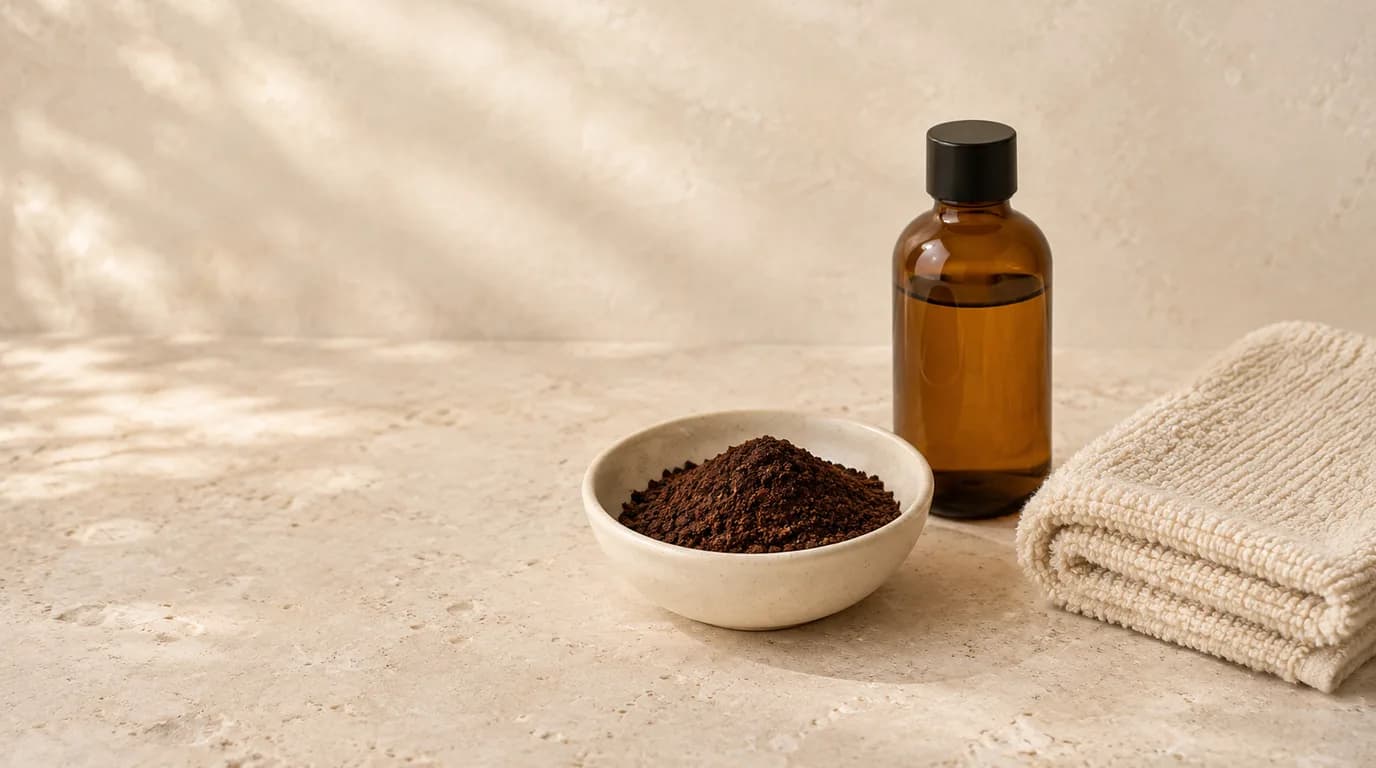
A coffee scrub can be an appealing extra step in the shower. Its most straightforward job is exfoliation: the particles help remove dead surface skin.[2]
The useful decision is whether a granular scrub suits your skin and routine. Here is how to judge that choice without needing every promise on the packet to come true.
What does a coffee scrub actually do?
A scrub is mechanical exfoliation: particles help remove dead surface skin. The American Academy of Dermatology recommends gentle application and moisturizing afterward. It also cautions that aggressive exfoliation can irritate skin and contribute to dark marks in some people.[2]
Ask whether you want a separate exfoliation step, then check the directions and ingredients. The amount of coffee alone is not a useful way to choose.
A scrub's name does not tell you its whole texture. For example, a bag of grounds-based scrub and a lathering coffee body wash are different formats. We explain those choices in coffee body scrubs compared.
Should cellulite claims influence your choice?
Choose a scrub for exfoliation. Research on caffeine delivery from creams does not tell us that rinsing off coffee grounds will produce the same effect.[3] The human trial below helps explain why the product format matters.
Research extra: what a cellulite trial actually tested
A 2026 trial analyzed 24 women. They used a special 2% caffeine cream on one thigh and its caffeine-free base on the other. They applied both twice daily for 12 weeks. Both sides improved; the caffeine side had a greater reduction in cellulite severity scores.
The analysis left out participants who withdrew and used replacements. That limits confidence in the result. This was a leave-on cream, not a rinse-off coffee scrub, and it does not establish lasting results after stopping.[1]
Is it suitable for your face or sensitive skin?
Do not assume that a scrub you like on your legs belongs around your eyes or on your face. Follow its intended-use label. The AAD notes that dry, sensitive or acne-prone skin may find mechanical exfoliation too irritating; exfoliation is not a compulsory step.[2]
If your main concern is the eye area, use the caffeine eye-care guide instead. Coffee grounds and a formulated eye product are not substitutes.
How often should you use a coffee scrub?
There is no single schedule that suits every skin type and scrub. The AAD says frequency depends on both your skin and the exfoliation method; stronger exfoliation generally calls for less frequent use.[2]
Start with the product's directions, rather than treating “daily” or “twice a week” as a rule for every coffee scrub. Consider the rest of your routine too. The AAD notes that retinoids, retinol and benzoyl peroxide can make exfoliation more irritating.[2]
Keep the step gentle and moisturize afterward. If it leaves your skin irritated, more scrubbing is not the next step. A routine can be complete without a scrub.
Can you reuse your coffee grounds?
Reusing grounds may sound appealing, but it introduces a separate storage question. The FDA identifies contaminated ingredients, inadequate preservation, storage conditions and dipping fingers into a product as possible routes for microbial contamination.[4]
We cannot give a reliable shelf life for an untested homemade mixture. “Keep it in the fridge for a week” is not a preservation test. If convenience matters, consider a finished product with clear storage and use instructions rather than keeping a wet homemade batch.
A simple plan for your next shower
- Check that the product is intended for the body area you want to use it on.
- Follow its directions with gentle pressure; skip exfoliation over wounds or sunburn.
- Moisturize afterward, and avoid repeating the step so often that it irritates your skin.[2]
If that sounds like a step you would enjoy, compare coffee scrubs and scrub-and-wash products to choose the format.
References
Every factual claim in this article is drawn from the sources below. See the source library for how we grade evidence.
- [1]Clinical Effectiveness of a Novel Caffeine Nano-Cream for Cellulite Reduction: A Randomised Double-Blind TrialPharmaceutics · 2026 · Controlled trial · Tier 2 · Moderate
- [2]How to safely exfoliate at homeAmerican Academy of Dermatology · 2026 · Agency guidance · Tier 1 · Strong
- [3]Skin penetration of caffeine from commercial eye creams and eye creams designed and optimized based on Hansen solubility parametersInternational Journal of Pharmaceutics · 2023 · Reference work · Tier 2 · Moderate
- [4]Microbiological safety and cosmeticsU.S. Food and Drug Administration · Agency guidance · Tier 1 · Strong
Related reading
- Caffeine SkincareDoes Caffeine Eye Cream Work? What to Expect→
- Coffee BeautyCoffee Oil for Skin: Oil, Extract and Caffeine Explained→
- Caffeine SkincareCaffeine Eye Cream vs Serum: Choosing a Formula→
- Coffee BeautyCoffee Body Scrubs: Choosing the Right Format→
- Coffee Beauty100% PURE Coffee Bean Eye Cream: What to Check→
- Coffee BeautyCoffee Skin Benefits: Drinking It vs Applying It→