Coffee Skin Benefits: Drinking It vs Applying It
By Coffee Studies Editorial·Published November 3, 2026·7 min read
Quick answer
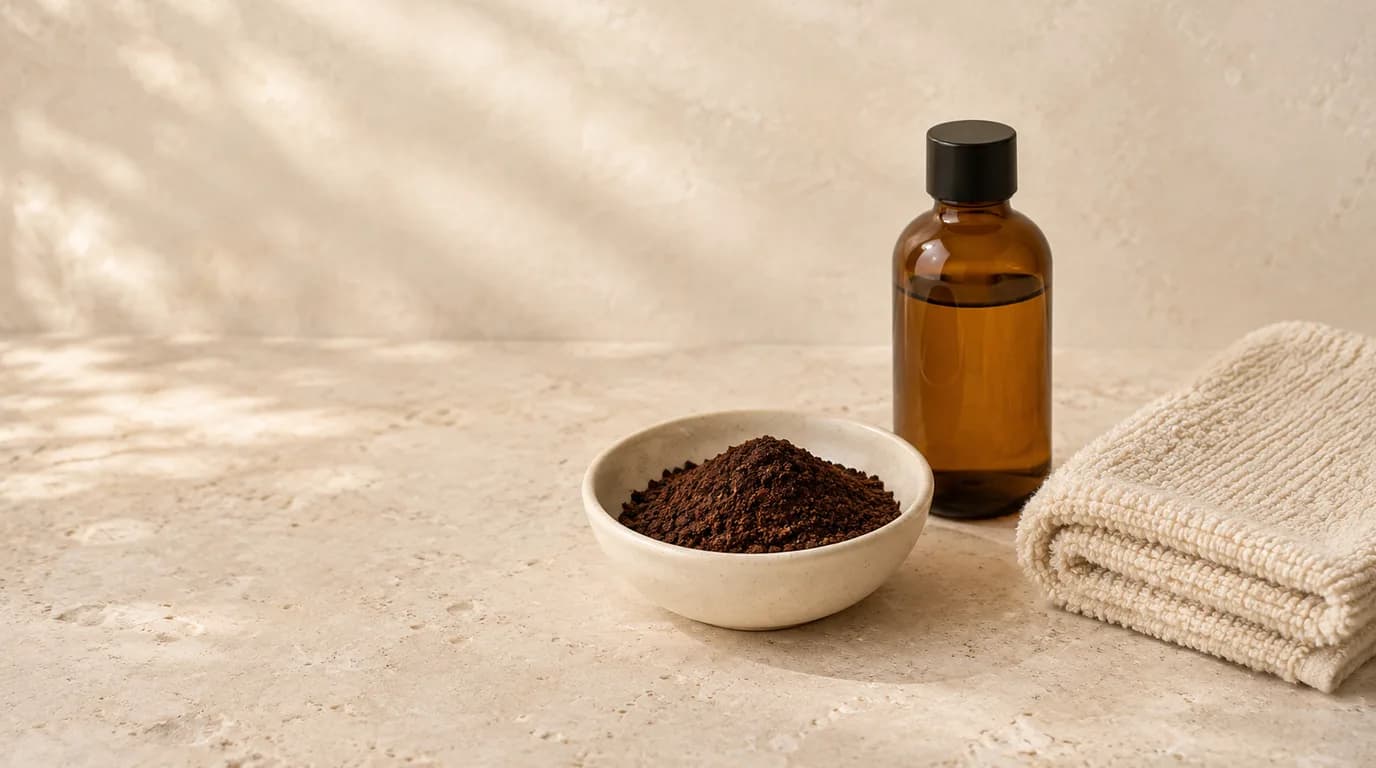
Coffee in your mug, coffee grounds in a scrub, caffeine in an eye serum: the shared name can make these sound like one skincare idea. They are different choices, and you can start with the one that interests you.
Looking for a body scrub? Focus on exfoliation. Curious about puffiness or hydration? The table below shows what researchers actually tested, so you can decide which claims deserve a closer look.
Coffee skin benefits at a glance
| Potential benefit | What the evidence supports | What it does not establish |
|---|---|---|
| Exfoliation | Scrubs physically remove dead surface cells. Coffee grounds can provide that mechanical action.[2] | Coffee is not proven superior to other exfoliants, or suitable for every face. |
| Less eye puffiness | A 34-person caffeine-gel trial found improvement with both the active gel and its base.[4] | The caffeine gel did not significantly outperform the base overall. |
| Better hydration | An eight-week trial of a specific coffee-polyphenol drink reported improvements in women with mildly dry skin.[6] | This was not a test of ordinary brewed coffee or a homemade face mask. |
| Reduced cellulite appearance | A small trial found greater improvement with a specialized leave-on caffeine cream than its base.[7] | It did not test rinse-off scrubs or establish permanent removal. |
| Anti-aging effects | Green coffee oil produced changes in skin cells and tissue studied outside the body.[3] | Laboratory changes are not proof that a retail oil reverses visible aging. |
Use the middle column to see what was tested, then the last column to decide how closely it matches the product you are considering.
Applying coffee versus drinking it
Topical products act where they are applied, but their ingredients, concentration and contact time matter. A scrub rinsed away in the shower is a different exposure from a cream left on overnight. For example, the cellulite trial used a formulated cream twice daily for 12 weeks, not coffee grounds.[7]
Drinking coffee is a separate research question. There is some human evidence involving coffee-derived drinks, but it would be a stretch to promise that another daily latte will improve your complexion.
Research extra: the coffee-polyphenol drink trial
In 2017, researchers studied 49 women with mildly dry skin. Participants received either a placebo drink or 100 mL daily containing 270 mg of coffee polyphenols for eight weeks. The researchers reported improved hydration and lower skin water loss—less moisture escaping through the skin—with the test drink.
The authors worked for Kao Corporation. Independent researchers need to repeat this small, short study. It tested a standardized extract drink, not the varied coffee people brew at home.[6]
For your routine, the useful distinction is the drink itself: a measured extract in a study is different from the coffee you brew at home. This finding is not a reason to increase your caffeine intake.
Does coffee dehydrate your skin?
Coffee does not automatically cause dehydration. A controlled study followed 50 men who regularly drank coffee. It compared moderate coffee intake with the same volume of water. Hydration measures did not differ significantly between the two. It was a short study of body hydration, not a test of facial dryness or every possible intake level.[9]
If you are weighing up your daily coffee habit, consider coffee and sleep and the broader coffee health evidence.
Can I apply coffee directly on my face?
We would not choose kitchen coffee grounds as a first facial skincare step. A body scrub, face product and eye treatment are not interchangeable. If you want a coffee ingredient, choose a finished product labeled for the area you intend to use it on.
The American Academy of Dermatology notes that mechanical exfoliation can irritate dry, sensitive or acne-prone skin. Avoid exfoliating wounds or sunburn, use a gentle touch, and moisturize afterward. More frequent or harder scrubbing is not necessarily better.[2]
For body use, compare coffee scrub benefits and scrub versus wash formats before picking a product.
Can coffee remove dark skin or dark spots?
Natural skin tone, individual dark spots and under-eye darkness are different concerns. The studies here do not show that coffee grounds reliably change natural skin tone or remove facial dark spots.
A small study in 11 women reported improvements with an eye pad combining caffeine, vitamin K and emu oil. Because the comparison was a water pad, it could not isolate caffeine's contribution. It also does not validate a homemade coffee mask.[8]
Scrubbing harder can be counterproductive: the AAD warns that aggressive exfoliation may increase dark spots, especially in darker skin tones.[2] If pigmentation is your main concern, seek advice aimed at its cause rather than buy a coffee product on a general “brightening” promise.
Which type of coffee is best for skin?
There is no single winner established by the studies here. Choose by the job you want the product to do:
- Ground coffee in a scrub: a physical exfoliation choice. Decide whether you want a granular body product.
- Coffee seed oil: an oil ingredient; it is not the same as a measured dose of caffeine.
- Coffee extract: check the finished formula and the evidence for its particular claim.
- Caffeine cream or serum: compare format, ingredients and tolerance rather than assume that more caffeine means better results.
The distinctions matter because the green-coffee-oil research used cells and tissue models, while the eye-gel trial tested a particular caffeine formula in people. Neither identifies the best roast or bean to put on your face.[3][4] Our coffee oil guide and eye cream versus serum comparison explain those choices further.
Does coffee help with wrinkles or “anti-aging”?
Ask what was measured. Changes in cultured skin cells are interesting research, but they do not tell you how a face will look after using a shop-bought oil. The green coffee oil study measured cells and tissue outside the body, not visible wrinkles in people.[3]
The eye-pad study measured several skin properties, but it combined caffeine with vitamin K and emu oil in just 11 women. It cannot tell us whether caffeine alone produces the same changes.[8]
For shopping, turn a broad anti-aging promise into a specific question: is the claim about hydration, pigmentation or measured wrinkles? Then check whether the research tested that outcome in the finished product. That is more useful than choosing whichever bottle makes the longest list of promises.
What do coffee and Vaseline do?
Petroleum jelly has an established role in moisturizing dry skin; the AAD recommends applying it to damp skin. That recommendation is for petroleum jelly, not a coffee mixture.[10]
We did not identify a controlled trial of coffee grounds mixed with Vaseline in the research reviewed for this guide. Adding grounds creates a granular mixture, but it does not establish a treatment for wrinkles or dark spots. If dryness is the problem, a plain moisturizer is a simpler starting point than an untested recipe.
Choose one useful next step
Start with the result you want, then decide whether a coffee product offers a useful format for it. For puffiness, read does caffeine eye cream work?. For specific purchases, the 100% PURE and The Ordinary guides separate label information from claims we have not tested ourselves.
Keep sun protection separate from coffee's antioxidant story. Coffee-consumption research includes observational findings, which cannot by themselves prove prevention of disease.[1] A coffee drink or cosmetic is not a replacement for sunscreen; the AAD recommends broad-spectrum, water-resistant SPF 30 or higher.[5]
Before adding anything, ask:
- What do I want this step to do?
- Is the product intended for the area where I will use it?
- Does the formula and price fit a routine I would enjoy keeping?
If eye care is the answer, start with whether caffeine eye cream is worth trying. You can make one useful choice without building a whole routine around coffee.
References
Every factual claim in this article is drawn from the sources below. See the source library for how we grade evidence.
- [1]Coffee consumption and health: umbrella review of meta-analyses of multiple health outcomesBMJ · 2017 · Umbrella review · Tier 1 · Strong
- [2]How to safely exfoliate at homeAmerican Academy of Dermatology · 2026 · Agency guidance · Tier 1 · Strong
- [3]Effect of green Coffea arabica L. seed oil on extracellular matrix components and water-channel expression in in vitro and ex vivo human skin modelsJournal of Cosmetic Dermatology / UNESP repository · 2009 · Reference work · Tier 2 · Moderate
- [4]Evaluation of caffeine gels on physicochemical characteristics and in vivo efficacy in reducing puffy eyesJournal of Applied Pharmaceutical Science · 2011 · Controlled trial · Tier 2 · Moderate
- [5]How to select a sunscreenAmerican Academy of Dermatology · 2026 · Agency guidance · Tier 1 · Strong
- [6]Coffee polyphenols extracted from green coffee beans improve skin properties and microcirculatory functionBioscience, Biotechnology, and Biochemistry · 2017 · Controlled trial · Tier 2 · Moderate
- [7]Clinical Effectiveness of a Novel Caffeine Nano-Cream for Cellulite Reduction: A Randomised Double-Blind TrialPharmaceutics · 2026 · Controlled trial · Tier 2 · Moderate
- [8]Evaluation of the clinical efficacy and safety of an eye counter pad containing caffeine and vitamin K in emulsified Emu oil baseAdvanced Biomedical Research · 2015 · Controlled trial · Tier 2 · Moderate
- [9]No Evidence of Dehydration with Moderate Daily Coffee Intake: A Counterbalanced Cross-Over Study in a Free-Living PopulationPLoS ONE · 2014 · Controlled trial · Tier 2 · Moderate
- [10]5 ways to use petroleum jelly for skin careAmerican Academy of Dermatology · Agency guidance · Tier 1 · Strong
Related reading
- Caffeine SkincareDoes Caffeine Eye Cream Work? What to Expect→
- Coffee BeautyCoffee Scrub Benefits: Smoother Skin, Realistic Expectations→
- Coffee BeautyCoffee Oil for Skin: Oil, Extract and Caffeine Explained→
- Caffeine SkincareCaffeine Eye Cream vs Serum: Choosing a Formula→
- Coffee Beauty100% PURE Coffee Bean Eye Cream: What to Check→
- Coffee BeautyCoffee Body Scrubs: Choosing the Right Format→