Where Do Coffee Shops Buy Their Coffee? Four Routes
By Coffee Studies Editorial·Published October 30, 2026·15 min read
Quick answer
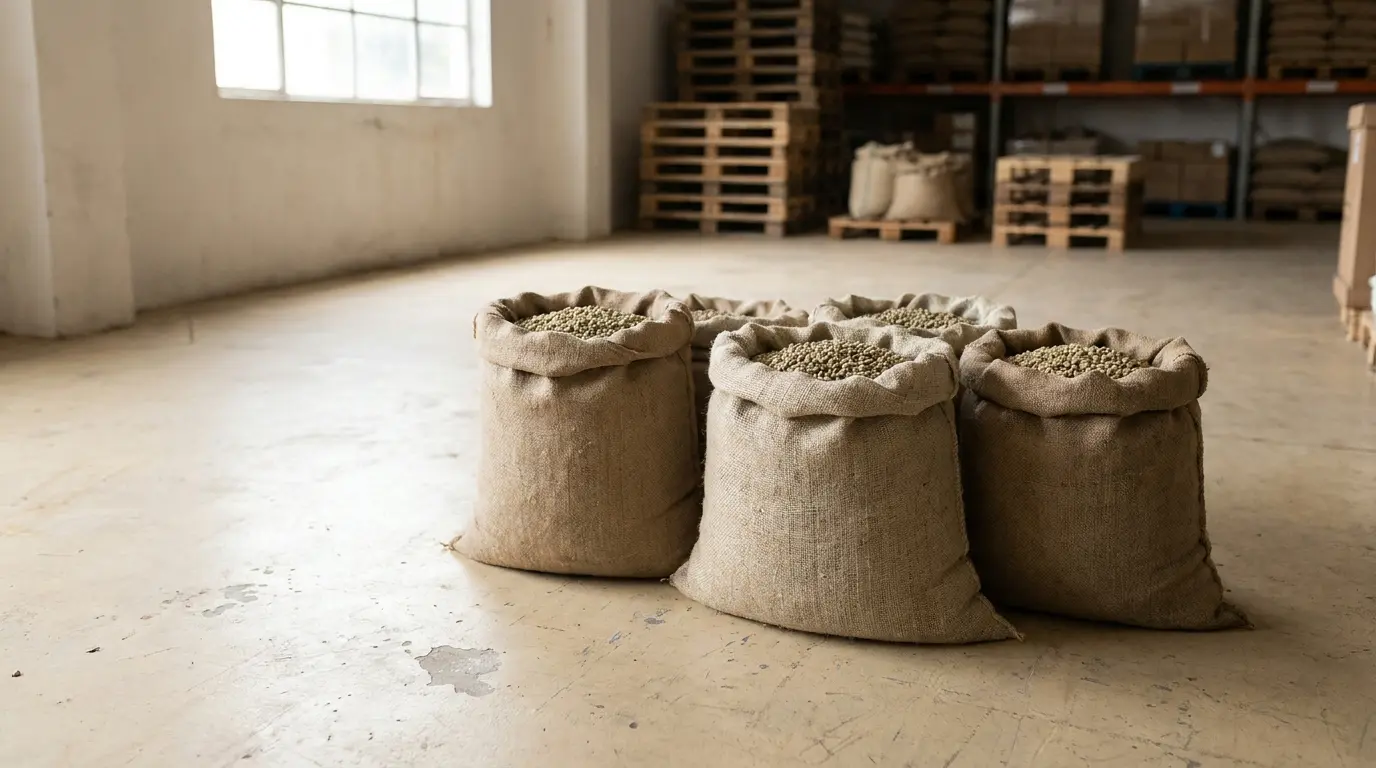
Read the whole first page of results for this question, as we did on 30 October 2026, and there is exactly one price on it. Google's AI Overview says bulk 25 lb cases typically start around $250, with no date and no source attached. That is $10 a pound by our division. Everything else is a roaster or a distributor selling one route into beans, a map of nearby suppliers, and a few forum threads.
So we read the price lists instead. On one New Jersey roaster's own published bulk list a 20 lb bag of whole bean runs from $200.00 to $280.00, which puts $10 a pound at the bottom of a single roaster's range rather than in the middle of a market. [1] And there are four routes into coffee, not one, with a different bargain on each; on two of them the bargain is not the price per pound at all.
$200.00 to $280.00
the span of one roaster's own published 20 lb bulk bags on 30 October 2026, against the single figure the result page prints[1]
$5.00 per pound
published, not derived, by a green importer for a named 154 lb spot bag of Colombia Excelso EP the same day[9]
27% of net sales
the share of US Foods' fiscal 2025 net sales made on terms negotiated by group purchasing organisations[15]
Where do coffee shops actually buy their coffee?
Four routes, and they are not four versions of the same thing.
A local or regional roaster's wholesale programme. Roasted coffee by the bag or the case from a roaster you can drive to, usually with equipment sourcing, training and a service number attached. It suits a shop where the coffee is the draw.
A national roaster or a branded foodservice programme. A name customers recognise, plus account management. Peet's describes its partners as licensed stores on university campuses, airport terminals and boutique hotels. [8] A variation is your own name on a coffee somebody else roasts, which is private label.
A broadline distributor. Coffee becomes one line on a truck already bringing cups, dairy and food. Sysco describes itself as distributing food and related products to customers who prepare meals away from home, which suits an operation where one delivery beating five matters more than the bean. [14]
Green coffee, roasted by you. Unroasted coffee from an importer, with the roasting, the shrinkage and the machine all yours. Royal Coffee publishes the shape of it: 22 lb boxes, 50 lb boxes, full-size bags at 132 to 154 lb. [10] A different business, costed in how to start a coffee roastery.
| Route | What comes with it | What is published |
|---|---|---|
| Local or regional roaster | Equipment survey, installation, barista training, emergency service [5] | Sometimes a full list, often nothing. Minimums rarely stated [2] |
| National roaster or branded programme | Account manager, quarterly reviews, training, leasing referrals [7] | Requirements in words. No price on any of the five we tried [8] |
| Broadline distributor | Ordering software, delivery windows, private brand lines [16] | No coffee price, no case price, no minimum order, no minimum delivery value |
| Green, roasted by you | Nothing. The roaster, the training and the time are yours to buy | One importer published a per pound price; three published nothing to an anonymous visitor [10] |
What does a pound actually cost?
Every roasted price we could read, in US dollars, on 30 October 2026. The published column is the seller's figure; the per pound column is our division of it by the stated weight, to the nearest cent where the division does not come out even.
| Seller | Unit as published | Published price | Per pound, our division |
|---|---|---|---|
| T.M. Ward [1] | 20 LB whole bean, Amazon Blend | $200.00 | $10.00 |
| T.M. Ward | 20 LB whole bean, Sumatra Mandheling Grade 1 | $280.00 | $14.00 |
| WB Law [2] | 15 lb case, three 5 lb bags, Premium House Blend | $157.00 | $10.47 |
| WB Law | 15 lb case, Brazilian Cerrado | $160.25 | $10.68 |
| Temecula [3] | 60 fractional packs of 2 oz | $129.00 | $17.20 |
| Coffee Bean Direct [4] | 5 lb whole bean, Espresso Subscription | $53.95 | $10.79 |
The dearest line is the pre-portioned fractional pack, not a rare origin: portioning is part of what you buy. The cheapest, at $10.00 a pound by our division, is a 20 lb bag of house blend, which is where the result page's one unsourced figure lands. Green is a separate list, because roasting loses weight and a pound of green is not a pound of roasted.
| Seller | Unit as published | Published price | Per pound |
|---|---|---|---|
| Royal Coffee [9] | Colombia Excelso EP, 154 lb bag, spot | $5.00 per pound | published per pound, not derived |
| Royal Coffee | Brazil Sul de Minas SS GC 17/18, 130 lb bag, spot | $4.60 per pound | published per pound, not derived |
| Royal Coffee | Crown Jewel Yemen Sharqi Haraz, 22 lb box | $660.00 per box | $30.00, our division |
| Coffee Bean Direct [4] | 25 lb unroasted Brazilian Santos | $219.75 | $8.79, our division |
| Temecula [3] | 20 lb green, every origin on the list | $200.00 | $10.00, our division |
| WB Law | 5 lb green, Huila, Colombia | $45.25 | $9.05, our division |
Scale is the whole story. Royal published $5.00 a pound for a 154 lb spot bag; Temecula published a flat $200.00 for 20 lb, which is $10.00 a pound by our division, at every one of eighteen origins. A list with no origin differential is a retail price, not a market one.
The bigger finding is how little gets published. Of the twenty supplier pages we opened across these four routes, five published a price we could read. Up Coffee publishes training and equipment terms, then asks you to fill out the form. [5] Driven publishes shipping times and no price. [6] Counter Culture puts prices behind a wholesale login. [7] Cafe Imports rendered its offerings table to us as the literal words no data available in table, and Sucafina's North American offerings rendered no listing rows at all. [12] [13]
So your quote is a negotiated number nobody else can check. Get it in writing with bag size, case size, minimum order and delivery schedule on the same page, then put it into what it costs to open a coffee shop and the monthly cost of goods in the margin maths.
What comes with the beans, and what does it cost you?
On the first two routes the price per pound is not the deal. The deal is the machine, the installation, the training and the service call, and what you give up to get them. One roaster writes that part down.
Counter Culture publishes this, verbatim: "Access to our entire workshop catalog and online courses is available with all charges waived for all staff of exclusive wholesale partners." [7] Read the condition. It is not volume, it is exclusivity. The price of free education on that route is your freedom to buy a bag from anyone else, and that cost is on no price list.
Peet's gates on volume instead and never says what the volume is: "if you have the volume and a commitment to quality, we want to talk." What you get is named: a dedicated account manager, comprehensive training, quarterly business reviews. The threshold is published nowhere we could read. [8]
Smaller roasters publish the service and not the price. WB Law surveys your electric and water, installs and maintains, runs barista training and advertises 7 day a week emergency repair service; it sells equipment and publishes no equipment price. [2] Up Coffee publishes the one concrete term here: equipment "comes with free installation (within our service area), calibration, training, and a one-year parts and labor warranty." [5] Driven promises on-site equipment training and a direct line to your rep. [6] Those are vendor claims on vendor pages, dated and readable but no more than that.
Three of the large branded programmes could not be read at all: one returned 403 to a desktop header set, a plain fetch and headless Chromium, one failed at the TLS handshake, one served a page whose own title was the number 403. Their terms are not public, and we print no machine-on-loan offer from anybody, because we could not open a page that states one.
The Peet's page footer lists Peet's Coffee, JDE Peet's and KDP, and JDE Peet's said a KDP offer was expected to close early in the second quarter of 2026, so a shop weighing a national roaster against a branded programme may be choosing twice from the same owner. [8] [24] If it is the hardware you are costing, it is in the equipment list.
Why can nobody tell you what a distributor charges?
Because they do not publish it, and the absence is the finding.
Across Sysco, US Foods and Gordon Food Service we found no coffee price, no case price, no minimum order value and no minimum delivery value on any public page. Sysco's become-a-customer page is entirely client-rendered and gave two words of text to a plain fetch, then failed twice in headless Chromium. US Foods' equivalent page returned 404. Gordon Food Service's American and Canadian pages loaded, published delivery promises and ordering software, and published no price at all. [16]
Everything numeric came from annual reports instead. Sysco estimates it serves about 18% of an approximately $377 billion annual United States foodservice market for calendar year 2025, as estimated by Technomic, and says that "switching costs are very low" and "there are few barriers to market entry." [14] US Foods reports approximately 250,000 customer locations and net sales of $39,424 million in fiscal 2025. [15]
Then there is the sentence a founder should act on, which appears in a filing and on no marketing page anywhere:
"GPOs act as agents on behalf of their members by negotiating pricing, delivery, and other terms with us ... approximately 27% of our net sales in fiscal year 2025 were made to customers under terms negotiated by GPOs (including approximately 14% ... members of a single GPO)."
A distributor is stating, in a regulated document, that an independent operator's price depends on whether they belong to a buying group. [15] So when you are quoted a distributor price, ask whether a buying group changes it.
What sets the price underneath all of this?
Every route sits on the same floor: the world price of green coffee. The International Coffee Organization's composite indicator price averaged 262.18 US cents per pound in September 2026, down 8.7% from August, ranging between 248.44 and 279.85 and closing at 261.60 US cents per pound on 30 September. Its four group indicators averaged 290.19 US cents per pound for Brazilian Naturals, 356.15 for Colombian Milds, 329.44 for Other Milds and 167.49 for Robustas. [17]
A floor is not a price. The clearest published explanation of the gap is in Starbucks' own annual report: "high-altitude arabica coffee of the quality sought by Starbucks tends to trade on a negotiated basis at a premium above the 'C' coffee commodity price." That is why a roaster's quote moves with the market without matching it. The same filing shows how a large buyer handles the exposure: it buys on fixed-price and price-to-be-fixed commitments, where quality, quantity and delivery period are agreed but the date the C price component gets fixed is not. As of 28 September 2025 it had committed to $129 million of green coffee under fixed-price contracts and an estimated $1.1 billion under price-to-be-fixed contracts, with green coffee at 88% of total purchase obligations. [20]
Underneath that is the ICE Coffee C future: 37,500 pounds of physically deliverable exchange-grade green beans from one of 20 origins, priced in cents and hundredths of a cent. [19] We print no settlement price for it: ICE's data page rendered no price table to us, its data call returned 403, and the ICO's data platform returned 401.
Two bodies disagree about how much coffee exists, and we are not going to resolve it. For coffee year 2025/26 the ICO publishes total production of 183.6 million 60-kilogram bags against consumption of 180.6 million, a surplus of 3.0 million bags after four deficit years. [17] The USDA's July 2026 circular puts 2025/26 world production at 178.8 million bags and forecasts a record 189.7 million for 2026/27, noting that coffee prices dropped 25 percent in the preceding seven months on the ICO's composite index. [18] They use different year definitions and scopes. Both are published and dated, and they do not agree.
What about Canada?
Every advertisement on this result page was Canadian and not one competing page covers Canada. The trap first.
A United States importer's own Canada page publishes its Canadian terms in US dollars and says so outright: "All transactions are in USD." Release fees at its Vancouver-area warehouse are US$25 per release of 1 to 2 loose bags and US$50 per release of 1 to 2 bags palletized, and the coffee sits in Delta, British Columbia. [11] A Canadian roaster buying green from an American importer carries currency risk on coffee that never leaves the country, and nobody on this result page mentions it.
The figures genuinely in Canadian dollars are these. Monogram publishes a minimum wholesale order of CA$250 and free shipping within Canada over CA$440. [27] Detour publishes free shipping on orders of $400 or over, in Canadian dollars, with free barista training for wholesale partner accounts. [28] Pilot publishes complimentary shipping on orders of $50 or more, in Canadian dollars, and sells its wholesale programme in 2.1 kg bags. [29] Green Beanery publishes Unroasted Brazilian Santos at 540.00 for 50 lb, which is CA$10.80 a pound by our division, and Unroasted Indian Robusta Parchment Kaapi Royale at 396.00 for 50 lb, which is CA$7.92 a pound by our division. [26]
Be careful with the Canadian roaster numbers you find, and we are being careful here too. Detour's 2.27 kg bags are published at 147.00 to 190.00 and Pilot's 2.1 kg bags at 150.50 to 165.75, both in Canadian dollars, but those are open catalogue prices on a public store, not wholesale rates. [28] [29] Every Canadian wholesale rate we tried was gated. Canterbury publishes equipment partnerships and no price. [30] Mother Parkers publishes one scale claim, that it sources, blends and roasts more than 11 billion cups of coffee each year, and no terms. [31] Club Coffee publishes capabilities and no terms at all. [32] One Canadian supplier publishes a statistic about how many Canadians drink coffee with no source attached, which is why it is not here.
Who is the biggest coffee supplier?
Harder than it looks, because these companies do not report in the same currency or on the same basis, and we do not convert between currencies.
The largest coffee-only revenue line we could verify belongs to JDE Peet's, which reported Coffee revenue of EUR 8,903 million for FY2025 against EUR 7,708 million in FY2024, inside total sales of EUR 9,921 million, and calls itself "the world's leading pure-play coffee company." Its cost of product rose to EUR 5,974 million from EUR 4,718 million. [24]
Nestle is the name people expect at the top, and it publishes no coffee-only revenue line at all. Its 2025 financial statements report Powdered and Liquid Beverages at CHF 25,144 million, a category wider than coffee, with Nespresso reported separately as a segment at CHF 6,481 million, inside group sales of CHF 89,490 million. [23] Anyone presenting that CHF 25,144 million as Nestle's coffee revenue is overstating it.
The rest, each in its own reported currency and period. Lavazza reported turnover of EUR 3.9 billion for 2025, up 15.7%, and says on its own site that global coffee volumes fell a further 2.4% in 2025 after a 3.5% decline across 2023 and 2024, which is Lavazza's figure rather than an independent one. [25] Starbucks reported total net revenues of $37,184.4 million for fiscal 2025, company revenue rather than a coffee line. [20] Westrock Coffee reported total net sales of $1,188,952 thousand for 2025, its Sustainable Sourcing and Traceability segment at $280,503 thousand net of intersegment revenues, up 46.6%. [22] Massimo Zanetti Beverage Group we could not reach: its investor pages served an application shell with no figures in it.
What do the big chains serve?
For the largest chains, coffee they roast themselves, and the cleanest statement of it is in a filing rather than on a menu. Restaurant Brands International says it operates two coffee roasting facilities where it roasts the majority of the coffee for Tim Hortons restaurants globally, uses third-party roasting for some take-home products and international markets, and monitors the world market for green coffee while contracting future supply volumes, on Tim Hortons supply chain sales of $2,909 million in 2025. [21]
Starbucks says it generally controls substantially all coffee purchasing, roasting and packaging and the global distribution of coffee used in its operations, and operates ten farmer support centres. Its packaged coffee outside its own stores is distributed by Nestle under the Global Coffee Alliance. [20]
Second Cup publishes what it serves rather than who roasts it: Cuzco and Rwanda Musasa light roasts as Fairtrade Certified, nearly every coffee Rainforest Alliance Certified, decaf by the Swiss Water process. [33] McDonald's and Dunkin' publish nothing fetchable about sourcing: the McCafe pages we tried returned 404 and 403, and Dunkin's about page carried a seasonal promotion. Tim Hortons' own coffee page rendered a cookie banner and a region selector, which is why the answer above comes from a filing.
What to do
- Ask for the price list in writing, with units on it. Fifteen of the twenty supplier pages we opened published no price, so your quote is a number nobody else can check. [5] [6]
- Ask whether training and service are conditional on exclusivity. One roaster publishes that charges are waived for staff of exclusive wholesale partners, which is a contract term and not a perk. [7]
- Ask a branded programme what the volume threshold is. Peet's says "if you have the volume" and never prints the number. [8]
- Ask a distributor whether a buying group changes your price, since approximately 27% of US Foods' fiscal 2025 net sales went to customers on GPO terms. [15]
- In Canada, ask which currency the invoice is in. An American importer with coffee in a Delta, British Columbia warehouse states that all transactions are in US dollars. [11]
The short version
The one price on the whole result page carries no date and no source, and read against the published lists it sits at the bottom of a single roaster's own range rather than in the middle of a market. There are four routes into beans, not one, and on the two that most new shops use the real bargain is the equipment, the training and the service rather than the price per pound. The condition attached to that bargain is sometimes exclusivity and sometimes an unpublished volume threshold, so ask about it before you negotiate the pound. Most suppliers publish nothing, so the quote in front of you is uncheckable and should arrive in writing with its units on it. Distributors publish least of all, and the most useful thing any of them has said about pricing an independent operator sits in a filing. The floor under every route is the world green price, published and dated and moving, while the premium above it is negotiated and is not. And in Canada, check the currency on the invoice before you check the price.
Watch
See it, not just read it
2 videos picked for this page. They play right here, full screen on a phone, and you come straight back to the article.
Hosted on YouTube. Credit belongs to the channels named.
Frequently asked questions
- Where do coffee shops buy their coffee?
- Four routes. From a local or regional roaster's wholesale programme, from a national roaster or branded foodservice programme, from a broadline distributor that already brings the cups and the dairy, or as green coffee from an importer, roasted in house. Price depends on the route, not on the bean alone: on the lists we read on 30 October 2026, one roaster's published 20 lb bulk bags ran from $200.00 to $280.00, while a green importer published $5.00 a pound for a 154 lb spot bag of Colombia Excelso EP the same day.
- What coffee do most coffee shops use?
- The large chains mostly roast their own. Restaurant Brands International says in its 2025 annual report that it operates two coffee roasting facilities and roasts the majority of the coffee for Tim Hortons restaurants globally, and Starbucks says it generally controls substantially all coffee purchasing, roasting and packaging. An independent usually serves a roaster's house blend bought by the case: WB Law published a 15 lb case of Premium House Blend whole bean at $157.00 on 30 October 2026. McDonald's and Dunkin' publish nothing fetchable about who roasts for them.
- Who is the biggest supplier of coffee?
- It depends which figure you are allowed to use. JDE Peet's reported coffee revenue of EUR 8,903 million for FY2025 and calls itself the world's leading pure-play coffee company, and that is the largest coffee-only line we could verify. Nestle publishes no coffee-only revenue line at all: its 2025 financial statements report Powdered and Liquid Beverages at CHF 25,144 million, a category wider than coffee, with Nespresso reported separately at CHF 6,481 million. We do not convert between those currencies and neither should anyone else.
- How do you get a coffee supplier?
- You ask, in writing, because most of them do not publish. Of the twenty supplier pages we opened across the four routes on 30 October 2026, five published a price we could read. Ask for the list with bag and case size on it, the minimum order, and the delivery schedule. Monogram Coffee is unusual in publishing both: a CA$250 minimum wholesale order and free shipping within Canada over CA$440. Also ask whether free training or service is conditional on buying exclusively from that roaster.
References
Every factual claim in this article is drawn from the sources below. See the source library for how we grade evidence.
- [1]Bulk Coffee & Wholesale Coffee SupplierT.M. Ward Coffee Company · 2026 · Reference work · Tier 3 · Contextual
- [2]Wholesale Coffee & FoodserviceWB Law Coffee Co. · 2026 · Reference work · Tier 3 · Contextual
- [3]Green Coffee (Unroasted) and Coffee House Offerings price listsTemecula Coffee Roasters · 2026 · Reference work · Tier 3 · Contextual
- [4]Bulk roasted and unroasted coffee price listCoffee Bean Direct · 2026 · Reference work · Tier 3 · Contextual
- [5]WholesaleUp Coffee Roasters · 2026 · Reference work · Tier 3 · Contextual
- [6]Wholesale CoffeeDriven Coffee Roasters · 2026 · Reference work · Tier 3 · Contextual
- [7]Partner With UsCounter Culture Coffee · 2026 · Reference work · Tier 3 · Contextual
- [8]Foodservice ProgramPeet's Coffee · 2026 · Reference work · Tier 3 · Contextual
- [9]Green coffee offerings: 22 lb Crown Jewels and full-size bagsRoyal Coffee Inc. · 2026 · Reference work · Tier 3 · Contextual
- [10]How To Buy Coffee From UsRoyal Coffee Inc. · 2026 · Reference work · Tier 3 · Contextual
- [11]How to Order: CanadaRoyal Coffee Inc. · 2026 · Reference work · Tier 3 · Contextual
- [12]Offerings (anonymous view returns no listing data)Cafe Imports · 2026 · Reference work · Tier 3 · Contextual
- [13]Offerings, North America (anonymous view returns no listing data)Sucafina · 2026 · Reference work · Tier 3 · Contextual
- [14]Sysco Corporation Annual Report on Form 10-K, fiscal year ended June 27, 2026U.S. Securities and Exchange Commission (EDGAR) · 2026 · Government data · Tier 1 · Strong
- [15]US Foods Holding Corp. Annual Report on Form 10-K, fiscal year ended December 27, 2025U.S. Securities and Exchange Commission (EDGAR) · 2026 · Government data · Tier 1 · Strong
- [16]Become a CustomerGordon Food Service · 2026 · Reference work · Tier 3 · Contextual
- [17]Coffee Market Report – September 2026International Coffee Organization · 2026 · Industry report · Tier 1 · Strong
- [18]Coffee: World Markets and Trade, July 2026USDA Foreign Agricultural Service · 2026 · Government data · Tier 1 · Strong
- [19]Coffee C Futures contract specificationsICE Futures U.S. (Intercontinental Exchange) · 2026 · Reference work · Tier 1 · Strong
- [20]Starbucks Corporation Annual Report on Form 10-K, fiscal year ended September 28, 2025U.S. Securities and Exchange Commission (EDGAR) · 2025 · Government data · Tier 1 · Strong
- [21]Restaurant Brands International Inc. Annual Report on Form 10-K, year ended December 31, 2025U.S. Securities and Exchange Commission (EDGAR) · 2026 · Government data · Tier 1 · Strong
- [22]Westrock Coffee Company Annual Report on Form 10-K, year ended December 31, 2025U.S. Securities and Exchange Commission (EDGAR) · 2026 · Government data · Tier 1 · Strong
- [23]Consolidated Financial Statements of the Nestlé Group 2025Nestlé S.A. · 2026 · Industry report · Tier 1 · Strong
- [24]JDE Peet's reports full-year results 2025JDE Peet's N.V. · 2026 · Industry report · Tier 1 · Strong
- [25]2025 ResultsLavazza Group (Luigi Lavazza S.p.A.) · 2026 · Industry report · Tier 2 · Moderate
- [26]Green Beans price list (Canadian dollars)Green Beanery · 2026 · Reference work · Tier 3 · Contextual
- [27]WholesaleMonogram Coffee · 2026 · Reference work · Tier 3 · Contextual
- [28]Wholesale ProgramDetour Coffee Roasters · 2026 · Reference work · Tier 3 · Contextual
- [29]WholesalePilot Coffee Roasters · 2026 · Reference work · Tier 3 · Contextual
- [30]EquipmentCanterbury Coffee Corporation · 2026 · Reference work · Tier 3 · Contextual
- [31]Mother Parkers Tea & Coffee Inc.Mother Parkers Tea & Coffee Inc. · 2026 · Reference work · Tier 3 · Contextual
- [32]Club CoffeeClub Coffee L.P. · 2026 · Reference work · Tier 3 · Contextual
- [33]Our StorySecond Cup Café · 2026 · Reference work · Tier 3 · Contextual
Related reading
- Coffee BusinessHow to Start a Coffee Roastery, Priced From the Machines→
- Coffee BusinessCost to Open a Coffee Shop, Priced Line by Line→
- Coffee BusinessCoffee Shop Equipment List: Prices, Power and Water→
- Coffee BusinessCoffee Shop Profit Margins: Why the Numbers Disagree→
- Coffee BusinessPrivate Label Coffee: What the Label Puts On You→
- Coffee BusinessWhy Coffee Got So Expensive→