Coffee Truck Business: What It Costs, What It Earns
By Coffee Studies Editorial·Published October 30, 2026·Updated November 4, 2026·25 min read
Quick answer
Yes, a coffee truck can pay for itself, and it takes less than you think. About nine cups a day.
Nine a day will cover the truck, the machine, the licence, the kitchen you report to and a market stall. The figure is ours, from a price list you can read yourself, and the sum is below.
What moves your cost most is not the truck. It is whether your health office calls you a coffee truck or a kitchen on wheels.
About nine cups a day
what it takes to cover a trailer, a machine, a generator, a licence, a kitchen to report to, insurance and a stall. Ours, from published prices, and the whole sum is on this page[64]
$21,000 to $100k
the cheapest and the dearest coffee trailer prices any builder prints, in US dollars. Most will quote you instead, so you have to ask[22]
$630, then $1,008
what King County charges your unit a year for espresso only, and what the same unit pays the moment it grills a sandwich on board, both read 30 October 2026[3]
Build your coffee truck purchase list
Price the coffee service equipment alongside the vehicle conversion. A machine that fits the counter may still exceed the truck's power, water or payload budget. Give the converter the exact model specifications before ordering.
Price a compact coffee service
- One-group commercial, volumetricOne-group commercial, volumetricOne-group commercial, volumetricThe standard answer for a kiosk or a low-volume shop: built to run all day, plumbs in, and doses by programmed volume so every member of staff pulls the same length of shot. Needs a dedicated circuit and treated water; confirm both against the site before choosing a model.no price from amazon.comno price from amazon.caView on Amazon
- Hopper grinder for an espresso serviceHopper grinder for an espresso serviceHopper grinder for an espresso serviceTimed dosing and a hopper suit repeated orders. Check peak-hour output, hopper clearance and local service before committing. The Canadian listing exists but had no purchasable offer when checked; use a local dealer quote if it remains unavailable.no price from amazon.comno price from amazon.caView on Amazon
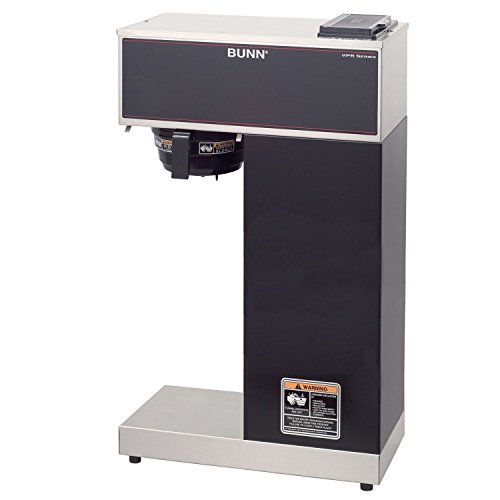
- Manually filled airpot batch brewerManually filled airpot batch brewerManually filled airpot batch brewerThe VPR-APS brews into an insulated airpot, not a decanter on a warmer. You fill it by hand, so it does not need a plumbed water line. Check power and counter clearance, and whether the listing includes a compatible airpot or you need to buy one separately.no price from amazon.comno price from amazon.caView on Amazon
Product prices and availability are accurate as of the date/time indicated and are subject to change. Any price and availability information displayed on Amazon at the time of purchase will apply to the purchase of this product. Certain content that appears on this site comes from Amazon. This content is provided ‘as is’ and is subject to change or removal at any time.
The Appia listing is a one-group candidate, not a completed mobile installation. The BUNN is an alternative or additional filter-coffee service, not a substitute for an espresso machine if espresso is on your menu. Confirm their loads with the vehicle's other equipment.
| Purchase line | Starting quantity | Who should confirm the specification? |
|---|---|---|
| Espresso machine and grinder | 1 each for an espresso menu | Equipment supplier and converter |
| Batch brewer and airpots | Optional menu line | Supplier; check included vessels |
| Milk refrigeration | 1 appropriately sized unit | Converter and refrigeration supplier |
| Fresh/wastewater system, pump and sinks | One designed system | Converter and local approving authority |
| Shore power, generator or battery system | One calculated power design | Qualified installer; include simultaneous loads |
| Work surfaces, storage and restraints | Layout-dependent | Converter; include loaded weight |
| Scale, pitchers, tamper and knock box | Match the service station | Owner and equipment supplier |
| POS, fire equipment and vehicle insurance | Separate budget lines | Providers and local authority |
Request itemized vehicle, electrical, water-system and refrigeration quotes. Use the shop equipment guide for supplier references and the worked truck funding package to see how equipment spending fits into the wider budget. The package uses fictional allowances; these listings do not automatically replace them.
An Amazon offer verifies a listing price at the time shown, not the installed cost or suitability of the equipment for your premises. Keep USD and CAD budgets separate. Add quantity, delivery, tax, installation and commissioning before putting a number into your funding request. When a price is unavailable, request a quote; do not enter zero.
Turn the list into a working budget. Download the editable coffee truck workbook to connect equipment costs, staff hours and sales assumptions to a five-year forecast. It starts with a fictional example; replace its allowances with your own researched costs. The planning guide explains the inputs and the evidence still needed. Changes to the workbook do not rewrite the earlier example PDFs.
Download the equipment purchasing worksheet. It includes all three business types and spaces for your selected model, currency, costs and quote reference. Prices stay on these live pages so the worksheet does not present an old Amazon offer as current.
Will a coffee truck make you money?
Yes, once you pass about nine cups a day. Below that you pay for your kit. Above it you pay yourself.
Charge five dollars a cup. Your coffee, milk, cup and lid cost about 86 cents, so each cup leaves you about $4.14. Your bill for the year comes to about $9,600, or nine or ten cups a day.
Every input, its published price and our assumptions
A 12 oz paper hot cup is published at "$0.05 / Each" in a case of 1,000 [73], its travel lid at "$0.03 / Each" [74] and a kraft sleeve at "$0.03 / Each" [75], so our addition puts packaging at $0.11.
A roaster publishes its espresso blend at "From $12.33 lb" in a 5 lb bag [76]; at 18 grams per double shot, our assumption and not the roaster's, our arithmetic gets 25 doubles from a pound and $0.4932 of coffee into a drink.
Milk is the weakest input: the only dated figure we hold is the US Bureau of Labor Statistics average retail price for whole milk, 4.106 per gallon for September 2026, a retail price and not a foodservice case price [77]; at 8 fluid ounces a drink, our assumption again, that is $0.256625.
Our total is $0.859825 per drink. At five dollars a cup, the price that operator published charging at a festival, our arithmetic leaves $4.140175 of contribution. Two of the three inputs rest on an assumption of ours, not a supplier's. All US dollars, all read 30 October 2026.
| Yearly bill, each price published and each five-year spread an assumption | Cost |
|---|---|
| Coffee trailer, "Espresso - Ivory + Cedar" at $21,000.00 [22] | $4,200.00 |
| Espresso machine, a cart-marketed two-group at $7,480.00; the same page also shows $8,000.00 [63] | $1,496.00 |
| Generator, Honda EU3000iS at $2,399 [58] | $479.80 |
| Texas Type II licence: $618 application, $400 pre-licensing inspection, one $400 routine inspection [8] | $1,418.00 |
| Commissary kitchen, Austin annual rate [5] | $720.00 |
| Insurance, "$299 annually" [78] | $299.00 |
| Seasonal market stall, prepared foods and food trucks [79] | $1,000.00 |
| Total | $9,612.80 |
| Cups a year to cover it, at $4.140175 left on a five-dollar cup | 2,321.83, or 9.48 a day across 245 trading days |
Four things sit outside that sum: your own pay, staff pay, fuel and the van that tows it.
One owner reckons you want "100+ cups per day on a weekday". Nine pays your kit. The other ninety pay you.
The cups-a-day quotes in full, and where they come from
"I'd suggest that a single-barista coffee truck needs to sell 100+ cups per day on a weekday, and 150+ cups on a weekend to be viable, plus other retail sales." The words "I'd suggest" mark it as a named operator's opinion. [64] The 245 trading days in the table above are the 49 weeks at five days a week the same operator published as his own pattern.
One American figure sits beside it. Vincent LaVolpa of Green Joe Coffee School publishes a monthly range for his own trailer, "On average, I see about $6,000 - $9,000 a month on the coffee trailer with 30-40 hours of work a week" [71], and separately a single festival day in full, "$6,770" gross on "1354 cups" at five dollars each, less "25% - Concession Cost". [72] He sells a coffee truck course, which argues for caution. His average sits below the blog consensus, which argues the other way.
That same owner printed his books. He ran a London street pitch in 2022. Wages took a fifth of what came in, coffee an eighth, and two fifths was left as profit.
| Line, as published | Pounds | Percent of total revenue |
|---|---|---|
| Total Sales | £144,560 | |
| Pitch Fees (Rent) | £1,100 | under 1% |
| Business Rates | £0 | 0% |
| Wages | £27,500 | 19% |
| Utilities | £1,560 | 1% |
| Coffee Costs | £18,792 | 13% |
| Bakes Costs | £10,119 | 7% |
| Milk Costs | £4,336 | 3% |
| Disposables | £4,550 | 3% |
| Miscellaneous Costs | £1,331 | 1% |
| Net Profit | £57,925 | 40% |
| Value Added Tax (VAT) | £17,347 | 12% |
How to read that table, and the one thing in it that conflicts
Dear Coco Street Coffee traded a London street pitch for 49 weeks, five days a week, in 2022. Amounts in pounds sterling, percentages as printed, compared to nothing in dollars. It is one operator's own business, not evidence about the category, and the statement is published as an image, so every figure above is a visual transcription.
The article's own description of the trading pattern, "operating 3 days a week", conflicts with the statement's header, "49 weeks, 5 days a week".
[64]Be careful with the monthly sales you will see quoted. The best travelled one, $14,000 to $21,000 a month, sits on a page that gives it no backing. Treat it as a guess.
The $14,000 to $21,000 sentence, and every page that carried it on
The sentence, verbatim: "A successful coffee truck can generate between $14,000 and $21,000 in monthly revenue and sell between 200 and 300 cups of coffee per day." The sentence before cites Grand View Research. The sentence after cites Verified Market Research. The claim itself carries no citation and borrows its neighbours' authority. [1]
From there it propagates verbatim and unsourced [68], and once into euros on a page whose "low traffic" and "average rural" rows carry the identical range. [69] That is what happens when a table is generated rather than observed.
The "15% to 35%" margin is worse: we found no coffee truck page carrying it at all, so we print it as unverified. The one page that does claim a coffee truck margin, "15% to 20% net profit", publishes a worked example on the same page leaving $4,450 on $10,000 of revenue.
[70]Google's monthly figure, and what each credited page actually says
Google's AI Overview credits its "$6,000 to $21,000+ per month, selling roughly 200 to 300 cups a day" to three publishers, and two do not carry it.
Perfect Daily Grind's coffee truck article contains no such figure: every monetary or percentage number on it is £40,000, $49,900, 40 percent, 5 percent, 10 percent and 18 percent. [65]
Texas Coffee School publishes startup ranges only, with no monthly revenue and no cups-per-day figure. [66]
The only Prima page on mobile coffee economics is a cart owner interview with no revenue, cups or margin figure at all.
[67]The franchise that files earnings and prints none
"Travelin' Tom's Coffee does not disclose specific franchisee earnings in Item 19 of its 2025 Franchise Disclosure Document", on a system of "more than 250 Travelin' Tom's trucks ... in 36 states". A franchisor files that document under federal rules and is permitted to publish a financial performance representation in Item 19 of it.
[1]What will one cost you to buy?
Plan on $21,000 for the cheapest price anyone prints, and $60,000 to $80,000 for a finished one. Most will quote you rather than print.
| Unit, as the seller names it | Published price |
|---|---|
| Cedar Trailer Co., "Espresso - Ivory + Cedar", 12 feet, espresso machine not included [22] | $21,000.00 |
| Eastcoast Concessions, "the 14-foot Arabica, our standard coffee build" [24] | $31,900 |
| Hudson Trailer Company, 14' Mobile Coffee Shop Trailer [29] | $46,000, or "$60k-$78k" complete |
| Concession Nation, 14 ft. truck conversion, "Step Van is not included." [21] | $47,000 |
| Legion Food Trucks, its entire published pricing [28] | "Buildouts starting at $100k." |
Which builders print a price, and what each page showed
Six concession trailer builders, read 30 October 2026. Two publish a price list, one publishes a single model price, one publishes in-stock prices with no coffee build among them, and two publish nothing at all.
[21][23][26]One publishes a page titled "Concession Packages and Pricing" inviting you to "compare our package pricing with other builders". All nine packages on it read "Contact Us for Quote". [25]
The Ontario builder most visible in search publishes a booking deposit and a payment schedule, and no price.
[27]Hudson's own FAQ adds that "Most clients invest $60,000-$80,000 for a fully equipped coffee trailer". [29]
Eastcoast Concessions lists "the 14-foot Arabica, our standard coffee build" at $31,900. The same page also carries "Starting at $15,990" and "Most coffee trailers we build are $45,000-$75,000". We report that unresolved.
[24]The used market will show you what the new market hides. On one day you could see a 2010 coffee trailer at $19,040 and a 2026 one at $71,500. Buy the build, not the year.
| Listing, verbatim | Asking | State |
|---|---|---|
| 2010 Beverage and Coffee Concession Trailer [30] | $19,040 | OH |
| 2021 7' x 16' Coffee and Beverage Trailer w/ 2025 Buildout | $33,000 | NC |
| 2026 13' Coffee/Espresso and Beverage Trailer | $71,500 | TN |
| 2020 Ford Transit Coffee/Espresso Van, 75,712 miles [31] | $60,500 | ID |
| Turnkey 2003 Ford Coffee and Espresso Truck, 130,000 miles on the body | $76,890 | AZ |
Shopping in Canada? Much of that stock is priced in US money.
The used and Canadian listings, and how each page labels its money
Asking prices as displayed on 30 October 2026, US dollars. A 2003 unit with 130,000 miles asks more than a 2020 van with 75,712, so here the build carries the price, not the chassis. [31]
Canadian listings on the main US marketplace carry an explicit "USD" suffix, from $20,160 USD to $82,500 USD, so they are not Canadian dollar figures although the units sit in Canada.
[32]An Ontario marketplace lists a Toronto coffee truck at $ 300,000 and a Welland food trailer at $ 35,000 with no currency marker on the page, so we print them unlabelled. [33]
One seller publishes both: "Fully equipped from $15,850 USD ($22,500 CAD before tax)", which lets us quote both and convert neither.
[34]Cart, trailer, truck or kiosk?
What splits them is what each one makes you own. Pick yours and read your own four lines.
Your situation
Which format are you weighing up?
A cart is the cheapest thing to move and the easiest to place, but something else has to carry it.
- Tow vehicle
- A van or a trailer to move it
- Driving licence
- Ordinary
- Commissary and power
- Usually a commissary. A socket or a battery for power
- Where it can stand
- Sidewalk and indoor pitches a vehicle cannot reach
- What to read next
- Our cart page prices a build line by line and works the arithmetic
Where the two licence lines come from
Ontario: the Ministry of Transportation handbook on towing, which sets class G to 4,600 kilograms gross trailer weight and requires brakes at 1,360.
[35]California: the DMV licence classes page, on which class C tows one vehicle of 10,000 lbs GVWR or less. What a commercial food trailer needs is not stated on the page we read. [36]
Both read 30 October 2026.
Pricing a cart instead? Our cart page prices a build line by line. Weighing a truck against four walls is the cost to open a coffee shop.
The one choice that cuts your bill most
Ask your health office which class you fall in before you buy. A food truck is a kitchen on wheels. Plain coffee often is not, and that word changes your sink, your tank and your fee.
British Columbia is the plainest about it. Sell nothing but packaged food, plain tea and plain coffee, and you need no hand sink and no wash sink at all.
Steam milk for a latte and you move up a class: a permit, a hand sink, two wash sinks and 36 L of clean water. That line is most of what a build will cost.
The exact wording, and where it comes from
BC Centre for Disease Control, Mobile Food Premises Guidelines, July 2024. Type A covers units that "only dispense pre-packaged foods, plain tea and coffee, pre-packaged sandwiches" and "Do not require a hand sink or ware washing sinks". They need "approval from the local Health Authority". Type B covers "specialty coffee" and requires the permit, the handwashing sink, two warewashing sinks and 36 L of potable water. [2]
Type A pays no permit fee. Type B and Type C pay $75.00.
[15][16]Read 30 October 2026.
Six places print a lighter class a coffee truck can sit in. Pick yours and read only your own lines.
Your situation
Where will your unit operate?
Sell only plain tea and plain coffee and you need no hand sink and no wash sinks. You just need the health authority to approve the unit.
- Who gets the lighter class
- Units that only sell pre-packaged food, plain tea and plain coffee, and pre-packaged sandwiches
- What it saves you
- The hand sink and the wash sinks
- Permit fee
- Type A pays nothing. Type B and Type C pay $75.00Read 30 October 2026.
- Your waste tank
- 25% larger than the clean water tank
- Water on board
- 36 L for Type A and B, 130 L for Type C
- The catch
- Specialty coffee moves you to Type B: a permit, a hand sink, two wash sinks and 36 L of potable water
The exact wording of the other five, and where each comes from
Washington: the commissary exemption, RCW 43.20.148. The verb is "must": the authority "must approve a request" meeting nine conditions.
[6]Texas: the Central Preparation Facility exemption, printed as an inspector's checklist of eight items. The form ends "CPF Exemption: Granted / NOT GRANTED".
[9]Ontario: O. Reg. 493/17 s. 4(2), premises selling "only pre-packaged or non-hazardous food". What it saves is the separate potable and waste tanks, and the readable gauge on each. [11]
California: "limited food preparation" covers "preparing BEVERAGEs that are for immediate service, in response to an individual consumer order, that do not contain frozen milk products". The tank drops from "at least 25 gallons" to "At least 15 gallons". [12]
Austin, Texas: "Fire permits are not required for MFV units that do not have propane and do not have cooking equipment (i.e, those that serve ice cream, coffee, etc.)". What it saves is the fire permit and its $222 inspection fee. [13]
All read 30 October 2026.
Read your own rule twice. One city lets you off the fire permit for having no propane and no cooking gear. A propane water heater puts you back inside it.
One province leaves it open: nothing in writing says whether brewed coffee, or a coffee with milk in it, counts. Ask, do not guess.
What we could not find out about this
No Ontario regulation, guidance or public health document we could open says whether brewed coffee, or a coffee drink containing dairy, falls inside the s. 4(2) exemption. That determination belongs to the local medical officer of health, and we found nobody making it in writing.
[11]Sometimes coffee is named to charge you more. One county charges $630 a year for espresso alone, and $1,008 the moment you grill a sandwich. And Texas will not licence a tap facing the customer at all.
The fee schedules and code these come from
Texas puts "Coffee trucks" in its Type II definition, at $618 to apply plus a $400 pre-licensing inspection fee, against $309 and no inspection fee for a Type I prepackaged unit. [8]
Los Angeles County prints "coffee cart" at $299 a year and "beverage truck" at $598. [17]
King County fixes "Any mobile food establishment serving only espresso or hot dogs or both, with no other food preparation" at Risk Category 1 by name, and moves anything "grilling sandwiches or toast" to Risk 2, which is the $630 against $1,008 on the fee schedule.
[4][3]Texas DSHS lists motorised vehicles "with outward-facing beverage taps" among vehicles "not designed to be licensed as an MFV", so a kegged cold brew trailer with customer-facing taps is not licensable there at all.
[10]All read 30 October 2026.
What you need on board
Your dirty water tank has to be bigger than your clean one, and every place picks its own number. Check yours before you order: this is what makes a truck legal in one state and illegal in the next.
| Jurisdiction | Waste tank must exceed the fresh tank by |
|---|---|
| FDA Food Code 2022, § 5-401.11(A) [20] | "Sized 15 percent larger in capacity than the water supply tank" |
| Washington, WAC 246-215-09135(6) [7] | "at least fifteen percent more capacity than the water supply tank" |
| Texas, DSHS checklist item 1 [9] | "at least 15% larger than the potable water storage tank" |
| British Columbia, BCCDC [2] | "25% larger than the capacity of the potable water tank" |
| California, § 114240 [12] | "50 percent greater than the POTABLE WATER tanks", never under 7.5 gallons, plus "at least 15 percent of the water supply" where water is supplied for beverage preparation, plus "one-third of the volume of the ice cabinet" where ice is used |
Build to the common ratio and two of the five below will still turn you away.
Water and sinks come next. Most places want five gallons on board for hand washing. One sets no number at all, so ask what will pass.
The exact sink and water wording, and where each comes from
Washington sets five gallons minimum for handwashing, a hand sink "within 25 feet" of food preparation and toilets "within 500 feet" once you are in one spot over an hour, against 200 feet for fixed premises. It requires three sink compartments "when utensils are reused on the mobile food unit" and lets the authority waive that where the operation "Includes limited food preparation", a phrase nowhere defined in that chapter. [7]
California sets five gallons for handwashing plus 15 gallons for limited food preparation, lets an unenclosed unit preparing potentially hazardous beverages to order run a one-compartment sink with an integral metal drainboard and warewashing "in a reasonable proximity", and exempts "the bulk dispensing of nonPOTENTIALLY HAZARDOUS BEVERAGEs" from its handwashing section.
[12]British Columbia sets 36 L for Type A and B and 130 L for Type C.
[2]Texas publishes no minimum gallonage at all: its checklist prints "Size:______ gallons" as a blank and fixes only the 15 percent relationship.
[9]Fire is the easy part. An espresso machine makes no smoke and no fatty steam, so the food truck fire rule will not reach you. In California you owe an extinguisher and no hood.
The exact equipment and fire wording, and where it comes from
California requires that "Coffee urns, deep fat fryers, steam tables, and similar EQUIPMENT shall be equipped with positive closing lids that are fitted with a secure latch mechanism", with a compartment as the alternative, and that "Metal protective devices shall be installed on the glass liquid level sight gauges on all coffee urns". The same section requires a 10 BC-rated extinguisher on any unit "equipped with heating elements or cooking equipment". It is the only coffee-specific equipment rule we found in US retail food law.
[12]The fire code threshold applies only to "Mobile food preparation vehicles that are equipped with appliances that produce smoke or grease-laden vapors". [14] Read 30 October 2026.
We could not render the mechanical code chapter that would settle hood classification for a mobile unit, so we assert no hood requirement for one.
Nobody will size your generator for you. Add up the draw of your machine, grinder, fridge, water heater and pump, because they all come on at once. One seller would size a small cart at two to three thousand watts.
| Model | Output | Noise, as published | Price |
|---|---|---|---|
| Honda EU2200i [57] | "120V 2200W max. (18.3A), 1800W rated (15A)" | "57 dB(A) @ rated load 48 dB(A) @ 1/4 load" | "$1199*" |
| Honda EU3000iS [58] | "120V 3000W max.(25A) 2800W rated (23.3A)" | "57 dB(A) @ rated load, 50 dB(A) @ 1/4 load" | "$2399*" |
| Honda EU7000iS [59] | "120/240V 7000W max. ... 5500W rated" | "58 dB(A) @ rated load, 52 dB(A) @ 1/4 load" | "$4899* (iSNAN) / $4999 (iSNAC)" |
| Generac iQ3500 [60] | 3000 running watts, 3500 starting | none published | "$1,049.00" |
| Westinghouse iGen4000DFc [61] | "4000" peak, "3300" running | "52 dBA" | "859.00" |
Plan for it on top of the truck, because one trailer package ships with no generator at all. Buy more than you think you need: one London owner killed his first in eight months. Which machine to put behind it is choosing an espresso machine for a small coffee shop.
The sizing figures, the makers' absences, and the price riders
"A generator sized to running watts is a generator sized for the easy part of the day", says the only coffee-specific sizing guidance we found, an equipment seller's, putting a single-group cart in "the 2,000 to 3,000 watt range once the grinder, fridge, water heater and pump are counted", plus twenty to twenty-five percent headroom. [53]
A battery maker's food truck article puts "large coffee equipment" at "around 1100 watts" instead. [54]
Machine makers publish machine draw and not generator choice. La Marzocco's pre-installation and installation PDFs contain zero occurrences of "generator" or "genset", and nothing of the kind surfaced for Nuova Simonelli, Astoria, Rancilio or Crem. [52] Champion's own appliance wattage chart contains no coffee maker row and no espresso machine row at all. [55]
No maker publishes a decibel figure with both its measurement distance and its load, and a number without a distance and a load cannot be checked against an organiser's cap. Champion publishes a value and "from 23 feet" and no load, and publishes no price on its own product pages at all. [56] Honda publishes a value and the load and no distance. Westinghouse publishes a bare number. Generac publishes none. Every figure in the table above is as published on 30 October 2026.
A Canadian dealer lists the Honda EU2200iTC at $1,544.00 and the EU7000i at $5,948.00, in Canadian dollars, and the model codes do not match the US strings. [62]
One coffee trailer seller's base package includes "30 Amp electrical" and no generator. [29]
A London operator published this: "Our initial generator (£4,000 cost) only lasted 8 months due to workload. I subsequently invested £6,000 and 6 months to get mains power installed along the street at our trading location." Pounds sterling, as published and not converted.
[64]The kitchen you report to
Between $99 and $1,300 a month. A commissary is a licensed kitchen you report to, where you fill clean water and dump dirty water. Both sat on the web the same day, so ring round.
At the cheap end you get a signed letter and a water fill. At the dear end, a parking space.
You may not need one at all. The Food Code leaves that call to your inspector.
Ask what a water fill costs, not just the rent. One kitchen sells it in a band on top, and water is what your truck needs most.
The published rates, what each includes, and the water bands
Seven facilities publish a rate. All US dollars, all read 30 October 2026. The cheap end is Austin at $99 a month and the dear end Anaheim at $1300 a month, the same product category on the same day at thirteen times the price.
Austin: "Monthly rate $99, quarterly rate $264, and annual rate $720" for the signed Servicing Area Authorization, water fill and wastewater dump.
[5]Norfolk: "$100.00 per month" for a food cart and "$150.00 per month" for a food truck, each covering the agreement, 24/7 potable water and grey water, with parking extra at $200.00 or $350.00 with an electrical hookup.
[39]San Antonio: "Commissary Letter Access: $300/yr" for the notarised letter and the right to fill, dump and dispose of grease, or "Home Base Access: $450/mo" with a monitored parking space and storage.
[37]Groveland, Florida: "$799.00 + tax per year" or "$75.00 + tax per monthly.", kitchen time not included, plus water in bands on top of the rent: "1 water load and 1 water disposal per month: $15.00+tax", "Up to 5 water loads and disposals per month: $40.00+tax" and "Up to 10 water loads and disposals per month: $70.00+tax". [38]
Seattle: "Hot Dog Cart ... $400/month (no utilities)" for daily dishwash access, at a facility with "16 secure parking spaces, each with overnight power". [40]
Los Angeles: "$1200 MONTH" plus deposit, with hookup, potable and wash water, unlimited ice, grey water, grease and a truck wash.
[41]Anaheim: "Food truck spots are $1300 per month."
[42]The FDA Food Code's own mobile matrix rests the "decision to require auxiliary support services such as a commissary or servicing area" on "the menu, type of operation, and availability of on-board or on-site equipment". [20] California then requires reporting "on a daily basis" by statute, Boston "twice a day", and Washington sets no number in rule at all. [12] [51] [7]
We got this wrong once. Our cart page used to say nobody publishes a commissary rate. More than a dozen facilities publish one, and four price the thing a mobile unit actually buys.
What we could not find out about this
One facility publishes "We have competitive pricing, and we'll beat any competitors in our area" and "Los Angeles charges around $1,200 per month. We don't.", which corroborates the Los Angeles figure while quoting no rate of its own. [43]
No Toronto facility was found publishing a rate at all, only aggregator guides naming no facility. The two Vancouver-area facilities we did find print a bare dollar sign with no currency code, so their figures are not labelled here as Canadian dollars. [44]
Where can you park and sell?
Your pitch can cost more than your licence. In Toronto the road permit runs $7,793.15 for the year against $1,464.14 for the licence, so price your pitch before you buy a truck.
Two things decide your spot: distance from the nearest cafe, and how long you can stay. Five cities, five answers.
| City | How far from a cafe | How long you can stay | What the pitch costs |
|---|---|---|---|
| Chicago [45] | 200 feet from any street level restaurant door, and the rules count coffee shops as restaurants | 2 hours, with a fitted GPS box reporting where you are | |
| Toronto [19] | 30 linear metres from an open and operating restaurant, two trucks a block, nothing on Gould Street from July 30 | 12 hours at a time | $7,793.15 road permit against $1,464.14 for the licence, twelve months each |
| Austin [46] | No public right-of-way at all. Private commercial or industrial ground, with a written toilet deal with a business within 150 feet | 6 a.m. to 11 p.m., and no more than 180 consecutive days in one spot | |
| New York [48] | 190 restricted street segments, each with its own days and hours, plus three blanket zones. Most operators take private property instead | A Restricted Area permit is the one with no cap on it | $200.00 Processing or $75.00 new Non-Processing, plus a $50.00 two-year licence and a $53.00 course |
| Boston [51] | Private locations, with the owner's permission | $500 a year to apply |
Get it in writing wherever you stand on private ground. And ask your city which insurance figure it wants: in Toronto the by-law and the City's own page do not agree.
The exact Chicago ordinance wording, and where it comes from
No mobile food vehicle may park "within 200 feet of any principal customer entrance to a restaurant which is located on the street level", and the ordinance defines "Restaurant" to include "coffee shops", so every cafe radiates a 200-foot zone the City testified applies "as the crow flies". Two hours maximum in a legal spot, and a permanently installed GPS device must send real-time data to a public API "at least once every five minutes", accurate "no less than 95% of the time", with "a rebuttable presumption ... that a mobile food vehicle is parked at places and times as shown in the data". [45] One caveat: an appellate court recites that text as amended in July 2012, in a 2018 opinion, so a later amendment would not show.
The exact Toronto wording, and the two insurance numbers
"30 linear metres from an open and operating restaurant", "No more than two food trucks per block", "Maximum of 12 hours at a time", and no Gould Street from July 30. Vendors propose areas that "may be designated as Mobile Vending Zones" rather than picking from a list. The road permit is $7,793.15 for twelve months inclusive of HST, against $1,464.14 for the business licence.
[19]Municipal Code Chapter 545, consolidated to 1 January 2025, says "$1,000,000". [18] The City's current food truck page demands "$2,000,000 in Commercial General Liability (CGL) insurance". Both read the same day. The page is newer; the by-law is the law. We print both.
The exact Austin, New York and Boston wording, and where it comes from
Under the Mobile Retail use, Land Development Code § 25-2-818: commercial or industrial private property only, "Mobile Retail may not occur on public right-of-way", hours of "6 a.m. - 11 p.m.", a written agreement with a business "within 150 feet" for restroom access once at one location over two hours, and no more than "180 consecutive days" in the same spot. [46] Austin's Mobile Food Establishment use is a separate zoning use with its own numbers, whose text we could not retrieve.
New York publishes every restricted street segment with its own days and hours, 190 of them as the file stands, plus three named blanket zones. [47] Broadway at the World Trade Center is restricted "12 a.m. 11:59 p.m." every day, a ban written as hours; Fifth Avenue between 47th and 58th on Sundays only, and only between "November 1" and "January 15".
Street permits are capped by law and waitlisted, while the Restricted Area permit "is exempt from the statutory limits which apply to public street vending", costs "$200.00" for Processing or "$75.00" for a new Non-Processing, and needs "a valid contract or lease with the NYC Department of Parks and Recreation or the private property owner where you will operate".
[48][49]The licence is separate and cheap, "$50.00: full-term (two-year) license fee" plus "$53.00" for the mandatory course. [50] Which side of Processing and Non-Processing a coffee unit falls on is not stated in any New York document we reached, and the gap is $125, so we do not guess.
Boston says only "Private locations: You need permission from the property owner", on a $500 annual application fee.
[51]Finding a pitch, marketing and payment are a separate job.
What to do first
-
Ask your health office which class you fall in, before you buy anything. It sets your sink and your tank.
[2] -
Check the waste tank ratio where you mean to trade. Fifteen percent will not pass everywhere. [12]
-
Ring three kitchens and ask what a water fill costs, not just the rent.
[38] -
Read the parking rule for the exact street you want.
[47] -
If you want a tap facing the customer, check your state first. Texas will not licence you. [10]
-
Then settle your beans. Where coffee shops buy their coffee answers that for a truck, and the shop licences sit beside yours.
The short version
A coffee truck costs $21,000 at the cheapest printed price, or $60,000 to $80,000 finished. Nine cups a day pays for the kit, and a real pitch wants a hundred.
Before you buy, find out which class your health office puts you in. Plain coffee often sits lighter than a food truck: no sink, a smaller tank, no fire permit.
Then price the two things people forget: the kitchen you report to, and the pitch.
Watch
See it, not just read it
2 videos picked for this page. They play right here, full screen on a phone, and you come straight back to the article.
Hosted on YouTube. Credit belongs to the channels named.
Frequently asked questions
- Do coffee trucks make money?
- Some do, and the clearest picture you can read is one operator's own books. Dear Coco Street Coffee in London published its 2022 profit and loss for a 49-week, five-day-a-week street pitch: total sales of £144,560 and a net profit of £57,925, which the statement puts at 40 percent of revenue, with wages at 19 percent and coffee at 13 percent. That is one pitch in one city in pounds, so treat it as a worked example and not a category average. The franchise best placed to speak for the category, with more than 250 trucks on the road, prints no franchisee earnings in Item 19 of its 2025 Franchise Disclosure Document.
- How much does a coffee truck owner make?
- Treat every monthly figure you see as a guess until someone shows you their books. The $14,000 to $21,000 a month you will find quoted comes from Franchise Business Review, where it sits between a sentence citing Grand View Research and a sentence citing Verified Market Research and carries no citation of its own. The closest thing to an owner's own answer is Vincent LaVolpa of Green Joe Coffee School, who publishes "On average, I see about $6,000 - $9,000 a month on the coffee trailer with 30-40 hours of work a week", and who also sells a coffee truck course, which cuts both ways.
- What is the most profitable type of food truck?
- No ranking of food truck types by profit is published anywhere we could open, so this page prints none. What is published is how much your permit class changes your costs: King County charges a mobile unit serving only espresso $630 a year and the same unit $1,008 once it grills a sandwich on board, a difference written into the Board of Health code by name. The one page that does claim a coffee truck margin, 7shifts at "15% to 20% net profit margin", also publishes a worked example on the same page leaving $4,450 on $10,000 of revenue. Both cannot be right.
- How much money do I need to start a coffee van?
- Budget $21,000 for the cheapest trailer anyone prints a price for, and $60,000 to $80,000 for a finished one. Most builders will quote you rather than publish: of six sellers checked on 30 October 2026, two publish a price list, one publishes a single model, one publishes in-stock prices with no coffee build among them, and two publish nothing at all. Cedar Trailer Co. lists one 12-foot coffee trailer at $21,000.00 with no espresso machine included; The Hudson Trailer Company lists a 14-foot coffee trailer at $46,000 and says "Most clients invest $60,000-$80,000 for a fully equipped coffee trailer"; Legion Food Trucks publishes one sentence, "Buildouts starting at $100k." All US dollars.
References
Every factual claim in this article is drawn from the sources below. See the source library for how we grade evidence.
- [1]Want to Start a Coffee Business? Start a Mobile Coffee TruckFranchise Business Review · 2025 · Industry report · Tier 2 · Moderate
- [2]Mobile Food Premises Guidelines, July 2024BC Centre for Disease Control · 2024 · Agency guidance · Tier 1 · Strong
- [3]Food & Facilities Program Fees – 2026Public Health – Seattle & King County · 2026 · Government data · Tier 1 · Strong
- [4]King County Board of Health Code, Title 5 Food EstablishmentsKing County Board of Health · 2025 · Government data · Tier 1 · Strong
- [5]Food Truck Central Prep Facility & SAA: mobile food ratesCapital Kitchens, Austin, Texas · 2026 · Reference work · Tier 3 · Contextual
- [6]RCW 43.20.148: Mobile food units, commissary and servicing area requirementsWashington State Legislature · 2019 · Government data · Tier 1 · Strong
- [7]WAC chapter 246-215 Food Service, Part 9 Subpart 1 Mobile Food UnitsWashington State Legislature / Washington State Board of Health · 2026 · Government data · Tier 1 · Strong
- [8]Mobile Food Vendors: licence types, fee schedule and the July 2026 transitionTexas Department of State Health Services · 2026 · Government data · Tier 1 · Strong
- [9]2026 Mobile Food Vendor Guide, with the Food Vending Vehicle Inspection Checklist and the Central Preparation Facility / Commissary Exemption ChecklistTexas Department of State Health Services · 2026 · Agency guidance · Tier 1 · Strong
- [10]Who Should Be Licensed as a Mobile Food Vendor?Texas Department of State Health Services · 2026 · Agency guidance · Tier 1 · Strong
- [11]Ontario Regulation 493/17 (Food Premises) under the Health Protection and Promotion ActGovernment of Ontario, e-Laws · 2026 · Government data · Tier 1 · Strong
- [12]California Retail Food Code 2022, excerpt from the California Health and Safety CodeCounty of Alameda Department of Environmental Health, posting the California state code · 2022 · Government data · Tier 1 · Strong
- [13]Mobile Food Vending Fire InspectionsAustin Fire Department, City of Austin · 2026 · Government data · Tier 1 · Strong
- [14]2021 International Fire Code, Section 319 Mobile Food Preparation VehiclesInternational Code Council · 2021 · Reference work · Tier 1 · Strong
- [15]Mobile Food Premises Permits and Health ApprovalsVancouver Coastal Health · 2026 · Government data · Tier 1 · Strong
- [16]Health Protection Programs Food Service Permit Application Form, with the permit fee pro-rating tableVancouver Coastal Health · 2026 · Government data · Tier 1 · Strong
- [17]New Mobile Food Facility Fees (Summary), effective 6 March 2024County of Los Angeles Department of Public Health, Environmental Health Division · 2024 · Government data · Tier 1 · Strong
- [18]City of Toronto Municipal Code Chapter 545, LicensingCity of Toronto · 2025 · Government data · Tier 1 · Strong
- [19]Food Trucks: licence, mobile vending permit, fees and siting rulesCity of Toronto · 2026 · Government data · Tier 1 · Strong
- [20]FDA Food Code 2022U.S. Food and Drug Administration · 2022 · Agency guidance · Tier 1 · Strong
- [21]Concession Nation: food trailer and food truck price gridConcession Nation · 2026 · Reference work · Tier 3 · Contextual
- [22]Coffee Trailer For SaleCedar Trailer Co. · 2026 · Reference work · Tier 3 · Contextual
- [23]Custom Food Trailers: in-stock units and pricesCustom Trailer Pros · 2026 · Reference work · Tier 3 · Contextual
- [24]Coffee Trailers for Sale: the 14-foot ArabicaEastcoast Concessions · 2026 · Reference work · Tier 3 · Contextual
- [25]Concession Packages and PricingM&R Specialty Trailers and Trucks · 2026 · Reference work · Tier 3 · Contextual
- [26]Trailer King Builders: FAQTrailer King Builders · 2026 · Reference work · Tier 3 · Contextual
- [27]Nomad 14: Nomad Custom TrailersNomad Custom Trailers · 2026 · Reference work · Tier 3 · Contextual
- [28]Legion Food Trucks: custom food truck buildsLegion Food Trucks · 2026 · Reference work · Tier 3 · Contextual
- [29]Mobile Coffee Trailer for Sale: 14ft and 17ft modelsThe Hudson Trailer Company · 2026 · Reference work · Tier 3 · Contextual
- [30]Coffee Trailers, Mobile Bar Trailers & Horse Trailer Bars for SaleUsedFoodTrucks.com · 2026 · Official dataset · Tier 3 · Contextual
- [31]Coffee Trucks, Mobile Bar Trucks and Smoothie Trucks for SaleUsedFoodTrucks.com · 2026 · Official dataset · Tier 3 · Contextual
- [32]Canada Coffee Trailers, Mobile Bar Trailers & Horse Trailer Bars for SaleUsedFoodTrucks.com · 2026 · Official dataset · Tier 3 · Contextual
- [33]Food Trucks, Carts & Trailers for Sale in OntarioMobile Food Alliance · 2026 · Official dataset · Tier 3 · Contextual
- [34]Buy a Coffee Bike: base packages and build calculatorCoffeeBike.ca · 2026 · Reference work · Tier 3 · Contextual
- [35]Official MTO Driver's Handbook: TowingOntario Ministry of Transportation · 2026 · Government data · Tier 1 · Strong
- [36]Driver's Licenses: noncommercial licence classes and towing allowancesCalifornia Department of Motor Vehicles · 2026 · Government data · Tier 1 · Strong
- [37]Food Trucks: Food Truck Commissary ratesLocalSprout Food Hub, San Antonio, Texas · 2026 · Reference work · Tier 3 · Contextual
- [38]EME'S Commissary Kitchen: pricing including per-water-load ratesEME'S Commissary Kitchen, Groveland, Florida (listing on The Kitchen Door) · 2026 · Reference work · Tier 3 · Contextual
- [39]My Commissary Kitchen: kitchen, food truck and food cart ratesMy Commissary Kitchen, Norfolk, Virginia · 2023 · Reference work · Tier 3 · Contextual
- [40]KBM Seattle Commissary Kitchen: rates including the Hot Dog Cart planKBM Seattle Commissary Kitchen, Seattle, Washington · 2026 · Reference work · Tier 3 · Contextual
- [41]Sunny Days Commissary: pricelistSunny Days Commissary, Los Angeles, California · 2026 · Reference work · Tier 3 · Contextual
- [42]Fast Dash Commissary: membership packages and food truck spotsFast Dash Commissary, Anaheim, California (listing on The Kitchen Door) · 2026 · Reference work · Tier 3 · Contextual
- [43]Salted Lightly Commissary: food truck parking and servicesSalted Lightly Commissary (Lancaster CA, Sylmar CA, Las Vegas NV) · 2026 · Reference work · Tier 3 · Contextual
- [44]Holy Cow Commissary: commissary kitchen pricing, Vancouver BCHoly Cow Foods Inc., Vancouver, British Columbia (listing on The Kitchen Door) · 2026 · Reference work · Tier 3 · Contextual
- [45]LMP Services, Inc. v. City of Chicago, No. 1-16-3390: appellate opinion reciting Chicago Municipal Code 7-38-115Illinois Appellate Court, First District · 2018 · Government data · Tier 1 · Strong
- [46]Mobile Retail Establishments: operational requirements under Land Development Code 25-2-818Austin Development Services Department, City of Austin · 2026 · Government data · Tier 1 · Strong
- [47]Mobile Food Vending Restricted Streets GuideNew York City Department of Health and Mental Hygiene · 2026 · Official dataset · Tier 1 · Strong
- [48]Restricted Area Mobile Food Vending Permit: fees and private-property requirementsCity of New York, MyCity Business · 2026 · Government data · Tier 1 · Strong
- [49]Mobile and Temporary Food Vendors: permit types, caps and Local Law 18 of 2021New York City Department of Health and Mental Hygiene · 2026 · Government data · Tier 1 · Strong
- [50]Mobile Food Vending License: fees and the Food Protection Course for Mobile Food VendorsCity of New York, MyCity Business · 2026 · Government data · Tier 1 · Strong
- [51]How to Get a Food Truck PermitCity of Boston, Office of Small Business Development · 2026 · Government data · Tier 1 · Strong
- [52]Pre-Installation Specifications: La Marzocco AustraliaLa Marzocco · 2024 · Reference work · Tier 3 · Contextual
- [53]Coffee cart power sizingCaffe Werks · 2026 · Reference work · Tier 3 · Contextual
- [54]What Generator Is Best for a Food Truck? What Size Generator Do I Need?BLUETTI · 2026 · Reference work · Tier 3 · Contextual
- [55]Generator Wattage ChartChampion Power Equipment · 2026 · Reference work · Tier 3 · Contextual
- [56]Champion Power Equipment: inverter and portable generator product specificationsChampion Power Equipment · 2026 · Reference work · Tier 3 · Contextual
- [57]Honda EU2200i: specifications and MSRPHonda Power Equipment · 2026 · Reference work · Tier 3 · Contextual
- [58]Honda EU3000iS: specifications and MSRPHonda Power Equipment · 2026 · Reference work · Tier 3 · Contextual
- [59]Honda EU7000iS: specifications and MSRPHonda Power Equipment · 2026 · Reference work · Tier 3 · Contextual
- [60]iQ3500 CoSense Portable Inverter Generator: specification sheetGenerac · 2026 · Reference work · Tier 3 · Contextual
- [61]Westinghouse portable and inverter generators: specifications and pricesWestinghouse Outdoor Power Equipment · 2026 · Reference work · Tier 3 · Contextual
- [62]Honda generators: Canadian dealer listing with prices in Canadian dollarsArnold's Equipment (arns.ca) · 2026 · Reference work · Tier 3 · Contextual
- [63]Nuova Simonelli Appia II Compact 2 Group 110V for Coffee CartsTorque Coffee · 2026 · Reference work · Tier 3 · Contextual
- [64]A step-by-step guide to creating a successful coffee truck businessFLTR Magazine · 2023 · Reference work · Tier 3 · Contextual
- [65]Can coffee trucks be profitable for operators?Perfect Daily Grind · 2023 · Reference work · Tier 3 · Contextual
- [66]Starting a Coffee Truck BusinessTexas Coffee School · 2026 · Reference work · Tier 3 · Contextual
- [67]Coffee Carts & Corgis: The Loyal Cup's Journey to SuccessPrima Coffee Equipment · 2025 · Reference work · Tier 3 · Contextual
- [69]How Much Can a Coffee Cart Make Per Day? Revenue, Costs & Profit ExplainedPorchDrinking · 2026 · Reference work · Tier 3 · Contextual
- [70]How Much Do Coffee Trucks Make?7shifts · 2026 · Reference work · Tier 3 · Contextual
- [71]Are Coffee Trucks Profitable? How I made over 11k in One Month on the Coffee TruckGreen Joe Coffee School (Vincent LaVolpa) · 2019 · Reference work · Tier 3 · Contextual
- [72]How Much Money Can You Make on a Coffee Truck?Green Joe Coffee School (Vincent LaVolpa) · 2021 · Reference work · Tier 3 · Contextual
- [73]Choice 12 oz. White Poly Paper Hot Cup: 1000/caseWebstaurantStore · 2026 · Reference work · Tier 3 · Contextual
- [74]Choice 8 oz. Squat to 24 oz. White Hot Paper Cup Travel Lid: 1000/caseWebstaurantStore · 2026 · Reference work · Tier 3 · Contextual
- [75]EcoChoice 10-24 oz. Kraft Coffee Cup Sleeve: 1200/caseWebstaurantStore · 2026 · Reference work · Tier 3 · Contextual
- [76]Wholesale Coffee: published per-pound pricesKaldi's Coffee · 2026 · Reference work · Tier 3 · Contextual
- [77]CPI Average Price Data, series APU0000709112: milk, whole, fortified, per gallon, U.S. city averageU.S. Bureau of Labor Statistics · 2026 · Official dataset · Tier 1 · Strong
- [78]Food Truck Insurance: published starting priceFLIP (Food Liability Insurance Program) · 2026 · Reference work · Tier 3 · Contextual
- [79]Farmers Market Handbook 2026Valley Junction Farmers Market, West Des Moines, Iowa · 2026 · Reference work · Tier 3 · Contextual
Related reading
- Coffee BusinessIs a Mobile Coffee Cart Profitable? Costs, Permits, the Math→
- Coffee BusinessCoffee Shop Licenses and Permits: What You Need→
- Coffee BusinessCost to Open a Coffee Shop, Priced Line by Line→
- Coffee BusinessCoffee Shop Profit Margins: Why the Numbers Disagree→
- Coffee BusinessWhere Do Coffee Shops Buy Their Coffee? Four Routes→
- Coffee BusinessWhy Coffee Got So Expensive→