Cortado: Espresso Cut with Equal Warm Milk
By Coffee Studies Editorial·Published July 15, 2026·8 min read
Quick answer
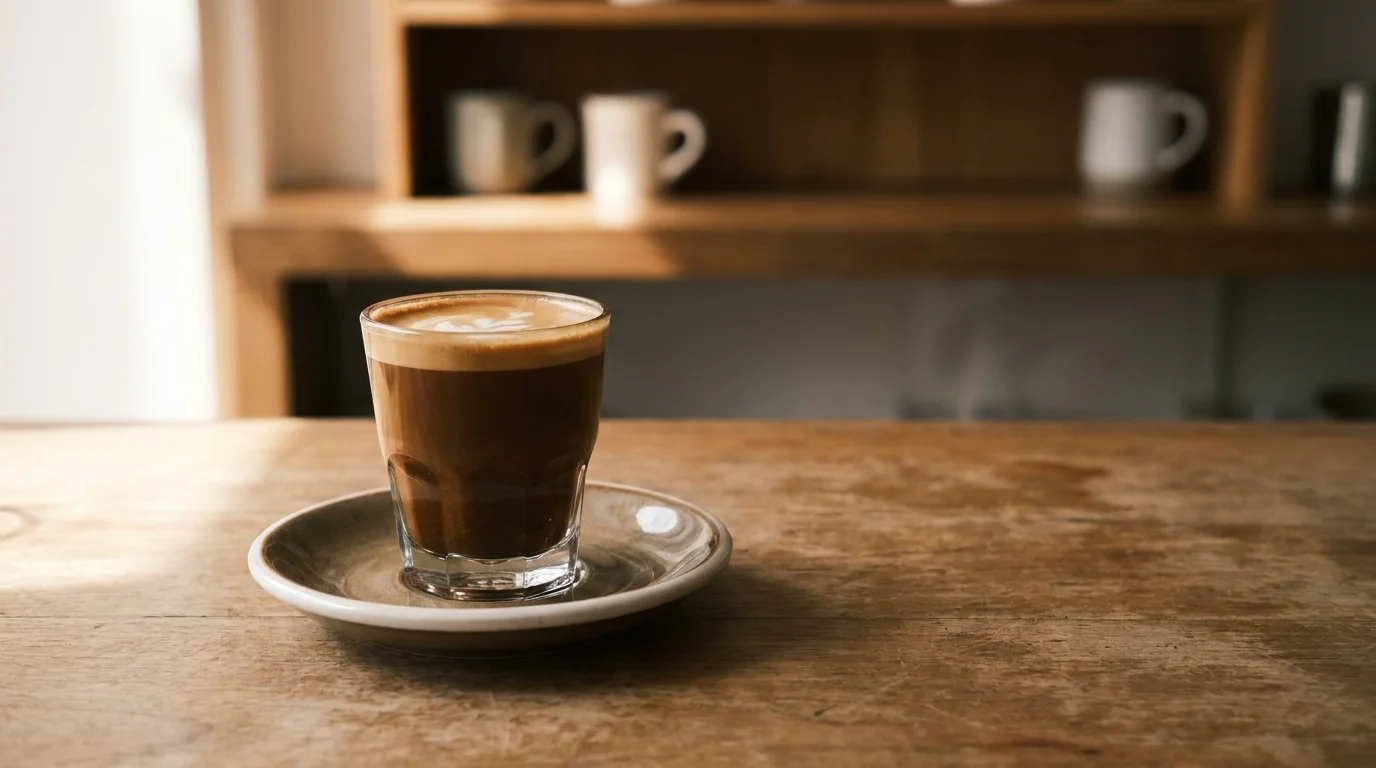
The cortado is the espresso-and-milk drink that specialty coffee has been championing for the past decade as an alternative to the larger, milkier drinks that dominate Anglosphere café menus. It's a specifically Spanish and Basque contribution to global espresso culture — small, coffee-forward, without the microfoam complexity of a flat white or the tiny-mark aesthetic of a macchiato. Ordering a cortado marks you as someone who's been paying attention to specialty coffee, and gets you a drink that's genuinely different from the more common espresso-milk options.
'Cut' with milk
Spanish 'cortar' means 'to cut' — the milk cuts the espresso's intensity while preserving coffee character[3]
4-5 oz total
cortados are small — typically served in Gibraltar-style glasses holding 120-160 mL[1]
~1:1 ratio
cortado uses approximately equal parts espresso and warm milk — meaningfully more milk than a macchiato, less than a flat white[4]
What a cortado actually is
The specifications:
- A double shot of espresso — approximately 60 mL from a proper espresso pull.
- An approximately equal amount of warm milk — 60-100 mL, lightly textured or just steamed to temperature without significant aeration.
- Total volume 120-160 mL in a small 4-5 oz glass or cup.
- Served immediately — cortado doesn't have much foam to degrade, but hot milk cools quickly.
The finished drink is coffee-forward — espresso character is prominent, softened but not muted by the milk. Because the milk isn't heavily textured, there's no substantial foam layer sitting on top; the drink is essentially two liquids combined.
The visual signature: a small glass or cup showing the dark espresso base with a lighter milk top, sometimes with a subtle marbling where the two combined. No latte art (insufficient foam for it).
The Spanish and Basque origin
Cortado emerged from Spanish coffee culture, likely in the Basque country or northern Spain in the mid-20th century. It fit a specific need: an espresso-and-milk drink that kept coffee character prominent without becoming a full milk-heavy drink.
Spanish cortado tradition:
- Standard menu item in Spanish cafés for decades.
- Served alongside espresso (solo), cortado, cafe con leche (larger, more like a small latte).
- Typically a double shot of espresso with a small amount of warm milk.
- Traditional serving is a small glass, sometimes with a saucer.
Basque variations:
- Some Basque cafés serve cortados even smaller than standard Spanish — closer to macchiato territory.
- The distinctive Gibraltar-style glass service is associated with modern reinterpretations.
Latin American versions:
- Cortadito (Cuba, Puerto Rico) — similar concept with variations. Often sweetened at brewing time (Cuban cortadito is traditionally shaken with sugar).
- Similar drinks exist under various names across Latin American café cultures.
North American specialty adoption:
- Cortado became standard on third-wave specialty café menus from around 2010 onward.
- The Libbey Gibraltar rocks glass (originally a whisky glass) became the iconic serving vessel in American specialty cafés.
- "Gibraltar" is sometimes used interchangeably with "cortado" in American specialty contexts — the drink in the specific glass[4].
The milk texture
Cortado milk texture is meaningfully different from other espresso-milk drinks:
Traditional cortado milk:
- Steamed to temperature (60-65°C).
- Little or no aeration — basically just heated milk.
- Poured directly into the espresso.
- No significant foam layer results.
Modern specialty cortado milk:
- Some cafés use very lightly textured milk (thin microfoam).
- Just enough texture to marble the surface subtly.
- Not the silky microfoam of a flat white.
The key contrast with flat white:
- Flat white milk = silky microfoam, glossy surface, substantial texture.
- Cortado milk = warm milk with minimal texture.
Milk choice:
- Whole milk is standard.
- Oat milk works well as the best non-dairy option.
- Skim, soy, almond, coconut work but produce variable results.
The cortado vs macchiato vs flat white spectrum
Cortado sits between macchiato and flat white on the espresso-to-milk spectrum:
Macchiato (traditional espresso macchiato):
- 30-50 mL total.
- Single espresso + teaspoon of foam.
- Essentially espresso with a mark.
- Coffee dominates entirely.
- See Macchiato.
Cortado:
- 120-160 mL total.
- Double espresso + equal warm milk.
- Coffee-forward but softened.
- Balanced espresso and milk.
Flat white:
- 170-190 mL total.
- Double espresso + more milk with silky microfoam.
- Silky texture, integrated pour.
- Balanced coffee and milk with body from microfoam.
- See Flat White.
Cappuccino (for reference):
- 130-150 mL total.
- Single espresso + steamed milk + thick foam.
- Balanced with visible foam cap.
- Foam-textured drink.
- See Cappuccino.
Cortado's distinctive niche: coffee-forward like a macchiato, drinkable-volume like a flat white, without the microfoam complexity of either flat white or cappuccino.
Making a cortado at home
Requirements:
- Espresso machine capable of proper double shots.
- Steam wand (or a simple milk-heating method).
- Small glass (4-5 oz) or small ceramic cup, pre-warmed.
- Fresh whole milk.
Process:
- Pull a double espresso (18-20 g dose in, 40-60 mL out, 25-30 seconds) directly into the pre-warmed glass/cup.
- Steam the milk — approximately 3 oz of milk to 65°C. Aerate lightly (minimal foam) — the goal is warm liquid, not microfoam. Alternative: heat milk in a small saucepan or milk frother without significant aeration.
- Pour the milk directly onto the espresso, gently integrating without splashing. No specific pouring technique required.
- Serve immediately.
Common home-brewing mistakes:
- Over-aerating the milk (turns it into a small flat white).
- Using too much milk (turns it into a small latte).
- Not warming the glass (cools the drink).
- Under-pulling the espresso (weak coffee foundation).
The "Gibraltar" naming
Some specialty cafés in the US call their cortado a "Gibraltar." The naming comes from the Libbey Gibraltar rocks glass — a small clear ~4.5 oz glass originally designed as a whisky glass but adopted by specialty cafés for cortado service.
The story: The specialty coffee café Blue Bottle, Sightglass, and others in the San Francisco Bay Area started serving cortados in Libbey Gibraltar glasses in the late 2000s. The drink-and-glass combination became associated. "Order a Gibraltar" became café shorthand for "cortado in the Libbey Gibraltar glass."
In practice:
- Gibraltar and cortado are largely interchangeable in American specialty café contexts.
- Some cafés distinguish (Gibraltar = specific glass; cortado = generic Spanish/Basque drink).
- Most cafés use the terms without meaningful distinction.
Ordering cortados
In Spain: "un cortado" gets you the traditional Spanish version — usually a double shot with a small amount of warm milk in a small glass.
In specialty cafés (North America, Australia, UK): Cortado is standard on menus at third-wave and specialty cafés. Expect the traditional interpretation, usually in a Libbey Gibraltar glass or similar small vessel.
In chain cafés (Starbucks, etc.): Some chains have added cortado to their menus in the past 5-10 years. Interpretation is variable — sometimes larger than traditional, sometimes with more milk texture.
Cuban context: "cortadito" is the Cuban version, often served sweetened. Different but related drink.
Latin American context: "cortado" is standard in many Latin American café cultures with local variations.
Health notes
Standard cortado (double espresso + 3 oz whole milk):
- ~55-70 calories (mostly from milk).
- ~3-4 g fat.
- ~3 g protein.
- ~4 g carbs.
- ~125 mg caffeine (double shot).
- ~90 mg calcium.
Compared to other espresso drinks:
- Lower calorie than a latte (larger, more milk).
- Higher calorie than a macchiato (more milk).
- Similar calorie to a flat white (comparable size and double-espresso base).
- Similar caffeine to a flat white (both double shot).
- Higher caffeine per volume than a latte (smaller drink with same shot count).
For caffeine-per-volume, cortado is one of the strongest milk drinks — full double espresso in a small serving means concentrated coffee character per sip.
Common misconceptions
- "Cortado is just a small latte." Different in several dimensions: less milk overall, no significant foam texture, higher espresso-to-milk ratio, coffee-forward character. Not a smaller latte.
- "Cortado has to be in a Gibraltar glass." The glass is aesthetic and traditional in modern specialty contexts, but the drink is defined by ingredients and ratio, not the vessel.
- "Cortado is the same as a Cuban cortadito." Related but distinct. Cortadito is often sweetened; cortado traditionally isn't. Similar family, different drinks.
- "Cortado is a foamy drink." No — cortado uses minimally-textured warm milk, not foam.
- "Cortado is Spanish for 'small coffee.'" No — it means "cut" (past participle of cortar, "to cut"), referring to the espresso being cut by milk.
Practical rules
When to order cortado:
- You want a drink that's coffee-forward but not just espresso.
- You want less milk than a flat white but more than a macchiato.
- You like small, concentrated milk drinks.
- You're at a specialty café that will make it properly.
Making at home:
- Get the size right — 4-5 oz total; don't use a large cup.
- Warm the vessel.
- Warm milk to temperature without over-aerating.
- Double espresso base, equal warm milk.
Substitutions to know:
- Similar drinks: cortadito (Cuban, sweetened), piccolo latte (Australian, sometimes considered cortado variant), "Gibraltar" (American specialty naming).
The honest summary
A cortado is a small Spanish/Basque espresso-based drink combining a double shot of espresso with an approximately equal amount of warm, minimally-textured milk in a 4-5 oz glass or cup. The name comes from Spanish 'cortar' meaning 'to cut' — the milk cuts the espresso's intensity. Cortado sits between macchiato (mostly espresso) and flat white (more milk, silky microfoam) on the espresso-to-milk spectrum. Beloved in specialty coffee for its coffee- forward character in a drinkable volume without the microfoam complexity of flat white. In American specialty cafés, often served in a Libbey Gibraltar glass — hence sometimes called a "Gibraltar." A great choice for espresso lovers who want a small milk-softened drink without the milk dominating.
Frequently asked questions
- What is a cortado?
- A cortado is a small espresso-based drink combining espresso with approximately equal parts warm milk — typically a double shot of espresso plus 60-100 mL of milk in a small 4-5 oz glass. The name comes from Spanish 'cortar' meaning 'to cut' — the milk cuts the espresso's intensity while preserving coffee character. The drink originated in Spanish and Basque coffee culture and has become popular in North American specialty cafés.
- Cortado vs macchiato — what's the difference?
- Milk quantity. A macchiato has a small dollop of foam (about a teaspoon) on top of espresso — still essentially an espresso experience. A cortado has approximately equal parts espresso and warm milk — meaningfully more milk. Both are small drinks (macchiato ~40-50 mL total; cortado ~120-160 mL total) with prominent espresso character, but the cortado is more of a proper espresso-and-milk drink while the macchiato is closer to a marked espresso.
- Cortado vs flat white — what's the difference?
- Size and milk texture. A flat white is larger (5-6 oz) with silky microfoam. A cortado is smaller (4-5 oz) with warm milk that has little to no foam texture. Cortado uses barely-textured milk (sometimes just steamed to temperature without significant aeration); flat white uses proper microfoam. Flat white has more milk overall; cortado has a higher espresso-to-milk ratio.
- Where does the cortado come from?
- Spain and the Basque country. Cortado has been part of Spanish coffee culture for decades — probably originating in the Basque country or northern Spain in the mid-20th century. It's standard in Spanish cafés and spread through Latin America (Cuba, Puerto Rico, and parts of Central and South America have local variations). In the past 15 years, cortado has become common in third-wave specialty cafés in North America, Australia, and elsewhere as smaller espresso-and-milk drinks have grown in popularity.
- Why is cortado served in a glass?
- Traditional Spanish serving. The cortado is typically served in a small clear glass (a Gibraltar glass or similar) rather than a ceramic cup. The clear glass shows the espresso-milk layering — the dark espresso base with a paler milk top. It's aesthetically distinct and part of the drink's tradition. In North American specialty cafés, cortados are sometimes served in Libbey Gibraltar rocks glasses, which have become associated with the drink.
References
Every factual claim in this article is drawn from the sources below. See the source library for how we grade evidence.
- [1]Brewing FundamentalsCoffee Science Foundation · Reference work · Tier 2 · Moderate
- [2]Influence of Water Pressure on the Final Quality of Arabica Espresso CoffeeJournal of Agricultural and Food Chemistry · 2002 · Controlled trial · Tier 2 · Moderate
- [3]CoffeeEncyclopaedia Britannica · Reference work · Tier 3 · Contextual
- [4]Uncommon Grounds: The History of Coffee and How It Transformed Our World (revised edition)Basic Books (Mark Pendergrast) · 2010 · Reference work · Tier 2 · Moderate
Related reading
- Espresso & Coffee DrinksMacchiato: Espresso Marked with a Spot of Milk→
- Espresso & Coffee DrinksFlat White: The Antipodean Espresso Drink→
- Espresso & Coffee DrinksLatte vs Cappuccino vs Flat White→
- Espresso & Coffee DrinksSpanish Coffee: The Flambéed Rum Cocktail→
- Espresso & Coffee DrinksIrish Coffee: Whiskey, Cream, and Hot Coffee→
- Espresso & Coffee DrinksMocha: Espresso, Chocolate, and Steamed Milk→