Why Coffee Smells Like Urine (or Cat Pee)
By Coffee Studies Editorial·Published November 29, 2026·6 min read
Quick answer
Coffee smells like urine for one of three reasons, and only one of them lives in the cup. The beans may be giving off a sulfur compound with a "catty" smell. [1]
Your nose may be misreading coffee, a known problem after viral illness. [2] Or the search runs the other way, and your pee smells of coffee. [4] Each has its own study, and they rarely meet on one page.
Why does coffee smell like urine?
Start with who else can smell it. If everyone at the table agrees the coffee smells odd, look at the beans. If only you notice it, look at your nose.
| What you notice | Where it happens | What the research found | What it did not show |
|---|---|---|---|
| A cat-pee note in some coffee | In the cup | A sulfur odorant specific to Arabica, with a smell described as "catty"[1] | That this compound is what drinkers call urine |
| Coffee suddenly smells disgusting, only to you | In your nose | 29 people with parosmia named a shared set of trigger molecules in coffee[2] | Any link to urine; the paper never mentions it |
| Your pee smells of coffee | In your body | Coffee odorants rose in the urine of 14 volunteers, and the samples smelled different[4] | A health problem; it is a normal pathway |
The table draws on three papers: Baba and colleagues in 2020, Parker, Kelly and Gane in 2022, and Wagenstaller and Büttner in 2014.
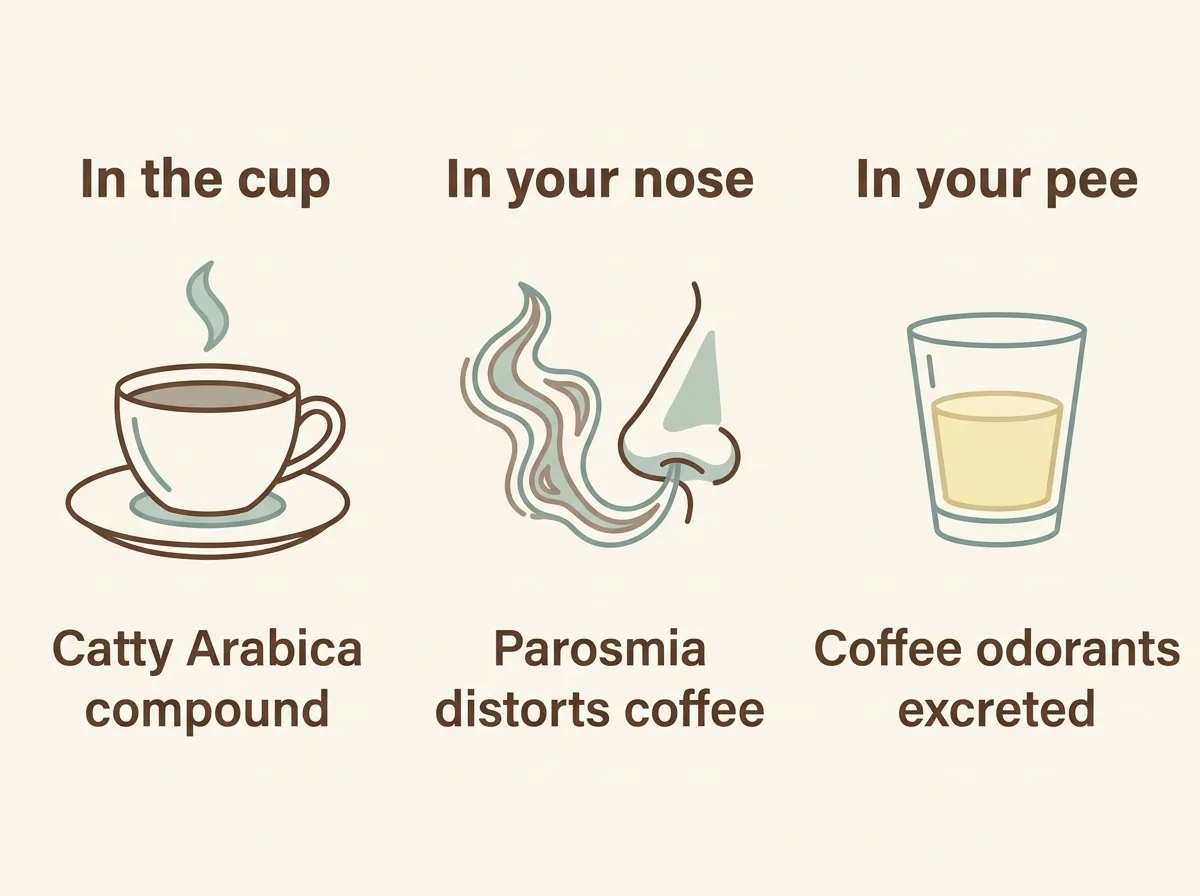
The three readings of the question, and where each one happens. Based on Baba et al. 2020, Parker et al. 2022 and Wagenstaller and Büttner 2014.
Is it the beans? Arabica's "catty" compound
Roasted coffee is full of smell molecules, and some of the most potent contain sulfur. [2] Our page on roasting chemistry covers where they come from.
A Japanese team looked at what makes Arabica smell like Arabica. They named one compound, 3-mercapto-3-methylbutyl formate, as "the specific potent odorant of Arabica coffee". [1] Its own smell, they wrote, was "catty". The beans as a whole smelled sour, floral and fruity.
That makes it a plausible source of the cat-pee note. Arabica is the species in most specialty coffee, as our Arabica and Robusta comparison explains. Be careful with the leap, though. Nobody has tested whether people who report a urine smell are reacting to this compound.
1 compound
named as the specific potent odorant of Arabica coffee, with a smell described as catty[1]
29 people
with parosmia sniffed coffee one molecule at a time to find what triggered it[2]
14 volunteers
gave urine before and after coffee, and some coffee odorants rose clearly[4]
Does coffee smell like urine to everyone, or just to you?
If coffee used to smell good and now smells revolting, the cause may be parosmia. That word means a distorted sense of smell, where familiar things smell wrong and often disgusting. [2] It usually follows a loss of smell after an infection.
COVID-19 made it common. The University of Reading puts smell and taste loss at 50 to 60% of COVID cases, with about 10% of those going on to parosmia. [3] Coffee sits near the top of the foods that set it off. [3]
Researchers at Reading tested this with instant coffee, chosen because it smells the same from one session to the next. They passed its aroma through a machine that separates it into single molecules. Volunteers sniffed each one as it came out and said what they smelled. [2] There were 29 people with parosmia and 15 without it.
Figure
The coffee molecules people with parosmia flagged most
Values in times reported as a trigger
The top trigger was 2-furanmethanethiol. To most noses it is simply the smell of coffee. [2] The parosmic group called it "disgusting, repulsive, and dirty", or just "new coffee". Many could not compare it to anything they had smelled before.
So the urine comparison is something people reach for, not what the study found. The paper does not mention urine at all.
Why can coffee smell like poop when you have parosmia?
This is the strangest finding, and it fits the same pattern. People with parosmia often say faeces no longer smell as bad as before. [2] Some say it smells like other distorted foods, or even "biscuity". The authors summed it up neatly: foods smell of faeces, yet faeces smell of food.
The likely reason is that the trigger molecules work at tiny amounts. 2-methyl-3-furanthiol, for one, can be smelled in water at well under one part per billion. [2] If a nose misfires on those few molecules, a whole family of foods turns at once.
Parosmia can be upsetting, especially when it hits a daily drink. If smells stay wrong for weeks, an ear, nose and throat specialist can check for other causes and talk through options.
Can your pee smell like coffee?
Yes, and it is normally harmless. A German team collected urine from 14 volunteers before and after a usual amount of coffee. [4] Some coffee odorants were "present at considerably elevated concentrations" afterwards. When the samples were smelled in a sensory test, they backed that up.
So the smell you notice is real. Your body clears coffee's smell molecules partly through your urine. The NHS lists coffee next to asparagus as a drink that can make pee smell stronger. [5]
What makes it more obvious:
- Drinking a lot of coffee, which puts more odorants into the same volume.
- Not drinking much water, so your urine is more concentrated. [5]
- Vitamin B6 supplements and some medicines, which the NHS also names.
Drinking water through the day is the simplest fix. For what coffee does to your kidneys, see coffee and kidney health.
When is a strong urine smell worth a doctor's visit?
Smelly pee on its own is not usually a worry, says the NHS. [5] Other symptoms alongside it change that.
See a doctor if the smell comes with any of these:
- Pain or burning when you pee, or needing to go often. [5]
- Cloudy pee, fever, chills or back pain, which can be signs of an infection. [6]
- Blood in your pee, or feeling confused, very tired or unwell. [5]
- A sweet smell, which may be a sign of diabetes that is not under control. [6]
A smell of ammonia usually means you are low on fluids. [6] A coffee smell after a few mugs, with no other symptoms, is not on any of these lists. This page explains causes; it cannot diagnose yours.
Does coffee make your breath smell?
It can, for a while. The NHS names strong-smelling foods and drinks as a common cause of bad breath. [7] Dry mouth is on its list too.
Its advice is plain: sugar-free gum or mints after strong drinks, and brush twice a day. [7] If bad breath lasts a few weeks after that, the NHS suggests seeing a dentist.
What to do when your coffee smells wrong
Run a quick test before you blame the beans:
-
Ask someone else to smell it. If they shrug, the cause is probably your nose.
-
Smell another food you know well. If onion, meat or toothpaste smell wrong too, think parosmia. [2]
-
Try a Robusta blend. The catty compound was singled out as an Arabica marker. [1]
-
Check the age of the coffee. Our guide on how long coffee lasts covers stale grounds.
If the smell is in the cup for everyone, it is a quirk of the bean, not a fault. Cuppers learn to name notes like this; our cupping guide shows how they do it.
Watch
See it, not just read it
One video picked for this page. They play right here, full screen on a phone, and you come straight back to the article.
Hosted on YouTube. Credit belongs to the channels named.
Frequently asked questions
- Does coffee smell like cat pee because of COVID?
- It can. Losing smell was common with COVID-19, and some people who recover it find certain smells distorted, a condition called parosmia. Coffee is one of the foods people with parosmia mention most. A smell that suddenly turns foul after an illness, while others say the coffee is fine, points that way. An ear, nose and throat doctor can assess it.
- Does coffee smell like ammonia?
- Fresh coffee should not. If your urine smells of ammonia, the more common cause is not drinking enough: MedlinePlus notes that concentrated urine can smell like ammonia. Drink more water and see whether the smell fades over a day or two.
- Does coffee make everyone's pee smell?
- Not noticeably for everyone. In the one study that measured it, some coffee odorants rose to clearly higher levels in urine after a normal amount of coffee, and the samples smelled different. How much you notice depends on how much you drink and how concentrated your urine is.
- Why does my whole house smell like coffee pee?
- Ask someone else first. If they smell it too, look for the source: old grounds in the bin, a coffee maker overdue for a clean, or, sadly, an actual cat. If only you can smell it, and other foods smell wrong too, that points to your nose rather than the house.
References
Every factual claim in this article is drawn from the sources below. See the source library for how we grade evidence.
- [1]Characterization of the unique aroma of Arabica coffee and its formationJournal of the Japanese Society for Food Science and Technology (via FAO AGRIS) · 2020 · Observational study · Tier 2 · Moderate
- [2]Insights into the molecular triggers of parosmia based on gas chromatography olfactometryCommunications Medicine (PMC9130211) · 2022 · Observational study · Tier 2 · Moderate
- [3]Secret of disordered smell foundUniversity of Reading · 2022 · Reference work · Tier 3 · Contextual
- [4]Coffee aroma constituents and odorant metabolites in human urineMetabolomics (Springer), via FAU CRIS · 2014 · Observational study · Tier 2 · Moderate
- [5]Smelly urineNHS · Agency guidance · Tier 1 · Strong
- [6]Urine odorMedlinePlus (US National Library of Medicine) · 2025 · Agency guidance · Tier 1 · Strong
- [7]Bad breathNHS · 2025 · Agency guidance · Tier 1 · Strong
Related reading
- Brewing ScienceCoffee Cupping: How SCA Sensory Evaluation Works→
- Brewing ScienceCoffee Strength vs Caffeine: They're Not the Same→
- Brewing ScienceCoffee Creamer: How Long Good After Opening→
- Brewing ScienceWhat Is in Coffee Creamer? Homemade vs Store-Bought→
- Brewing ScienceWhat Is Coffee Bloom? CO₂, Degassing, and Why It Matters→
- Brewing ScienceCoffee Grounds for Plants: What Is in Them, Where They Go→