Black Tea vs Coffee: Caffeine, and Why the Leaf Loses
By Coffee Studies Editorial·Published October 28, 2026·5 min read
Quick answer
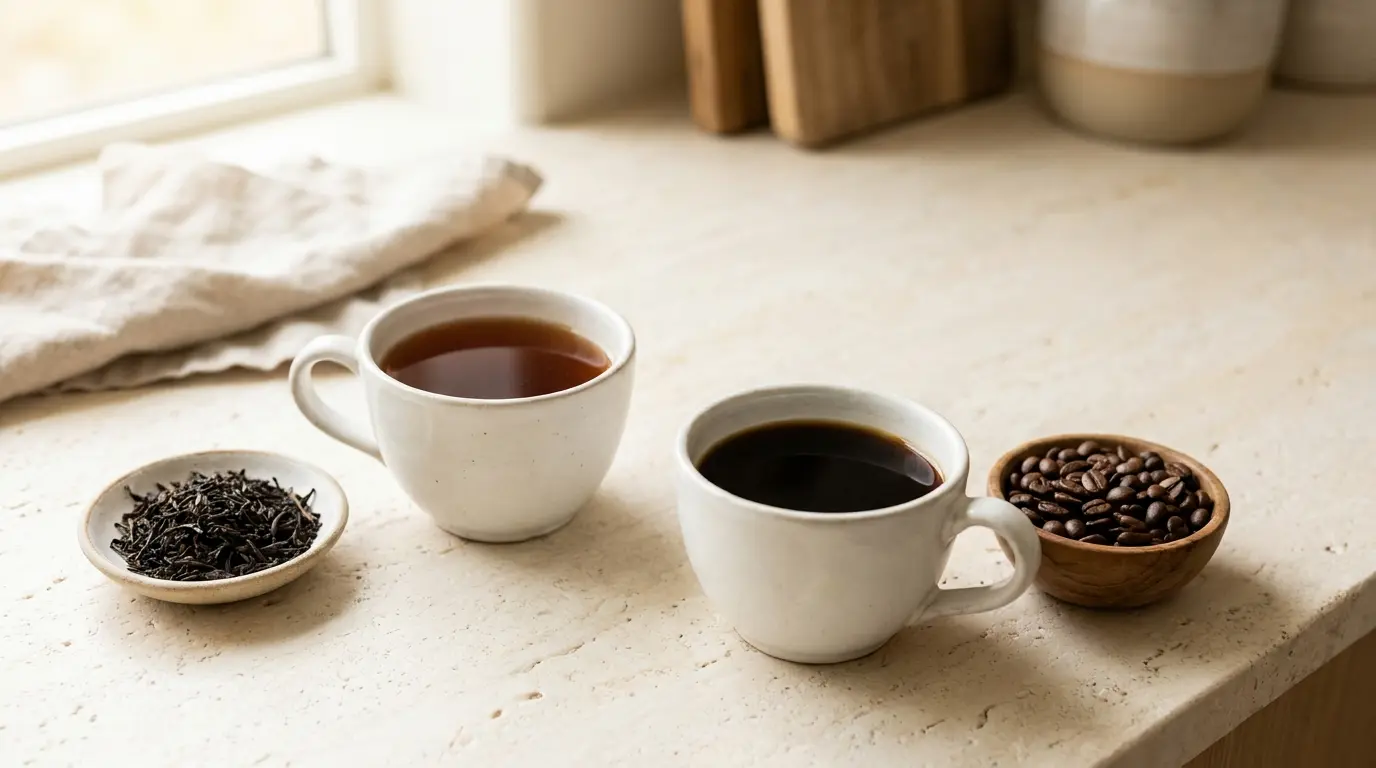
Brewed coffee carries about twice the caffeine of brewed black tea. What most pages leave out is the part that makes people doubt it: dry black tea leaf really does hold more caffeine, gram for gram, than a roasted coffee bean. Both facts are true at once, and the reason is not chemistry. It is dose.
How much caffeine is in each cup
About 95 mg in a cup of coffee and about 47 mg in black tea, close to two to one. These come from USDA FoodData Central, which publishes measured values per 100 g of the finished drink.
| Drink (brewed) | Caffeine per 100 g | Per 8 fl oz cup |
|---|---|---|
| Coffee, prepared with tap water | 40 mg | about 95 mg |
| Black tea, prepared with tap water | 20 mg | about 47 mg |
| Green tea | 12 mg | about 28 mg |
| Espresso, restaurant-prepared | 212 mg | about 63 mg per 1 oz shot |
The per-cup column is arithmetic: 8 fl oz of water weighs about 237 g, so the per-100 g figure times 2.37 gives the cup. The ratio holds across brewing methods well enough to plan a day around. For the coffee side by brew method, see how much caffeine is in coffee.
Why the leaf is richer and the cup is weaker
Because you put nearly four times as much coffee in the cup as tea. The people insisting tea is the stronger stimulant are quoting a real number about the wrong thing.
| Dry material | Caffeine by weight |
|---|---|
| Black tea leaf | 3 to 4 percent; five commercial UK blends measured at 2.7 to 3.2 percent |
| Roasted arabica coffee | about 1.2 percent |
| Roasted robusta coffee | 2.2 percent |
So black tea leaf is roughly two to three times as caffeinated as an arabica bean, by weight. What settles it is the dose. The Specialty Coffee Association's cupping protocol specifies 8.25 g of coffee per 150 mL of water (55 to 60 g per litre for brewing); the IARC estimates for tea are built on 2.25 g of leaf per 150 mL cup. Same cup, nearly four times the dry weight of coffee.
[3] [2]Run it through:
- Coffee: 8.25 g at 1.2 percent gives about 99 mg of caffeine in the dry grounds
- Black tea: 2.25 g at 3.0 percent gives about 68 mg in the dry leaf
The bean starts with about one and a half times more caffeine on the spoon, despite being the less concentrated of the two. The dose erases a threefold difference in concentration and then some, and extraction widens the gap a little further: IARC puts caffeine recovery from coffee at 70 to 85 percent of what was in the grounds. [2]
Matcha is the one everyday exception, and it proves the point: you drink the powdered leaf instead of steeping and discarding it, so the dose stops working against the tea.
Why the published figures disagree so much
Partly real variation, mostly brewing. Every page hands you a different range and rarely says where it came from.
| What the first page of results says | Black tea per cup | Coffee per cup |
|---|---|---|
| One page | 14 to 70 mg | 90 to 120 mg |
| Another | 28 to 46 mg | 90 to 200 mg |
| Another | 40 to 70 mg | 95 to 200 mg |
Some of the spread is real. Bunker and McWilliams measured caffeine across common beverages in 1979 and reported 28 to 46 mg per cup of black tea against 107 to 151 mg for brewed coffee. Preparation method for coffee and brewing time for tea both moved the result significantly, and a cup of tea, a cup of instant coffee and a can of cola could all land in the same 55 to 65 mg band. That 1979 paper is still the source under much of what circulates. [4]
The rest is brewing: steep time, leaf grade, grind, water temperature and how much you used all move the result, which is why a ratio and a range beat a single number. One more thing, said plainly: several of the pages ranking above the research are published by companies that sell tea, at least one by a company that sells coffee, and each range leans the way its seller would like. That does not make the figures wrong, but it explains why nobody reconciles them.
What this means in a cup
Swapping coffee for black tea roughly halves your caffeine. It does not remove it: four cups of strong black tea through a working day is not a low-caffeine day. Health Canada's guidance is 400 mg a day for most healthy adults, and 300 mg for people who are pregnant. On the USDA figures that is about four cups of coffee or eight of black tea, before anything else you drink is counted. If you want no caffeine at all, decaffeinated black tea is listed at 1 mg per 100 g, and a naturally caffeine-free infusion such as rooibos sidesteps the question.
[5] [1]Two things people fold into this decision are not settled by the caffeine number: blood pressure, and whether coffee is harder on the stomach than tea, covered in coffee and acid reflux.
What to do
- Cutting caffeine, not quitting? Black tea gives you about half the dose per cup.
- Counting against the 400 mg line? Coffee about 95 mg a cup, black tea about 47, and count everything else too.
- Want a lighter cup of tea? Steep it for less time.
- Want none at all? Decaf black tea or rooibos.
The short of it
Coffee wins the cup by about two to one. Tea wins the gram by about three to one. Both are correct, and they only feel contradictory because nobody drinks a gram of anything. Count the cups, not the leaves.
Frequently asked questions
- Is it healthier to drink black tea or coffee?
- That is not a caffeine question, and the research does not hand you a winner. Both are associated with favourable outcomes in large observational studies, and neither association is proof of cause. If caffeine is what you are managing, the number on this page is the useful part.
- Does black tea have more caffeine than green tea?
- Slightly, in the cup. USDA FoodData Central lists brewed black tea at 20 mg of caffeine per 100 g and brewed green tea at 12 mg. The IARC monograph notes that the dry leaves are comparable, so most of the gap comes from how each is brewed rather than from the leaf itself.
- What tea has more caffeine than coffee?
- By the cup, essentially none of the everyday ones. Matcha is the usual exception people mean, because you drink the powdered leaf rather than an infusion of it, so the dose is far higher than a steeped cup.
- Which is better for blood pressure, tea or coffee?
- Caffeine from any source can raise blood pressure acutely, and regular drinkers blunt that response. The coffee evidence is covered separately in our article on coffee and blood pressure.
- Is tea better for your stomach than coffee?
- Many people report that it is, though the evidence is thinner than the confidence with which it gets repeated. Coffee and acid reflux is its own topic and we treat it separately.
- Does steeping tea longer add caffeine?
- Yes, within limits. Bunker and McWilliams measured caffeine in black tea brews across different brewing times and found it climbs with time, which is one reason published per-cup figures vary so widely.
References
Every factual claim in this article is drawn from the sources below. See the source library for how we grade evidence.
- [1]FoodData CentralU.S. Department of Agriculture · Official dataset · Tier 1 · Strong
- [2]Coffee, Tea, Mate, Methylxanthines and Methylglyoxal (IARC Monographs, Volume 51)International Agency for Research on Cancer · 1991 · Agency guidance · Tier 1 · Strong
- [3]SCA Cupping ProtocolsSpecialty Coffee Association · 2023 · Reference work · Tier 3 · Contextual
- [4]Caffeine content of common beveragesJournal of the American Dietetic Association · 1979 · Observational study · Tier 2 · Moderate
- [5]Caffeine in foodsHealth Canada · 2022 · Agency guidance · Tier 1 · Strong
Related reading
- Coffee AlternativesGolden Milk (Turmeric Latte): The Complete Guide→
- Coffee AlternativesGuayusa: The Amazonian Caffeine Leaf→
- Coffee AlternativesRooibos Tea: The South African Alternative→
- Coffee AlternativesWhat Is Cascara? Tea Brewed from Coffee Cherry Husks→
- Coffee AlternativesPostum and Roasted Grain Coffee: The Cereal Beverage Story→
- Coffee AlternativesYerba Mate: The South American Coffee Alternative→