The Ethiopian Coffee Ceremony: Jebena, Ritual, and Culture
By Coffee Studies Editorial·Published July 15, 2026·7 min read
Quick answer
Coffee originated in Ethiopia. Not "developed a strong coffee tradition in Ethiopia" — genuinely originated. Wild Coffea arabica still grows in Ethiopian montane forests, and the country has cultivated and consumed coffee for a very long time. The Ethiopian coffee ceremony is what coffee culture looks like when it's had thousands of years to develop into a ritual worth building an afternoon around.
Coffee's homeland
wild Coffea arabica originates from Ethiopian montane forests — the country is the genetic birthplace of the world's dominant coffee species[5]
Three rounds
Abol, Tona, and Bereka — the three sequential brews that constitute a complete ceremony[2]
1-2 hours
typical duration of a full ceremony — the unhurried pace is part of the point[3]
Coffee's genetic homeland
Coffea arabica — the species that accounts for roughly 60% of world coffee production — is native to Ethiopia. Wild arabica still grows in the montane forests of Ethiopia's southwestern regions, part of the Eastern Afromontane biodiversity hotspot. The plant was domesticated and cultivated in Ethiopia long before it spread anywhere else.
Analytical studies of Ethiopian coffee document consistent chemical signatures that distinguish Ethiopian arabica from other origins — the country's geographic and genetic diversity produces coffee character no other origin replicates[4].
The famous Kaldi legend — an Ethiopian goatherd who discovered coffee after noticing his goats becoming energetic from eating red coffee cherries — is unverifiable but reflects genuine cultural claim to coffee's origin[3].
From Ethiopia, coffee cultivation spread to Yemen (probably by the 15th century), then to the wider Islamic world (Turkey, Egypt, North Africa), and eventually to Europe and the Americas[2]. But the plant, and the coffee culture that surrounds it, began in Ethiopia.
What actually happens in a ceremony
An Ethiopian coffee ceremony (called bunna in Amharic — the word for both the beverage and the ceremony) has a distinct sequence:
1. Preparation of the space. The host — traditionally a woman of the household — sets up a low table with fresh grass or leaves scattered on the floor (a symbol of welcome and the natural world). Incense is often burned throughout the ceremony, creating a distinctive aromatic atmosphere.
2. Washing the beans. Green (unroasted) coffee beans are washed in front of the guests — visible preparation is part of the ritual, not a chore hidden in the kitchen.
3. Roasting. The beans are roasted over hot coals in a shallow pan called a menkeshkesh or menkeshkessa. The roasting is watched and managed by the host, who agitates the beans continuously to prevent burning. When done, the pan is passed around the group so guests can smell the freshly-roasted beans — an important sensory moment.
4. Grinding. The roasted beans are ground by hand — traditionally in a wooden mortar and pestle (called a mukecha and zenezena).
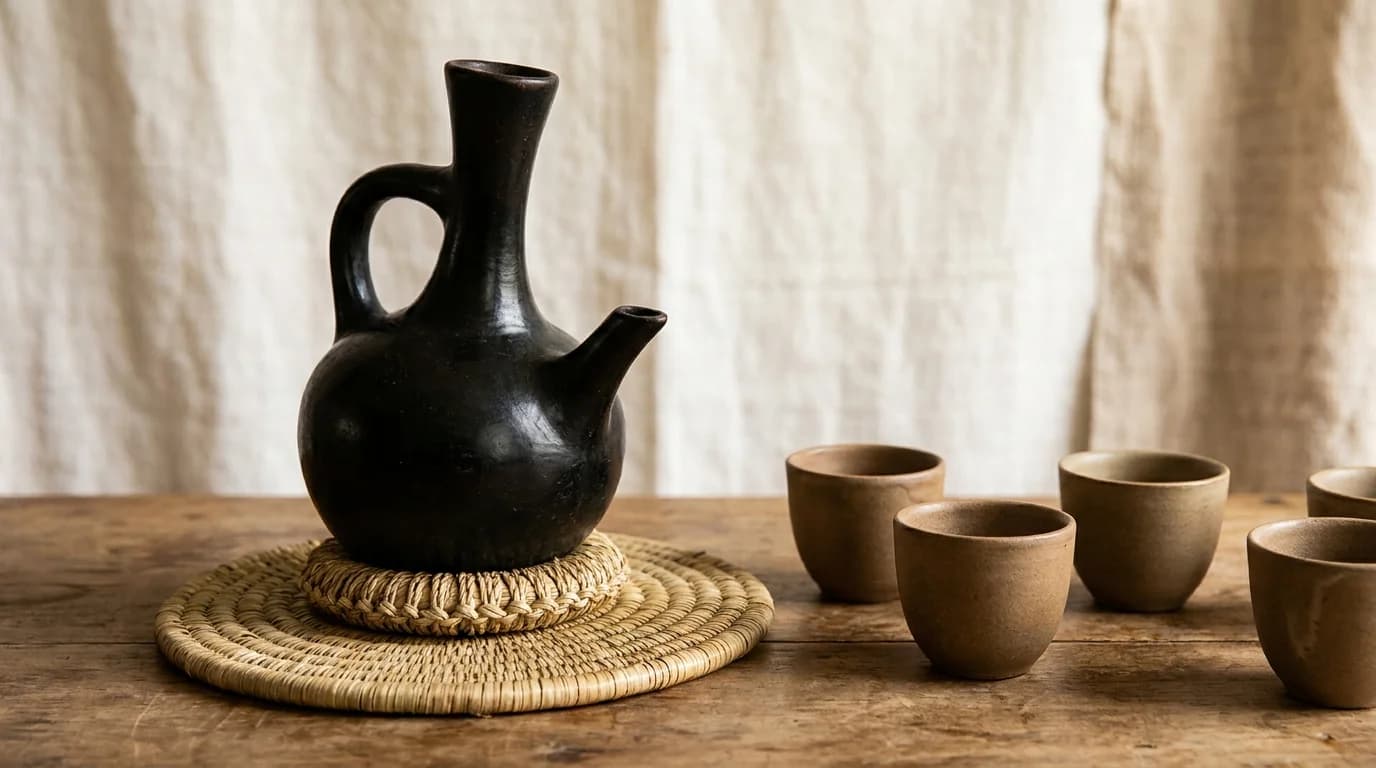
5. Brewing. The ground coffee is added to water in the jebena — a traditional black clay pot with a spherical body and a long narrow neck, unique to Ethiopian coffee culture. The jebena sits on the coals to boil. When ready, coffee is poured from a height into small handleless cups (cini or si'ini) — the height is deliberate, allowing a bit of aeration and letting the grounds settle in the jebena.
6. Serving in three rounds.
- Abol — the first and strongest round. Served to all present.
- Tona — the second round. The same grounds are re-brewed by adding more water to the jebena. Slightly weaker but still substantive.
- Bereka — the third round, meaning "blessing." The weakest of the three, but considered spiritually significant and often accompanied by well-wishes for the guests.
Participating in all three rounds is a sign of respect. Leaving before Bereka is culturally awkward without a good reason.
7. Accompaniments. Coffee is typically served with light snacks — popcorn (fandisha), roasted barley (kolo), or bread. Sugar is common; milk is not traditional. Some ceremonies include spices in the coffee (cardamom, cinnamon, cloves) though this is regional.
Why it matters culturally
The Ethiopian coffee ceremony is more than a way to prepare coffee — it's a social institution:
Hospitality. Offering coffee to a guest is a fundamental act of Ethiopian hospitality. Declining is difficult without cause.
Community. The ceremony creates a bounded social time when participants sit, talk, and be present with each other. In an increasingly hurried world, the deliberate pace is part of the appeal.
Family and daily life. In many Ethiopian households, coffee ceremonies happen daily — often twice a day. It's a rhythm of domestic life, not a special occasion (though it's also a special-occasion event).
Spiritual practice. In many Christian and Muslim Ethiopian households, coffee ceremonies incorporate prayers, blessings, and moments of reflection. The Bereka round in particular is often framed as a spiritual gift.
Economic and social significance. Coffee is Ethiopia's largest export crop and central to millions of Ethiopian livelihoods — over 15 million Ethiopians depend on the coffee sector economically[1]. The ceremony is one of many ways coffee is deeply woven into Ethiopian identity.
Ethiopian coffee itself
The ceremony celebrates coffee that Ethiopia produces — and Ethiopian coffee is distinct. Key characteristics:
- Heirloom varieties. Most Ethiopian coffee is descended from wild arabica lineages that don't have formal variety names. This genetic diversity is unique — most of the world's coffee outside Ethiopia is far more genetically uniform.
- Regional character. Different growing regions produce very
different profiles:
- Yirgacheffe (Sidamo region) — light, floral, tea-like with jasmine and citrus notes. World-famous.
- Sidamo — sweet, complex, wine-like acidity.
- Harrar — dry-processed, fruity, wild, blueberry notes.
- Limu — balanced, sweet, spice notes.
- Djimmah — earthy, full-bodied.
- Processing traditions. Both washed and natural (dry) processing are traditional; naturals are especially distinctive from Ethiopia, producing intensely fruit-forward coffees.
Attending an Ethiopian coffee ceremony
If you're invited to a ceremony (in Ethiopia or by an Ethiopian host), some cultural considerations:
- Accept warmly. Declining is difficult.
- Stay for all three rounds if you possibly can. This is the cultural norm and the most respectful behaviour.
- Compliment the roasting. When the pan of roasted beans is passed for you to smell, take a moment and comment appreciatively. This is expected.
- Don't rush. The ceremony is not efficient by design. Your patience is the point.
- Bring or offer a small gift if you're a guest in a household — flowers, fruit, or something you know your host enjoys.
- Learn a few Amharic words: "amasegenallehu" (thank you) and "buna" (coffee).
Outside Ethiopia
The Ethiopian diaspora has brought coffee ceremony traditions to cities around the world. In North America (Toronto, Washington DC, Minneapolis-St. Paul), London, Rome, and other cities with substantial Ethiopian communities:
- Ethiopian restaurants often serve coffee ceremony-style after meals.
- Cultural centres and events host ceremony demonstrations.
- Some third-wave specialty coffee shops partner with Ethiopian community members to host occasional ceremonies — especially shops that specialise in Ethiopian coffees.
Some Ethiopian community members offer coffee ceremony experiences privately or at markets — an increasingly common way to encounter the tradition.
Common misconceptions
- "Ethiopian coffee ceremony is just how they make coffee." It's a specific ritualised form. Ethiopians make quick coffee too — the ceremony is a deliberate social event.
- "The ceremony is a tourist show." It's a living cultural practice performed daily in ordinary Ethiopian homes, not a performance for outsiders.
- "It's very ancient/thousand-year-old." Elements are old, but the specific bunna ceremony as practiced today evolved over centuries and continues to evolve. Coffee cultivation in Ethiopia is very old; the current ceremony format is a cultural distillation.
- "You need special equipment to try it at home." A jebena is nice-to-have; the more important element is the deliberate, communal pace. Grinding beans fresh, brewing at the table, and serving multiple rounds — you can approximate the spirit without traditional equipment.
The honest summary
The Ethiopian coffee ceremony is what coffee culture looks like when it's had millennia to mature. Green beans are washed, roasted, ground, and brewed at the table, then served in three sequential rounds — Abol, Tona, and Bereka. It's a social act, a spiritual practice, and a demonstration of respect. If you love coffee and haven't experienced one, seek out an Ethiopian restaurant or cultural event where they still host them. And if you're ever invited to one, stay for all three rounds.
Frequently asked questions
- What is the Ethiopian coffee ceremony?
- A communal ritual where fresh green coffee beans are washed, roasted over hot coals, ground in a mortar, and brewed in a traditional clay pot called a jebena — all in front of the guests. Served in three sequential rounds (Abol, Tona, Bereka), each with its own significance.
- How long does an Ethiopian coffee ceremony take?
- The full ceremony typically takes 1-2 hours from washing the beans to the final round. It's deliberately unhurried — the pace is part of the point, and the ceremony functions as a time to gather, converse, and be present with the host and other guests.
- Why three rounds of coffee?
- Each of the three rounds — Abol (first), Tona (second), and Bereka (third, meaning 'blessing') — has cultural and often spiritual significance. Participating in all three is considered a sign of respect and completeness. Each round is progressively lighter as the same grounds are re-brewed.
- Where can I experience an Ethiopian coffee ceremony?
- In Ethiopia itself, coffee ceremonies happen daily in homes, restaurants, and cultural venues. Outside Ethiopia, some Ethiopian restaurants and specialty coffee events host ceremonies — especially in cities with substantial Ethiopian diaspora communities. Some third-wave specialty coffee shops also occasionally host demonstrations.
References
Every factual claim in this article is drawn from the sources below. See the source library for how we grade evidence.
- [1]Ethiopia's Coffee Sector: A Bitter or Better Future?Journal of Agrarian Change · 2007 · Review · Tier 2 · Moderate
- [2]CoffeeEncyclopaedia Britannica · Reference work · Tier 3 · Contextual
- [3]The History of CoffeeNational Coffee Association · Reference work · Tier 3 · Contextual
- [4]Characterization of the Cultivation Region of Ethiopian Coffee by Elemental AnalysisAnalytical Letters · 2016 · Observational study · Tier 2 · Moderate
- [5]Coffee Varieties CatalogWorld Coffee Research · Reference work · Tier 2 · Moderate
Related reading
- Beans, Roasts & OriginsCoffee Origins Around the World→
- Beans, Roasts & OriginsArabica vs Robusta: Taste, Caffeine, and Differences→
- Brew MethodsCafé de Olla: Mexico's Traditional Spiced Coffee→
- Beans, Roasts & OriginsEthiopian Coffee: Yirgacheffe, Sidamo, and Harrar→
- Beans, Roasts & OriginsThe History of Coffee: From Ethiopia to the Modern Cup→
- Beans, Roasts & OriginsKissaten: Japan's Historic Coffee Shop Culture→