Cafe con Leche vs Latte: Ratio and Milk
By Coffee Studies Editorial·Published November 19, 2026·6 min read
Quick answer
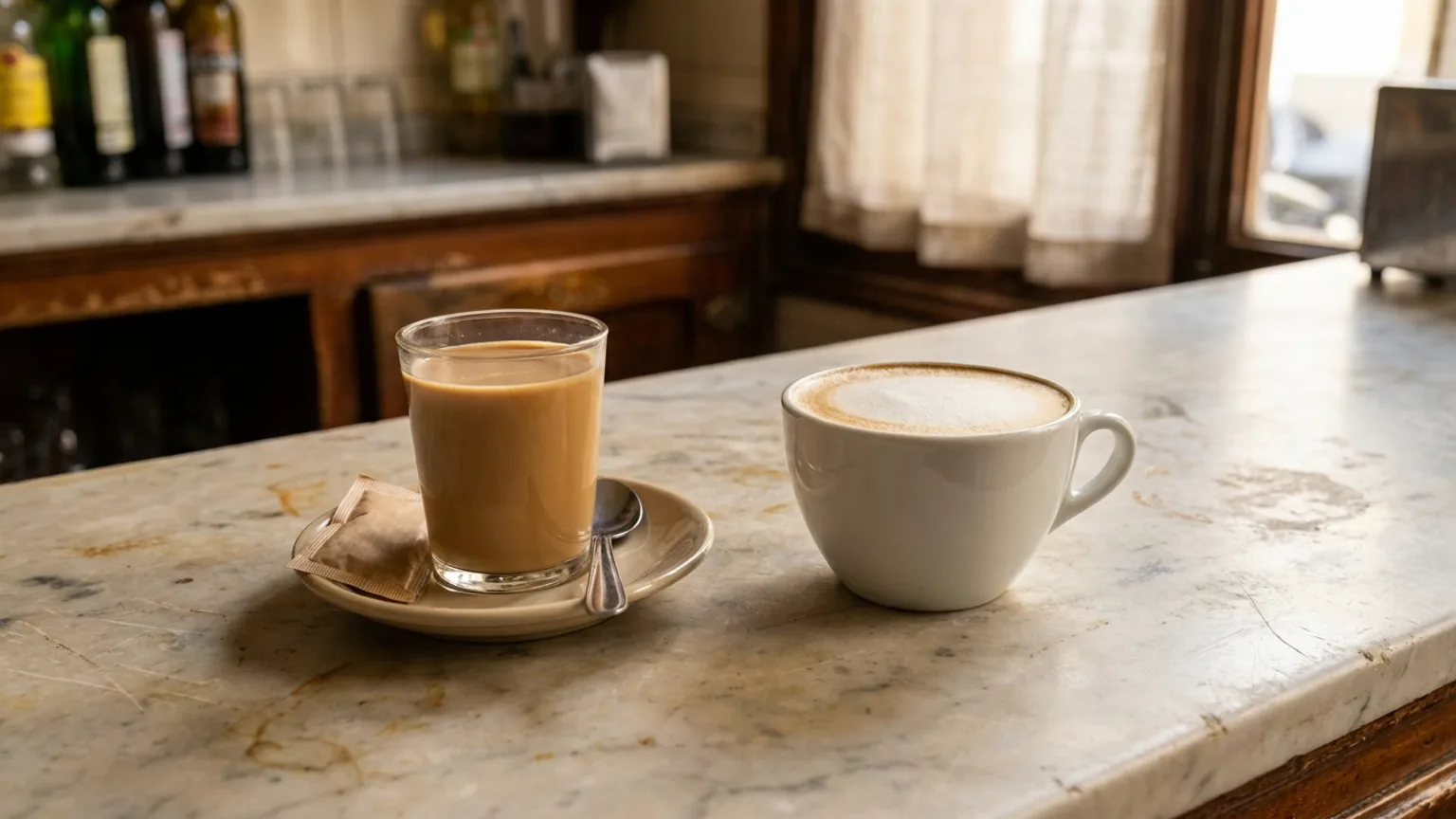
Cafe con leche vs latte is the question most people ask the first time they see both drinks on one menu. They look similar, but they are built differently.
A cafe con leche is roughly half espresso and half very hot milk, with almost no foam. A latte is mostly milk, steamed until it turns silky, with a thin cap of foam on top.
1 to 1
espresso to milk in a Spanish cafe con leche, with the milk scalded rather than steamed[1]
1 to 2 or 3
espresso to steamed milk in a typical latte, finished with a thin layer of foam[2]
€1.70 to €2
what a cafe con leche costs in a typical Spanish bar in 2026; a Madrid specialty shop charges €3[3]
550 cups a year
the average Spaniard's coffee intake, by the Spanish coffee trade body's estimate[4]
What is a cafe con leche?
The name simply means "coffee with milk" in Spanish. The drink is strong coffee, usually espresso, mixed with scalded milk in approximately equal amounts. [5] It originated in Spain and later spread across Latin America and its communities abroad. [1]
"Scalded" is the important word here. It means the milk is heated to just below boiling. Baristas do it with the steam wand. The result is hot, smooth milk without the layer of foam a latte gets. [1]
A head barista in Barcelona described it plainly to Perfect Daily Grind. It is an espresso with the same amount of milk added. In the barista's words, it "tends to be hotter and less creamy than a latte". Spaniards usually drink it from a glass, not a cup. [1]
Cafe con leche vs latte: what actually differs?
Three things separate them: the quantity of milk, the way it is heated, and whether there is foam. The espresso underneath can be identical.
| Cafe con leche | Latte | |
|---|---|---|
| Espresso to milk | About 1 to 1 | About 1 to 2, up to 1 to 3 |
| How the milk is heated | Scalded, close to boiling | Steamed, with fine bubbles |
| Foam | Almost none | A thin layer on top |
| Usual vessel | Small clear glass | Tall glass or larger cup |
| Sugar | A packet on the side in Spain | Only if you ask |
| Taste | Stronger, hotter, less creamy | Milder, creamier |
Sources for the table: Spanish baristas on the cafe con leche, a roaster's latte guide and a Spanish ordering guide. [1] [2] [6] [9]
A typical 12-ounce latte contains a double shot, about 2 ounces, under roughly 8 ounces of steamed milk. [2] Pour a cafe con leche into that same cup and it would look half empty. That isn't a stingy barista. It's the recipe.
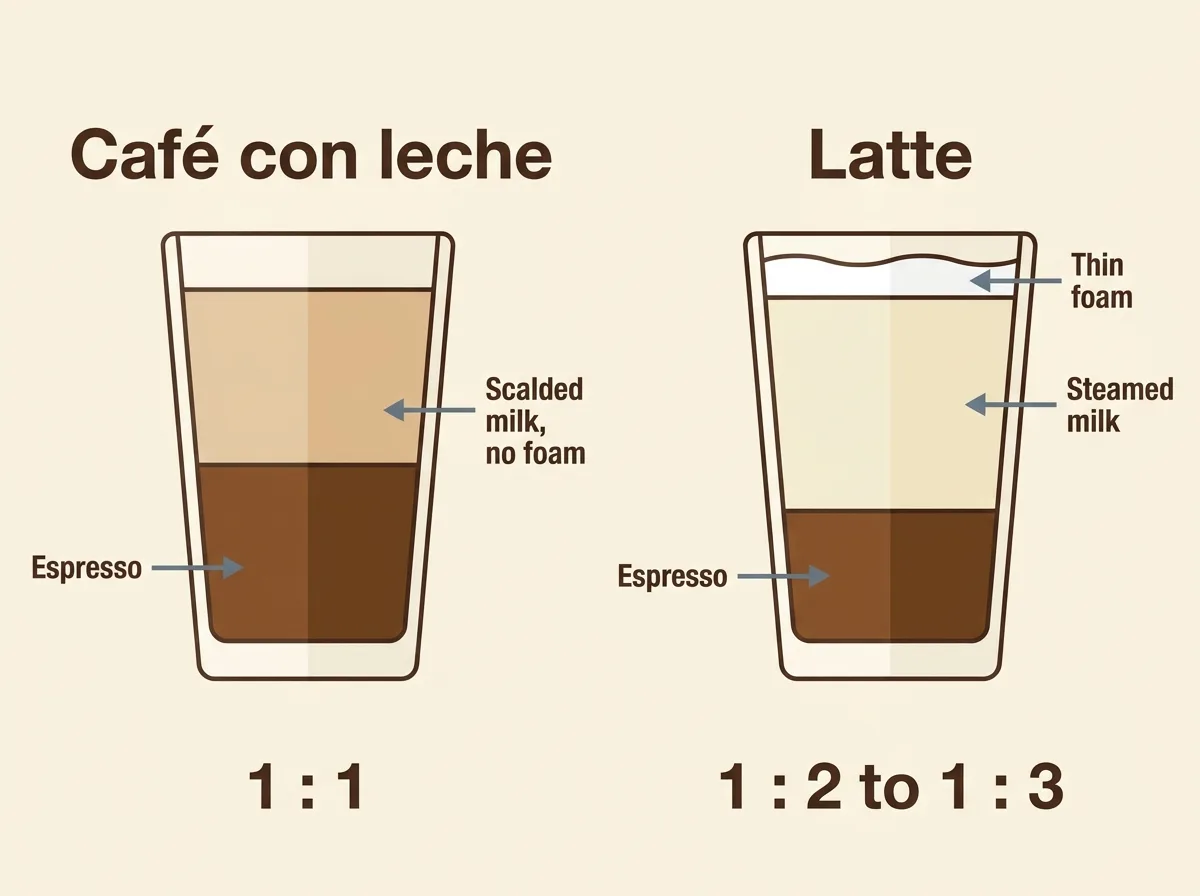
Cafe con leche is half espresso and half scalded milk; a latte is one part espresso under two or three parts steamed milk. Ratios from Perfect Daily Grind and Methodical Coffee.
Is a cafe con leche a cortado, a cappuccino or a flat white?
None of them, although each is a close neighbour. The difference is always the milk.
-
Cortado. In Spain, this is a small espresso with just a splash of milk. A cafe con leche contains considerably more. [6]
-
Cappuccino. The certified Italian version is 25 ml of espresso and 100 ml of steam-foamed milk. That means more milk and much more foam. [7]
-
Flat white. Spanish specialty cafés will make you one. In an ordinary bar, a cafe con leche is the closest thing on the menu. [6]
For the complete family of milk drinks, our guide to the latte, cappuccino and flat white compares them directly. The cortado has its own page as well.
Does one have more caffeine than the other?
No. Milk contains no caffeine, so every milligram comes from the espresso. What matters is the number of shots, not the amount of milk.
USDA data lists restaurant espresso at 212 mg of caffeine per 100 grams. [8] A certified Italian shot measures 25 ml. [7] That works out to roughly 53 mg of caffeine per shot.
So a cafe con leche made with one shot contains about 53 mg. A latte made with a double contains about twice that. The Spanish drink tastes stronger because the coffee is less diluted, not because the dose is bigger.
How do they make cafe con leche in Spain?
Simply and quickly. The barista pulls an espresso into a small glass. Next, the milk is heated with the steam wand until nearly boiling, then poured in to roughly equal height. [1]
A few Spanish habits are worth knowing before you visit:
-
Sugar arrives separately. The drink comes unsweetened, with a packet of sugar on the saucer. [6]
-
You can request cooler milk. The waiter may ask how hot you want it. For lukewarm milk, ask for leche templada. [6]
-
The beans may be torrefacto. That means sugar was added to the beans during the final stage of roasting, which makes the coffee noticeably bitter. [6] Torrefacto still accounts for 12.5% of Spanish coffee consumption. [3]
With beans like that, the sugar packet on the saucer starts to make sense.
How do you order one in a Spanish bar, and what does it cost?
Say "un cafe con leche, por favor." That is genuinely all you need. If you want to adjust it, these words help: [6] [5]
| Say | What you get |
|---|---|
| Cafe con leche | Espresso and hot milk, about half and half |
| Cafe solo | A small black espresso |
| Cortado | Espresso with a splash of milk |
| Manchado | Mostly warm milk, "stained" with a little coffee |
| En vaso | Served in a small glass |
| En taza | Served in a cup with a handle |
Most traditional bars will serve it in the glass anyway. [6]
Expect to pay €1.70 to €2 in a typical bar. Toma Café, one of Madrid's early specialty shops, charges €3 for the same drink. [3] Bars are only part of the picture, though. Of every 100 cups consumed in Spain, 67 are made at home and 33 are served in bars and cafés. [4]
How are the Cuban and Puerto Rican versions different?
They are usually sweeter, and the Cuban version is milkier. Cuban and Puerto Rican cafés often prepare the drink with sugar already added. [5]
In Miami, the Cuban version uses more concentrated coffee. It also uses a larger volume of milk, steamed rather than scalded, plus plenty of sugar. [1] You can order it clarito, with more milk, or oscurito, with less. [5]
The sweetened Cuban espresso underneath is a separate tradition. Our page on Cuban coffee explains the sugar foam, the cortadito and the colada.
How do you make cafe con leche at home without an espresso machine?
You don't need an espresso machine. A moka pot or a French press will produce coffee that's concentrated enough. [1]
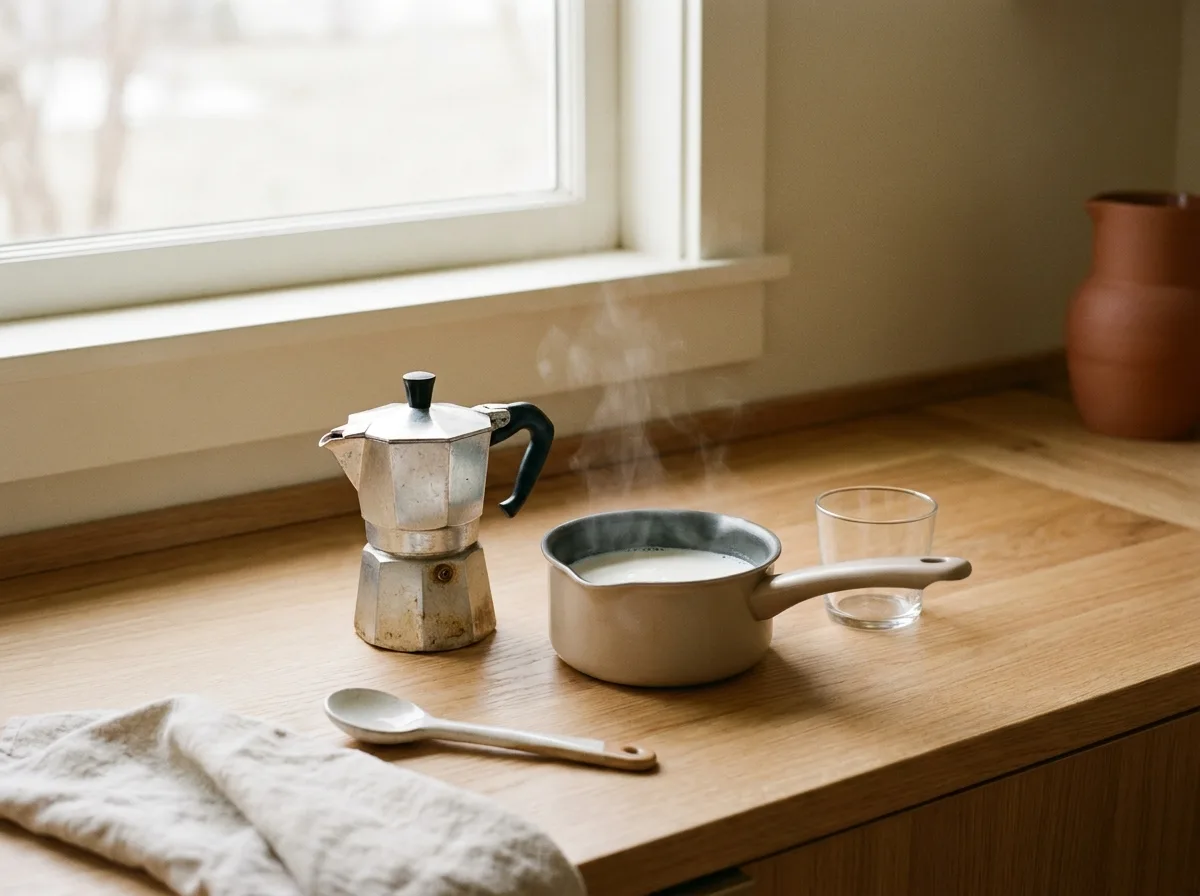
This is the method a Barcelona barista recommended to Perfect Daily Grind: [1]
-
Brew concentrated coffee. Use about 1 gram of coffee for every 10 or 11 grams of water, which is stronger than an ordinary mug.
-
Heat the milk in a saucepan. Remove it from the heat at about 82 °C, when small bubbles appear around the edge.
-
Swirl the milk. Stir and swirl it to add a little air and body.
-
Pour in equal amounts. Pour the milk over the coffee, one to one.
-
Sweeten at the table, if you like. The sugar is your decision.
No thermometer? Watch the edge of the pan. Once it starts steaming and fizzing gently, the milk is ready.
The moka pot guide covers the brewing itself. If you only own a drip machine, you're closer to a café au lait, the French cousin made with filter coffee.
Watch
See it, not just read it
2 videos picked for this page. They play right here, full screen on a phone, and you come straight back to the article.
Hosted on YouTube. Credit belongs to the channels named.
Frequently asked questions
- Is cafe con leche sweet? Does it have sugar?
- Not as served in Spain. A Spanish bar makes it unsweetened and puts a packet of sugar on the saucer, so you add your own. Cuban and Puerto Rican cafés often sweeten it for you, and the Cuban version tends to be quite sweet. Ask for it without sugar if you want it plain.
- Can you make cafe con leche with almond milk or evaporated milk?
- Yes, though it changes the drink. Whole dairy milk is the usual choice. Other dairy and plant milks work, with a change in taste and texture, and plant milks may not behave the same way when you scald them. Evaporated and condensed milk will work too, but neither is in the Spanish original, which uses whole milk.
- How do you say cafe con leche in English?
- It means coffee with milk. Say it kah-FEH kon LEH-cheh. The French name for the same idea is café au lait, and the Italian one is caffè latte. They share a name but not a recipe: the French drink is usually made with brewed coffee rather than espresso.
- What is the American version of cafe con leche?
- There isn't an exact one. The closest order in an American café is a small latte with less milk, or a cortado if you want it stronger. If you ask for coffee with hot milk on the side, you can pour it one to one yourself, which is the Spanish drink in all but name.
- Is cafe con leche stronger than a latte?
- It tastes stronger, because there is less milk for each shot of espresso. It is not more caffeinated, though. Caffeine comes from the espresso, so a latte made with two shots carries more caffeine than a cafe con leche made with one.
References
Every factual claim in this article is drawn from the sources below. See the source library for how we grade evidence.
- [1]What Is A Café Con Leche?Perfect Daily Grind · 2020 · Reference work · Tier 3 · Contextual
- [2]What is a Latte? And How Do You Make One?Methodical Coffee · 2026 · Reference work · Tier 3 · Contextual
- [3]Why Spain is becoming one of Europe's most innovative specialty coffee marketsPerfect Daily Grind · 2026 · Industry report · Tier 3 · Contextual
- [4]Café (Alimentación en España 2025)Mercasa · 2026 · Industry report · Tier 2 · Moderate
- [5]Café con lecheWikipedia · 2026 · Reference work · Tier 3 · Contextual
- [6]How to Order Coffee in Spain: The Complete GuideDevour Tours · 2026 · Reference work · Tier 3 · Contextual
- [7]The Certified Italian Espresso and CappuccinoIstituto Nazionale Espresso Italiano · 2014 · Reference work · Tier 3 · Contextual
- [8]FoodData CentralU.S. Department of Agriculture · Official dataset · Tier 1 · Strong
- [9]LatteWikipedia · Reference work · Tier 3 · Contextual
Related reading
- Espresso & Coffee DrinksCafé au Lait: French Coffee with Warm Milk→
- Espresso & Coffee DrinksCuban Coffee: Cafecito, Colada, Cortadito, and the Embargo→
- Espresso & Coffee DrinksCortado: Espresso Cut with Equal Warm Milk→
- Espresso & Coffee DrinksMocha: Espresso, Chocolate, and Steamed Milk→
- Espresso & Coffee DrinksIced Latte: Cold Espresso with Milk Explained→
- Espresso & Coffee DrinksLungo: The Long Espresso Shot, Explained→