Kona Coffee: Hawaii's Famous Volcanic-Grown Beans
By Coffee Studies Editorial·Published July 16, 2026·10 min read
Quick answer
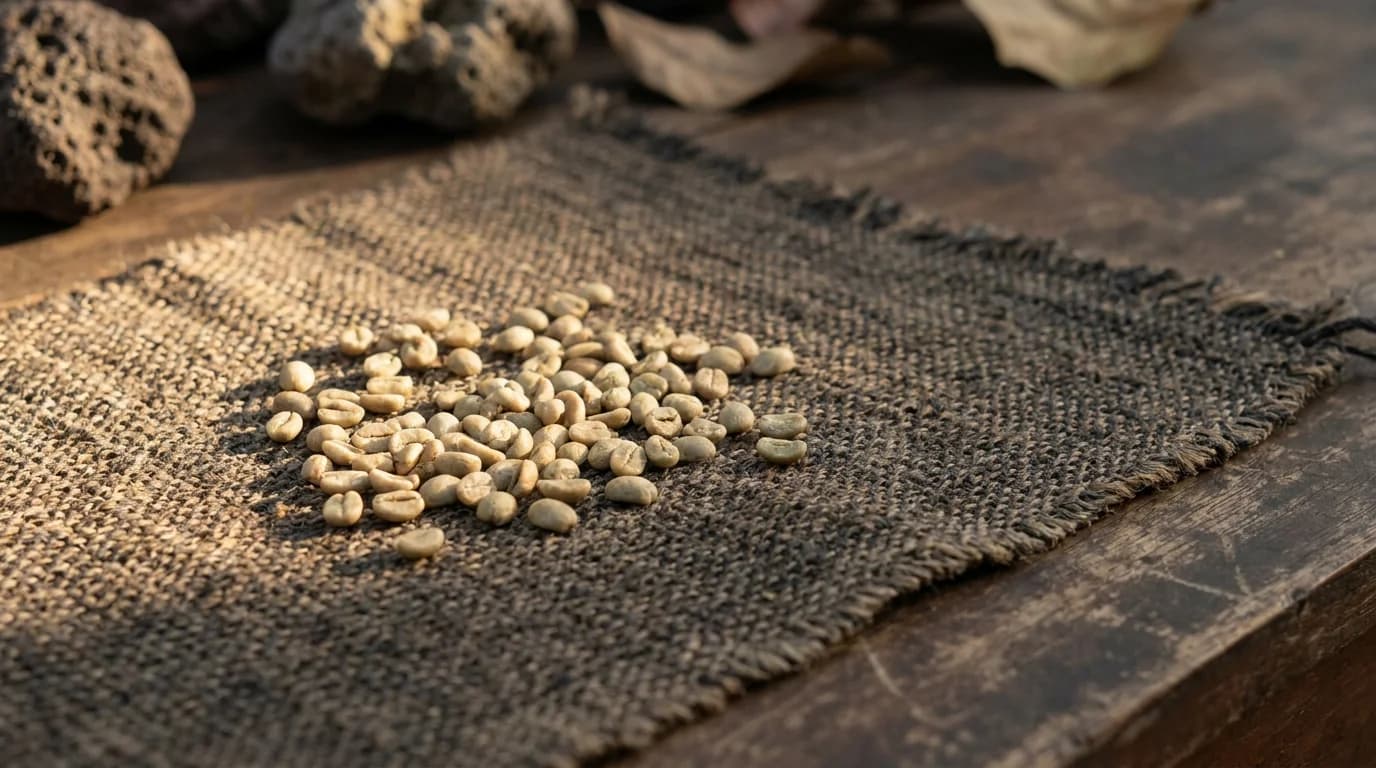
Kona coffee occupies a specific place in American coffee culture — the country's only meaningful domestic coffee origin, a genuine specialty region with 200+ years of cultivation history, and one of the most successfully- marketed origin names in the world. It's also one of the most abused origin names, thanks to Hawaii's permissive "Kona Blend" laws that allow products with just 10% Kona content to use the name. Understanding what Kona coffee actually is — the specific geography, the climate, the quality profile, the labelling rules — matters if you're paying premium prices for the real thing.
Only US origin at scale
Kona is the only US-grown coffee available in meaningful commercial quantities — small production also exists in other Hawaiian islands and Puerto Rico[3]
~30 mile belt
the Kona Coffee Belt is a narrow strip on the western slopes of Mauna Loa and Hualalai volcanoes — approximately 2,700 acres total[2]
10% law problem
Hawaii state law requires only 10% Kona coffee in products labelled 'Kona Blend' — a huge consumer confusion issue[5]
The Kona Coffee Belt
Kona coffee grows in a specific narrow geographic strip:
Location: the western (leeward) slopes of Mauna Loa and Hualalai volcanoes on Hawaii's Big Island (Hawaii Island). The strip runs roughly north-south along the coast from Kailua-Kona in the north to Honaunau in the south — approximately 30 miles long and 1-2 miles wide.
Elevation: 500-2,500 feet (approximately 150-750 metres). Notably lower than most specialty coffee-growing regions worldwide, which typically prefer 1,000-2,000+ metres. Kona's unique climate compensates for the lower elevation.
Total plantable area: approximately 2,700 acres. Small compared to most origin regions worldwide.
Number of farms: approximately 600-800 coffee farms in the Kona region, ranging from tiny family operations (1-2 acres) to larger estates (up to ~40 acres). Most are smallholder operations by Hawaiian standards[2].
Growing regions within Kona:
- North Kona — around Kailua-Kona town.
- South Kona — around Captain Cook, Kealakekua, Honaunau. Slightly higher elevation on average; considered by some to produce the best Kona coffee.
- Kau district — technically separate from Kona (adjacent southern region on Big Island); produces distinct "Kau coffee" that's growing in specialty reputation but can't be labelled Kona.
The distinctive Kona climate
Kona coffee's quality traces to a specific microclimate:
Morning sunshine
Morning sunshine. Kona has bright, sunny mornings — coffee plants get intense direct sunlight for photosynthesis.
Afternoon cloud cover
Afternoon cloud cover. By early afternoon, marine layer clouds roll in from the Pacific. This provides cooling and shade during the hottest part of the day, protecting the plants from thermal stress.
Mild consistent temperatures
Mild consistent temperatures. Kona's coastal-adjacent location moderates temperature — rarely too hot, rarely too cold. Coffee's flowering and cherry development benefit from this stability.
Volcanic soil
Volcanic soil. Kona sits on relatively young volcanic soil derived from Mauna Loa lava flows. Rich in minerals, free-draining, and slightly acidic — well-suited to arabica coffee.
Rainfall pattern
Rainfall pattern. Kona receives roughly 30-70 inches of rain annually, concentrated in the summer growing season. Consistent moisture without excessive rain that would cause disease problems.
No frost risk. Hawaii's tropical latitude eliminates frost — a critical risk factor for coffee in mainland producing regions.
The combination produces conditions that let arabica thrive at lower elevations than most origins, while still producing quality coffee. This microclimate is essentially unique to Kona[6].
The 200-year history
Kona coffee has a longer history than many people realise:
1820: First coffee plants brought to Hawaii by Chief Boki, Royal Governor of Oahu, from Brazil.
1828: Reverend Samuel Ruggles planted coffee in Kona, initially as an ornamental plant.
Mid-1800s: Commercial Kona coffee production began. Coffee prices supported small-farm agriculture.
1892: Introduction of Guatemala-origin Typica variety that became the standard "Kona Typica" — the traditional Kona cultivar still grown widely today.
Late 1800s-early 1900s: Japanese immigrant workers brought to Hawaii for sugarcane plantations transitioned into coffee farming, developing the smallholder model that still characterises Kona today.
1930s-1970s: Coffee prices fluctuated dramatically. Many Kona farms consolidated or closed. Government programs supported struggling farmers.
1980s onward: Specialty coffee movement elevated Kona's reputation and prices. Small family farms became viable again as specialty premiums rewarded quality-focused production.
Modern era: Kona operates as a specialty-focused smallholder region with strong consumer brand recognition, premium pricing, and active tourism/direct-sales economy[6].
Varieties
Kona coffee cultivars:
Kona Typica (also called Kona Coffea, Guatemalan Typica): The traditional Kona cultivar, descended from the 1892 Guatemala introduction. Produces the classic Kona flavour profile. Lower-yielding than modern varieties but higher cup quality.
Bourbon, Caturra, and various selections: Some Kona farms grow additional varieties.
Ka'u Coffee Cultivars: The adjacent Ka'u district often grows the same varieties but produces distinct "Ka'u coffee" (can't be labelled Kona).
What Kona coffee tastes like
The classic Kona profile:
- Smooth medium body — not thin, not heavy.
- Mild bright acidity — present but not sharp; more than dark-roast Sumatran, less than Ethiopian.
- Sweet nutty-chocolatey character — macadamia nut, hazelnut, milk chocolate notes commonly cited.
- Clean finish — very drinkable; no lingering harshness.
- Not aggressively distinctive — Kona doesn't have the assertive character of Ethiopian yirgacheffe, the wine-like intensity of Kenyan, or the earthiness of Sumatran. It's more of a refined balanced profile.
How it compares:
- More approachable than Ethiopian coffees.
- Less complex than premium single-origin Ethiopian or Panama Geisha (see Panama Geisha Coffee).
- Similar in balance profile to premium Central American coffees (Guatemala Antigua, Costa Rica Tarrazú).
- Distinctively "Kona" once you've had good examples.
Some coffee experts find Kona quite subtle for the price — arguing that similarly-good Central American coffees sell for a fraction of the price. Others love Kona specifically because it's approachable and pleasant rather than challenging or exotic. Both perspectives are valid.
The 10% "Kona Blend" problem
Hawaii state law (HRS §486-120.6) allows products with only 10% Kona coffee to be labelled "Kona Blend" or similar terms. This is a substantial consumer confusion issue:
Legal Kona labelling categories
Legal Kona labelling categories:
- "100% Kona" — all coffee is Kona. Genuine.
- "Kona Blend" — as little as 10% Kona; the other 90%+ is other-origin coffee.
- "Kona Style" — no specific requirement; often no Kona content at all.
- "Kona Type" — similar; typically no Kona.
Why this matters
Why this matters:
- Kona Blends often sell in supermarkets at $8-15/lb — looking like a bargain compared to $40-80/lb 100% Kona.
- Consumers assume they're getting Kona coffee at a discount.
- The 90% non-Kona portion is typically standard commercial coffee.
- The 10% Kona doesn't provide meaningful Kona character in the finished cup.
The advocacy history
The advocacy history: Kona coffee farmers have repeatedly attempted to change the law — proposing raising the minimum to 51% or higher. Multiple legislative attempts have failed, largely due to opposition from Kona Blend producers whose business model depends on the current 10% rule.
Consumer guidance: if you want genuine Kona coffee, look specifically for "100% Kona" on the label. Anything else provides minimal or no Kona content.
Pricing
Kona coffee price range:
- Kona Blend (10% Kona): $8-15/lb at retail.
- Estate blend (50%+ Kona): $15-30/lb; less common.
- 100% Kona: $40-80/lb typical.
- Named estate 100% Kona: $60-120/lb.
- Premium peaberry, competition-grade: $100-200+/lb.
Why so expensive:
- US labour costs. Hawaiian minimum wage requirements make handpicked coffee genuinely expensive compared to coffee from producing countries.
- Limited production. ~2 million pounds annual production compared to Brazil's billions of pounds.
- Marketing/prestige premium. Kona brand recognition supports premium pricing.
- Direct-to-consumer economics. Many Kona farms sell directly to consumers, capturing more of the price.
Grades
Kona has specific quality grading:
- Extra Fancy — the top grade. Largest beans (screen 19+), less than 10 defects per 1 lb sample.
- Fancy — second tier. Screen 18+, less than 16 defects per sample.
- Number 1 — screen 16+, less than 20 defects.
- Select — smaller/mixed sizing, up to 5% defects.
- Prime — commercial grade, larger defect tolerance.
- Peaberry — the ~5% of cherries that produce a single rounded bean instead of two flat beans. Distinctive premium grade — commands additional premium.
Grades correlate loosely with cup quality — Extra Fancy is typically better than Prime, but well-processed Number 1 can rival Extra Fancy. The grade system is more useful for professional buyers than consumers.
Kona coffee tourism
Kona coffee tourism is genuinely accessible:
Major farm operations:
- Greenwell Farms — one of the largest Kona operations with extensive visitor infrastructure.
- Mountain Thunder Coffee — organic Kona farm with tours and tastings.
- Kona Joe Coffee — distinctive trellised farming approach.
- Buddha's Cup — small-farm competition winner.
- Ka'ū Coffee Mill (adjacent Ka'u district) — for Ka'ū coffee context.
Kona Coffee Cultural Festival — annual November event across the region celebrating harvest with tours, tastings, farm-to-cup events, and cultural programming.
Practical: Kona district is compact; a full day's visit can include multiple farms. Most farms welcome walk-in visitors; some prefer reservations.
Buying Kona coffee
Reading labels carefully:
- "100% Kona" — genuine Kona.
- "Grown in Kona" — implies 100% Kona.
- "Kona Blend" — 10-90% Kona; usually 10%.
- "Kona Style" / "Kona Type" — usually no Kona.
Where to buy:
- Direct from Hawaii farms — best guarantee of quality and freshness. Most Kona farms ship worldwide.
- Specialty coffee roasters — many carry 100% Kona.
- Kona farm cooperatives — sell aggregated production.
- Supermarket Kona Blends — inexpensive but minimal Kona content.
Storage: Kona coffee ages like any specialty coffee. Peak flavour within 3-4 weeks of roast date. Buy in quantities you'll consume in that window.
Common misconceptions
- "Kona Blend is a good way to try Kona affordably." Kona Blends are essentially standard coffee with a 10% Kona additive. Not a meaningful way to experience Kona character.
- "Kona coffee is the world's best coffee." Kona is well-regarded but not universally considered the top premium origin. Panama Geisha, Yemen Mocha, top Ethiopian, and top Kenyan coffees are often rated higher in professional cupping.
- "All Hawaiian coffee is Kona." Coffee also grows on Maui, Molokai, Kauai, and adjacent Big Island regions (Ka'u, Hamakua) — these produce distinct Hawaiian coffees with their own characters.
- "Kona coffee is Fair Trade or organic by default." Not automatically. Some Kona farms are certified organic; some are not. Fair Trade certification doesn't really apply to US-grown coffee (Fair Trade was developed for developing-country producer support).
- "Kona farms are large plantations." Most Kona operations are small family farms — average size approximately 3-5 acres.
Practical rules
If you want to try genuine Kona:
- Look for "100% Kona" specifically.
- Buy from a farm's direct website or a reputable specialty roaster.
- Expect $40-80/lb for good quality.
- Fresh roast dates matter — Kona ages like other specialty coffees.
If you're on a Kona visit:
- Take farm tours; visit the coffee mill; buy directly.
- The Kona Coffee Cultural Festival (November) is worth planning around if timing works.
- Ka'u coffee is a legitimate adjacent premium — try it alongside Kona.
If you want the Kona experience at lower cost:
- Consider Hawaiian coffees from other islands (Maui, Molokai, Kauai) — sometimes lower prices for similar quality.
- Consider premium Central American coffees (Guatemala Antigua, Costa Rica Tarrazú) — similar balanced profiles at lower prices.
- Kona Blend won't provide the Kona experience — skip it.
The honest summary
Kona coffee is coffee grown in the narrow ~30-mile Kona Coffee Belt on the western slopes of Hawaii's Big Island — the only US-grown coffee available at meaningful commercial scale. The distinctive climate (morning sun, afternoon clouds, volcanic soil, mild consistent temperatures) produces smooth, mild, sweet-nutty coffee that has established a strong premium reputation in American consumer awareness. The Kona Blend labelling law (allowing 10% Kona content) creates significant consumer confusion — genuine Kona requires "100% Kona" labelling. Real Kona coffee is genuinely good and worth trying, but also expensive due to US labour costs, limited production, and prestige pricing. Other premium origins (Central American, Ethiopian, Panamanian) can rival or exceed Kona quality at lower prices — Kona's premium is as much about scarcity and marketing as about objective cup superiority.
Frequently asked questions
- What is Kona coffee?
- Kona coffee is coffee grown in the Kona district on the western (leeward) slopes of Mauna Loa and Hualalai volcanoes on Hawaii's Big Island. Only coffee grown in this specific ~30-mile-long, 1-2-mile-wide 'Kona Coffee Belt' can legally be called Kona coffee. It's the only US-grown coffee available at meaningful commercial scale (small amounts also grow in Puerto Rico and other Hawaiian islands). The specific microclimate — volcanic soil, morning sunshine, afternoon cloud cover, mild temperatures — produces coffee with a distinctive smooth, mild, sweet-nutty profile.
- What's the difference between '100% Kona' and 'Kona Blend'?
- Hawaii state law requires a 'Kona Blend' to contain only 10% Kona coffee — the other 90% can be any origin (typically Central American or other cheaper coffee). '100% Kona' means all of the coffee is Kona. This is one of the biggest consumer confusion points in coffee — many 'Kona' products at supermarkets are actually 10% Kona blends. If you want genuine Kona coffee, look specifically for '100% Kona' labelling.
- Why is Kona coffee so expensive?
- Multiple factors: (1) Very limited production geography — only the Kona Belt qualifies, roughly 2,700 acres total. (2) US labour costs are much higher than most coffee-producing countries — Hawaiian minimum wage requirements make handpicked coffee genuinely expensive. (3) Volcanic soil and Kona climate produce quality that commands specialty premium. (4) Marketing/prestige — Kona has developed a premium reputation in mainstream American consumer awareness. Genuine 100% Kona typically retails for $40-80+/lb; some estate lots $100+/lb.
- What does Kona coffee taste like?
- Kona's signature profile: smooth, medium body, mild bright acidity (not sharp), sweet nutty-chocolatey character (macadamia and hazelnut are commonly cited), clean finish. Not aggressively distinctive like Ethiopian coffees or high-acidity Kenyan; more like a refined balanced medium-roast experience. Some tasters find Kona quite subtle compared to competing premium origins; others love the smooth balanced character. It's a very drinkable coffee that's designed to be enjoyed straightforwardly rather than analysed deeply.
- Are Kona farms open to visitors?
- Yes — coffee tourism is significant in Kona district. Many Kona coffee farms offer tours, tastings, and direct-from-farm purchases. Popular farms include Greenwell Farms, Mountain Thunder Coffee, Kona Joe Coffee, and dozens of smaller estates. The annual Kona Coffee Cultural Festival (November) celebrates the harvest with events across the region. Visiting Kona farms is one of the best ways to understand coffee agriculture up close — the entire growing region is accessible by rental car.
References
Every factual claim in this article is drawn from the sources below. See the source library for how we grade evidence.
- [1]Coffee Varieties CatalogWorld Coffee Research · Reference work · Tier 2 · Moderate
- [2]Coffee agronomyFood and Agriculture Organization of the United Nations · Reference work · Tier 2 · Moderate
- [3]International Coffee OrganizationInternational Coffee Organization · Official dataset · Tier 1 · Strong
- [4]Caffeine and related purine alkaloids: biosynthesis, catabolism, function and genetic engineeringPhytochemistry · 2008 · Review · Tier 2 · Moderate
- [5]CoffeeEncyclopaedia Britannica · Reference work · Tier 3 · Contextual
- [6]Uncommon Grounds: The History of Coffee and How It Transformed Our World (revised edition)Basic Books (Mark Pendergrast) · 2010 · Reference work · Tier 2 · Moderate
Related reading
- Beans, Roasts & OriginsJamaican Blue Mountain Coffee: Why It Costs So Much→
- Beans, Roasts & OriginsCoffee Origins Around the World→
- Beans, Roasts & OriginsArabica Coffee: The World's Leading Coffee Species→
- Beans, Roasts & OriginsFika: The Swedish Coffee Culture→
- Beans, Roasts & OriginsGuatemalan Coffee: Regions, Flavour, and What to Look For→
- Beans, Roasts & OriginsKenyan Coffee: AA Grade and Bright Acidity Explained→